📋 Given Parameters & Problem Setup
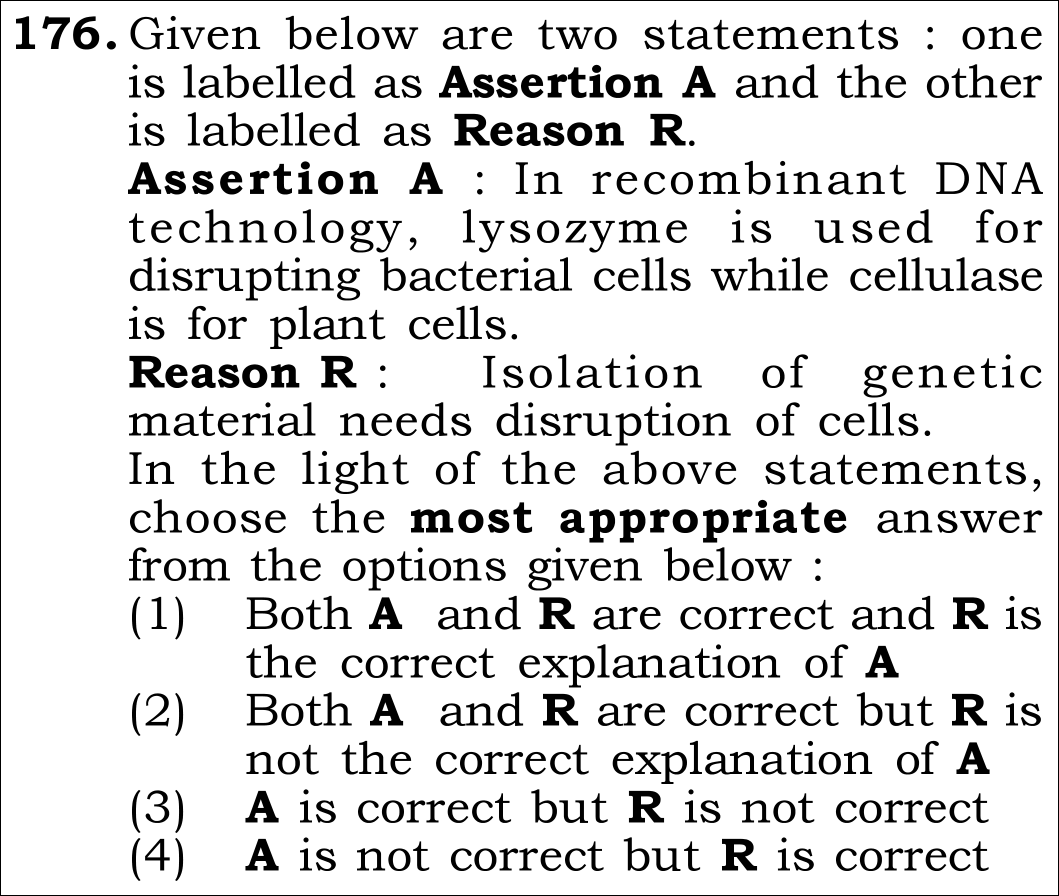
Assertion (A) For isolating DNA, bacterial cells are treated with lysozyme and plant cells are treated with cellulase.
Reason (R) Cell walls of bacteria and plants are composed of different chemical substances that require specific hydrolytic enzymes for cell lysis.
Bacteria = Peptidoglycan (Lysozyme); Plants = Cellulose (Cellulase); Fungi = Chitin (Chitinase)!
1 Read Assertion (A): Lysozyme for bacteria, cellulase for plants -> TRUE (NCERT verbatim).
2 Read Reason (R): Bacterial and plant cell walls have different chemical compositions requiring specific enzymes -> TRUE (bacteria = peptidoglycan, plant = cellulose).
3 Apply "BECAUSE": Different enzymes are used BECAUSE bacterial walls are peptidoglycan (cleaved by lysozyme) while plant walls are cellulose (cleaved by cellulase). Enzymes are substrate-specific.
4 Reason (R) provides the exact biochemical explanation for Assertion (A).
5 Select Option (1).
🛡️ Why You Can 100% Trust This Shortcut: NCERT Biology · Biotechnology: Principles and Processes (Polymerase Chain Reaction: Thermostable Taq polymerase from Thermus aquaticus).
⚠️
Remember the complete NCERT triad for DNA extraction: Bacteria -> Lysozyme; Plant -> Cellulase; Fungus -> Chitinase.
🛡️ How to avoid the -1 mark: Match the root word: Cellulose -> Cellulase; Chitin -> Chitinase; Peptidoglycan -> Lysozyme.
📖
NEET Biology Core Syllabus · Biotechnology: Principles and Processes Standard Benchmark
Core Scientific Principle Tested:
"Bacterial cells are treated with lysozyme, plant cells with cellulase, and fungus with chitinase to degrade specific cell wall components."
Syllabus Focus: Isolation of the Genetic Material (DNA)
Bacteria-Lysozyme, Plant-Cellulase, Fungus-Chitinase: Match the Wall to the Axe!