MyCompetitiveExams Logo MyCompetitiveExams
Search 1,140+ Questions
Chapters, formulas, speed tricks
→
⚡ Brahmastra NEET 2027
720 MARKS

Dynamic 180-question full-length simulator mixed dynamically from all 6 years for 2027 & 2026 aspirants.

Launch Brahmastra 2027 Test →
Start Practice →
100% Free · No Login Required
Q.162 Zoology ⭐ 360° Option Elimination Active
Vault ↗

NEET 2026 Zoology Question 162 Solution

Topic: Biotechnology: Principles and Processes · Official NTA Booklet Code 50
NEET 2026 Zoology Question 162: Polymerase Chain Reaction (PCR) Steps & Primer Annealing

Question

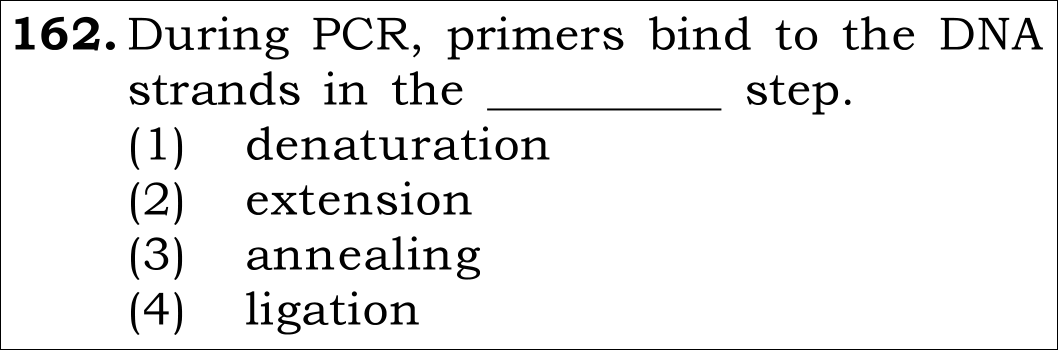
During PCR, primers bind to the DNA strands in the step.

  1. (1)denaturation
  2. (2)extension
  3. (3)annealing
  4. (4)ligation
✓
Verified Against NTA Final Answer Key
Option (3) : Annealing
📚 Biotechnology: Principles and Processes Easy
📋 Given Parameters & Problem Setup
Molecular Technique Polymerase Chain Reaction (PCR)
Defined Event Binding of two sets of oligonucleotide primers to single-stranded DNA templates
⚡

The 30-Second Exam Hall Shortcut: ⚡ PCR Triad Temperature Trap

⏱️ Save ~30 seconds

Denature (94°C) -> Anneal Primers (50-60°C) -> Extend (72°C)!

1 Recall 3 PCR steps in chronological order: Denaturation, Annealing, Extension.
2 (Denaturation): High temp separates dsDNA into single strands.
3 (Annealing): Primers bind (hybridize) to complementary regions on ssDNA templates.
4 (Extension): Taq polymerase synthesizes new DNA strands.
5 Question asks specifically for primer binding -> Annealing.
6 Select Option (3) Annealing.
🛡️
Why You Can 100% Trust This Shortcut: NCERT Biology · Biotechnology: Principles and Processes (Competent Host Preparation: Divalent cation treatment facilitates plasmid uptake).
📐

Step-by-Step Rigorous Workflow & Mathematical Proof

Step 1

Mechanism of Annealing in PCR

Annealing involves the hybridization of two sets of oligonucleotide primers to the single-stranded template DNA at an optimal temperature (typically 50–60°C).

ssDNA Templates+2 Primer Sets→50−60∘CPrimer-Template Duplexes (Annealing)\text{ssDNA Templates} + 2 \text{ Primer Sets} \xrightarrow{50-60^\circ\text{C}} \text{Primer-Template Duplexes (Annealing)}
  • • Primers are small chemically synthesized oligonucleotides complementary to the regions of DNA.
Step 2

Contrast with Denaturation and Extension

Denaturation uses heat (~94°C) to break hydrogen bonds between complementary strands. Extension (~72°C) uses thermostable DNA polymerase (Taq polymerase isolated from Thermus aquaticus) and dNTPs to extend the primers.

Denaturation (94∘C)→Annealing(54∘C)→Extension (72∘C)\text{Denaturation (94}^\circ\text{C)} \rightarrow \mathbf{Annealing (54^\circ\text{C})} \rightarrow \text{Extension (72}^\circ\text{C)}
  • • Repeated cycles achieve billion-fold amplification (~10⁹ times).
⭐

360° Option Elimination Engine Key Feature

Diagnose every choice: Know exactly why the right option works and why distractors fail.

4-Option Deep Scan
1 A
✗ Incorrect
Verdict & Scientific Reason:

Incorrect. Denaturation is the thermal separation of double-stranded DNA into single strands, not primer binding.

⚠️
Student Fallacy (Why candidates pick this trap): Confusing initial strand separation with primer binding.
2 B
✗ Incorrect
Verdict & Scientific Reason:

Incorrect. Extension is the primer elongation phase catalyzed by Taq polymerase at ~72°C.

⚠️
Student Fallacy (Why candidates pick this trap): Confusing DNA synthesis with primer hybridization.
3 C
✓ 100% Correct
Verdict & Scientific Reason:

100% correct. Annealing is the specific PCR step where oligonucleotide primers bind to complementary single strands of DNA.

💡
Why this is airtight: None; standard PCR textbook step.
4 D
✗ Incorrect
Verdict & Scientific Reason:

Incorrect. Amplification is the overall outcome of the entire multi-cycle PCR process, not an individual step.

⚠️
Student Fallacy (Why candidates pick this trap): Confusing overall process outcome with the specific hybridization step.
⚠️

NTA Trap Alert: Confusing Annealing with Extension

Some students confuse annealing (putting primers on) with extension (running down the track synthesizing DNA). Annealing attaches primers; extension elongates them.

🛡️ How to avoid the -1 mark: Remember: "A" comes before "E": Anneal primers first, then Extend!
📖

Core NEET Syllabus Standard

NEET Biology Core Syllabus · Biotechnology: Principles and Processes Standard Benchmark
Core Scientific Principle Tested:

"PCR consists of three steps: Denaturation, Annealing (primer binding), and Extension."

Syllabus Focus: Polymerase Chain Reaction (PCR)
✓ Core NEET UG Syllabus Anchor Syllabus & Academic Standards ↗
D-A-E: Denature the double strand, Anneal the primer, Extend the polymer!

Ready to attempt under real exam pressure?

Test your speed and accuracy in the authentic 180-minute timed NTA simulator.

Launch NEET 2026 CBT Test →

Spotted a mistake in this solution? Report an error ([email protected])

⚖️ Legal & Fair Dealing Notice: Sourced from publicly released NEET 2026 question papers and NEET answer keys for private study, research, and non-commercial educational practice under Fair Dealing (Section 52(1)(a) of the Indian Copyright Act, 1957). Not affiliated with or endorsed by NTA or NMC.

Solve 4 NEET Questions a Day — One per Subject

Cover all 1,140 official NEET questions in 285 days at your own pace. Progress is saved on your device. No login needed.