MyCompetitiveExams Logo MyCompetitiveExams
Search 1,140+ Questions
Chapters, formulas, speed tricks
→
⚡ Brahmastra NEET 2027
720 MARKS

Dynamic 180-question full-length simulator mixed dynamically from all 6 years for 2027 & 2026 aspirants.

Launch Brahmastra 2027 Test →
Start Practice →
100% Free · No Login Required
Q.41 Physics ⭐ 360° Option Elimination Active
Vault ↗

NEET 2021 Physics Question 41 Solution

Topic: Motion in a Plane · Official NTA Booklet Code M1
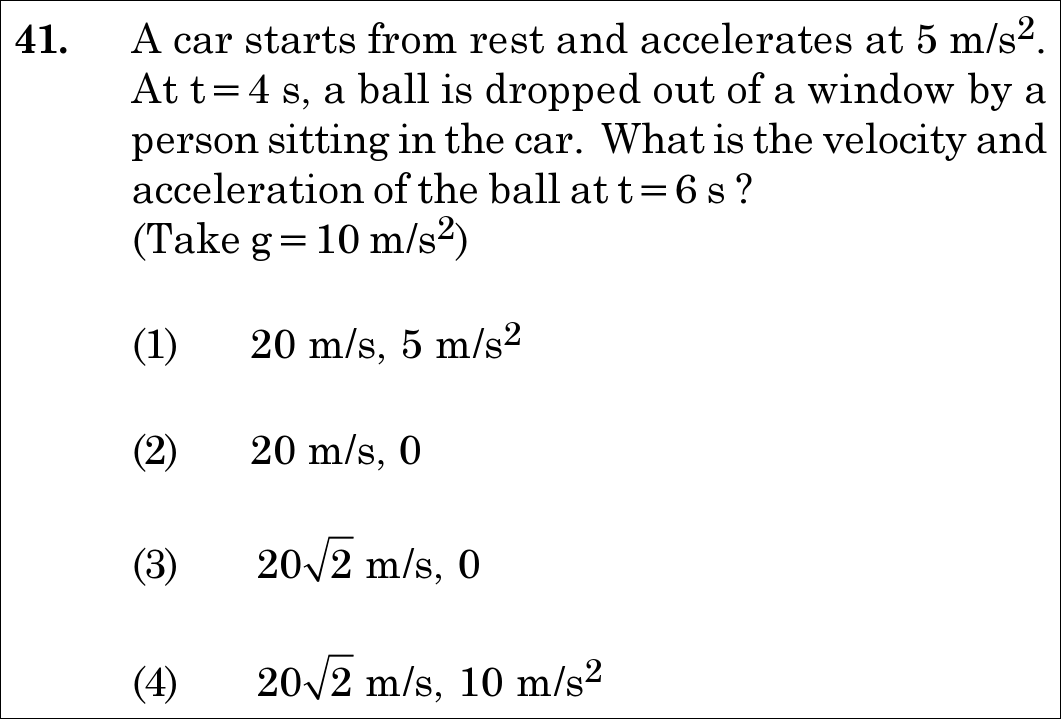
NEET 2021 Physics Question 41: Projectile Motion from an Accelerating Frame: Velocity and Acceleration upon Release

Question

A car starts from rest and accelerates at 5 m/s². At t = 4 s, a ball is dropped out of a window by a person sitting in the car. What is the velocity and acceleration of the ball at t = 6 s? (Take g = 10 m/s²)

✓
Verified Against NTA Final Answer Key
Option (4) : 20√2 m/s, 10 m/s^2
📚 Motion in a Plane Medium
📋 Given Parameters & Problem Setup
Car Acceleration (a_c) 5 m/s^2 along horizontal
Drop Time (t_1) 4 s
Observation Time (t_2) 6 s (Δt = 2 s after release)
Acceleration Due to Gravity (g) 10 m/s^2
⚡

The 30-Second Exam Hall Shortcut: ⚡ 2-Step Projectile: v_x = 20 m/s, v_y = 20 m/s, a = g = 10 m/s²

⏱️ Save ~25 seconds

Horizontal velocity at drop (t=4 st = 4\text{ s}): vx=act=5×4=20 m/sv_x = a_c t = 5 \times 4 = 20\text{ m/s}. The instant released, car acceleration stops acting on it! Downward acceleration is purely gravity: a=g=10 m/s2a = g = 10\text{ m/s}^2! After Δt=2 s\Delta t = 2\text{ s}, vertical speed is vy=gΔt=10×2=20 m/sv_y = g \Delta t = 10 \times 2 = 20\text{ m/s}. Net speed v=202+202=202 m/sv = \sqrt{20^2 + 20^2} = 20\sqrt{2}\text{ m/s}. Match Option (4)!

1 At t=4 st = 4\text{ s}, horizontal velocity of car is vx=u+act1=0+(5)(4)=20 m/sv_x = u + a_c t_1 = 0 + (5)(4) = 20\text{ m/s}.
2 When dropped, the ball is in free flight: the only acceleration is gravity g=10 m/s2g = 10\text{ m/s}^2 downwards.
3 Time of free fall until t=6 st = 6\text{ s} is Δt=6−4=2 s\Delta t = 6 - 4 = 2\text{ s}.
4 Vertical velocity: vy=gΔt=10×2=20 m/sv_y = g \Delta t = 10 \times 2 = 20\text{ m/s}.
5 Total velocity: v=vx2+vy2=202+202=202 m/sv = \sqrt{v_x^2 + v_y^2} = \sqrt{20^2 + 20^2} = 20\sqrt{2}\text{ m/s}.
6 Acceleration is 10 m/s210\text{ m/s}^2. Match Option (4).
🛡️
Why You Can 100% Trust This Shortcut: Canonical independence of orthogonal kinematic motions and Newton's law of gravitation for released projectiles.
📐

Step-by-Step Rigorous Workflow & Mathematical Proof

Step 1

Determining the Velocity of the Car at the Instant of Release

The car starts from rest (u=0u = 0) and accelerates uniformly at ac=5 m/s2a_c = 5\text{ m/s}^2 along the horizontal. At t=4 st = 4\text{ s}, its horizontal velocity is:

vx=u+act1=0+(5 m/s2)(4 s)=20 m/sv_x = u + a_c t_1 = 0 + (5\text{ m/s}^2)(4\text{ s}) = 20\text{ m/s}
Step 2

Determining Acceleration After Release

The moment the ball is released from the window, it loses contact with the accelerating car. No horizontal force acts on the ball (ignoring air resistance). The only force acting on the ball is gravity. Therefore, its acceleration at all times t>4 st > 4\text{ s} is strictly the acceleration due to gravity:

a=g=10 m/s2(acting vertically downward)a = g = 10\text{ m/s}^2 \quad (\text{acting vertically downward})
Step 3

Determining the Velocity Components at t = 6 s

The time elapsed since release is Δt=6 s−4 s=2 s\Delta t = 6\text{ s} - 4\text{ s} = 2\text{ s}. - Horizontal velocity remains constant: vx=20 m/sv_x = 20\text{ m/s} - Vertical velocity acquired under gravity: vy=uy+gΔt=0+(10)(2)=20 m/sv_y = u_y + g \Delta t = 0 + (10)(2) = 20\text{ m/s}

v=vx2+vy2=202+202=800=202 m/sv = \sqrt{v_x^2 + v_y^2} = \sqrt{20^2 + 20^2} = \sqrt{800} = 20\sqrt{2}\text{ m/s}
⭐

360° Option Elimination Engine Key Feature

Diagnose every choice: Know exactly why the right option works and why distractors fail.

4-Option Deep Scan
1 1
✗ Incorrect
Verdict & Scientific Reason:

Falsely assumes the car acceleration continues to act on the released ball and ignores vertical velocity.

⚠️
Student Fallacy (Why candidates pick this trap): Assuming horizontal acceleration persists after release.
2 2
✗ Incorrect
Verdict & Scientific Reason:

Ignores gravitational acceleration and vertical velocity entirely.

⚠️
Student Fallacy (Why candidates pick this trap): Assuming zero gravity in the problem.
3 3
✗ Incorrect
Verdict & Scientific Reason:

Calculates velocity correctly but claims acceleration is zero, which is impossible in Earth's gravitational field.

⚠️
Student Fallacy (Why candidates pick this trap): Confusing zero net horizontal acceleration with zero total acceleration.
4 4
✓ 100% Correct
Verdict & Scientific Reason:

Exact physical values: speed v=202 m/sv = 20\sqrt{2}\text{ m/s} and acceleration a=g=10 m/s2a = g = 10\text{ m/s}^2.

💡
Why this is airtight: None; rigorous projectile kinematics.
⚠️

NTA Trap Alert: Persistent Car Acceleration Fallacy

Students frequently think that because the car was accelerating at 5 m/s25\text{ m/s}^2, the ball continues to experience an acceleration of 5 m/s25\text{ m/s}^2 horizontally. Once released, the horizontal force is ZERO; the ONLY acceleration is gravity (g=10 m/s2g = 10\text{ m/s}^2).

🛡️ How to avoid the -1 mark: A dropped object in air experiences ONLY gravitational acceleration: a=g=10 m/s2a = g = 10\text{ m/s}^2.
📖

Core NEET Syllabus Standard

NCERT Physics · Motion in a Plane Standard Benchmark
Core Scientific Principle Tested:

"An object released from an accelerating vehicle retains the velocity of the vehicle at release, but experiences only gravitational acceleration thereafter."

Syllabus Focus: Projectile Motion and Inertia
✓ Core NEET UG Syllabus Anchor Syllabus & Academic Standards ↗

Ready to attempt under real exam pressure?

Test your speed and accuracy in the authentic 200-minute timed NTA simulator.

Launch NEET 2021 CBT Test →

Spotted a mistake in this solution? Report an error ([email protected])

⚖️ Legal & Fair Dealing Notice: Sourced from publicly released NEET 2021 question papers and NEET answer keys for private study, research, and non-commercial educational practice under Fair Dealing (Section 52(1)(a) of the Indian Copyright Act, 1957). Not affiliated with or endorsed by NTA or NMC.

Solve 4 NEET Questions a Day — One per Subject

Cover all 1,140 official NEET questions in 285 days at your own pace. Progress is saved on your device. No login needed.