MyCompetitiveExams Logo MyCompetitiveExams
Search 1,140+ Questions
Chapters, formulas, speed tricks
→
⚡ Brahmastra NEET 2027
720 MARKS

Dynamic 180-question full-length simulator mixed dynamically from all 6 years for 2027 & 2026 aspirants.

Launch Brahmastra 2027 Test →
Start Practice →
100% Free · No Login Required
Q.40 Physics ⭐ 360° Option Elimination Active
Vault ↗

NEET 2021 Physics Question 40 Solution

Topic: Alternating Current · Official NTA Booklet Code M1
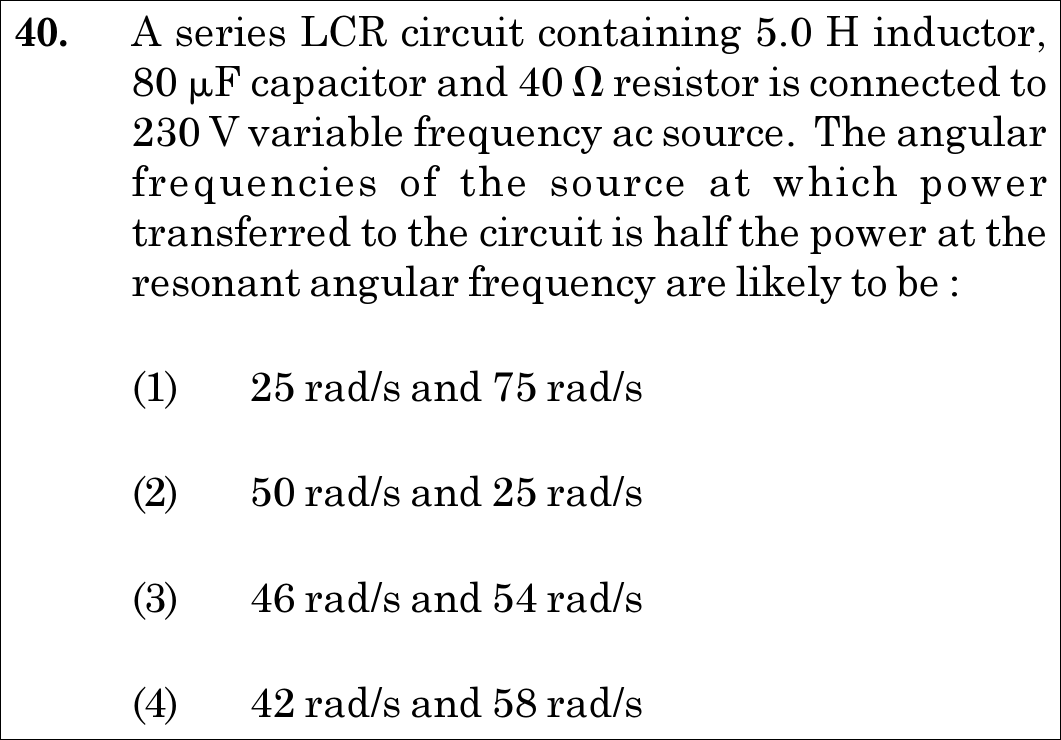
NEET 2021 Physics Question 40: Series LCR Resonance: Half-Power Frequencies and Bandwidth

Question

A series LCR circuit containing 5.0 H inductor, 80 μF capacitor and 40 Ω resistor is connected to 230 V variable frequency ac source. The angular frequencies of the source at which power transferred to the circuit is half the power at the resonant angular frequency are likely to be:

✓
Verified Against NTA Final Answer Key
Option (3) : 46 rad/s and 54 rad/s
📚 Alternating Current Medium
📋 Given Parameters & Problem Setup
Inductance (L) 5.0 H
Capacitance (C) 80 μF = 80 × 10^-6 F
Resistance (R) 40 Ω
RMS Voltage 230 V
⚡

The 30-Second Exam Hall Shortcut: ⚡ Half-Power Frequencies: ω0 ± R/(2L)

⏱️ Save ~25 seconds

Resonant frequency ω0=1LC=15×80×10−6=10.02=50 rad/s\omega_0 = \frac{1}{\sqrt{LC}} = \frac{1}{\sqrt{5 \times 80 \times 10^{-6}}} = \frac{1}{0.02} = 50\text{ rad/s}. Half bandwidth Δω=R2L=402×5=4 rad/s\Delta\omega = \frac{R}{2L} = \frac{40}{2 \times 5} = 4\text{ rad/s}. Half-power frequencies are ω=50±4=46 rad/s\omega = 50 \pm 4 = 46\text{ rad/s} and 54 rad/s54\text{ rad/s}! Match Option (3)!

1 Compute resonant angular frequency: ω0=1LC=1400×10−6=120×10−3=50 rad/s\omega_0 = \frac{1}{\sqrt{L C}} = \frac{1}{\sqrt{400 \times 10^{-6}}} = \frac{1}{20 \times 10^{-3}} = 50\text{ rad/s}.
2 Compute half-bandwidth: Δω=R2L=40 Ω2(5.0 H)=4 rad/s\Delta\omega = \frac{R}{2L} = \frac{40\ \Omega}{2(5.0\text{ H})} = 4\text{ rad/s}.
3 Lower half-power frequency: ω1=ω0−Δω=50−4=46 rad/s\omega_1 = \omega_0 - \Delta\omega = 50 - 4 = 46\text{ rad/s}.
4 Upper half-power frequency: ω2=ω0+Δω=50+4=54 rad/s\omega_2 = \omega_0 + \Delta\omega = 50 + 4 = 54\text{ rad/s}.
5 Match Option (3).
🛡️
Why You Can 100% Trust This Shortcut: Canonical series LCR resonance half-power bandwidth definitions from NCERT Alternating Current.
📐

Step-by-Step Rigorous Workflow & Mathematical Proof

Step 1

Definition of Half-Power Frequencies in LCR Circuits

In an LCR series circuit, power dissipated is P=Irms2RP = I_{\text{rms}}^2 R. At resonance (ω=ω0\omega = \omega_0), power is maximum: Pmax=V2RP_{\text{max}} = \frac{V^2}{R}. The half-power frequencies ω1\omega_1 and ω2\omega_2 are the frequencies where power drops to half of maximum (P=Pmax/2P = P_{\text{max}} / 2):

ω1=ω0−Δω,ω2=ω0+Δω,where Δω=R2L\omega_1 = \omega_0 - \Delta\omega, \quad \omega_2 = \omega_0 + \Delta\omega, \quad \text{where } \Delta\omega = \frac{R}{2L}
Step 2

Calculating the Resonant Angular Frequency (ω0)

Substitute L=5.0 HL = 5.0\text{ H} and C=80 μF=80×10−6 FC = 80\ \mu\text{F} = 80 \times 10^{-6}\text{ F}:

ω0=1LC=15.0×80×10−6=1400×10−6=12×10−2=50 rad/s\omega_0 = \frac{1}{\sqrt{LC}} = \frac{1}{\sqrt{5.0 \times 80 \times 10^{-6}}} = \frac{1}{\sqrt{400 \times 10^{-6}}} = \frac{1}{2 \times 10^{-2}} = 50\text{ rad/s}
Step 3

Calculating the Half-Bandwidth (Δω)

Substitute R=40 ΩR = 40\ \Omega and L=5.0 HL = 5.0\text{ H}:

Δω=R2L=40 Ω2×5.0 H=4010=4 rad/s\Delta\omega = \frac{R}{2L} = \frac{40\ \Omega}{2 \times 5.0\text{ H}} = \frac{40}{10} = 4\text{ rad/s}
Step 4

Computing the Half-Power Angular Frequencies

Evaluate the two frequencies:

ω1=50−4=46 rad/s,ω2=50+4=54 rad/s\omega_1 = 50 - 4 = 46\text{ rad/s}, \quad \omega_2 = 50 + 4 = 54\text{ rad/s}
⭐

360° Option Elimination Engine Key Feature

Diagnose every choice: Know exactly why the right option works and why distractors fail.

4-Option Deep Scan
1 1
✗ Incorrect
Verdict & Scientific Reason:

Uses an arbitrary bandwidth of ±25 rad/s\pm 25\text{ rad/s}.

⚠️
Student Fallacy (Why candidates pick this trap): Guessing wide bandwidth.
2 2
✗ Incorrect
Verdict & Scientific Reason:

Contains the resonant frequency itself (50 rad/s), where power is maximum, not half-maximum.

⚠️
Student Fallacy (Why candidates pick this trap): Confusing resonant frequency with half-power points.
3 3
✓ 100% Correct
Verdict & Scientific Reason:

Exact half-power frequencies derived from ω0±R2L=50±4 rad/s\omega_0 \pm \frac{R}{2L} = 50 \pm 4\text{ rad/s}.

💡
Why this is airtight: None; textbook bandwidth calculation.
4 4
✗ Incorrect
Verdict & Scientific Reason:

Result of using full bandwidth R/L=8R/L = 8 instead of half-bandwidth R/2L=4R/2L = 4 (50±850 \pm 8).

⚠️
Student Fallacy (Why candidates pick this trap): Using Δω=R/L\Delta\omega = R/L instead of R/2LR/2L.
⚠️

NTA Trap Alert: Full Bandwidth vs. Half Bandwidth Trap

The full bandwidth is 2Δω=RL=8 rad/s2\Delta\omega = \frac{R}{L} = 8\text{ rad/s}. Students who add and subtract the full bandwidth (50±850 \pm 8) obtain 42 rad/s42\text{ rad/s} and 58 rad/s58\text{ rad/s} (Option 4). The shift on either side of ω0\omega_0 is the HALF-bandwidth Δω=R2L=4 rad/s\Delta\omega = \frac{R}{2L} = 4\text{ rad/s}.

🛡️ How to avoid the -1 mark: ω1=ω0−R2L\omega_1 = \omega_0 - \frac{R}{2L} and ω2=ω0+R2L\omega_2 = \omega_0 + \frac{R}{2L}. Divide R/LR/L by 2!
📖

Core NEET Syllabus Standard

NCERT Physics · Alternating Current Standard Benchmark
Core Scientific Principle Tested:

"The frequencies at which power is half the resonant value are ω=ω0±Δω\omega = \omega_0 \pm \Delta\omega, where Δω=R2L\Delta\omega = \frac{R}{2L}."

Syllabus Focus: Sharpness of Resonance and Bandwidth
✓ Core NEET UG Syllabus Anchor Syllabus & Academic Standards ↗

Ready to attempt under real exam pressure?

Test your speed and accuracy in the authentic 200-minute timed NTA simulator.

Launch NEET 2021 CBT Test →

Spotted a mistake in this solution? Report an error ([email protected])

⚖️ Legal & Fair Dealing Notice: Sourced from publicly released NEET 2021 question papers and NEET answer keys for private study, research, and non-commercial educational practice under Fair Dealing (Section 52(1)(a) of the Indian Copyright Act, 1957). Not affiliated with or endorsed by NTA or NMC.

Solve 4 NEET Questions a Day — One per Subject

Cover all 1,140 official NEET questions in 285 days at your own pace. Progress is saved on your device. No login needed.