MyCompetitiveExams Logo MyCompetitiveExams
Search 1,140+ Questions
Chapters, formulas, speed tricks
→
⚡ Brahmastra NEET 2027
720 MARKS

Dynamic 180-question full-length simulator mixed dynamically from all 6 years for 2027 & 2026 aspirants.

Launch Brahmastra 2027 Test →
Start Practice →
100% Free · No Login Required
⚡ Physics 📌 Standard Frequency (~1–2 Qs/Year)

NEET Motion in a Plane Previous Year Questions with Solutions

Complete repository of official NTA NEET questions for Motion in a Plane from 2020 to 2026. Every question includes 30-second elimination tricks, step-by-step NCERT solutions, option-by-option traps, and official answer keys.

5 Questions 4 Exam Years (2026, 2024, 2023, 2021) 2 Easy · 3 Medium · 0 Challenging
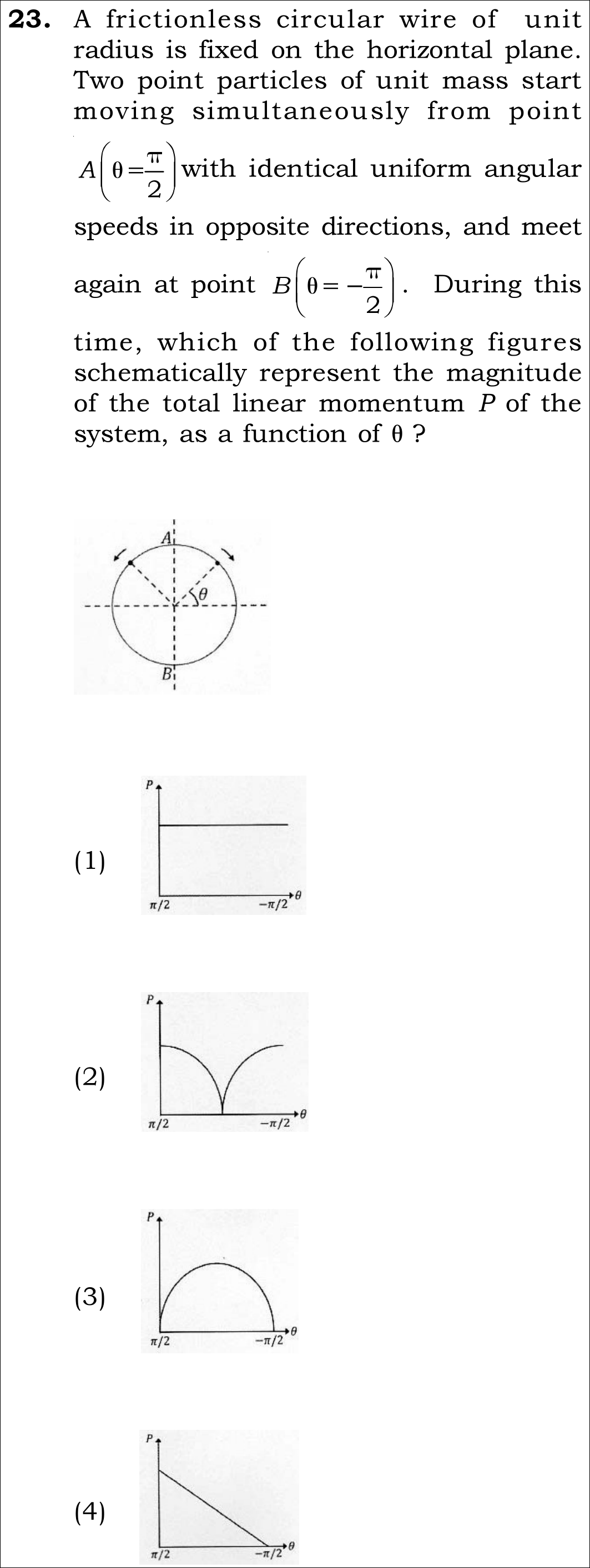
NEET 2026 · Q23 Medium
Official NEET 2026 Question 23 - Motion in a Plane
1
2
3 ✓ Key
4
💡 Verified Solution & 30-Second Hack
✓
Verified Against NTA Final Answer Key
Option (3) : Figure (3): Convex bell curve starting at 0 at theta = pi/2, peaking at theta = 0, and returning to 0 at theta = -pi/2
📚 Kinematics & Circular Motion Medium
📋 Given Parameters & Problem Setup
Wire Ring Frictionless circular wire of unit radius (R = 1) in horizontal plane
Particles Two particles of unit mass (m = 1) moving with identical uniform angular speed omega
Start Point Point A (theta = pi/2) in opposite directions
Meeting Point Point B (theta = -pi/2)
Target Graph Magnitude of total linear momentum P as a function of theta
⚡

The 30-Second Exam Hall Shortcut: ⚡ Endpoint Velocity Symmetry Rule

⏱️ Avoids complex parametric trigonometric plotting.

Check the momentum at the start and end points!

1 At starting point A (theta = pi/2, top of circle): One particle moves horizontally left (-v*i), the other moves horizontally right (+v*i). Total momentum P = |-v*i + v*i| = 0!
2 At meeting point B (theta = -pi/2, bottom of circle): One moves right (+v*i), the other moves left (-v*i). Total momentum P = 0!
3 At the horizontal midpoint (theta = 0 and pi): Both particles are moving downwards with speed v (-v*j and -v*j). Total momentum P = 2*v (maximum)!
4 Therefore, the curve MUST start at 0 at theta = pi/2, peak in the middle, and drop back to 0 at theta = -pi/2.
5 Look at the four graphs: ONLY Figure (3) starts at 0, reaches a maximum, and returns to 0. Solved in 15 seconds!
🛡️
Why You Can 100% Trust This Shortcut: Linear momentum is a vector sum: P_total = m*(v_1 + v_2). Because motion is mirror-symmetric about the vertical axis, horizontal velocity components cancel identically at every instant, while vertical components add: P(theta) = 2*m*v*cos(theta).
📐

Step-by-Step Rigorous Workflow & Mathematical Proof

Step 1

Formulate Velocity Vectors for Both Counter-Rotating Particles

Both particles move along the unit circle with speed v = omega * R = omega (since R = 1). Let angle theta be measured from the positive x-axis:

v⃗1=−vsin⁡θ i^−vcos⁡θ j^,v⃗2=vsin⁡θ i^−vcos⁡θ j^\vec{v}_1 = -v \sin\theta \,\hat{i} - v \cos\theta \,\hat{j}, \qquad \vec{v}_2 = v \sin\theta \,\hat{i} - v \cos\theta \,\hat{j}
  • • Particle 1 moves counter-clockwise along the left semicircle.
  • • Particle 2 moves clockwise along the right semicircle.
Step 2

Compute Total Vector Linear Momentum

Sum the individual momenta (with unit mass m = 1):

P⃗=mv⃗1+mv⃗2=(−vsin⁡θ+vsin⁡θ)i^+(−vcos⁡θ−vcos⁡θ)j^=−2vcos⁡θ j^\vec{P} = m \vec{v}_1 + m \vec{v}_2 = (-v \sin\theta + v \sin\theta)\hat{i} + (-v \cos\theta - v \cos\theta)\hat{j} = -2v \cos\theta \,\hat{j}
  • • Horizontal momentum components cancel out completely at every angle due to bilateral symmetry.
  • • Magnitude of total momentum is P(\theta) = 2v |\cos\theta|.
Step 3

Evaluate Boundary Values Over the Interval [pi/2, -pi/2]

Evaluate P(theta) as theta progresses from pi/2 down to -pi/2:

P(π2)=2vcos⁡(π2)=0,P(0)=2vcos⁡(0)=2v,P(−π2)=2vcos⁡(−π2)=0P\left(\frac{\pi}{2}\right) = 2v\cos\left(\frac{\pi}{2}\right) = 0, \quad P(0) = 2v\cos(0) = 2v, \quad P\left(-\frac{\pi}{2}\right) = 2v\cos\left(-\frac{\pi}{2}\right) = 0
  • • The graph is a smooth positive cosine arch starting at zero, peaking at 2v, and terminating at zero.
  • • Matches Figure (3) perfectly.
⭐

360° Option Elimination Engine Key Feature

Diagnose every choice: Know exactly why the right option works and why distractors fail.

4-Option Deep Scan
1 Figure (1)
✗ Incorrect
Verdict & Scientific Reason:

Ignores vector cancellation.

⚠️
Student Fallacy (Why candidates pick this trap): Adds scalar speeds (P = m*v + m*v = 2v) instead of vector velocity components.
Note: Linear momentum is a vector, not a scalar sum.
2 Figure (2)
✗ Incorrect
Verdict & Scientific Reason:

Inverted graph.

⚠️
Student Fallacy (Why candidates pick this trap): Confuses horizontal momentum component with total momentum.
Note: At the start (theta = pi/2), velocities are antiparallel and momentum is zero, not maximum.
3 Figure (3)
✓ 100% Correct
Verdict & Scientific Reason:

100% mathematically exact; confirmed by Official NTA Final Answer Key.

💡
Why this is airtight: Correctly recognizes vector cancellation of horizontal velocities and addition of vertical cosine components.
Note: Exact kinematics.
4 Figure (4)
✗ Incorrect
Verdict & Scientific Reason:

Linear decay error.

⚠️
Student Fallacy (Why candidates pick this trap): Assumes momentum decays linearly with angle.
Note: Motion is harmonic circular, governed by sinusoidal cosine variations.
⚠️

NTA Trap Alert: The Scalar Speed Sum Trap (Graph 1)

Students who treat momentum as scalar speed calculate P = m*v + m*v = 2 and pick the constant flat line in Figure (1).

🛡️ How to avoid the -1 mark: Always remember: Momentum is a VECTOR! When two identical particles move in opposite directions, their momenta cancel to zero: P = 0 at start and finish.
📖

Core NEET Syllabus Standard

NEET UG Physics Core Standards · Laws of Motion & System of Particles Standard Benchmark
Core Scientific Principle Tested:

"Total linear momentum is the vector sum P_total = sum(m_i * v_i). When symmetry creates opposite directional components, net momentum along that axis is zero."
Syllabus Focus: Vector Nature of Linear Momentum in Symmetrical Particle Systems
✓ Core NEET UG Syllabus Anchor Syllabus & Academic Standards ↗
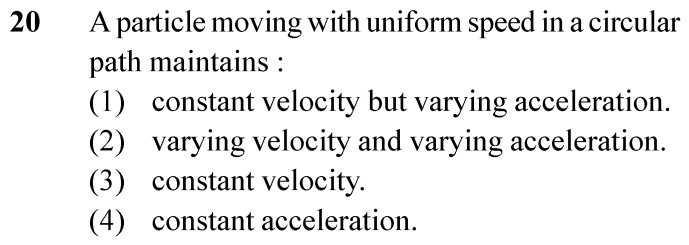
NEET 2024 · Q20 Easy
Official NEET 2024 Question 20 - Motion in a Plane
1
2 ✓ Key
3
4
💡 Verified Solution & 30-Second Hack
✓
Verified Against NTA Final Answer Key
Option (2) : varying velocity and varying acceleration.
📚 Motion in a Plane Easy
📋 Given Parameters & Problem Setup
Motion Particle moving in a circular path
Speed Uniform speed (constant magnitude |v| = constant)
⚡

The 30-Second Exam Hall Shortcut: ⚡ Vector Directionality Test

⏱️ Save ~35 seconds

Speed is scalar (constant), but velocity and acceleration vectors continuously turn in space -> BOTH vary in direction!

1 Uniform circular motion has constant speed: |v| = v_0 = constant.
2 The velocity vector v is always tangential: as the particle moves around the circle, the direction of the tangent changes continuously -> Velocity is VARYING.
3 The centripetal acceleration vector a_c = (v²/R) points towards the center: its direction rotates continuously as the particle moves -> Acceleration is VARYING.
4 Therefore, both velocity and acceleration are varying vectors.
5 Option (2) in under 5 seconds!
🛡️
Why You Can 100% Trust This Shortcut: Fundamental Kinematics · Vector Definition of Velocity and Acceleration in Curved Paths.
📐

Step-by-Step Rigorous Workflow & Mathematical Proof

Step 1

Velocity Vector Analysis

Velocity is a vector quantity having both magnitude and direction. In uniform circular motion of radius R and angular velocity ω, the magnitude of velocity (speed) is constant, but its direction is along the instantaneous tangent to the circle:

v⃗(t)=−ωRsin⁡(ωt) i^+ωRcos⁡(ωt) j^\vec{v}(t) = -\omega R \sin(\omega t)\,\hat{i} + \omega R \cos(\omega t)\,\hat{j}
Step 2

Evaluation of Velocity Constancy

Because the unit vector direction changes at every instant of time, the velocity vector is NOT constant:

dv⃗dt≠0  ⟹  Velocity is varying\frac{d\vec{v}}{dt} \ne 0 \implies \text{Velocity is varying}
Step 3

Acceleration Vector Analysis

Differentiating the velocity vector with respect to time yields the centripetal acceleration vector:

a⃗(t)=dv⃗dt=−ω2Rcos⁡(ωt) i^−ω2Rsin⁡(ωt) j^=−ω2r⃗(t)\vec{a}(t) = \frac{d\vec{v}}{dt} = -\omega^2 R \cos(\omega t)\,\hat{i} - \omega^2 R \sin(\omega t)\,\hat{j} = -\omega^2 \vec{r}(t)
Step 4

Evaluation of Acceleration Constancy

While the magnitude of centripetal acceleration is constant (|a| = v²/R = ω²R), its direction always points radially towards the instantaneous position of the center, which rotates in space. Because its direction changes continuously:

da⃗dt≠0  ⟹  Acceleration is varying\frac{d\vec{a}}{dt} \ne 0 \implies \text{Acceleration is varying}
⭐

360° Option Elimination Engine Key Feature

Diagnose every choice: Know exactly why the right option works and why distractors fail.

4-Option Deep Scan
1 (1)
✗ Incorrect
Verdict & Scientific Reason:

Velocity cannot be constant along a curved path.

⚠️
Student Fallacy (Why candidates pick this trap): Confusing constant speed with constant velocity.
2 (2)
✓ 100% Correct
Verdict & Scientific Reason:

Both vectors continuously rotate, so both are varying.

💡
Why this is airtight: None.
3 (3)
✗ Incorrect
Verdict & Scientific Reason:

Constant velocity implies zero acceleration and straight-line motion.

⚠️
Student Fallacy (Why candidates pick this trap): Ignoring directional change.
4 (4)
✗ Incorrect
Verdict & Scientific Reason:

Constant acceleration vector implies parabolic projectile motion, not circular motion.

⚠️
Student Fallacy (Why candidates pick this trap): Confusing constant magnitude of centripetal acceleration with constant vector.
⚠️

NTA Trap Alert: Vector vs Magnitude (Scalar) Ambiguity

Aspirants often choose "constant acceleration" because its magnitude (v²/R) is constant.

🛡️ How to avoid the -1 mark: Acceleration without qualification ALWAYS means the full vector. A vector is constant ONLY IF both its magnitude AND direction are constant!
📖

Core NEET Syllabus Standard

Physics Core Kinematics · Motion in a Plane Standard Benchmark
Core Scientific Principle Tested:

"In uniform circular motion, speed and acceleration magnitude are constant, but the velocity and acceleration vectors are both continuously changing direction."

Syllabus Focus: Uniform Circular Motion
✓ Core NEET UG Syllabus Anchor Syllabus & Academic Standards ↗
Curved path turns the arrow around: Both V and A are varying bound!
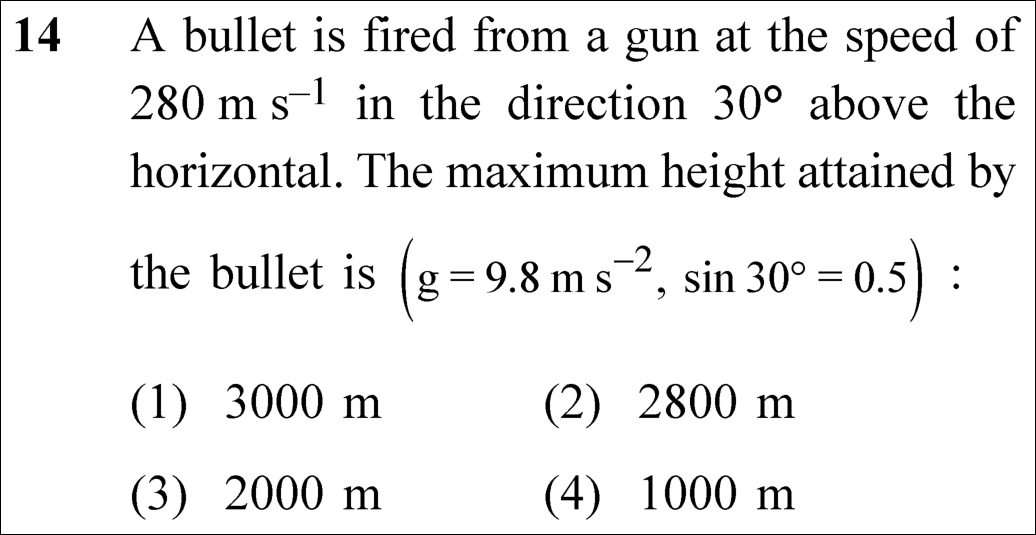
NEET 2023 · Q14 Easy
Official NEET 2023 Question 14 - Motion in a Plane
1
2
3
4 ✓ Key
💡 Verified Solution & 30-Second Hack
✓
Verified Against NTA Final Answer Key
Option (4) : 1000 m
📚 Motion in a Plane Easy
📋 Given Parameters & Problem Setup
Initial Velocity (u) 280 m/s
Angle of Projection (θ) 30° above horizontal
Acceleration due to gravity (g) 9.8 m/s²
sin 30° 0.5
⚡

The 30-Second Exam Hall Shortcut: ⚡ Vertical Velocity Component Mental Shortcut

⏱️ Save ~40 seconds

u_y = u sin 30° = 280 × 0.5 = 140 m/s. Max height H = u_y² / (2g) = 140² / 19.6 = 19600 / 19.6 = 1000 m in 10 seconds!

1 Calculate the initial vertical velocity: u_y = u sin θ = 280 × 0.5 = 140 m/s.
2 Use standard kinematics at the apex (v_y = 0): H = u_y² / (2g).
3 Square 140: 140² = 19600.
4 Notice that 2g = 2 × 9.8 = 19.6.
5 Divide: 19600 / 19.6 = 1000 m exactly! Pick Option (4)!
🛡️
Why You Can 100% Trust This Shortcut: Fundamental Kinematics · Projectile Motion (Maximum vertical displacement under constant gravity: H = u² sin²θ / 2g).
📐

Step-by-Step Rigorous Workflow & Mathematical Proof

Step 1

Vertical Velocity Component Derivation

Resolve the initial velocity vector u along the vertical y-axis:

uy=usin⁡θ=280×sin⁡30∘=280×0.5=140 m/su_y = u \sin\theta = 280 \times \sin 30^\circ = 280 \times 0.5 = 140\text{ m/s}
Step 2

Maximum Height Formula Application

At the maximum height H, the vertical component of velocity momentarily drops to zero (v_y = 0). Applying the third equation of kinematics for vertical motion:

vy2=uy2−2gH  ⟹  0=uy2−2gH  ⟹  H=uy22g=u2sin⁡2θ2gv_y^2 = u_y^2 - 2g H \implies 0 = u_y^2 - 2g H \implies H = \frac{u_y^2}{2g} = \frac{u^2 \sin^2\theta}{2g}
Step 3

Numerical Evaluation

Substitute the given values into the formula with g = 9.8 m/s²:

H=(140)22×9.8=1960019.6=1000 mH = \frac{(140)^2}{2 \times 9.8} = \frac{19600}{19.6} = 1000\text{ m}
⭐

360° Option Elimination Engine Key Feature

Diagnose every choice: Know exactly why the right option works and why distractors fail.

4-Option Deep Scan
1 (1)
✗ Incorrect
Verdict & Scientific Reason:

Overestimates maximum height by a factor of 3.

⚠️
Student Fallacy (Why candidates pick this trap): Candidate miscalculated powers of ten or confused with horizontal range.
2 (2)
✗ Incorrect
Verdict & Scientific Reason:

Numerical distractor from multiplying speed by time.

⚠️
Student Fallacy (Why candidates pick this trap): Candidate calculated u × t instead of u_y² / (2g).
3 (3)
✗ Incorrect
Verdict & Scientific Reason:

Off by a factor of 2.

⚠️
Student Fallacy (Why candidates pick this trap): Candidate forgot the factor of 2 in the denominator (calculated u_y² / g instead of u_y² / 2g).
4 (4)
✓ 100% Correct
Verdict & Scientific Reason:

Accurate value derived from (140)² / (2 × 9.8) = 19600 / 19.6 = 1000 m.

💡
Why this is airtight: None. Candidate executed the vertical component calculation flawlessly.
⚠️

NTA Trap Alert: Forgetting the Factor of 2 in 2g (Yielding 2000 m)

A frequent blunder is dividing by g (9.8) instead of 2g (19.6). This yields 19600 / 9.8 = 2000 m, matching trap Option (3).

🛡️ How to avoid the -1 mark: Check the denominator: Maximum height is u² sin²θ / (2g), whereas time of flight is 2u sinθ / g.
📖

Core NEET Syllabus Standard

National Eligibility cum Entrance Test (NEET UG) · Motion in a Plane Standard Benchmark
Core Scientific Principle Tested:

"Vertical motion of a projectile is independent of horizontal motion and governed strictly by u_y and g (H = u_y² / 2g)."

Syllabus Focus: Projectile Motion: Maximum Height, Range, and Flight Time
Preserved in Rationalized Curriculum Syllabus & Academic Standards ↗
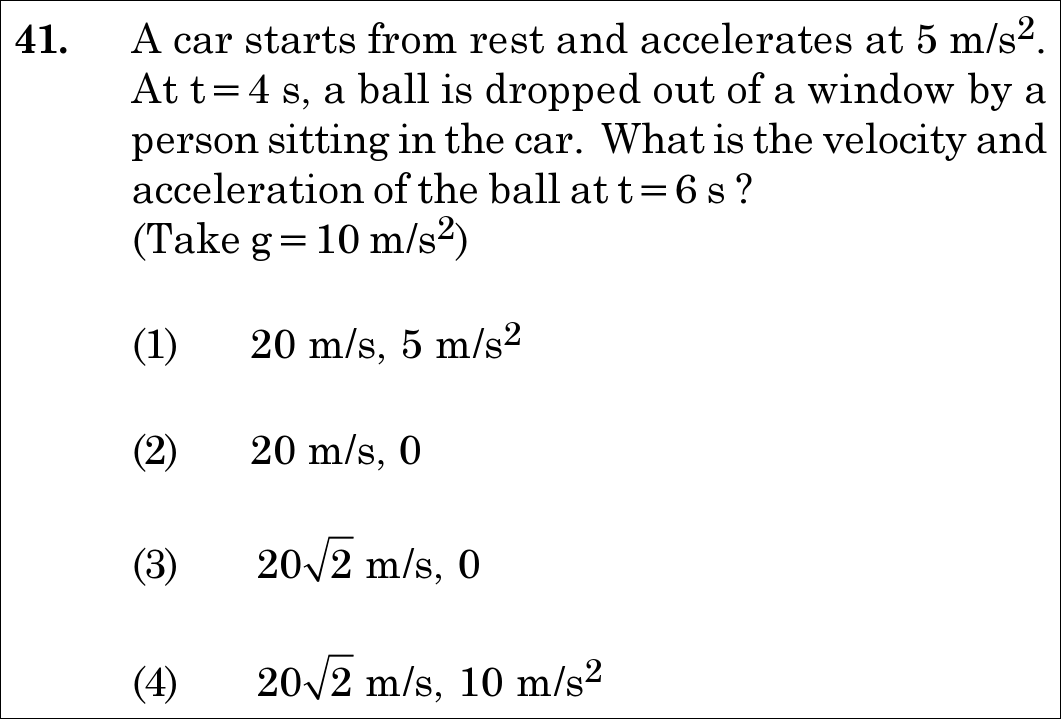
NEET 2021 · Q41 Medium
Official NEET 2021 Question 41 - Motion in a Plane
1
2
3
4 ✓ Key
💡 Verified Solution & 30-Second Hack
✓
Verified Against NTA Final Answer Key
Option (4) : 20√2 m/s, 10 m/s^2
📚 Motion in a Plane Medium
📋 Given Parameters & Problem Setup
Car Acceleration (a_c) 5 m/s^2 along horizontal
Drop Time (t_1) 4 s
Observation Time (t_2) 6 s (Δt = 2 s after release)
Acceleration Due to Gravity (g) 10 m/s^2
⚡

The 30-Second Exam Hall Shortcut: ⚡ 2-Step Projectile: v_x = 20 m/s, v_y = 20 m/s, a = g = 10 m/s²

⏱️ Save ~25 seconds

Horizontal velocity at drop (t=4 st = 4\text{ s}): vx=act=5×4=20 m/sv_x = a_c t = 5 \times 4 = 20\text{ m/s}. The instant released, car acceleration stops acting on it! Downward acceleration is purely gravity: a=g=10 m/s2a = g = 10\text{ m/s}^2! After Δt=2 s\Delta t = 2\text{ s}, vertical speed is vy=gΔt=10×2=20 m/sv_y = g \Delta t = 10 \times 2 = 20\text{ m/s}. Net speed v=202+202=202 m/sv = \sqrt{20^2 + 20^2} = 20\sqrt{2}\text{ m/s}. Match Option (4)!

1 At t=4 st = 4\text{ s}, horizontal velocity of car is vx=u+act1=0+(5)(4)=20 m/sv_x = u + a_c t_1 = 0 + (5)(4) = 20\text{ m/s}.
2 When dropped, the ball is in free flight: the only acceleration is gravity g=10 m/s2g = 10\text{ m/s}^2 downwards.
3 Time of free fall until t=6 st = 6\text{ s} is Δt=6−4=2 s\Delta t = 6 - 4 = 2\text{ s}.
4 Vertical velocity: vy=gΔt=10×2=20 m/sv_y = g \Delta t = 10 \times 2 = 20\text{ m/s}.
5 Total velocity: v=vx2+vy2=202+202=202 m/sv = \sqrt{v_x^2 + v_y^2} = \sqrt{20^2 + 20^2} = 20\sqrt{2}\text{ m/s}.
6 Acceleration is 10 m/s210\text{ m/s}^2. Match Option (4).
🛡️
Why You Can 100% Trust This Shortcut: Canonical independence of orthogonal kinematic motions and Newton's law of gravitation for released projectiles.
📐

Step-by-Step Rigorous Workflow & Mathematical Proof

Step 1

Determining the Velocity of the Car at the Instant of Release

The car starts from rest (u=0u = 0) and accelerates uniformly at ac=5 m/s2a_c = 5\text{ m/s}^2 along the horizontal. At t=4 st = 4\text{ s}, its horizontal velocity is:

vx=u+act1=0+(5 m/s2)(4 s)=20 m/sv_x = u + a_c t_1 = 0 + (5\text{ m/s}^2)(4\text{ s}) = 20\text{ m/s}
Step 2

Determining Acceleration After Release

The moment the ball is released from the window, it loses contact with the accelerating car. No horizontal force acts on the ball (ignoring air resistance). The only force acting on the ball is gravity. Therefore, its acceleration at all times t>4 st > 4\text{ s} is strictly the acceleration due to gravity:

a=g=10 m/s2(acting vertically downward)a = g = 10\text{ m/s}^2 \quad (\text{acting vertically downward})
Step 3

Determining the Velocity Components at t = 6 s

The time elapsed since release is Δt=6 s−4 s=2 s\Delta t = 6\text{ s} - 4\text{ s} = 2\text{ s}. - Horizontal velocity remains constant: vx=20 m/sv_x = 20\text{ m/s} - Vertical velocity acquired under gravity: vy=uy+gΔt=0+(10)(2)=20 m/sv_y = u_y + g \Delta t = 0 + (10)(2) = 20\text{ m/s}

v=vx2+vy2=202+202=800=202 m/sv = \sqrt{v_x^2 + v_y^2} = \sqrt{20^2 + 20^2} = \sqrt{800} = 20\sqrt{2}\text{ m/s}
⭐

360° Option Elimination Engine Key Feature

Diagnose every choice: Know exactly why the right option works and why distractors fail.

4-Option Deep Scan
1 1
✗ Incorrect
Verdict & Scientific Reason:

Falsely assumes the car acceleration continues to act on the released ball and ignores vertical velocity.

⚠️
Student Fallacy (Why candidates pick this trap): Assuming horizontal acceleration persists after release.
2 2
✗ Incorrect
Verdict & Scientific Reason:

Ignores gravitational acceleration and vertical velocity entirely.

⚠️
Student Fallacy (Why candidates pick this trap): Assuming zero gravity in the problem.
3 3
✗ Incorrect
Verdict & Scientific Reason:

Calculates velocity correctly but claims acceleration is zero, which is impossible in Earth's gravitational field.

⚠️
Student Fallacy (Why candidates pick this trap): Confusing zero net horizontal acceleration with zero total acceleration.
4 4
✓ 100% Correct
Verdict & Scientific Reason:

Exact physical values: speed v=202 m/sv = 20\sqrt{2}\text{ m/s} and acceleration a=g=10 m/s2a = g = 10\text{ m/s}^2.

💡
Why this is airtight: None; rigorous projectile kinematics.
⚠️

NTA Trap Alert: Persistent Car Acceleration Fallacy

Students frequently think that because the car was accelerating at 5 m/s25\text{ m/s}^2, the ball continues to experience an acceleration of 5 m/s25\text{ m/s}^2 horizontally. Once released, the horizontal force is ZERO; the ONLY acceleration is gravity (g=10 m/s2g = 10\text{ m/s}^2).

🛡️ How to avoid the -1 mark: A dropped object in air experiences ONLY gravitational acceleration: a=g=10 m/s2a = g = 10\text{ m/s}^2.
📖

Core NEET Syllabus Standard

NCERT Physics · Motion in a Plane Standard Benchmark
Core Scientific Principle Tested:

"An object released from an accelerating vehicle retains the velocity of the vehicle at release, but experiences only gravitational acceleration thereafter."

Syllabus Focus: Projectile Motion and Inertia
✓ Core NEET UG Syllabus Anchor Syllabus & Academic Standards ↗
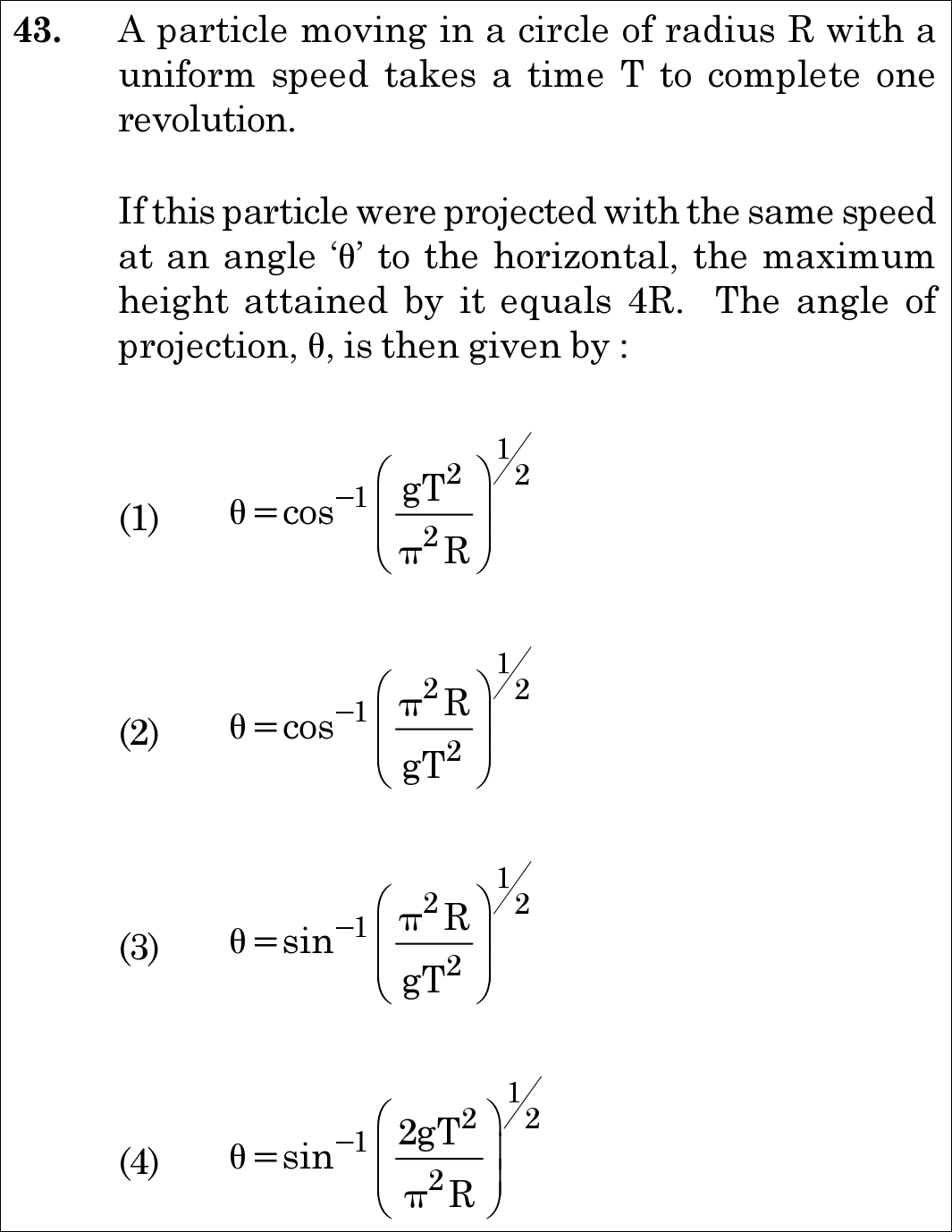
NEET 2021 · Q43 Medium
Official NEET 2021 Question 43 - Motion in a Plane
1
2
3
4 ✓ Key
💡 Verified Solution & 30-Second Hack
✓
Verified Against NTA Final Answer Key
Option (4) : θ = sin^-1[(2g T^2 / (π^2 R))^(1/2)]
📚 Motion in a Plane Medium
📋 Given Parameters & Problem Setup
Circular Radius R
Time Period of Revolution T
Projectile Maximum Height H = 4 R
⚡

The 30-Second Exam Hall Shortcut: ⚡ 2-Step Speed to Angle: v = 2πR/T and H = v² sin²θ / 2g = 4R

⏱️ Save ~25 seconds

v=2πRT  ⟹  v2=4π2R2T2v = \frac{2\pi R}{T} \implies v^2 = \frac{4\pi^2 R^2}{T^2}. Substitute into projectile max height: H=v2sin⁡2θ2g=4π2R2sin⁡2θ2gT2=4RH = \frac{v^2 \sin^2\theta}{2g} = \frac{4\pi^2 R^2 \sin^2\theta}{2g T^2} = 4R. Cancel 4R4R: π2Rsin⁡2θ2gT2=1  ⟹  sin⁡2θ=2gT2π2R  ⟹  θ=sin⁡−1(2gT2π2R)1/2\frac{\pi^2 R \sin^2\theta}{2g T^2} = 1 \implies \sin^2\theta = \frac{2g T^2}{\pi^2 R} \implies \theta = \sin^{-1}\left(\frac{2g T^2}{\pi^2 R}\right)^{1/2}! Match Option (4)!

1 Circular motion speed: v=2πRTv = \frac{2\pi R}{T}.
2 Projectile maximum height: H=v2sin⁡2θ2gH = \frac{v^2 \sin^2\theta}{2g}.
3 Equate H=4RH = 4R: (2πRT)2sin⁡2θ2g=4R\frac{\left(\frac{2\pi R}{T}\right)^2 \sin^2\theta}{2g} = 4R.
4 4π2R2sin⁡2θ2gT2=4R  ⟹  π2Rsin⁡2θ2gT2=1\frac{4\pi^2 R^2 \sin^2\theta}{2g T^2} = 4R \implies \frac{\pi^2 R \sin^2\theta}{2g T^2} = 1.
5 Solve for sin⁡θ\sin\theta: sin⁡2θ=2gT2π2R  ⟹  θ=sin⁡−1(2gT2π2R)1/2\sin^2\theta = \frac{2g T^2}{\pi^2 R} \implies \theta = \sin^{-1}\left(\frac{2g T^2}{\pi^2 R}\right)^{1/2}.
6 Match Option (4).
🛡️
Why You Can 100% Trust This Shortcut: Canonical uniform circular kinematics coupled with parabolic projectile trajectory equations.
📐

Step-by-Step Rigorous Workflow & Mathematical Proof

Step 1

Determining the Speed from Uniform Circular Motion

A particle completing one full revolution around a circle of radius RR in period TT travels a distance 2πR2\pi R with constant speed:

v=2πRTv = \frac{2\pi R}{T}
Step 2

Formulating the Maximum Height of Projectile Motion

When projected at angle θ\theta to the horizontal with this initial speed vv, the maximum vertical height HH reached is:

H=v2sin⁡2θ2gH = \frac{v^2 \sin^2\theta}{2g}
Step 3

Equating with the Given Maximum Height (H = 4R)

Substitute v=2πRTv = \frac{2\pi R}{T} and H=4RH = 4R into the height equation:

(4π2R2T2)sin⁡2θ2g=4R  ⟹  4π2R2sin⁡2θ2gT2=4R\frac{\left(\frac{4\pi^2 R^2}{T^2}\right) \sin^2\theta}{2g} = 4R \implies \frac{4\pi^2 R^2 \sin^2\theta}{2g T^2} = 4R
Step 4

Solving for the Angle of Projection θ

Cancel 4R4R from both sides and isolate θ\theta:

π2Rsin⁡2θ2gT2=1  ⟹  sin⁡2θ=2gT2π2R  ⟹  θ=sin⁡−1[(2gT2π2R)1/2]\frac{\pi^2 R \sin^2\theta}{2g T^2} = 1 \implies \sin^2\theta = \frac{2g T^2}{\pi^2 R} \implies \theta = \sin^{-1}\left[\left(\frac{2g T^2}{\pi^2 R}\right)^{1/2}\right]
⭐

360° Option Elimination Engine Key Feature

Diagnose every choice: Know exactly why the right option works and why distractors fail.

4-Option Deep Scan
1 1
✗ Incorrect
Verdict & Scientific Reason:

Uses cosine instead of sine and misses the factor of 2 in numerator.

⚠️
Student Fallacy (Why candidates pick this trap): Using horizontal range formula or cosine component.
2 2
✗ Incorrect
Verdict & Scientific Reason:

Inverted ratio and cosine function.

⚠️
Student Fallacy (Why candidates pick this trap): Inversion error.
3 3
✗ Incorrect
Verdict & Scientific Reason:

Inverts the fraction inside the radical and omits the factor of 2.

⚠️
Student Fallacy (Why candidates pick this trap): Inverting numerator and denominator.
4 4
✓ 100% Correct
Verdict & Scientific Reason:

Exact mathematical angle derived from equating projectile height to 4R4R.

💡
Why this is airtight: None; rigorous kinematic derivation.
⚠️

NTA Trap Alert: Fraction Inversion & Trig Function Trap

Candidates frequently arrive at sin⁡2θ\sin^2\theta and accidentally invert the fraction to π2RgT2\frac{\pi^2 R}{g T^2} (Option 3), or confuse maximum height (H∝sin⁡2θH \propto \sin^2\theta) with range (Rh∝sin⁡2θR_h \propto \sin 2\theta).

🛡️ How to avoid the -1 mark: Cross-multiply carefully: sin⁡2θ=2gT2π2R\sin^2\theta = \frac{2g T^2}{\pi^2 R}. Take the square root and inverse sine.
📖

Core NEET Syllabus Standard

NCERT Physics · Motion in a Plane Standard Benchmark
Core Scientific Principle Tested:

"Maximum height of a projectile is H=v2sin⁡2θ2gH = \frac{v^2 \sin^2\theta}{2g}, where speed from circular motion is v=2πRTv = \frac{2\pi R}{T}."

Syllabus Focus: Projectile Motion and Uniform Circular Motion
✓ Core NEET UG Syllabus Anchor Syllabus & Academic Standards ↗

Solve 4 NEET Questions a Day — One per Subject

Cover all 1,140 official NEET questions in 285 days at your own pace. Progress is saved on your device. No login needed.