MyCompetitiveExams Logo MyCompetitiveExams
Search 1,140+ Questions
Chapters, formulas, speed tricks
→
⚡ Brahmastra NEET 2027
720 MARKS

Dynamic 180-question full-length simulator mixed dynamically from all 6 years for 2027 & 2026 aspirants.

Launch Brahmastra 2027 Test →
Start Practice →
100% Free · No Login Required
Q.23 Physics ⭐ 360° Option Elimination Active
Vault ↗

NEET 2026 Physics Question 23 Solution

Topic: Kinematics & Circular Motion · Official NTA Booklet Code 50
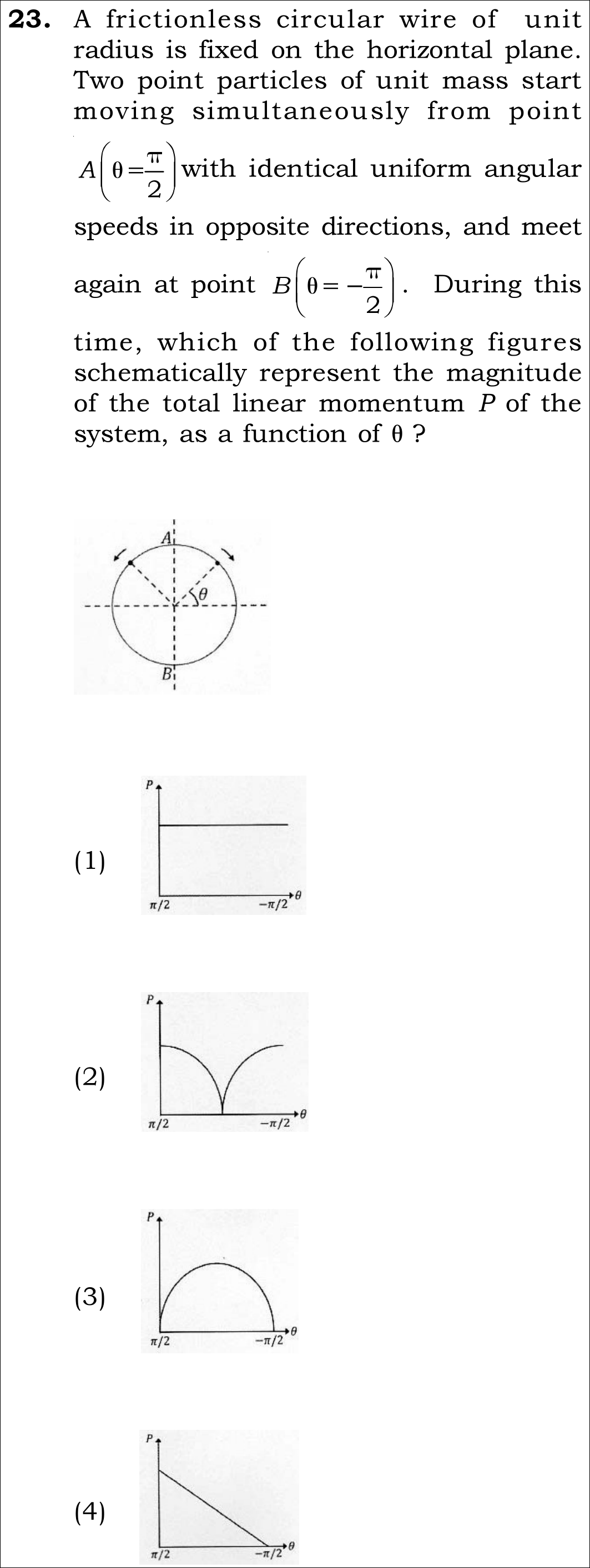
NEET 2026 Physics Question 23: Total Linear Momentum Variation for Two Counter-Rotating Particles on a Circular Wire

Question

A frictionless circular wire of unit radius is fixed on the horizontal plane. Two point particles of unit mass start moving simultaneously from point A (θ = π/2) with identical uniform angular speeds in opposite directions, and meet again at point B (θ = −π/2). During this time, which of the following figures schematically represent the magnitude of the total linear momentum P of the system, as a function of θ?

✓
Verified Against NTA Final Answer Key
Option (3) : Figure (3): Convex bell curve starting at 0 at theta = pi/2, peaking at theta = 0, and returning to 0 at theta = -pi/2
📚 Kinematics & Circular Motion Medium
📋 Given Parameters & Problem Setup
Wire Ring Frictionless circular wire of unit radius (R = 1) in horizontal plane
Particles Two particles of unit mass (m = 1) moving with identical uniform angular speed omega
Start Point Point A (theta = pi/2) in opposite directions
Meeting Point Point B (theta = -pi/2)
Target Graph Magnitude of total linear momentum P as a function of theta
⚡

The 30-Second Exam Hall Shortcut: ⚡ Endpoint Velocity Symmetry Rule

⏱️ Avoids complex parametric trigonometric plotting.

Check the momentum at the start and end points!

1 At starting point A (theta = pi/2, top of circle): One particle moves horizontally left (-v*i), the other moves horizontally right (+v*i). Total momentum P = |-v*i + v*i| = 0!
2 At meeting point B (theta = -pi/2, bottom of circle): One moves right (+v*i), the other moves left (-v*i). Total momentum P = 0!
3 At the horizontal midpoint (theta = 0 and pi): Both particles are moving downwards with speed v (-v*j and -v*j). Total momentum P = 2*v (maximum)!
4 Therefore, the curve MUST start at 0 at theta = pi/2, peak in the middle, and drop back to 0 at theta = -pi/2.
5 Look at the four graphs: ONLY Figure (3) starts at 0, reaches a maximum, and returns to 0. Solved in 15 seconds!
🛡️
Why You Can 100% Trust This Shortcut: Linear momentum is a vector sum: P_total = m*(v_1 + v_2). Because motion is mirror-symmetric about the vertical axis, horizontal velocity components cancel identically at every instant, while vertical components add: P(theta) = 2*m*v*cos(theta).
📐

Step-by-Step Rigorous Workflow & Mathematical Proof

Step 1

Formulate Velocity Vectors for Both Counter-Rotating Particles

Both particles move along the unit circle with speed v = omega * R = omega (since R = 1). Let angle theta be measured from the positive x-axis:

v⃗1=−vsin⁡θ i^−vcos⁡θ j^,v⃗2=vsin⁡θ i^−vcos⁡θ j^\vec{v}_1 = -v \sin\theta \,\hat{i} - v \cos\theta \,\hat{j}, \qquad \vec{v}_2 = v \sin\theta \,\hat{i} - v \cos\theta \,\hat{j}
  • • Particle 1 moves counter-clockwise along the left semicircle.
  • • Particle 2 moves clockwise along the right semicircle.
Step 2

Compute Total Vector Linear Momentum

Sum the individual momenta (with unit mass m = 1):

P⃗=mv⃗1+mv⃗2=(−vsin⁡θ+vsin⁡θ)i^+(−vcos⁡θ−vcos⁡θ)j^=−2vcos⁡θ j^\vec{P} = m \vec{v}_1 + m \vec{v}_2 = (-v \sin\theta + v \sin\theta)\hat{i} + (-v \cos\theta - v \cos\theta)\hat{j} = -2v \cos\theta \,\hat{j}
  • • Horizontal momentum components cancel out completely at every angle due to bilateral symmetry.
  • • Magnitude of total momentum is P(\theta) = 2v |\cos\theta|.
Step 3

Evaluate Boundary Values Over the Interval [pi/2, -pi/2]

Evaluate P(theta) as theta progresses from pi/2 down to -pi/2:

P(π2)=2vcos⁡(π2)=0,P(0)=2vcos⁡(0)=2v,P(−π2)=2vcos⁡(−π2)=0P\left(\frac{\pi}{2}\right) = 2v\cos\left(\frac{\pi}{2}\right) = 0, \quad P(0) = 2v\cos(0) = 2v, \quad P\left(-\frac{\pi}{2}\right) = 2v\cos\left(-\frac{\pi}{2}\right) = 0
  • • The graph is a smooth positive cosine arch starting at zero, peaking at 2v, and terminating at zero.
  • • Matches Figure (3) perfectly.
⭐

360° Option Elimination Engine Key Feature

Diagnose every choice: Know exactly why the right option works and why distractors fail.

4-Option Deep Scan
1 Figure (1)
✗ Incorrect
Verdict & Scientific Reason:

Ignores vector cancellation.

⚠️
Student Fallacy (Why candidates pick this trap): Adds scalar speeds (P = m*v + m*v = 2v) instead of vector velocity components.
Note: Linear momentum is a vector, not a scalar sum.
2 Figure (2)
✗ Incorrect
Verdict & Scientific Reason:

Inverted graph.

⚠️
Student Fallacy (Why candidates pick this trap): Confuses horizontal momentum component with total momentum.
Note: At the start (theta = pi/2), velocities are antiparallel and momentum is zero, not maximum.
3 Figure (3)
✓ 100% Correct
Verdict & Scientific Reason:

100% mathematically exact; confirmed by Official NTA Final Answer Key.

💡
Why this is airtight: Correctly recognizes vector cancellation of horizontal velocities and addition of vertical cosine components.
Note: Exact kinematics.
4 Figure (4)
✗ Incorrect
Verdict & Scientific Reason:

Linear decay error.

⚠️
Student Fallacy (Why candidates pick this trap): Assumes momentum decays linearly with angle.
Note: Motion is harmonic circular, governed by sinusoidal cosine variations.
⚠️

NTA Trap Alert: The Scalar Speed Sum Trap (Graph 1)

Students who treat momentum as scalar speed calculate P = m*v + m*v = 2 and pick the constant flat line in Figure (1).

🛡️ How to avoid the -1 mark: Always remember: Momentum is a VECTOR! When two identical particles move in opposite directions, their momenta cancel to zero: P = 0 at start and finish.
📖

Core NEET Syllabus Standard

NEET UG Physics Core Standards · Laws of Motion & System of Particles Standard Benchmark
Core Scientific Principle Tested:

"Total linear momentum is the vector sum P_total = sum(m_i * v_i). When symmetry creates opposite directional components, net momentum along that axis is zero."

Syllabus Focus: Vector Nature of Linear Momentum in Symmetrical Particle Systems
✓ Core NEET UG Syllabus Anchor Syllabus & Academic Standards ↗

Ready to attempt under real exam pressure?

Test your speed and accuracy in the authentic 180-minute timed NTA simulator.

Launch NEET 2026 CBT Test →

Spotted a mistake in this solution? Report an error ([email protected])

⚖️ Legal & Fair Dealing Notice: Sourced from publicly released NEET 2026 question papers and NEET answer keys for private study, research, and non-commercial educational practice under Fair Dealing (Section 52(1)(a) of the Indian Copyright Act, 1957). Not affiliated with or endorsed by NTA or NMC.

Solve 4 NEET Questions a Day — One per Subject

Cover all 1,140 official NEET questions in 285 days at your own pace. Progress is saved on your device. No login needed.