NEET 2021 Physics Question 14 Solution
Question
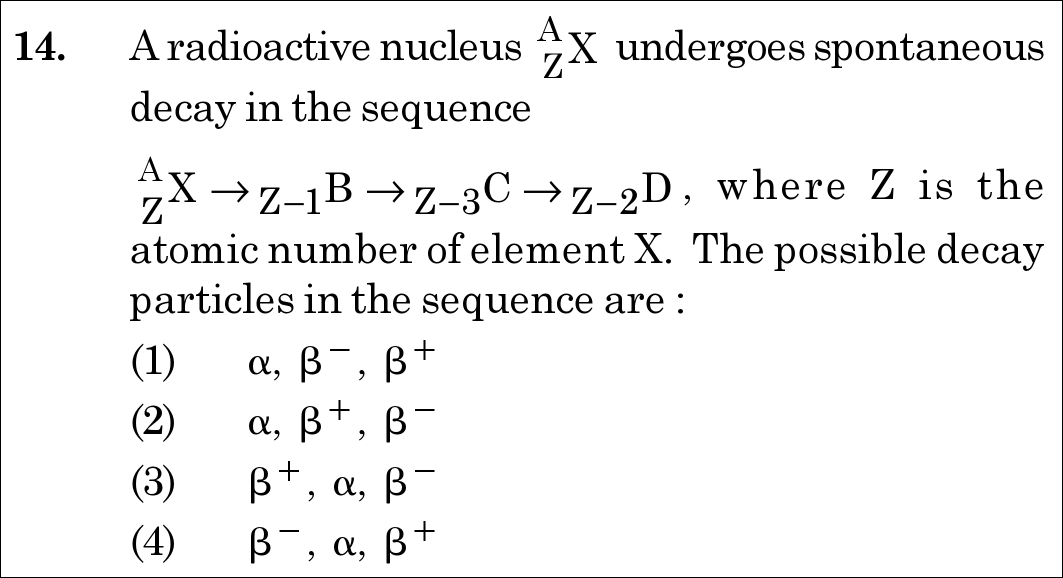
A radioactive nucleus ᴬ_ZX undergoes spontaneous decay in the sequence ᴬ_ZX → Z−1B → Z−3C → Z−2D, where Z is the atomic number of element X. The possible decay particles in the sequence are:
Dynamic 180-question full-length simulator mixed dynamically from all 6 years for 2027 & 2026 aspirants.
A radioactive nucleus ᴬ_ZX undergoes spontaneous decay in the sequence ᴬ_ZX → Z−1B → Z−3C → Z−2D, where Z is the atomic number of element X. The possible decay particles in the sequence are:
Track the change in atomic number Z at each decay step: 1. () decay! 2. () decay! 3. () decay! The sequence is ! Match Option (3)!
In all nuclear reactions, the total electric charge (atomic number ) is strictly conserved. Let be the change in atomic number of the daughter nucleus relative to the parent nucleus.
The atomic number changes from to (decreases by 1). This occurs when a proton converts into a neutron, emitting a positron ():
The atomic number changes from to (decreases by 2). This occurs when an alpha particle () is emitted:
The atomic number changes from to (increases by 1). This occurs when a neutron converts into a proton, emitting an electron ():
Diagnose every choice: Know exactly why the right option works and why distractors fail.
Starts with alpha decay (which would reduce by 2 to , not ).
Incorrect first step ( instead of ).
Exact match with the nuclear charge changes: (), (), ().
Inverts and : increases by 1, which would produce , not .
Students frequently remember "beta decay changes Z by 1" and mix up the signs: emission INCREASES by 1 (), while emission DECREASES by 1 ().
"In -decay, decreases by 2; in -decay, decreases by 1; in -decay, increases by 1."
Test your speed and accuracy in the authentic 200-minute timed NTA simulator.
Spotted a mistake in this solution? Report an error ([email protected])
Cover all 1,140 official NEET questions in 285 days at your own pace. Progress is saved on your device. No login needed.