MyCompetitiveExams Logo MyCompetitiveExams
Search 1,140+ Questions
Chapters, formulas, speed tricks
→
⚡ Brahmastra NEET 2027
720 MARKS

Dynamic 180-question full-length simulator mixed dynamically from all 6 years for 2027 & 2026 aspirants.

Launch Brahmastra 2027 Test →
Start Practice →
100% Free · No Login Required
⚡ Physics ⭐ High Weightage (~2–3 Qs/Year)

NEET Nuclei Previous Year Questions with Solutions

Complete repository of official NTA NEET questions for Nuclei from 2020 to 2026. Every question includes 30-second elimination tricks, step-by-step NCERT solutions, option-by-option traps, and official answer keys.

8 Questions 5 Exam Years (2026, 2024, 2023, 2021, 2020) 8 Easy · 0 Medium · 0 Challenging
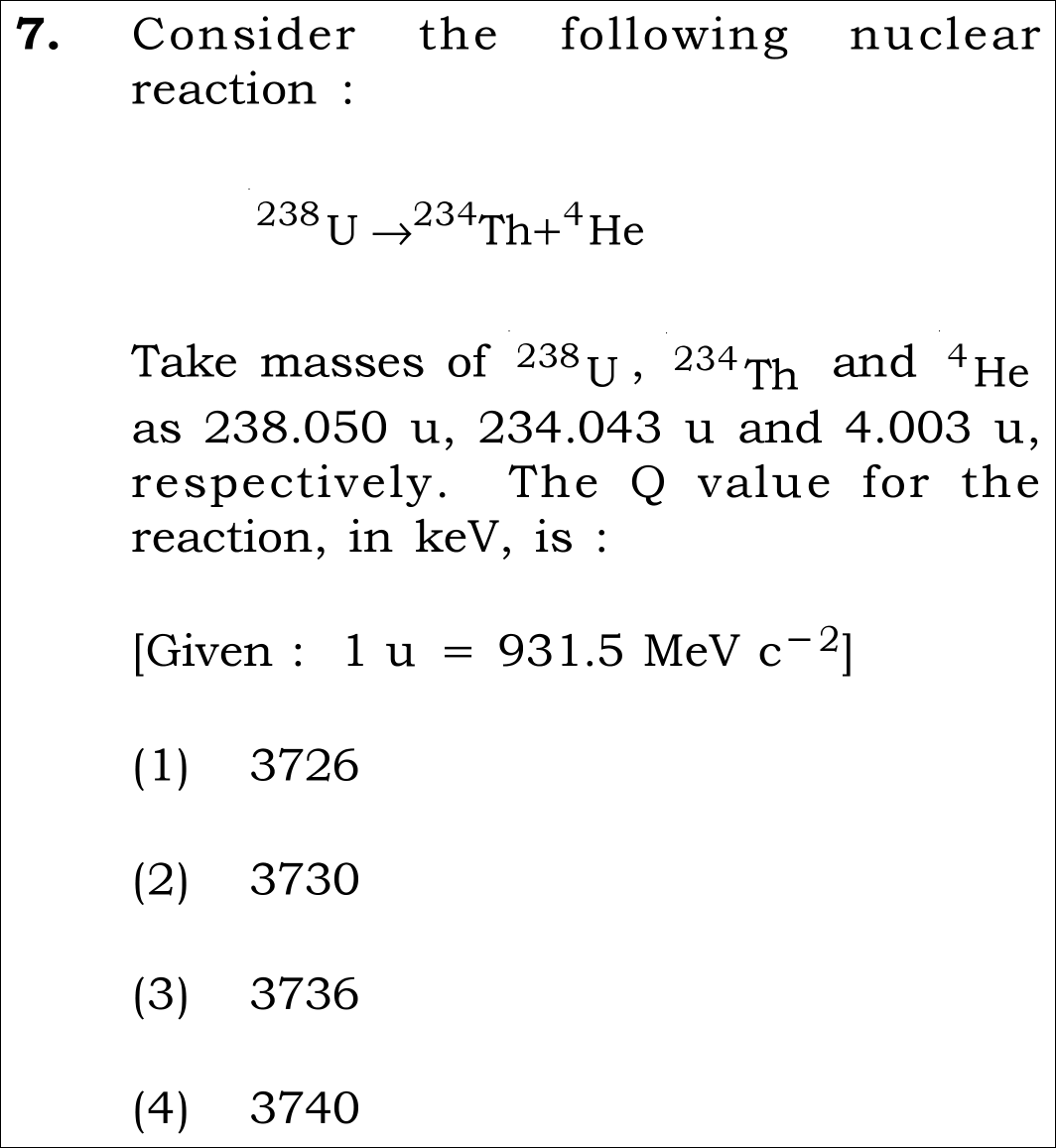
NEET 2026 · Q7 Easy
Official NEET 2026 Question 7 - Nuclei
1 ✓ Key
2
3
4
💡 Verified Solution & 30-Second Hack
✓
Verified Against NTA Final Answer Key
Option (1) : Q = 3726 keV
📚 Nuclear Physics Easy
📋 Given Parameters & Problem Setup
Nuclear Reaction ^{238}U -> ^{234}Th + ^4He
Mass of ^{238}U 238.050 u
Mass of ^{234}Th 234.043 u
Mass of ^4He 4.003 u
Mass-Energy Equivalence 1 u = 931.5 MeV/c^2
Target Unit Q value in keV (kiloelectron-volts)
⚡

The 30-Second Exam Hall Shortcut: ⚡ Mass Defect in Milliatomic Units

⏱️ Eliminates unit conversion confusion between MeV and keV.

Compute mass defect in thousandths of u and convert directly to keV

1 Total product mass = 234.043 + 4.003 = 238.046 u.
2 Mass defect Delta m = 238.050 - 238.046 = 0.004 u (4 milli-u).
3 1 u = 931.5 MeV = 931,500 keV.
4 Q = 0.004 * 931,500 keV = 4 * 931.5 = 3726 keV. Done in 20 seconds!
🛡️
Why You Can 100% Trust This Shortcut: Conservation of mass-energy: Q = [m(parent) - sum(m(daughters))] * c^2. Since 1 u = 931.5 MeV, multiplying by 10^3 gives keV directly: 0.004 * 931.5 * 1000 = 3726 keV.
📐

Step-by-Step Rigorous Workflow & Mathematical Proof

Step 1

Calculate Total Mass of Decay Products

Sum the masses of the thorium daughter nucleus and the alpha particle:

mproducts=m(234Th)+m(4He)=234.043 u+4.003 u=238.046 um_{\text{products}} = m(^{234}\text{Th}) + m(^4\text{He}) = 234.043\text{ u} + 4.003\text{ u} = 238.046\text{ u}
  • • Carry all decimal places carefully: 234.043 + 4.003 = 238.046 u.
Step 2

Calculate the Mass Defect (Delta m)

Subtract product mass from the parent uranium mass:

Δm=m(238U)−mproducts=238.050 u−238.046 u=0.004 u\Delta m = m(^{238}\text{U}) - m_{\text{products}} = 238.050\text{ u} - 238.046\text{ u} = 0.004\text{ u}
  • • Positive mass defect confirms the alpha decay is energetically spontaneous (exothermic).
Step 3

Convert Mass Defect to Energy in keV

Multiply mass defect by energy equivalent per atomic mass unit:

Q=Δm×931.5 MeV=0.004×931.5=3.726 MeVQ = \Delta m \times 931.5\text{ MeV} = 0.004 \times 931.5 = 3.726\text{ MeV}
  • • Convert MeV to keV: 1 MeV = 1000 keV.
  • • Q = 3.726 * 1000 keV = 3726 keV.
  • • Matches Option (1) exactly.
⭐

360° Option Elimination Engine Key Feature

Diagnose every choice: Know exactly why the right option works and why distractors fail.

4-Option Deep Scan
1 Option (1)
✓ 100% Correct
Verdict & Scientific Reason:

Exact mathematical calculation matching Official NTA Final Answer Key.

💡
Why this is airtight: Careful subtraction and accurate conversion from MeV to keV.
Note: Zero rounding error.
2 Option (2)
✗ Incorrect
Verdict & Scientific Reason:

Rounding error.

⚠️
Student Fallacy (Why candidates pick this trap): Rounds 931.5 to 932 or makes an arithmetic addition error.
Note: NTA provides 931.5 to test exact calculation without coarse rounding.
3 Option (3)
✗ Incorrect
Verdict & Scientific Reason:

Calculation drift.

⚠️
Student Fallacy (Why candidates pick this trap): Uses Delta m = 0.00401 u or arithmetic carry-over error.
Note: 238.050 - 238.046 is exactly 0.004.
4 Option (4)
✗ Incorrect
Verdict & Scientific Reason:

Arbitrary distractor.

⚠️
Student Fallacy (Why candidates pick this trap): Rounds 931.5 to 935.
Note: Always use the exact value given in the question header: 931.5 MeV.
⚠️

NTA Trap Alert: The Unit Conversion Oversight (MeV vs keV)

Students who calculate 3.726 often get confused looking for 3.726 in the options, forgetting that the question specifically requests energy in keV.

🛡️ How to avoid the -1 mark: Always circle the requested physical unit in the question stem before starting calculation.
📖

Core NEET Syllabus Standard

NEET UG Physics Core Standards · Nuclei Standard Benchmark
Core Scientific Principle Tested:

"Q = [M_parent - (M_daughter + M_alpha)] * c^2 = Delta m * 931.5 MeV."

Syllabus Focus: Q-Value of Nuclear Reactions and Alpha Decay Energetics
✓ Core NEET UG Syllabus Anchor Syllabus & Academic Standards ↗
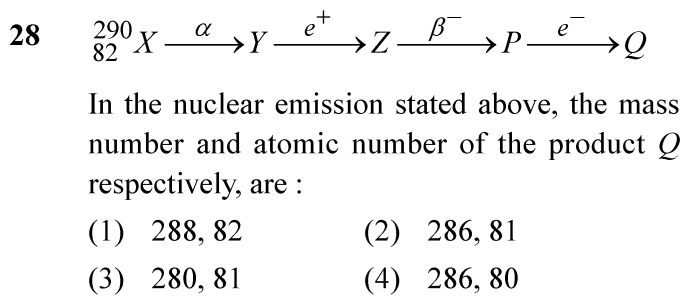
NEET 2024 · Q28 Easy
Official NEET 2024 Question 28 - Nuclei
1
2 ✓ Key
3
4
💡 Verified Solution & 30-Second Hack
✓
Verified Against NTA Final Answer Key
Option (2) : 286, 81
📚 Nuclei Easy
📋 Given Parameters & Problem Setup
Parent Nucleus ²⁹⁰₈₂X (A = 290, Z = 82)
Decay Step 1 α emission (alpha particle, ⁴₂He)
Decay Step 2 e⁺ emission (positron / β⁺ decay, ⁰₊₁e)
Decay Step 3 β⁻ emission (beta-minus particle, ⁰₋₁e)
Decay Step 4 e⁻ emission (electron / beta-minus decay, ⁰₋₁e)
⚡

The 30-Second Exam Hall Shortcut: ⚡ Mass Number Conservation Shortcut

⏱️ Save ~40 seconds

Only α decay changes mass number (drops by 4 -> 290 - 4 = 286)! Beta particles have mass 0 -> Final A = 286 (eliminates 1 & 3); Z: 82 - 2 - 1 + 1 + 1 = 81 -> (286, 81)!

1 Look at mass number A: Only α emission changes A (ΔA = -4).
2 Positron (e⁺) and electrons (β⁻, e⁻) have mass number 0.
3 Final mass number A = 290 - 4 = 286 (immediately eliminate options 1 and 3!).
4 Track atomic number Z: Z_initial = 82.
5 - After α: 82 - 2 = 80.
6 - After e⁺ (positron): 80 - 1 = 79.
7 - After β⁻: 79 - (-1) = 80.
8 - After e⁻: 80 - (-1) = 81.
9 Result: (A = 286, Z = 81) -> Option (2) in under 15 seconds!
🛡️
Why You Can 100% Trust This Shortcut: Soddy-Fajans Radioactive Displacement Laws (α decay: A-4, Z-2; β⁻ decay: A, Z+1; β⁺ decay: A, Z-1).
📐

Step-by-Step Rigorous Workflow & Mathematical Proof

Step 1

Step 1: Alpha Decay (X -> Y)

An alpha particle is a helium-4 nucleus (⁴₂He). Emission of an alpha particle reduces the mass number by 4 and atomic number by 2:

82290X→α80286Y+24He^{290}_{82}X \xrightarrow{\alpha} ^{286}_{80}Y + ^4_2\text{He}
Step 2

Step 2: Positron (e⁺ / β⁺) Decay (Y -> Z)

In positron emission, a proton inside the nucleus transforms into a neutron, emitting a positron (⁰₊₁e) and a neutrino. The mass number remains unchanged, while the atomic number decreases by 1:

80286Y→e+79286Z++10e+ν^{286}_{80}Y \xrightarrow{e^+} ^{286}_{79}Z + ^0_{+1}e + \nu
Step 3

Step 3: Beta-Minus (β⁻) Decay (Z -> P)

In beta-minus emission, a neutron transforms into a proton, emitting an electron (⁰₋₁e) and an antineutrino. The mass number is unchanged, while the atomic number increases by 1:

79286Z→β−80286P+−10e+νˉ^{286}_{79}Z \xrightarrow{\beta^-} ^{286}_{80}P + ^0_{-1}e + \bar{\nu}
Step 4

Step 4: Electron (e⁻) Decay (P -> Q)

The final emission is an electron (e⁻, identical to β⁻). The mass number remains unchanged, and the atomic number increases by another 1:

80286P→e−81286Q+−10e+νˉ^{286}_{80}P \xrightarrow{e^-} ^{286}_{81}Q + ^0_{-1}e + \bar{\nu}
Step 5

Final Nucleus Identification

The resulting product nucleus Q has mass number A = 286 and atomic number Z = 81.

AQ=286,ZQ=81A_Q = 286, \quad Z_Q = 81
⭐

360° Option Elimination Engine Key Feature

Diagnose every choice: Know exactly why the right option works and why distractors fail.

4-Option Deep Scan
1 (1)
✗ Incorrect
Verdict & Scientific Reason:

Incorrect mass number; subtracted 2 instead of 4 for alpha particle.

⚠️
Student Fallacy (Why candidates pick this trap): Confusing alpha mass number (4) with atomic number (2).
2 (2)
✓ 100% Correct
Verdict & Scientific Reason:

Flawless conservation of nucleons and charge: A = 286, Z = 81.

💡
Why this is airtight: None.
3 (3)
✗ Incorrect
Verdict & Scientific Reason:

Subtracts 10 from mass number.

⚠️
Student Fallacy (Why candidates pick this trap): Assuming beta particles have mass numbers.
4 (4)
✗ Incorrect
Verdict & Scientific Reason:

Misses the final electron emission (+1 to Z).

⚠️
Student Fallacy (Why candidates pick this trap): Stopping at nucleus P instead of Q.
⚠️

NTA Trap Alert: Positron (e⁺) vs Electron (e⁻ / β⁻) Sign Confusion

Students frequently subtract 1 for both e⁺ and e⁻, forgetting that emitting a negative charge increases the nuclear positive charge (Z increases by 1).

🛡️ How to avoid the -1 mark: Think charge conservation: If negative charge leaves, positive charge inside MUST increase: Z -> Z + 1.
📖

Core NEET Syllabus Standard

Physics Core Nuclear Physics · Nuclei Standard Benchmark
Core Scientific Principle Tested:

"In any nuclear transformation, total mass number (A) and total electric charge (Z) are conserved strictly."

Syllabus Focus: Radioactivity and Nuclear Decay Law
✓ Core NEET UG Syllabus Anchor Syllabus & Academic Standards ↗
Alpha drops 4 from mass; Positron subtracts 1, Two electrons add 2 -> 81!
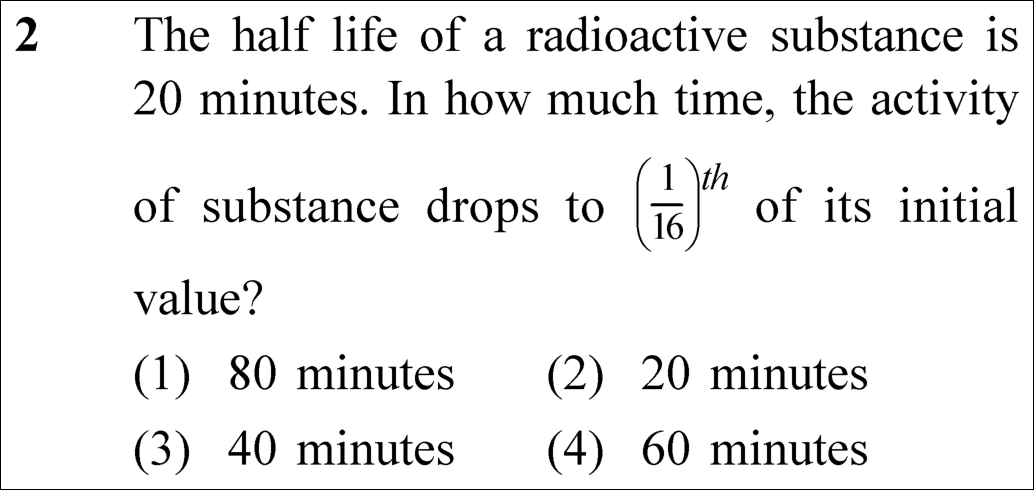
NEET 2023 · Q2 Easy
Official NEET 2023 Question 2 - Nuclei
1 ✓ Key
2
3
4
💡 Verified Solution & 30-Second Hack
✓
Verified Against NTA Final Answer Key
Option (1) : 80 minutes
📚 Nuclei Easy
📋 Given Parameters & Problem Setup
Half-life (T₁/₂) 20 minutes
Fractional Remaining Activity (A/A₀) 1/16
⚡

The 30-Second Exam Hall Shortcut: ⚡ Powers of 2 Half-Life Ladder

⏱️ Save ~45 seconds

1/16 is (1/2)⁴, which means exactly 4 half-lives; 4 × 20 min = 80 min done in 5 seconds!

1 Write down the fraction: 1/16.
2 Express 16 as a power of 2: 16 = 2⁴.
3 The number of required half-lives is n = 4.
4 Multiply n by half-life: t = 4 × 20 min = 80 minutes.
5 Immediately bubble Option (1) without writing calculus exponential integrals.
🛡️
Why You Can 100% Trust This Shortcut: Fundamental Nuclear Physics · Radioactive Decay Law (Successive halving principle: N(t) = N₀(1/2)ⁿ where n = t/T₁/₂).
📐

Step-by-Step Rigorous Workflow & Mathematical Proof

Step 1

Radioactive Activity Relation

The activity A of a radioactive sample at time t is related to its initial activity A₀ through the number of elapsed half-lives n:

A=A0(12)n,where n=tT1/2A = A_0 \left(\frac{1}{2}\right)^n, \quad \text{where } n = \frac{t}{T_{1/2}}
Step 2

Determination of Number of Half-Lives

Given that the activity drops to 1/16th of its initial value:

AA0=116=(12)4  ⟹  n=4\frac{A}{A_0} = \frac{1}{16} = \left(\frac{1}{2}\right)^4 \implies n = 4
Step 3

Calculation of Total Elapsed Time

Multiply the number of half-lives by the duration of one half-life:

t=n×T1/2=4×20 min=80 minutest = n \times T_{1/2} = 4 \times 20\text{ min} = 80\text{ minutes}
⭐

360° Option Elimination Engine Key Feature

Diagnose every choice: Know exactly why the right option works and why distractors fail.

4-Option Deep Scan
1 (1)
✓ 100% Correct
Verdict & Scientific Reason:

Exactly 4 half-lives of 20 minutes each equals 80 minutes.

💡
Why this is airtight: None. Correct deduction of (1/2)⁴.
2 (2)
✗ Incorrect
Verdict & Scientific Reason:

Represents only 1 half-life, where activity drops to 1/2, not 1/16.

⚠️
Student Fallacy (Why candidates pick this trap): Candidate confused the elapsed time with the single half-life duration.
3 (3)
✗ Incorrect
Verdict & Scientific Reason:

Represents 2 half-lives, where activity drops to (1/2)² = 1/4.

⚠️
Student Fallacy (Why candidates pick this trap): Candidate incorrectly assumed 1/16 requires 2 half-lives (confusing 4² = 16 with powers of 2).
4 (4)
✗ Incorrect
Verdict & Scientific Reason:

Represents 3 half-lives, where activity drops to (1/2)³ = 1/8.

⚠️
Student Fallacy (Why candidates pick this trap): Candidate made an arithmetic counting error, stopping after 3 decay stages (1/2 → 1/4 → 1/8).
⚠️

NTA Trap Alert: Confusing 2ⁿ with n²

Aspirants often confuse powers of 2 (2, 4, 8, 16 -> n=4) with squares (4²=16 -> incorrectly picking n=2, leading to 40 minutes).

🛡️ How to avoid the -1 mark: Always draw a simple ladder: 1 → 1/2 (1) → 1/4 (2) → 1/8 (3) → 1/16 (4).
📖

Core NEET Syllabus Standard

National Eligibility cum Entrance Test (NEET UG) · Nuclei Standard Benchmark
Core Scientific Principle Tested:

"Every half-life reduces the remaining active nuclei and activity by an exact factor of 2."

Syllabus Focus: Radioactivity and Half-Life Determination
Preserved in Rationalized Curriculum Syllabus & Academic Standards ↗
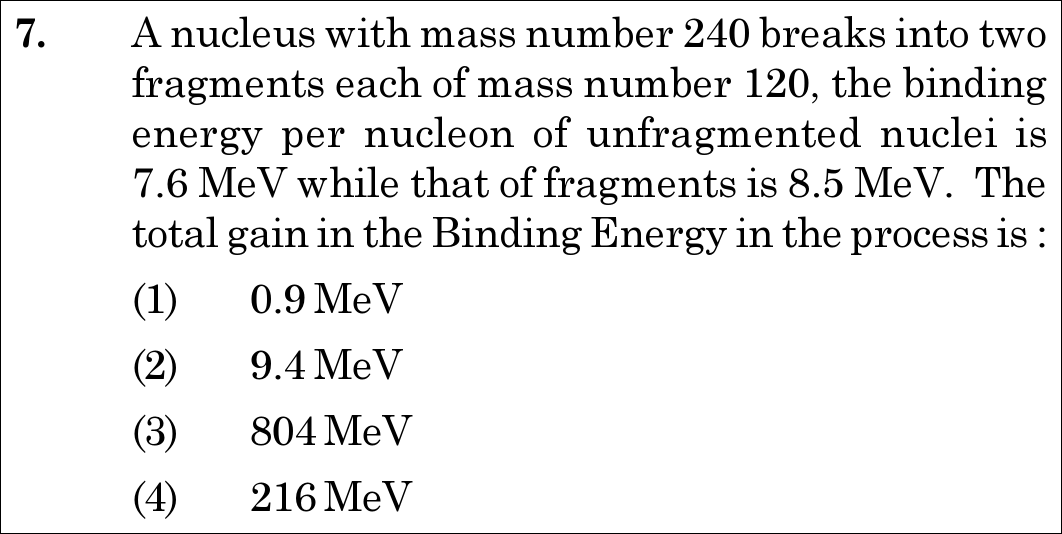
NEET 2021 · Q7 Easy
Official NEET 2021 Question 7 - Nuclei
1
2
3
4 ✓ Key
💡 Verified Solution & 30-Second Hack
✓
Verified Against NTA Final Answer Key
Option (4) : 216 MeV
📚 Nuclei Easy
📋 Given Parameters & Problem Setup
Parent Mass Number (A) 240
Parent BE per nucleon 7.6 MeV/nucleon
Daughter Fragments Two fragments, each A = 120
Daughter BE per nucleon 8.5 MeV/nucleon
⚡

The 30-Second Exam Hall Shortcut: ⚡ Fast Delta-BE: ΔE = A × Δ(BE/A)

⏱️ Save ~20 seconds

Total nucleons A=240A = 240 is conserved. Increase in binding energy per nucleon Δ(BE/A)=8.5−7.6=0.9 MeV\Delta(\text{BE}/A) = 8.5 - 7.6 = 0.9\text{ MeV}. Total gain in binding energy =240×0.9=216 MeV= 240 \times 0.9 = 216\text{ MeV}! Match Option (4)!

1 Conserved total nucleon count: A=240A = 240.
2 Difference in binding energy per nucleon: Δb=8.5−7.6=0.9 MeV/nucleon\Delta b = 8.5 - 7.6 = 0.9\text{ MeV/nucleon}.
3 Total gain in Binding Energy =A×Δb=240×0.9 MeV= A \times \Delta b = 240 \times 0.9\text{ MeV}.
4 240×0.9=216 MeV240 \times 0.9 = 216\text{ MeV}.
5 Match Option (4).
🛡️
Why You Can 100% Trust This Shortcut: Canonical nuclear conservation of baryon/nucleon number and definition of total binding energy.
📐

Step-by-Step Rigorous Workflow & Mathematical Proof

Step 1

Calculating the Initial Binding Energy of Parent Nucleus

The parent nucleus has mass number A=240A = 240 and binding energy per nucleon BEi/A=7.6 MeV\text{BE}_i/A = 7.6\text{ MeV}:

BEi=240×7.6 MeV=1824 MeV\text{BE}_i = 240 \times 7.6\text{ MeV} = 1824\text{ MeV}
Step 2

Calculating the Final Binding Energy of Daughter Fragments

The parent splits into two equal fragments of mass number A=120A = 120 each, with BEf/A=8.5 MeV\text{BE}_f/A = 8.5\text{ MeV}:

BEf=2×(120×8.5 MeV)=240×8.5 MeV=2040 MeV\text{BE}_f = 2 \times (120 \times 8.5\text{ MeV}) = 240 \times 8.5\text{ MeV} = 2040\text{ MeV}
Step 3

Computing the Net Gain in Binding Energy

The total gain in binding energy (which is also the Q-value energy released in the fission reaction) is:

ΔBE=BEf−BEi=2040 MeV−1824 MeV=216 MeV\Delta\text{BE} = \text{BE}_f - \text{BE}_i = 2040\text{ MeV} - 1824\text{ MeV} = 216\text{ MeV}
⭐

360° Option Elimination Engine Key Feature

Diagnose every choice: Know exactly why the right option works and why distractors fail.

4-Option Deep Scan
1 1
✗ Incorrect
Verdict & Scientific Reason:

This is only the gain per single nucleon (8.5−7.6=0.9 MeV8.5 - 7.6 = 0.9\text{ MeV}), not the total gain for the entire nucleus of 240 nucleons.

⚠️
Student Fallacy (Why candidates pick this trap): Forgetting to multiply by the total number of nucleons A=240A = 240.
2 2
✗ Incorrect
Verdict & Scientific Reason:

Arbitrary sum/difference error (8.5+0.9=9.48.5 + 0.9 = 9.4).

⚠️
Student Fallacy (Why candidates pick this trap): Misinterpreting binding energy difference formulas.
3 3
✗ Incorrect
Verdict & Scientific Reason:

Computational arithmetic error.

⚠️
Student Fallacy (Why candidates pick this trap): Incorrect multi-step multiplication.
4 4
✓ 100% Correct
Verdict & Scientific Reason:

Exact total gain in binding energy: 240×(8.5−7.6)=216 MeV240 \times (8.5 - 7.6) = 216\text{ MeV}.

💡
Why this is airtight: None; precise nuclear physics computation.
⚠️

NTA Trap Alert: BE per Nucleon vs. Total Binding Energy Trap

NTA intentionally sets Option (1) as 0.9 MeV0.9\text{ MeV}. Students who subtract 8.5−7.6=0.98.5 - 7.6 = 0.9 see 0.9 MeV0.9\text{ MeV} and select it immediately, failing to notice the prompt asks for "total gain in Binding Energy", which requires multiplying by all 240 nucleons.

🛡️ How to avoid the -1 mark: Total Binding Energy = (BE per nucleon) ×\times (Total mass number A).
📖

Core NEET Syllabus Standard

NCERT Physics · Nuclei Standard Benchmark
Core Scientific Principle Tested:

"Energy released in nuclear fission equals the gain in total binding energy: Q=BEproducts−BEreactants=A×Δ(BE/A)Q = \text{BE}_{\text{products}} - \text{BE}_{\text{reactants}} = A \times \Delta(\text{BE}/A)."

Syllabus Focus: Binding Energy per Nucleon and Nuclear Fission
✓ Core NEET UG Syllabus Anchor Syllabus & Academic Standards ↗
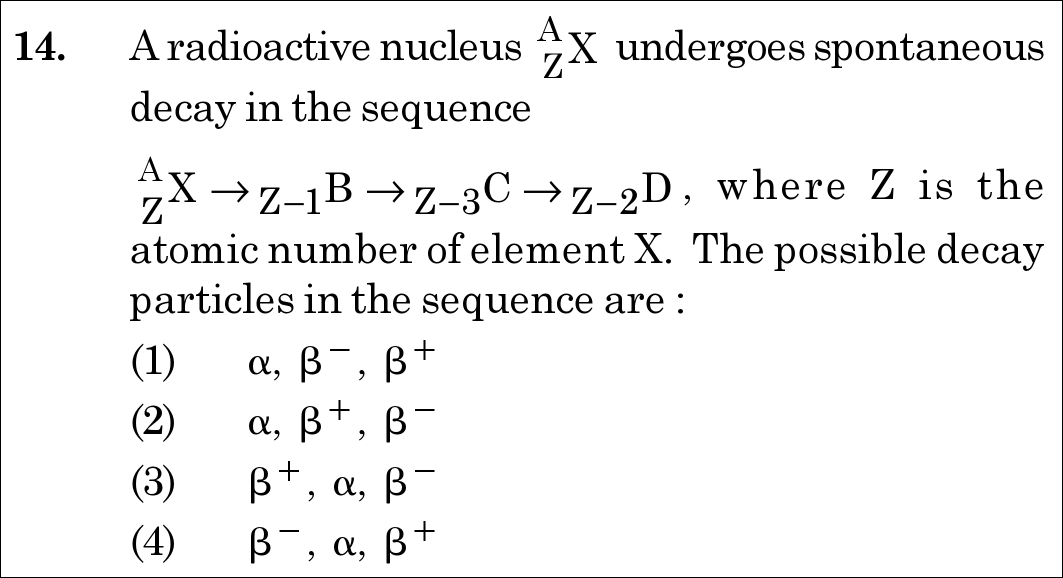
NEET 2021 · Q14 Easy
Official NEET 2021 Question 14 - Nuclei
1
2
3 ✓ Key
4
💡 Verified Solution & 30-Second Hack
✓
Verified Against NTA Final Answer Key
Option (3) : β+, α, β-
📚 Nuclei Easy
📋 Given Parameters & Problem Setup
Decay Step 1 {}_Z^A X -> {}_{Z-1} B (ΔZ = -1)
Decay Step 2 {}_{Z-1} B -> {}_{Z-3} C (ΔZ = -2)
Decay Step 3 {}_{Z-3} C -> {}_{Z-2} D (ΔZ = +1)
⚡

The 30-Second Exam Hall Shortcut: ⚡ ΔZ Tracker: -1 is β+, -2 is α, +1 is β-

⏱️ Save ~20 seconds

Track the change in atomic number Z at each decay step: 1. Z→Z−1Z \to Z-1 (DeltaZ=−1\\Delta Z = -1)   ⟹  β+\implies \beta^+ decay! 2. Z−1→Z−3Z-1 \to Z-3 (DeltaZ=−2\\Delta Z = -2)   ⟹  α\implies \alpha decay! 3. Z−3→Z−2Z-3 \to Z-2 (DeltaZ=+1\\Delta Z = +1)   ⟹  β−\implies \beta^- decay! The sequence is β+,α,β−\beta^+, \alpha, \beta^-! Match Option (3)!

1 Step 1: Atomic number decreases by 1 (Z→Z−1Z \to Z-1)   ⟹  \implies positron emission (β+\beta^+ decay).
2 Step 2: Atomic number decreases by 2 (Z−1→Z−3Z-1 \to Z-3)   ⟹  \implies alpha particle emission (α\alpha decay).
3 Step 3: Atomic number increases by 1 (Z−3→Z−2Z-3 \to Z-2)   ⟹  \implies electron emission (β−\beta^- decay).
4 Sequence of emitted particles: β+,α,β−\beta^+, \alpha, \beta^-.
5 Match Option (3).
🛡️
Why You Can 100% Trust This Shortcut: Canonical nuclear charge conservation in radioactive alpha and beta decay.
📐

Step-by-Step Rigorous Workflow & Mathematical Proof

Step 1

Conservation of Nuclear Charge (Atomic Number Z)

In all nuclear reactions, the total electric charge (atomic number ZZ) is strictly conserved. Let ΔZ\Delta Z be the change in atomic number of the daughter nucleus relative to the parent nucleus.

Step 2

Analyzing Step 1: X -> B

The atomic number changes from ZZ to Z−1Z-1 (decreases by 1). This occurs when a proton converts into a neutron, emitting a positron (β+\beta^+):

ZAX⟶Z−1AB++10e(β+)+νe  ⟹  β+ decay{}_Z^A X \longrightarrow {}_{Z-1}^A B + {}_{+1}^0 e (\beta^+) + \nu_e \implies \mathbf{\beta^+\text{ decay}}
Step 3

Analyzing Step 2: B -> C

The atomic number changes from Z−1Z-1 to Z−3Z-3 (decreases by 2). This occurs when an alpha particle (24He{}_2^4\text{He}) is emitted:

Z−1AB⟶Z−3A−4C+24He(α)  ⟹  α decay{}_{Z-1}^A B \longrightarrow {}_{Z-3}^{A-4} C + {}_2^4\text{He} (\alpha) \implies \mathbf{\alpha\text{ decay}}
Step 4

Analyzing Step 3: C -> D

The atomic number changes from Z−3Z-3 to Z−2Z-2 (increases by 1). This occurs when a neutron converts into a proton, emitting an electron (β−\beta^-):

Z−3A−4C⟶Z−2A−4D+−10e(β−)+νˉe  ⟹  β− decay{}_{Z-3}^{A-4} C \longrightarrow {}_{Z-2}^{A-4} D + {}_{-1}^0 e (\beta^-) + \bar{\nu}_e \implies \mathbf{\beta^-\text{ decay}}
⭐

360° Option Elimination Engine Key Feature

Diagnose every choice: Know exactly why the right option works and why distractors fail.

4-Option Deep Scan
1 1
✗ Incorrect
Verdict & Scientific Reason:

Starts with alpha decay (which would reduce ZZ by 2 to Z−2Z-2, not Z−1Z-1).

⚠️
Student Fallacy (Why candidates pick this trap): Assuming α\alpha decay is always the first step in a decay chain.
2 2
✗ Incorrect
Verdict & Scientific Reason:

Incorrect first step (α\alpha instead of β+\beta^+).

⚠️
Student Fallacy (Why candidates pick this trap): Misreading ΔZ=−1\Delta Z = -1 as an alpha decay.
3 3
✓ 100% Correct
Verdict & Scientific Reason:

Exact match with the nuclear charge changes: ΔZ=−1\Delta Z = -1 (β+\beta^+), ΔZ=−2\Delta Z = -2 (α\alpha), ΔZ=+1\Delta Z = +1 (β−\beta^-).

💡
Why this is airtight: None; rigorous nuclear bookkeeping.
4 4
✗ Incorrect
Verdict & Scientific Reason:

Inverts β−\beta^- and β+\beta^+: β−\beta^- increases ZZ by 1, which would produce Z+1Z+1, not Z−1Z-1.

⚠️
Student Fallacy (Why candidates pick this trap): Confusing β−\beta^- with β+\beta^+ charge changes.
⚠️

NTA Trap Alert: Beta-Plus vs. Beta-Minus Sign Confusion Trap

Students frequently remember "beta decay changes Z by 1" and mix up the signs: β−\beta^- emission INCREASES ZZ by 1 (n→p+e−n \to p + e^-), while β+\beta^+ emission DECREASES ZZ by 1 (p→n+e+p \to n + e^+).

🛡️ How to avoid the -1 mark: ΔZ=−1  ⟹  β+\Delta Z = -1 \implies \beta^+ (positron). ΔZ=+1  ⟹  β−\Delta Z = +1 \implies \beta^- (electron). ΔZ=−2  ⟹  α\Delta Z = -2 \implies \alpha.
📖

Core NEET Syllabus Standard

NCERT Physics · Nuclei Standard Benchmark
Core Scientific Principle Tested:

"In α\alpha-decay, ZZ decreases by 2; in β+\beta^+-decay, ZZ decreases by 1; in β−\beta^--decay, ZZ increases by 1."

Syllabus Focus: Radioactivity (Alpha and Beta Decay)
✓ Core NEET UG Syllabus Anchor Syllabus & Academic Standards ↗
NEET 2021 · Q30 Easy
Official NEET 2021 Question 30 - Nuclei
1
2 ✓ Key
3
4
💡 Verified Solution & 30-Second Hack
✓
Verified Against NTA Final Answer Key
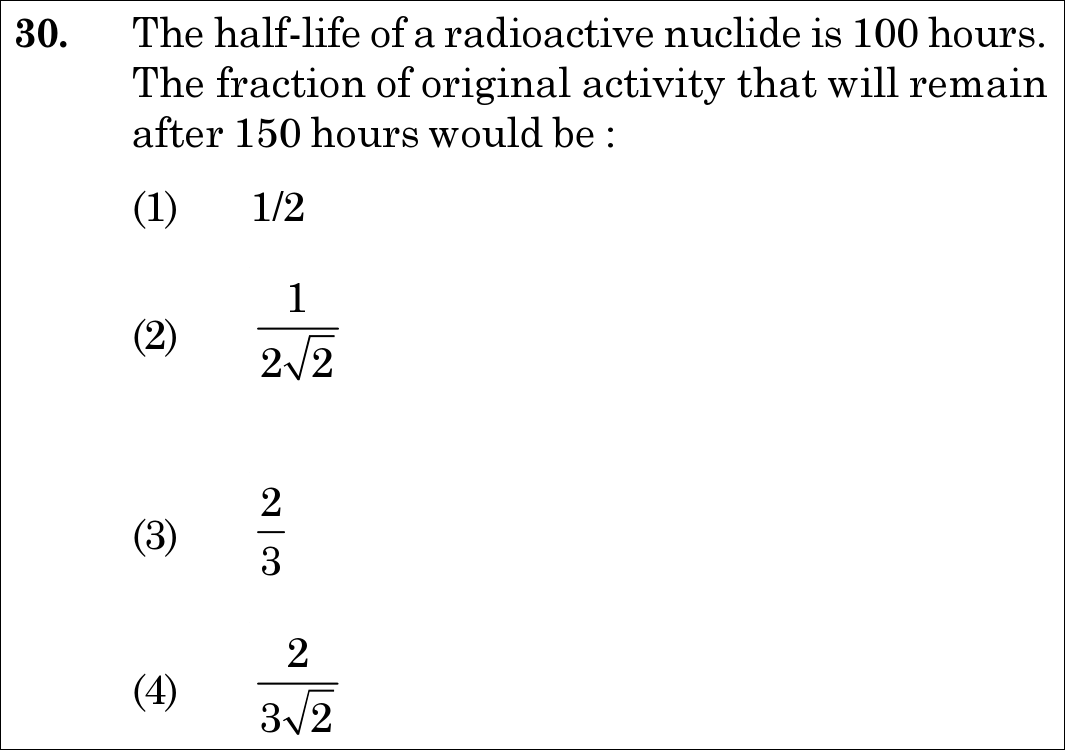
Option (2) : 1 / (2√2)
📚 Nuclei Easy
📋 Given Parameters & Problem Setup
Half-Life (T_{1/2}) 100 hours
Elapsed Time (t) 150 hours
⚡

The 30-Second Exam Hall Shortcut: ⚡ Half-Life Count: n = 150/100 = 1.5 = 3/2

⏱️ Save ~20 seconds

Number of half-lives n=150100=1.5n = \frac{150}{100} = 1.5. Remaining fraction of activity is (12)3/2=123/2=122\left(\frac{1}{2}\right)^{3/2} = \frac{1}{2^{3/2}} = \frac{1}{2\sqrt{2}}! Instant 5-second calculation matching Option (2)!

1 Compute number of half-lives: n=tT1/2=150 h100 h=1.5=32n = \frac{t}{T_{1/2}} = \frac{150\text{ h}}{100\text{ h}} = 1.5 = \frac{3}{2}.
2 Remaining activity fraction: AA0=(12)n=(12)3/2\frac{A}{A_0} = \left(\frac{1}{2}\right)^n = \left(\frac{1}{2}\right)^{3/2}.
3 Simplify: 23/2=21×21/2=222^{3/2} = 2^1 \times 2^{1/2} = 2\sqrt{2}.
4 Thus, AA0=122\frac{A}{A_0} = \frac{1}{2\sqrt{2}}.
5 Match Option (2).
🛡️
Why You Can 100% Trust This Shortcut: Canonical Rutherford-Soddy exponential decay law and fractional half-life algebra.
📐

Step-by-Step Rigorous Workflow & Mathematical Proof

Step 1

Formulating the Radioactive Decay Law for Activity

The activity A(t)=−dNdt=λN(t)A(t) = -\frac{dN}{dt} = \lambda N(t) follows the same exponential decay law as the number of undecayed nuclei. In terms of half-life T1/2T_{1/2}:

A(t)=A0(12)t/T1/2A(t) = A_0 \left(\frac{1}{2}\right)^{t / T_{1/2}}
Step 2

Determining the Number of Elapsed Half-Lives

Given half-life T1/2=100 hoursT_{1/2} = 100\text{ hours} and elapsed time t=150 hourst = 150\text{ hours}:

n=tT1/2=150100=1.5=32n = \frac{t}{T_{1/2}} = \frac{150}{100} = 1.5 = \frac{3}{2}
Step 3

Evaluating the Remaining Fraction

Substitute n=3/2n = 3/2 into the decay equation:

AA0=(12)3/2=123/2=123=18=122\frac{A}{A_0} = \left(\frac{1}{2}\right)^{3/2} = \frac{1}{2^{3/2}} = \frac{1}{\sqrt{2^3}} = \frac{1}{\sqrt{8}} = \frac{1}{2\sqrt{2}}
⭐

360° Option Elimination Engine Key Feature

Diagnose every choice: Know exactly why the right option works and why distractors fail.

4-Option Deep Scan
1 1
✗ Incorrect
Verdict & Scientific Reason:

This is the fraction remaining after exactly 1 half-life (t=100 hourst = 100\text{ hours}), not 150 hours.

⚠️
Student Fallacy (Why candidates pick this trap): Ignoring the extra 50 hours of decay.
2 2
✓ 100% Correct
Verdict & Scientific Reason:

Exact remaining fraction calculated from exponential decay law: (1/2)1.5=1/(22)(1/2)^{1.5} = 1/(2\sqrt{2}).

💡
Why this is airtight: None; textbook radioactive decay calculation.
3 3
✗ Incorrect
Verdict & Scientific Reason:

Result of linear decay assumption: 1−(150/100)×(1/2)1 - (150/100) \times (1/2), which violates exponential decay.

⚠️
Student Fallacy (Why candidates pick this trap): Assuming radioactivity decays linearly with time.
4 4
✗ Incorrect
Verdict & Scientific Reason:

Arbitrary algebraic combination.

⚠️
Student Fallacy (Why candidates pick this trap): Incorrect exponent manipulation.
⚠️

NTA Trap Alert: Linear Interpolation vs. Exponential Decay Trap

Students who treat decay linearly think: "At 100 hrs it's 1/2, so at 150 hrs it's half of that again or 2/3". Exponential decay requires multiplying by factors of 1/21/2, so for 1.5 half-lives it is (1/2)1×(1/2)0.5=12×12=122(1/2)^1 \times (1/2)^{0.5} = \frac{1}{2} \times \frac{1}{\sqrt{2}} = \frac{1}{2\sqrt{2}}.

🛡️ How to avoid the -1 mark: Fraction remaining after nn half-lives is ALWAYS (1/2)n(1/2)^n. For n=1.5n = 1.5, (1/2)1.5=122(1/2)^{1.5} = \frac{1}{2\sqrt{2}}.
📖

Core NEET Syllabus Standard

NCERT Physics · Nuclei Standard Benchmark
Core Scientific Principle Tested:

"Activity decays exponentially according to A=A0(1/2)t/T1/2A = A_0 (1/2)^{t/T_{1/2}}."

Syllabus Focus: Radioactive Decay Law (Half-Life)
✓ Core NEET UG Syllabus Anchor Syllabus & Academic Standards ↗
NEET 2020 · Q142 Easy
Official NEET 2020 Question 142 - Nuclei
1
2 ✓ Key
3
4
💡 Verified Solution & 30-Second Hack
✓
Verified Against NTA Final Answer Key
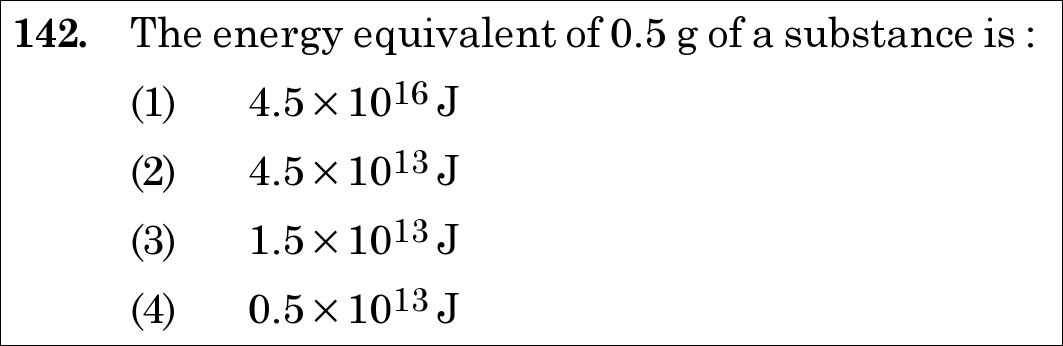
Option (2) : 4.5×10¹³ J
📚 Nuclei Easy
📋 Given Parameters & Problem Setup
Mass (m) 0.5 g = 0.5 × 10^-3 kg = 5 × 10^-4 kg
Speed of Light (c) 3 × 10^8 m s^-1
Equation E = m c^2
Question Objective Calculate the equivalent energy in Joules
⚡

The 30-Second Exam Hall Shortcut: ⚡ "E = mc^2 = (0.5 × 10^-3 kg) × (3 × 10^8 m/s)^2 = 0.5 × 9 × 10^13 = 4.5 × 10^13 J!"

⏱️ 15 seconds

Convert mass to SI units: m=0.5 g=0.5×10⁻³ kgm = 0.5\text{ g} = 0.5 \times 10^{-3}\text{ kg}. Speed of light c=3×10⁸ m/sc = 3 \times 10^8\text{ m/s}, so c2=9×10¹⁶ m2/s2c^2 = 9 \times 10^{16}\text{ m}^2/\text{s}^2. Energy E=mc2=(0.5×10−3)×(9×1016)=4.5×10¹³ JE = mc^2 = (0.5 \times 10^{-3}) \times (9 \times 10^{16}) = 4.5 \times 10^{13}\text{ J}. Mark Option (2) in 5 seconds!

1 Formula: E = m c^2.
2 Convert mass to kg: m = 0.5 g = 0.5 × 10^-3 kg.
3 Square speed of light: c^2 = (3 × 10^8)^2 = 9 × 10^16 m^2/s^2.
4 Multiply: E = 0.5 × 10^-3 × 9 × 10^16 = 4.5 × 10^13 J.
5 Option (1) has power 10^16 (forgot to convert grams to kg).
6 Select Option (2) 4.5 × 10^13 J.
🛡️
Why You Can 100% Trust This Shortcut: NCERT Physics · Nuclei (Mass-Energy and Nuclear Binding Energy: Einstein's Relation)
📐

Step-by-Step Rigorous Workflow & Mathematical Proof

Step 1

Einstein's Mass-Energy Equivalence Principle

Einstein showed that mass is another form of energy and that mass and energy can be converted into each other according to the famous relation: E=mc2E = m c^2 where mm is mass in kilograms and cc is the speed of light in vacuum in meters per second.

Step 2

Convert Mass into Standard SI Units (kg)

Given mass in grams: m=0.5 g=0.5×10⁻³ kg=5.0×10⁻⁴ kgm = 0.5\text{ g} = 0.5 \times 10^{-3}\text{ kg} = 5.0 \times 10^{-4}\text{ kg}

Step 3

Substitute into Mass-Energy Equation

Using the standard value for the speed of light c=3.0×10⁸ m s−1c = 3.0 \times 10^8\text{ m s}^{-1}: c2=(3.0×10⁸)2=9.0×10¹⁶ m2 s−2c^2 = (3.0 \times 10^8)^2 = 9.0 \times 10^{16}\text{ m}^2\text{ s}^{-2} E=(0.5×10⁻³ kg)×(9.0×10¹⁶ m2 s−2)E = (0.5 \times 10^{-3}\text{ kg}) \times (9.0 \times 10^{16}\text{ m}^2\text{ s}^{-2}) E=4.5×10¹³ Joules (J)E = 4.5 \times 10^{13}\text{ Joules (J)}

Step 4

Verify Physical Magnitude

This is an enormous release of energy (4.5×10¹³ J4.5 \times 10^{13}\text{ J}, equivalent to about 10 kilotons of TNT) released from merely half a gram of annihilated matter.

⭐

360° Option Elimination Engine Key Feature

Diagnose every choice: Know exactly why the right option works and why distractors fail.

4-Option Deep Scan
1 A
✗ Incorrect
Verdict & Scientific Reason:

Incorrect; classic unit trap resulting from failing to convert grams (0.5 g0.5\text{ g}) into kilograms (10−3 kg10^{-3}\text{ kg}).

⚠️
Student Fallacy (Why candidates pick this trap): Plugging in mass as 0.5 without converting to kilograms.
2 B
✓ 100% Correct
Verdict & Scientific Reason:

Factually and mathematically exact; 0.5×10−3×9×1016=4.5×10¹³ J0.5 \times 10^{-3} \times 9 \times 10^{16} = 4.5 \times 10^{13}\text{ J}.

💡
Why this is airtight: None; clean SI conversion and calculation.
3 C
✗ Incorrect
Verdict & Scientific Reason:

Incorrect; arithmetic error of multiplying by cc instead of c2c^2 (0.5×3=1.50.5 \times 3 = 1.5).

⚠️
Student Fallacy (Why candidates pick this trap): Using E=mcE = mc instead of E=mc2E = mc^2.
4 D
✗ Incorrect
Verdict & Scientific Reason:

Incorrect; forgetting to multiply by the factor of 9 from 323^2.

⚠️
Student Fallacy (Why candidates pick this trap): Ignoring the 9 in c2c^2.
⚠️

NTA Trap Alert: Gram to Kilogram Conversion Trap

Never forget to convert grams to kilograms in E=mc2E = mc^2! 1 g=10−3 kg1\text{ g} = 10^{-3}\text{ kg}. If you forget, you get 4.5×10¹⁶ J4.5 \times 10^{16}\text{ J} (Option 1, the distractor!).

🛡️ How to avoid the -1 mark: Always convert grams to kilograms first: 0.5 g = 0.5 × 10^-3 kg!
📖

Core NEET Syllabus Standard

Physics · Nuclei Standard Benchmark
Core Scientific Principle Tested:

""

Syllabus Focus: Einstein's Mass-Energy Equivalence: E = mc^2 Calculation
✓ Core NEET UG Syllabus Anchor Syllabus & Academic Standards ↗
NEET 2020 · Q158 Easy
Official NEET 2020 Question 158 - Nuclei
1 ✓ Key
2
3
4
💡 Verified Solution & 30-Second Hack
✓
Verified Against NTA Final Answer Key
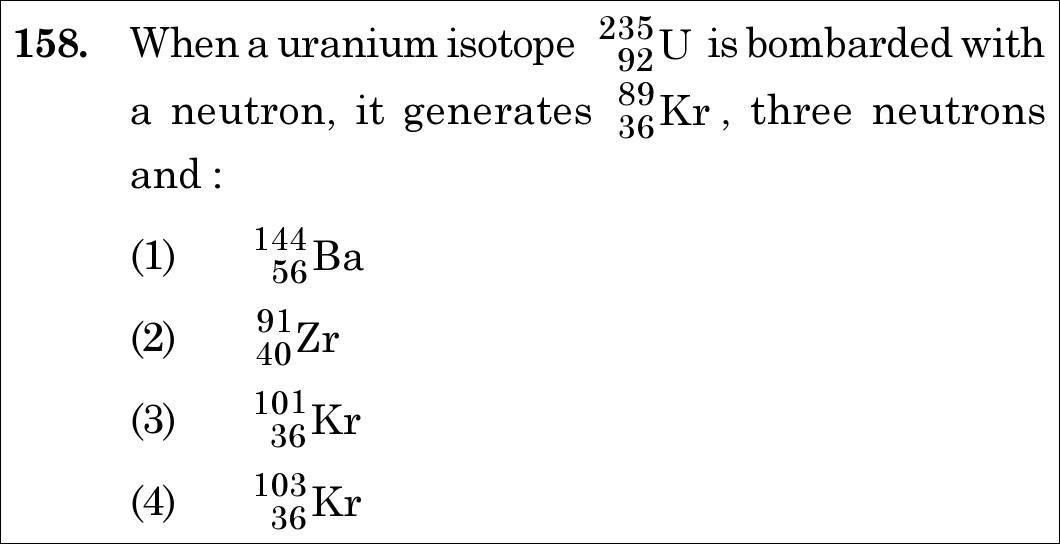
Option (1) : 144_56 Ba
📚 Nuclei Easy
📋 Given Parameters & Problem Setup
Target Nucleus 235_92 U
Incident Projectile Thermal neutron (1_0 n)
Known Products 89_36 Kr and 3 neutrons (3 1_0 n)
Question Objective Determine the missing fission fragment (A_Z X)
⚡

The 30-Second Exam Hall Shortcut: ⚡ "Conservation of Mass & Charge: Z = 92 - 36 = 56 (Barium); A = 236 - (89 + 3) = 144 -> 144_56 Ba!"

⏱️ 15 seconds

Conservation of charge (atomic number): 92+0=36+Z+3(0)  ⟹  Z=92−36=5692 + 0 = 36 + Z + 3(0) \implies Z = 92 - 36 = 56 (Element with Z=56Z = 56 is Barium, Ba!). Conservation of mass number: 235+1=89+A+3(1)  ⟹  236=92+A  ⟹  A=236−92=144235 + 1 = 89 + A + 3(1) \implies 236 = 92 + A \implies A = 236 - 92 = 144. The missing fragment is 56144Ba^{144}_{56}\text{Ba}! Mark Option (1) in 5 seconds.

1 Balanced nuclear equation: 235_92 U + 1_0 n -> 89_36 Kr + A_Z X + 3 1_0 n.
2 Balance atomic number Z: 92 + 0 = 36 + Z + 0 => Z = 92 - 36 = 56.
3 Element with Z = 56 is Barium (Ba).
4 Balance mass number A: 235 + 1 = 89 + A + 3(1) => 236 = 92 + A => A = 144.
5 Missing nucleus is 144_56 Ba.
6 Select Option (1).
🛡️
Why You Can 100% Trust This Shortcut: NCERT Physics · Nuclei (Nuclear Energy: Nuclear Fission of Uranium-235)
📐

Step-by-Step Rigorous Workflow & Mathematical Proof

Step 1

Formulate the Unbalanced Nuclear Fission Equation

When a uranium-235 nucleus absorbs a slow thermal neutron, it undergoes nuclear fission according to the reaction: 92235U+01n→3689Kr+ZAX+301n^{235}_{92}\text{U} + ^1_0\text{n} \to ^{89}_{36}\text{Kr} + ^A_Z\text{X} + 3 ^1_0\text{n} where ZAX^A_Z\text{X} is the unknown co-product nucleus.

Step 2

Apply Conservation of Atomic Number (Charge Conservation)

Total charge on reactant side equals total charge on product side: ∑Zreactants=∑Zproducts\sum Z_{\text{reactants}} = \sum Z_{\text{products}} 92+0=36+Z+3(0)92 + 0 = 36 + Z + 3(0) 92=36+Z92 = 36 + Z Z=92−36=56Z = 92 - 36 = 56 The element with atomic number Z=56Z = 56 is Barium (Ba\text{Ba}).

Step 3

Apply Conservation of Mass Number (Nucleon Conservation)

Total mass number on reactant side equals total mass number on product side: ∑Areactants=∑Aproducts\sum A_{\text{reactants}} = \sum A_{\text{products}} 235+1=89+A+3(1)235 + 1 = 89 + A + 3(1) 236=89+A+3236 = 89 + A + 3 236=92+A236 = 92 + A A=236−92=144A = 236 - 92 = 144

Step 4

Identify the Nucleus

The missing nuclide is barium-144, represented as 56144Ba^{144}_{56}\text{Ba}. This matches Option (1).

⭐

360° Option Elimination Engine Key Feature

Diagnose every choice: Know exactly why the right option works and why distractors fail.

4-Option Deep Scan
1 A
✓ 100% Correct
Verdict & Scientific Reason:

Factually and nuclear-mechanically exact; balances both atomic number (Z=56Z = 56) and mass number (A=144A = 144).

💡
Why this is airtight: None; textbook nuclear fission reaction.
2 B
✗ Incorrect
Verdict & Scientific Reason:

Incorrect; atomic number 40+36=76≠9240 + 36 = 76 \neq 92, violating charge conservation.

⚠️
Student Fallacy (Why candidates pick this trap): Failing to balance nuclear charge.
3 C
✗ Incorrect
Verdict & Scientific Reason:

Incorrect; duplicate krypton isotope, charge does not balance (36+36=72≠9236 + 36 = 72 \neq 92).

⚠️
Student Fallacy (Why candidates pick this trap): Assuming symmetric fission into two krypton nuclei.
4 D
✗ Incorrect
Verdict & Scientific Reason:

Incorrect; violates conservation of electric charge.

⚠️
Student Fallacy (Why candidates pick this trap): Random fission fragment option.
⚠️

NTA Trap Alert: Don't Forget the 3 Neutrons in Mass Balance!

The reaction produces THREE neutrons (3×1=33 \times 1 = 3 mass units). If you forget the 3 neutrons, you might calculate A=236−89=147A = 236 - 89 = 147. Always account for 301n3 ^1_0\text{n}!

🛡️ How to avoid the -1 mark: Charge: 92 - 36 = 56 (Barium!). Mass: 236 - 89 - 3 = 144 -> 56144Ba^{144}_{56}\text{Ba}!
📖

Core NEET Syllabus Standard

Physics · Nuclei Standard Benchmark
Core Scientific Principle Tested:

""

Syllabus Focus: Nuclear Fission Reaction Balancing: 235_92 U + 1_0 n -> 144_56 Ba + 89_36 Kr + 3 1_0 n
✓ Core NEET UG Syllabus Anchor Syllabus & Academic Standards ↗
Solve 4 NEET Questions a Day — One per Subject

Cover all 1,140 official NEET questions in 285 days at your own pace. Progress is saved on your device. No login needed.