MyCompetitiveExams Logo MyCompetitiveExams
Search 1,140+ Questions
Chapters, formulas, speed tricks
→
⚡ Brahmastra NEET 2027
720 MARKS

Dynamic 180-question full-length simulator mixed dynamically from all 6 years for 2027 & 2026 aspirants.

Launch Brahmastra 2027 Test →
Start Practice →
100% Free · No Login Required
Q.15 Physics ⭐ 360° Option Elimination Active
Vault ↗

NEET 2021 Physics Question 15 Solution

Topic: Work, Energy and Power · Official NTA Booklet Code M1
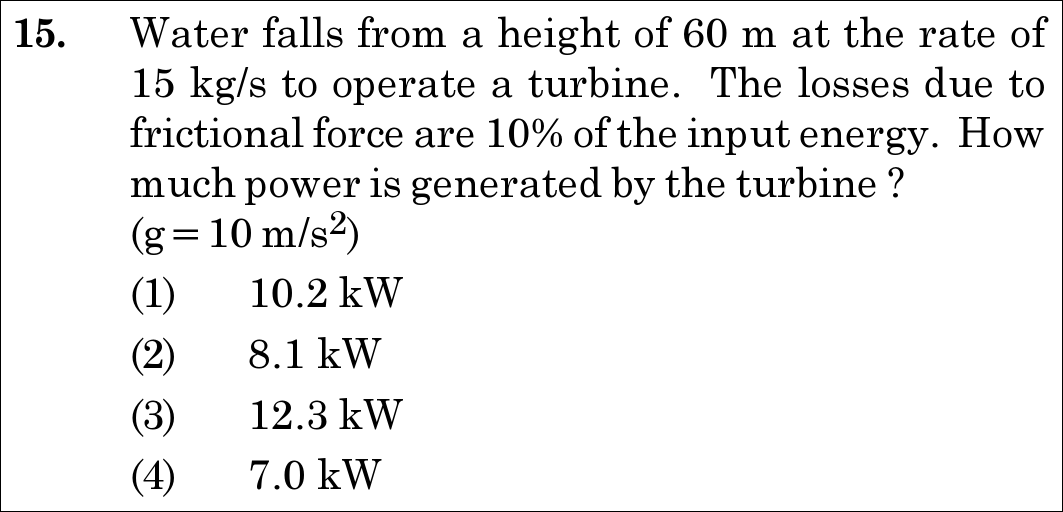
NEET 2021 Physics Question 15: Hydroelectric Power Generation and Efficiency

Question

Water falls from a height of 60 m at the rate of 15 kg/s to operate a turbine. The losses due to frictional force are 10% of the input energy. How much power is generated by the turbine? (g = 10 m/s²)

✓
Verified Against NTA Final Answer Key
Option (2) : 8.1 kW
📚 Work, Energy and Power Easy
📋 Given Parameters & Problem Setup
Height of Fall (h) 60 m
Rate of Water Flow (dm/dt) 15 kg/s
Frictional Loss 10% of input energy
Acceleration Due to Gravity (g) 10 m/s^2
⚡

The 30-Second Exam Hall Shortcut: ⚡ Input Power × 90% Efficiency

⏱️ Save ~20 seconds

Pin=dmdtgh=15×10×60=9000 W=9 kWP_{\text{in}} = \frac{dm}{dt} g h = 15 \times 10 \times 60 = 9000\text{ W} = 9\text{ kW}. Efficiency is 100%−10%=90%100\% - 10\% = 90\%. Generated power Pout=0.9×9 kW=8.1 kWP_{\text{out}} = 0.9 \times 9\text{ kW} = 8.1\text{ kW}! Instant 15-second calculation matching Option (2)!

1 Compute total gravitational input power: Pin=(dmdt)ghP_{\text{in}} = \left(\frac{dm}{dt}\right) g h.
2 Pin=15×10×60=9000 W=9.0 kWP_{\text{in}} = 15 \times 10 \times 60 = 9000\text{ W} = 9.0\text{ kW}.
3 Since 10% is lost to friction, efficiency η=90%=0.90\eta = 90\% = 0.90.
4 Generated power Pout=ηPin=0.90×9.0 kW=8.1 kWP_{\text{out}} = \eta P_{\text{in}} = 0.90 \times 9.0\text{ kW} = 8.1\text{ kW}.
5 Match Option (2).
🛡️
Why You Can 100% Trust This Shortcut: Canonical conservation of mechanical energy and hydroelectric turbine efficiency relation.
📐

Step-by-Step Rigorous Workflow & Mathematical Proof

Step 1

Calculating Gravitational Potential Energy Input Rate

Water of mass Δm\Delta m falling from height hh carries gravitational potential energy ΔU=(Δm)gh\Delta U = (\Delta m)gh. The rate of potential energy delivered (input power) is:

Pin=ΔUΔt=(dmdt)gh=(15 kg/s)×(10 m/s2)×(60 m)=9000 W=9.0 kWP_{\text{in}} = \frac{\Delta U}{\Delta t} = \left(\frac{dm}{dt}\right) g h = (15\text{ kg/s}) \times (10\text{ m/s}^2) \times (60\text{ m}) = 9000\text{ W} = 9.0\text{ kW}
Step 2

Accounting for Frictional Energy Losses

Frictional losses account for 10%10\% of the input energy. The remaining 90%90\% is converted into electrical output power by the turbine:

η=100%−10%=90%=0.90\eta = 100\% - 10\% = 90\% = 0.90
Step 3

Calculating Net Power Generated by the Turbine

Multiply input power by the net efficiency factor:

Pout=ηPin=0.90×9000 W=8100 W=8.1 kWP_{\text{out}} = \eta P_{\text{in}} = 0.90 \times 9000\text{ W} = 8100\text{ W} = 8.1\text{ kW}
⭐

360° Option Elimination Engine Key Feature

Diagnose every choice: Know exactly why the right option works and why distractors fail.

4-Option Deep Scan
1 1
✗ Incorrect
Verdict & Scientific Reason:

Exceeds the 100% ideal input power of 9.0 kW (unphysical).

⚠️
Student Fallacy (Why candidates pick this trap): Adding 10% to input power (9+0.9=9.99 + 0.9 = 9.9 or 10.210.2).
2 2
✓ 100% Correct
Verdict & Scientific Reason:

Exact electrical output power generated: 0.90×9.0 kW=8.1 kW0.90 \times 9.0\text{ kW} = 8.1\text{ kW}.

💡
Why this is airtight: None; textbook power and efficiency computation.
3 3
✗ Incorrect
Verdict & Scientific Reason:

Exceeds available gravitational potential energy.

⚠️
Student Fallacy (Why candidates pick this trap): Multiplication error.
4 4
✗ Incorrect
Verdict & Scientific Reason:

Incorrect subtraction of losses.

⚠️
Student Fallacy (Why candidates pick this trap): Subtracting 2 kW arbitrarily.
⚠️

NTA Trap Alert: Gross Input vs. Net Generated Power Trap

Students who compute P=9.0 kWP = 9.0\text{ kW} sometimes look for 9.0 kW, and if not present, guess a nearby number without applying the 10%10\% frictional loss reduction factor.

🛡️ How to avoid the -1 mark: Read carefully: "losses are 10% of input energy". Multiply PinP_{\text{in}} by 0.900.90.
📖

Core NEET Syllabus Standard

NCERT Physics · Work, Energy and Power Standard Benchmark
Core Scientific Principle Tested:

"Power generated equals rate of energy input multiplied by the efficiency of conversion (Pout=ηPinP_{\text{out}} = \eta P_{\text{in}})."

Syllabus Focus: Power and Efficiency of Machines
✓ Core NEET UG Syllabus Anchor Syllabus & Academic Standards ↗

Ready to attempt under real exam pressure?

Test your speed and accuracy in the authentic 200-minute timed NTA simulator.

Launch NEET 2021 CBT Test →

Spotted a mistake in this solution? Report an error ([email protected])

⚖️ Legal & Fair Dealing Notice: Sourced from publicly released NEET 2021 question papers and NEET answer keys for private study, research, and non-commercial educational practice under Fair Dealing (Section 52(1)(a) of the Indian Copyright Act, 1957). Not affiliated with or endorsed by NTA or NMC.

Solve 4 NEET Questions a Day — One per Subject

Cover all 1,140 official NEET questions in 285 days at your own pace. Progress is saved on your device. No login needed.