MyCompetitiveExams Logo MyCompetitiveExams
Search 1,140+ Questions
Chapters, formulas, speed tricks
→
⚡ Brahmastra NEET 2027
720 MARKS

Dynamic 180-question full-length simulator mixed dynamically from all 6 years for 2027 & 2026 aspirants.

Launch Brahmastra 2027 Test →
Start Practice →
100% Free · No Login Required
Q.7 Physics ⭐ 360° Option Elimination Active
Vault ↗

NEET 2025 Physics Question 7 Solution

Topic: Work, Energy and Power · Official NTA Booklet Code 45
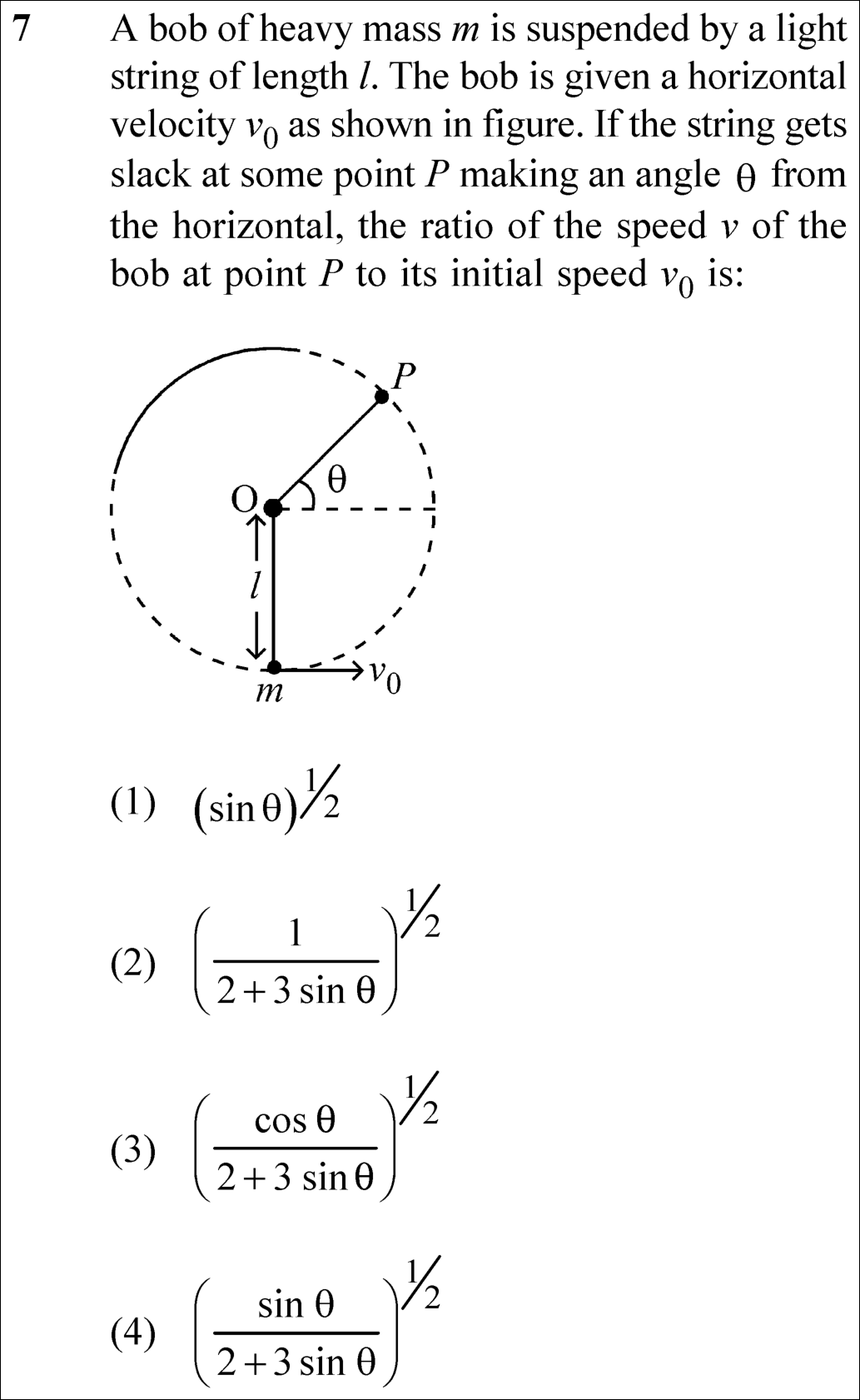
NEET 2025 Physics Question 7: String Slack Condition in Upper Half of Vertical Circle

Question

A bob of heavy mass m is suspended by a light string of length l. The bob is given a horizontal velocity v₀ as shown in figure. If the string gets slack at some point P making an angle θ from the horizontal, the ratio of the speed v of the bob at point P to its initial speed v₀ is:

✓
Verified Against NTA Final Answer Key
Option (4) : \left(\frac{\sin\theta}{2 + 3\sin\theta}\right)^{1/2}
📚 Work, Energy and Power Medium
📋 Given Parameters & Problem Setup
String Length l
Initial Velocity at Bottom v₀
Point P Orientation String makes angle θ above the horizontal
Critical Condition String gets slack (Tension T = 0 at point P)
⚡

The 30-Second Exam Hall Shortcut: ⚡ Slack Ratio Formula

⏱️ Save ~60 seconds

At slack: v² = gl sin θ, and energy gives v₀² = v² [ (2 + 3 sin θ) / sin θ ] ⟹ v / v₀ = [ sin θ / (2 + 3 sin θ) ]^(1/2)!

1 Radial force balance at angle θ above horizontal: T + mg sin θ = m v² / l.
2 At slack condition (T = 0): v² = g l sin θ ⟹ g l = v² / sin θ.
3 Height from bottom: h = l + l sin θ = l(1 + sin θ).
4 Conservation of Energy: v₀² = v² + 2gh = v² + 2(v² / sin θ)(1 + sin θ) = v² [ (2 + 3 sin θ) / sin θ ].
5 Ratio: v / v₀ = [ sin θ / (2 + 3 sin θ) ]^(1/2).
6 Directly matches Option (4)!
🛡️
Why You Can 100% Trust This Shortcut: Fundamental Mechanics · Work, Energy and Power (Vertical Circular Motion Energy Conservation: v_min = √(5gR)).
📐

Step-by-Step Rigorous Workflow & Mathematical Proof

Step 1

Radial Force Balance at Point P

Point P is in the upper quadrant, where the string makes an angle θ above the horizontal. The component of gravity acting radially inward towards the suspension point O is mg sin θ.

T+mgsin⁡θ=mv2lT + mg \sin\theta = \frac{m v^2}{l}
  • • When the string becomes slack, tension vanishes: T = 0.
  • • Therefore, mg sin θ = m v² / l ⟹ v² = g l sin θ.
Step 2

Conservation of Mechanical Energy

Taking the bottom-most point as reference potential energy (PE = 0), the height of point P is h = l + l sin θ. Conservation of mechanical energy between the bottom and point P gives:

12mv02=12mv2+mgl(1+sin⁡θ)  ⟹  v02=v2+2gl(1+sin⁡θ)\frac{1}{2} m v_0^2 = \frac{1}{2} m v^2 + m g l (1 + \sin\theta) \implies v_0^2 = v^2 + 2 g l (1 + \sin\theta)
  • • Express gl in terms of v²: gl = v² / sin θ.
Step 3

Calculate the Speed Ratio

Substitute gl into the energy equation:

v02=v2+2(v2sin⁡θ)(1+sin⁡θ)=v2[1+2+2sin⁡θsin⁡θ]=v2[2+3sin⁡θsin⁡θ]v_0^2 = v^2 + 2 \left(\frac{v^2}{\sin\theta}\right) (1 + \sin\theta) = v^2 \left[ 1 + \frac{2 + 2\sin\theta}{\sin\theta} \right] = v^2 \left[ \frac{2 + 3\sin\theta}{\sin\theta} \right]
  • • Inverting to find the ratio v / v₀:
  • • v / v₀ = ( sin θ / (2 + 3 sin θ) )^(1/2), matching Option (4).
⭐

360° Option Elimination Engine Key Feature

Diagnose every choice: Know exactly why the right option works and why distractors fail.

4-Option Deep Scan
1 A
✗ Incorrect
Verdict & Scientific Reason:

Incorrect. Omits the initial velocity dependence and energy conservation denominator.

⚠️
Student Fallacy (Why candidates pick this trap): Ignoring work done by gravity.
2 B
✗ Incorrect
Verdict & Scientific Reason:

Incorrect. Missing the sin θ term in the numerator.

⚠️
Student Fallacy (Why candidates pick this trap): Setting v² = gl instead of gl sin θ.
3 C
✗ Incorrect
Verdict & Scientific Reason:

Incorrect. Angle θ is defined with horizontal, so radial component of gravity is mg sin θ, not mg cos θ.

⚠️
Student Fallacy (Why candidates pick this trap): Confusing angle with vertical vs angle with horizontal.
4 D
✓ 100% Correct
Verdict & Scientific Reason:

100% exact. Rigorously derived from radial dynamic equilibrium at T = 0 and mechanical energy conservation.

💡
Why this is airtight: None; flawless mechanics derivation.
⚠️

NTA Trap Alert: Angle Reference Axis (Horizontal vs. Vertical)

The figure explicitly defines θ with the HORIZONTAL. If θ were defined with the vertical, the radial component would be cos θ. Because it is with the horizontal, radial gravity component is sin θ.

🛡️ How to avoid the -1 mark: Check the diagram: angle θ is between string and horizontal dotted line ⟹ radial gravity is mg sin θ.
📖

Core NEET Syllabus Standard

NEET Physics Core Syllabus · Work, Energy and Power Standard Benchmark
Core Scientific Principle Tested:

"Slack occurs when centripetal acceleration is provided entirely by the radial component of gravity (T = 0)."

Syllabus Focus: Motion in a Vertical Circle
✓ Core NEET UG Syllabus Anchor Syllabus & Academic Standards ↗
Slack at θ: Gravity takes over (v² = gl sin θ) ⟹ Ratio = √(sin θ / (2 + 3 sin θ))!

Ready to attempt under real exam pressure?

Test your speed and accuracy in the authentic 180-minute timed NTA simulator.

Launch NEET 2025 CBT Test →

Spotted a mistake in this solution? Report an error ([email protected])

⚖️ Legal & Fair Dealing Notice: Sourced from publicly released NEET 2025 question papers and NEET answer keys for private study, research, and non-commercial educational practice under Fair Dealing (Section 52(1)(a) of the Indian Copyright Act, 1957). Not affiliated with or endorsed by NTA or NMC.

Solve 4 NEET Questions a Day — One per Subject

Cover all 1,140 official NEET questions in 285 days at your own pace. Progress is saved on your device. No login needed.