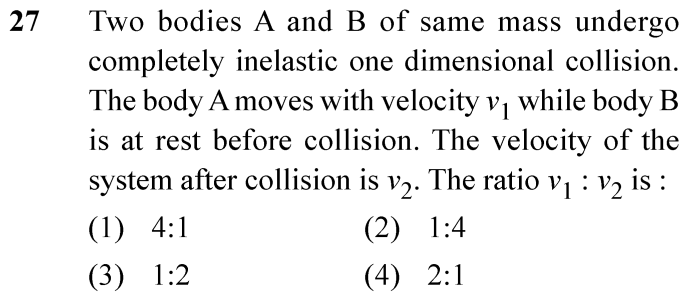
📋 Given Parameters & Problem Setup
Masses of both bodies m_A = m_B = m
Initial velocity of body A v_1
Initial velocity of body B 0 (at rest)
Final velocity of combined system v_2
m v_1 = (m + m) v_2 = 2m v_2 -> v_1 = 2 v_2 -> v_1 : v_2 = 2 : 1!
1 In a completely inelastic collision, the two bodies stick together and move with common velocity v_2.
2 Total initial momentum = m v_1 + m(0) = m v_1.
3 Total final momentum = (m + m) v_2 = 2m v_2.
4 By conservation of linear momentum: m v_1 = 2m v_2 => v_1 / v_2 = 2 / 1.
5 Option (4) in 5 seconds!
🛡️ Why You Can 100% Trust This Shortcut: Law of Conservation of Linear Momentum (Σ p_initial = Σ p_final in isolated collision).
⚠️
The velocity after collision is halved (v_2 = v_1 / 2), so students often think "half" and impulsively pick 1 : 2.
🛡️ How to avoid the -1 mark: The question asks for v_1 : v_2 (Initial to Final). Since initial is larger, the ratio MUST be greater than 1: 2 : 1!
📖
Physics Core Mechanics · Work, Energy and Power Standard Benchmark
Core Scientific Principle Tested:
"In a completely inelastic collision of two identical masses with one initially at rest, final velocity is halved and momentum is conserved."
Syllabus Focus: Collisions in One Dimension
Double the mass, halve the pace: Initial to final is 2 to 1 in the race!