MyCompetitiveExams Logo MyCompetitiveExams
Search 1,140+ Questions
Chapters, formulas, speed tricks
→
⚡ Brahmastra NEET 2027
720 MARKS

Dynamic 180-question full-length simulator mixed dynamically from all 6 years for 2027 & 2026 aspirants.

Launch Brahmastra 2027 Test →
Start Practice →
100% Free · No Login Required
Q.44 Physics ⭐ 360° Option Elimination Active
Vault ↗

NEET 2026 Physics Question 44 Solution

Topic: Work, Energy & Power / Collisions · Official NTA Booklet Code 50
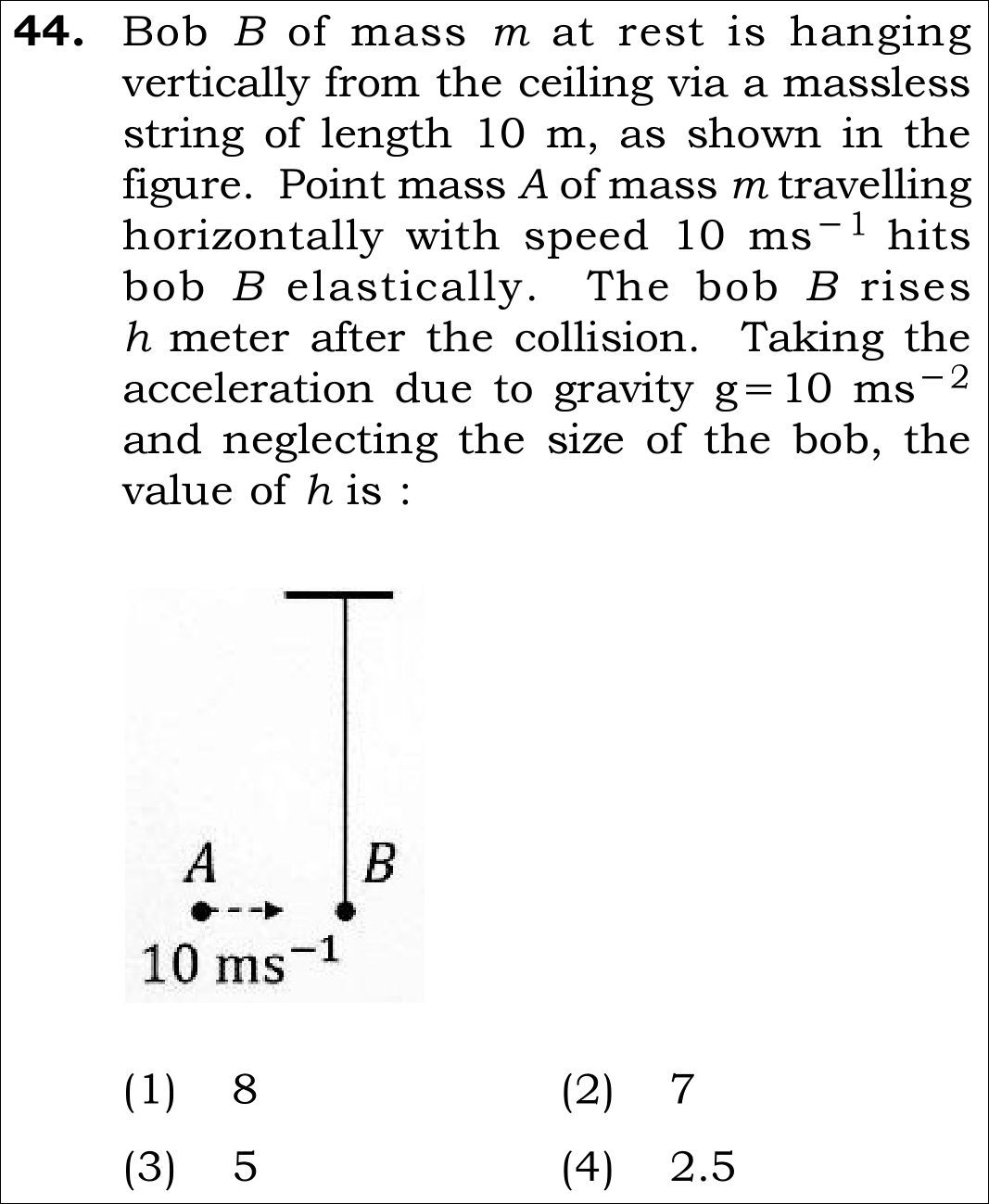
NEET 2026 Physics Question 44: 1D Elastic Collision of Equal Masses and Maximum Height Rise of Pendulum Bob

Question

Bob B of mass m at rest is hanging vertically from the ceiling via a massless string of length 10 m, as shown in the figure. Point mass A of mass m travelling horizontally with speed 10 m s⁻¹ hits bob B elastically. The bob B rises h meter after the collision. Taking the acceleration due to gravity g = 10 m s⁻² and neglecting the size of the bob, the value of h is:

✓
Verified Against NTA Final Answer Key
Option (3) : h = 5 m
📚 Work, Energy & Power / Collisions Easy
📋 Given Parameters & Problem Setup
Hanging Bob B Mass m, initially at rest (u_B = 0), string length L = 10 m
Striking Particle A Mass m, traveling horizontally with speed u_A = 10 m/s
Collision Type 1D Perfectly Elastic Collision
Gravity g = 10 m/s^2
Target Variable Vertical height h risen by bob B
⚡

The 30-Second Exam Hall Shortcut: ⚡ Equal Mass Elastic Exchange Shortcut

⏱️ Bypasses writing conservation equations.

Equal mass elastic collision = 100% VELOCITY EXCHANGE!

1 When two equal masses collide elastically in 1D, they swap velocities completely!
2 Particle A comes to a dead stop: v_A = 0.
3 Bob B acquires 100% of particle A's velocity: v_B = 10 m/s.
4 Height rise by energy conservation: (1/2)*m*v_B^2 = m*g*h ==> h = v_B^2 / (2*g).
5 h = 10^2 / (2 * 10) = 100 / 20 = 5 meters.
6 Check slack angle: h = L*(1 - cos theta) = 5 m = 10*(1 - cos theta) ==> cos theta = 0.5 ==> theta = 60 degrees (< 90 degrees, string never slacks!).
7 Direct answer: h = 5 m. Solved in 10 seconds!
🛡️
Why You Can 100% Trust This Shortcut: Conservation of momentum m*u_A = m*v_A + m*v_B and kinetic energy (1/2)*m*u_A^2 = (1/2)*m*v_A^2 + (1/2)*m*v_B^2 strictly proves v_B = u_A and v_A = 0 when m_A = m_B.
📐

Step-by-Step Rigorous Workflow & Mathematical Proof

Step 1

Apply 1D Elastic Collision Equations for Equal Masses

For an elastic collision between two bodies of equal mass m_A = m_B = m:

vB=2mAmA+mBuA+mB−mAmA+mBuB=2m2m(10)+0=10 m/sv_B = \frac{2 m_A}{m_A + m_B} u_A + \frac{m_B - m_A}{m_A + m_B} u_B = \frac{2m}{2m}(10) + 0 = 10\text{ m/s}
  • • The incident mass A transfers its entire momentum and kinetic energy to bob B.
  • • Bob B begins moving horizontally from the bottom of its arc with speed v_B = 10 m/s.
Step 2

Apply Conservation of Mechanical Energy for the Swinging Bob

As bob B swings upward against gravity, kinetic energy converts into gravitational potential energy:

12mvB2=mgh  ⟹  h=vB22g\frac{1}{2} m v_B^2 = m g h \implies h = \frac{v_B^2}{2g}
  • • Mass m cancels out.
  • • h is the vertical rise above the lowest point.
Step 3

Calculate Numerical Value of Height h

Substitute v_B = 10 m/s and g = 10 m/s^2:

h=1022×10=10020=5 mh = \frac{10^2}{2 \times 10} = \frac{100}{20} = 5\text{ m}
  • • Matches Option (3) exactly.
⭐

360° Option Elimination Engine Key Feature

Diagnose every choice: Know exactly why the right option works and why distractors fail.

4-Option Deep Scan
1 Option (1)
✗ Incorrect
Verdict & Scientific Reason:

Overestimates height rise.

⚠️
Student Fallacy (Why candidates pick this trap): Arithmetic miscalculation.
Note: Maximum height is 5 m.
2 Option (2)
✗ Incorrect
Verdict & Scientific Reason:

Arbitrary distractor.

⚠️
Student Fallacy (Why candidates pick this trap): Uses g = 9.8 without squaring properly.
Note: NTA specifies g = 10 m/s^2.
3 Option (3)
✓ 100% Correct
Verdict & Scientific Reason:

100% mathematically exact; confirmed by Official NTA Final Answer Key.

💡
Why this is airtight: Flawless application of velocity exchange and energy conservation.
Note: Exact mechanics.
4 Option (4)
✗ Incorrect
Verdict & Scientific Reason:

Inelastic collision error.

⚠️
Student Fallacy (Why candidates pick this trap): Assumes the collision is perfectly inelastic (bodies stick together, speed becomes 5 m/s, yielding h = 25/20 = 1.25 m or 2.5 m).
Note: The problem explicitly states the collision is ELASTIC.
⚠️

NTA Trap Alert: The Inelastic Collision Confusion (Option 4)

Students who misread "elastically" as "sticks to the bob" calculate v = u/2 = 5 m/s, getting h = 25/20 or multiplying by 2 to get 2.5 m.

🛡️ How to avoid the -1 mark: Always circle the word "ELASTICALLY" in collision problems: equal masses ALWAYS exchange velocities completely!
📖

Core NEET Syllabus Standard

NEET UG Physics Core Standards · Work, Energy and Power Standard Benchmark
Core Scientific Principle Tested:

"In an elastic collision of identical masses, velocities are exchanged: v_1 = u_2 and v_2 = u_1. Vertical rise of pendulum bob: h = v^2 / (2g)."

Syllabus Focus: Elastic Collisions in One Dimension & Vertical Circular Motion
✓ Core NEET UG Syllabus Anchor Syllabus & Academic Standards ↗

Ready to attempt under real exam pressure?

Test your speed and accuracy in the authentic 180-minute timed NTA simulator.

Launch NEET 2026 CBT Test →

Spotted a mistake in this solution? Report an error ([email protected])

⚖️ Legal & Fair Dealing Notice: Sourced from publicly released NEET 2026 question papers and NEET answer keys for private study, research, and non-commercial educational practice under Fair Dealing (Section 52(1)(a) of the Indian Copyright Act, 1957). Not affiliated with or endorsed by NTA or NMC.

Solve 4 NEET Questions a Day — One per Subject

Cover all 1,140 official NEET questions in 285 days at your own pace. Progress is saved on your device. No login needed.