MyCompetitiveExams Logo MyCompetitiveExams
Search 1,140+ Questions
Chapters, formulas, speed tricks
→
⚡ Brahmastra NEET 2027
720 MARKS

Dynamic 180-question full-length simulator mixed dynamically from all 6 years for 2027 & 2026 aspirants.

Launch Brahmastra 2027 Test →
Start Practice →
100% Free · No Login Required
Q.13 Physics ⭐ 360° Option Elimination Active
Vault ↗

NEET 2021 Physics Question 13 Solution

Topic: Semiconductor Electronics: Materials, Devices and Simple Circuits · Official NTA Booklet Code M1
NEET 2021 Physics Question 13: Carrier Mobility: Electron Mobility vs. Hole Mobility in Extrinsic Semiconductors

Question

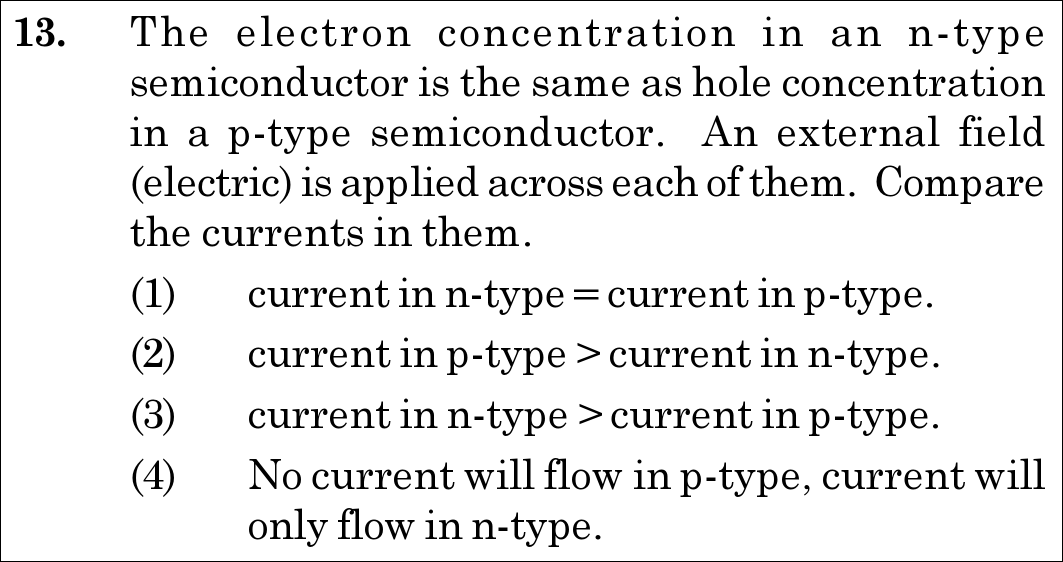
The electron concentration in an n-type semiconductor is the same as hole concentration in a p-type semiconductor. An external field (electric) is applied across each of them. Compare the currents in them.

✓
Verified Against NTA Final Answer Key
Option (3) : current in n-type > current in p-type.
📚 Semiconductor Electronics: Materials, Devices and Simple Circuits Easy
📋 Given Parameters & Problem Setup
Electron concentration in n-type (n_e) Equal to hole concentration in p-type (n_h)
External Electric Field (E) Same for both
⚡

The 30-Second Exam Hall Shortcut: ⚡ Electron Mobility Rule: μ_e > μ_h   ⟹  \implies I_n > I_p

⏱️ Save ~20 seconds

Electrons move freely in the conduction band, whereas holes move through valence bond step-by-step jumping. Hence, electron mobility is always strictly greater than hole mobility (μe>μh\mu_e > \mu_h). With identical carrier densities and electric fields, In>IpI_n > I_p! Match Option (3)!

1 Current in semiconductor: I=nqAvd=nqAμEI = n q A v_d = n q A \mu E.
2 For n-type: In=neeAμeEI_n = n_e e A \mu_e E. For p-type: Ip=nheAμhEI_p = n_h e A \mu_h E.
3 Given ne=nhn_e = n_h and EE is identical.
4 Since electrons in conduction band have higher mobility than valence band holes (μe>μh\mu_e > \mu_h), we have In>IpI_n > I_p.
5 Match Option (3) current in n-type > current in p-type.
🛡️
Why You Can 100% Trust This Shortcut: Canonical solid state physics energy band theory of carrier mobility.
📐

Step-by-Step Rigorous Workflow & Mathematical Proof

Step 1

Formulating Current in Terms of Carrier Mobility

The drift velocity of a charge carrier under an electric field EE is vd=μEv_d = \mu E, where μ\mu is mobility. Current through a semiconductor of cross-sectional area AA with carrier concentration nn is:

I=neAvd=neAμEI = n e A v_d = n e A \mu E
Step 2

Comparing n-type and p-type Currents

For n-type with electron density nen_e and p-type with hole density nhn_h:

In=neeAμeE,Ip=nheAμhEI_n = n_e e A \mu_e E, \quad I_p = n_h e A \mu_h E
Step 3

Physical Reason for Mobility Difference

Electrons in n-type occupy the conduction band, where they behave almost as free electrons with small effective mass. Holes in p-type move via the sequential vacancy-hopping of bound valence electrons. Consequently, in all semiconductors (Silicon, Germanium, GaAs):

μe>μh  ⟹  In>Ip\mu_e > \mu_h \implies I_n > I_p
⭐

360° Option Elimination Engine Key Feature

Diagnose every choice: Know exactly why the right option works and why distractors fail.

4-Option Deep Scan
1 1
✗ Incorrect
Verdict & Scientific Reason:

Fails to consider that electrons and holes have different mobilities ($mu_e eq mu_h$).

⚠️
Student Fallacy (Why candidates pick this trap): Assuming equal carrier concentrations guarantee equal currents.
2 2
✗ Incorrect
Verdict & Scientific Reason:

Inverts the mobility relationship (holes never have higher mobility than electrons).

⚠️
Student Fallacy (Why candidates pick this trap): Falsely assuming holes move faster.
3 3
✓ 100% Correct
Verdict & Scientific Reason:

Exact physical conclusion: because mue>muhmu_e > mu_h, the drift current in n-type exceeds that in p-type.

💡
Why this is airtight: None; rigorous semiconductor physics.
4 4
✗ Incorrect
Verdict & Scientific Reason:

Holes are mobile positive charge carriers that conduct macroscopic current readily.

⚠️
Student Fallacy (Why candidates pick this trap): Thinking holes cannot conduct electrical current.
⚠️

NTA Trap Alert: Carrier Density vs. Current Equality Trap

Students frequently equate current solely with carrier density (I∝nI \propto n), forgetting that current also depends on drift velocity (vd=μEv_d = \mu E). Since μe>μh\mu_e > \mu_h, current in n-type is always greater.

🛡️ How to avoid the -1 mark: Remember: I=neAμEI = n e A \mu E. Even if ne=nhn_e = n_h, electron mobility is ALWAYS higher (μe>μh\mu_e > \mu_h).
📖

Core NEET Syllabus Standard

NCERT Physics · Semiconductor Electronics: Materials, Devices and Simple Circuits Standard Benchmark
Core Scientific Principle Tested:

"Electron mobility in conduction band is significantly higher than hole mobility in valence band (μe>μh\mu_e > \mu_h)."

Syllabus Focus: Extrinsic Semiconductors
✓ Core NEET UG Syllabus Anchor Syllabus & Academic Standards ↗

Ready to attempt under real exam pressure?

Test your speed and accuracy in the authentic 200-minute timed NTA simulator.

Launch NEET 2021 CBT Test →

Spotted a mistake in this solution? Report an error ([email protected])

⚖️ Legal & Fair Dealing Notice: Sourced from publicly released NEET 2021 question papers and NEET answer keys for private study, research, and non-commercial educational practice under Fair Dealing (Section 52(1)(a) of the Indian Copyright Act, 1957). Not affiliated with or endorsed by NTA or NMC.

Solve 4 NEET Questions a Day — One per Subject

Cover all 1,140 official NEET questions in 285 days at your own pace. Progress is saved on your device. No login needed.