MyCompetitiveExams Logo MyCompetitiveExams
Search 1,140+ Questions
Chapters, formulas, speed tricks
→
⚡ Brahmastra NEET 2027
720 MARKS

Dynamic 180-question full-length simulator mixed dynamically from all 6 years for 2027 & 2026 aspirants.

Launch Brahmastra 2027 Test →
Start Practice →
100% Free · No Login Required
Q.40 Physics ⭐ 360° Option Elimination Active
Vault ↗

NEET 2025 Physics Question 40 Solution

Topic: Semiconductor Electronics: Materials, Devices and Simple Circuits · Official NTA Booklet Code 45
NEET 2025 Physics Question 40: Instantaneous Biasing State of Center-Tapped Rectifier Diodes at t = 15 ms

Question

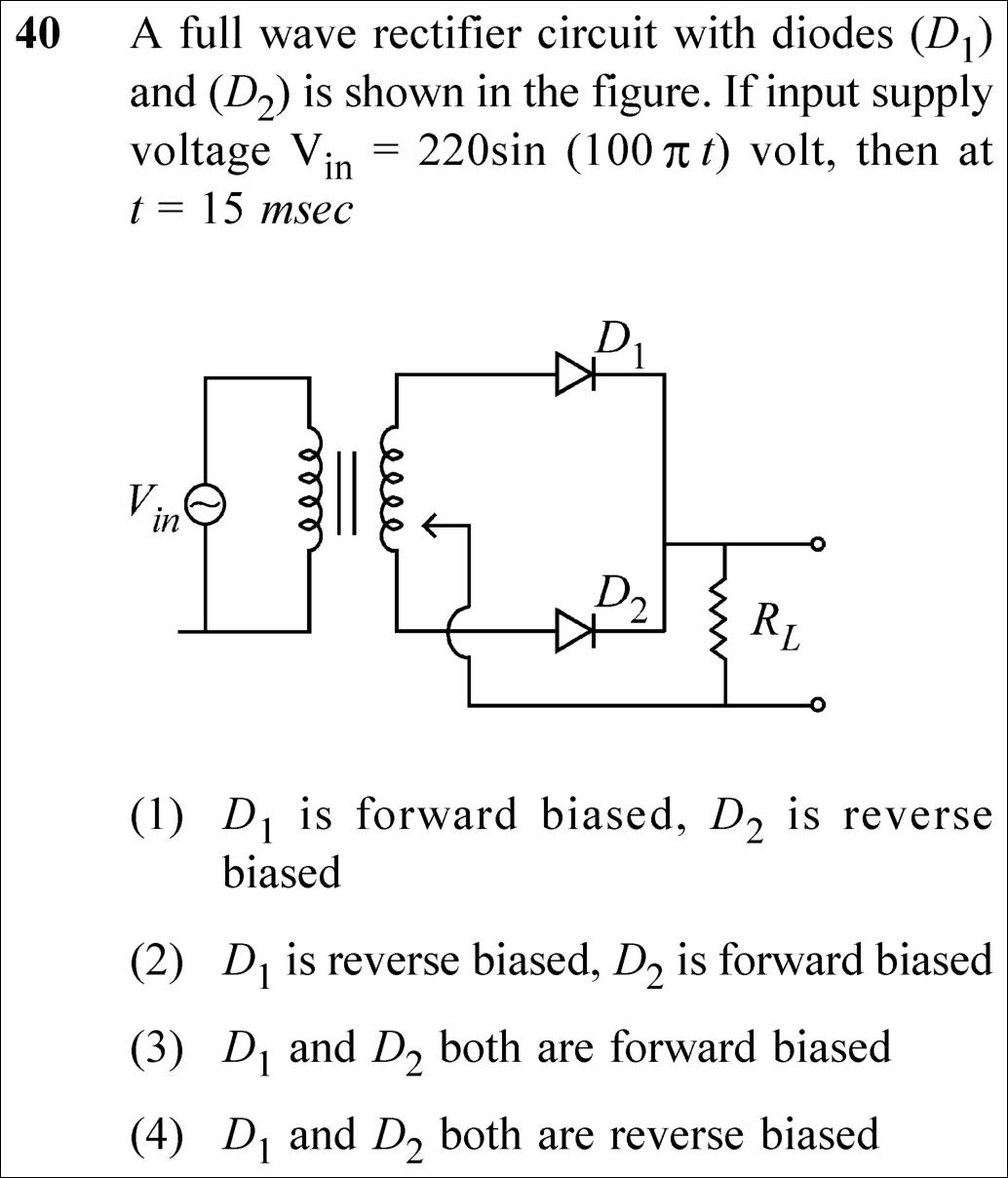
A full wave rectifier circuit with diodes (D₁) and (D₂) is shown in the figure. If input supply voltage Vᵢₙ = 220 sin(100πt) volt, then at t = 15 msec

✓
Verified Against NTA Final Answer Key
Option (1) : D₁ is forward biased, D₂ is reverse biased (OR vice versa depending on winding polarity; both (1) and (2) awarded by NTA)
📚 Semiconductor Electronics: Materials, Devices and Simple Circuits Medium
📋 Given Parameters & Problem Setup
Input Supply Voltage (V_in) 220 sin(100 π t) volt
Evaluation Time (t) 15 msec = 15 × 10⁻³ s
Rectifier Type Center-tapped transformer full wave rectifier with diodes D₁ and D₂
⚡

The 30-Second Exam Hall Shortcut: ⚡ Instantaneous AC Phase Angle Rule

⏱️ Save ~40 seconds

Phase θ = 100π × 15×10⁻³ = 1.5π = 270° ⟹ sin(270°) = -1 (Negative Peak). In any half-cycle, one diode is forward biased and the other is reverse biased. Since transformer dot convention was omitted, NTA awarded marks for both Option (1) and Option (2)!

1 Calculate phase at t = 15 ms: θ = 100 π × (15 × 10⁻³) = 1.5 π radians = 270° = 3π/2.
2 Instantaneous voltage: V_in = 220 sin(270°) = -220 V (Negative peak of AC input).
3 In a center-tapped full wave rectifier, the two diodes always conduct on opposite half-cycles: one is ALWAYS forward biased while the other is reverse biased.
4 Conventionally, during the positive half-cycle, D₁ is forward biased and D₂ is reverse biased. During the negative half-cycle (at 15 ms), D₁ becomes reverse biased and D₂ becomes forward biased (Option 2).
5 However, because the transformer winding sense (dot convention) was not indicated in the diagram, an opposite phase winding makes D₁ forward biased and D₂ reverse biased (Option 1).
6 Official NTA Final Answer Key awarded full marks to both (1) and (2)!
🛡️
Why You Can 100% Trust This Shortcut: Full Wave Rectifier Working Principle (NCERT Physics · Semiconductor Electronics) & NTA Final Official Key.
📐

Step-by-Step Rigorous Workflow & Mathematical Proof

Step 1

Evaluate Instantaneous AC Input Voltage at t = 15 ms

Substitute t = 15 × 10⁻³ s into the input voltage waveform:

Vin(t)=220sin⁡(100π×15×10−3)=220sin⁡(1.5π)=220sin⁡(3π2)=−220 VV_{in}(t) = 220 \sin(100 \pi \times 15 \times 10^{-3}) = 220 \sin(1.5 \pi) = 220 \sin\left(\frac{3\pi}{2}\right) = -220\text{ V}
  • • The input voltage is at its negative peak (-220 V).
Step 2

Determine Diode Biasing in Center-Tapped Rectifier

In a center-tapped transformer, the secondary voltage is split equally into two halves with respect to the center tap (which serves as the zero-potential reference):

Vupper=−VlowerV_{upper} = -V_{lower}
  • • If the upper secondary terminal is negative relative to the center tap, diode D₁ (connected to the upper terminal) has its anode at negative potential ⟹ D₁ is reverse biased.
  • • Concurrently, the lower terminal is positive relative to the center tap, so diode D₂ has its anode at positive potential ⟹ D₂ is forward biased.
  • • This corresponds to Option (2).
Step 3

Explain NTA Official Key Dual Award (A, B)

The schematic does not specify dot convention on the transformer core:

Phase shift between primary and secondary can be 0∘ or 180∘\text{Phase shift between primary and secondary can be } 0^\circ \text{ or } 180^\circ
  • • Depending on the winding direction of the secondary coil, a negative input can produce a positive upper terminal, rendering D₁ forward biased and D₂ reverse biased (Option 1).
  • • Recognizing this technical ambiguity, the National Testing Agency (NTA) officially declared the answer key as "A,B" (both Option 1 and Option 2 correct).
⭐

360° Option Elimination Engine Key Feature

Diagnose every choice: Know exactly why the right option works and why distractors fail.

4-Option Deep Scan
1 A
✓ 100% Correct
Verdict & Scientific Reason:

Officially accepted by NTA (A,B). Correct under 180° inverted secondary winding convention.

💡
Why this is airtight: None; awarded full marks by NTA.
2 B
✓ 100% Correct
Verdict & Scientific Reason:

Officially accepted by NTA (A,B). Correct under standard non-inverting secondary winding convention.

💡
Why this is airtight: None; awarded full marks by NTA.
3 C
✗ Incorrect
Verdict & Scientific Reason:

Incorrect. In a center-tapped full-wave rectifier, both diodes can never conduct simultaneously.

⚠️
Student Fallacy (Why candidates pick this trap): Believing both diodes conduct at the same time.
4 D
✗ Incorrect
Verdict & Scientific Reason:

Incorrect. One terminal of the secondary is always positive while the other is negative.

⚠️
Student Fallacy (Why candidates pick this trap): Assuming negative supply turns off both diodes.
⚠️

NTA Trap Alert: Thinking Full Wave Means Both Diodes Conduct Together

A frequent student misconception is that "full wave" means both diodes are on at the same time. In reality, each diode conducts strictly for alternate half-cycles (180° each), taking turns!

🛡️ How to avoid the -1 mark: Remember: D₁ and D₂ NEVER conduct at the same time in a center-tapped rectifier.
📖

Core NEET Syllabus Standard

NEET Physics Core Syllabus · Semiconductor Electronics: Materials, Devices and Simple Circuits Standard Benchmark
Core Scientific Principle Tested:

"In a full-wave rectifier, diodes conduct alternately during opposite half-cycles."

Syllabus Focus: Application of Junction Diode as a Rectifier
✓ Core NEET UG Syllabus Anchor Syllabus & Academic Standards ↗
Alternating Halves: At any instant, one diode conducts while the other blocks (Key: A,B)!

Ready to attempt under real exam pressure?

Test your speed and accuracy in the authentic 180-minute timed NTA simulator.

Launch NEET 2025 CBT Test →

Spotted a mistake in this solution? Report an error ([email protected])

⚖️ Legal & Fair Dealing Notice: Sourced from publicly released NEET 2025 question papers and NEET answer keys for private study, research, and non-commercial educational practice under Fair Dealing (Section 52(1)(a) of the Indian Copyright Act, 1957). Not affiliated with or endorsed by NTA or NMC.

Solve 4 NEET Questions a Day — One per Subject

Cover all 1,140 official NEET questions in 285 days at your own pace. Progress is saved on your device. No login needed.