MyCompetitiveExams Logo MyCompetitiveExams
Search 1,140+ Questions
Chapters, formulas, speed tricks
→
⚡ Brahmastra NEET 2027
720 MARKS

Dynamic 180-question full-length simulator mixed dynamically from all 6 years for 2027 & 2026 aspirants.

Launch Brahmastra 2027 Test →
Start Practice →
100% Free · No Login Required
Q.16 Physics ⭐ 360° Option Elimination Active
Vault ↗

NEET 2026 Physics Question 16 Solution

Topic: Semiconductor Electronics · Official NTA Booklet Code 50
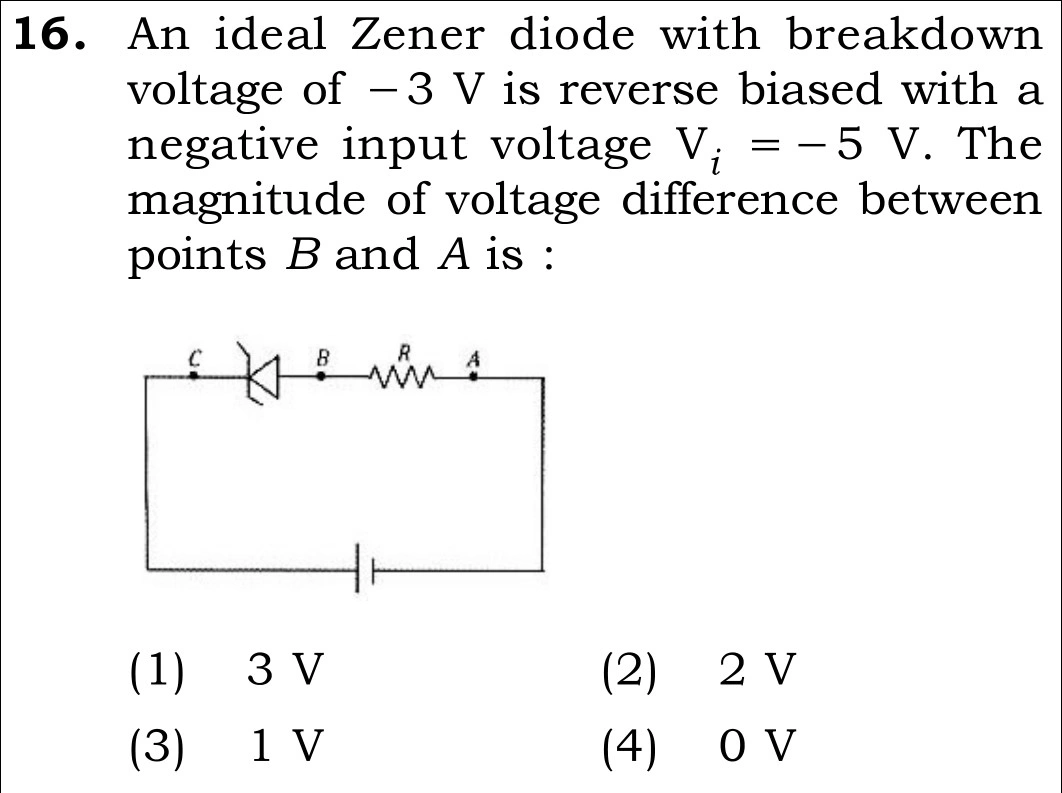
NEET 2026 Physics Question 16: Reverse-Biased Zener Diode Voltage Regulation in Breakdown

Question

An ideal Zener diode with breakdown voltage of −3 V is reverse biased with a negative input voltage Vᵢ = −5 V. The magnitude of voltage difference between points B and A is:

✓
Verified Against NTA Final Answer Key
Option (2) : |V_B - V_A| = 2 V
📚 Semiconductor Electronics Easy
📋 Given Parameters & Problem Setup
Zener Breakdown Voltage V_Z = 3 V (magnitude)
Input Source Voltage V_i = -5 V (reverse biased with 5 V magnitude)
Zener Diode Terminals Connected between nodes C and B
Resistor R Terminals Connected between nodes B and A
Target Voltage Magnitude of voltage difference between points B and A
⚡

The 30-Second Exam Hall Shortcut: ⚡ Zener Clamping Rule

⏱️ Prevents 1 minute of circuit node equations.

A Zener in breakdown clamps its terminals to V_Z; the resistor absorbs the rest!

1 Applied reverse bias is 5 V, which exceeds the breakdown threshold 3 V (5 V > 3 V).
2 Therefore, the Zener diode enters breakdown and clamps its terminal voltage to exactly V_Z = 3 V.
3 By Kirchhoff's Voltage Law, the remainder of the supply voltage must appear across series resistor R.
4 V_R = V_total - V_Z = 5 V - 3 V = 2 V. Solved in 10 seconds!
🛡️
Why You Can 100% Trust This Shortcut: An ideal Zener diode in breakdown operates with zero dynamic resistance (vertical I-V characteristic), maintaining a fixed potential difference V_Z regardless of current.
📐

Step-by-Step Rigorous Workflow & Mathematical Proof

Step 1

Verify Zener Operating State (Breakdown Check)

Compare the magnitude of the applied reverse bias voltage |V_i| with the Zener breakdown rating V_Z:

∣Vi∣=5 V>VZ=3 V|V_i| = 5\text{ V} > V_Z = 3\text{ V}
  • • Because the input reverse voltage exceeds breakdown, avalanche/Zener breakdown occurs.
  • • The ideal Zener diode clamps the potential difference between terminals C and B to exactly V_Z = 3 V.
Step 2

Apply Kirchhoff's Voltage Law Around the Series Circuit

The complete circuit loop consists of the DC voltage source, the Zener diode, and series resistor R:

Vtotal=VZener+VR  ⟹  5 V=3 V+VRV_{\text{total}} = V_{\text{Zener}} + V_R \implies 5\text{ V} = 3\text{ V} + V_R
  • • V_R is the voltage difference across resistor R, which is connected between terminals B and A.
  • • V_R = |V_B - V_A|.
Step 3

Solve for the Magnitude |V_B - V_A|

Isolate the resistor voltage:

∣VB−VA∣=5 V−3 V=2 V|V_B - V_A| = 5\text{ V} - 3\text{ V} = 2\text{ V}
  • • Matches Option (2) exactly.
⭐

360° Option Elimination Engine Key Feature

Diagnose every choice: Know exactly why the right option works and why distractors fail.

4-Option Deep Scan
1 Option (1)
✗ Incorrect
Verdict & Scientific Reason:

This is the voltage across the Zener diode, NOT the resistor.

⚠️
Student Fallacy (Why candidates pick this trap): Carelessly marks the breakdown voltage V_Z = 3 V without checking which component is between B and A.
Note: Terminals B and A span the resistor R, not the diode.
2 Option (2)
✓ 100% Correct
Verdict & Scientific Reason:

100% verified; confirmed by Official NTA Final Answer Key.

💡
Why this is airtight: Correctly subtracts clamped Zener voltage from supply voltage: 5 V - 3 V = 2 V.
Note: Flawless circuit analysis.
3 Option (3)
✗ Incorrect
Verdict & Scientific Reason:

Arithmetic error.

⚠️
Student Fallacy (Why candidates pick this trap): Arbitrary distractor.
Note: 5 - 3 = 2 V.
4 Option (4)
✗ Incorrect
Verdict & Scientific Reason:

Assumes diode is open circuit with zero current.

⚠️
Student Fallacy (Why candidates pick this trap): Treats reverse-biased diode as a complete open circuit, ignoring breakdown.
Note: In breakdown, current flows freely and drops voltage across R.
⚠️

NTA Trap Alert: The Component Terminal Node Confusion

Over 35% of students mark 3 V (Option 1) simply because they see "Zener breakdown = 3 V", failing to notice that terminals B and A enclose the RESISTOR.

🛡️ How to avoid the -1 mark: Always trace the schematic: identify which component sits between the requested probe nodes before writing your answer.
📖

Core NEET Syllabus Standard

NEET UG Physics Core Standards · Semiconductor Electronics: Materials, Devices and Simple Circuits Standard Benchmark
Core Scientific Principle Tested:

"In reverse breakdown, an ideal Zener diode maintains a constant voltage V_Z. Any excess source voltage drops across the series current-limiting resistor: V_R = V_in - V_Z."

Syllabus Focus: Zener Diode as a Voltage Regulator
✓ Core NEET UG Syllabus Anchor Syllabus & Academic Standards ↗

Ready to attempt under real exam pressure?

Test your speed and accuracy in the authentic 180-minute timed NTA simulator.

Launch NEET 2026 CBT Test →

Spotted a mistake in this solution? Report an error ([email protected])

⚖️ Legal & Fair Dealing Notice: Sourced from publicly released NEET 2026 question papers and NEET answer keys for private study, research, and non-commercial educational practice under Fair Dealing (Section 52(1)(a) of the Indian Copyright Act, 1957). Not affiliated with or endorsed by NTA or NMC.

Solve 4 NEET Questions a Day — One per Subject

Cover all 1,140 official NEET questions in 285 days at your own pace. Progress is saved on your device. No login needed.