MyCompetitiveExams Logo MyCompetitiveExams
Search 1,140+ Questions
Chapters, formulas, speed tricks
→
⚡ Brahmastra NEET 2027
720 MARKS

Dynamic 180-question full-length simulator mixed dynamically from all 6 years for 2027 & 2026 aspirants.

Launch Brahmastra 2027 Test →
Start Practice →
100% Free · No Login Required
Q.15 Physics ⭐ 360° Option Elimination Active
Vault ↗

NEET 2026 Physics Question 15 Solution

Topic: Magnetic Effects of Current · Official NTA Booklet Code 50
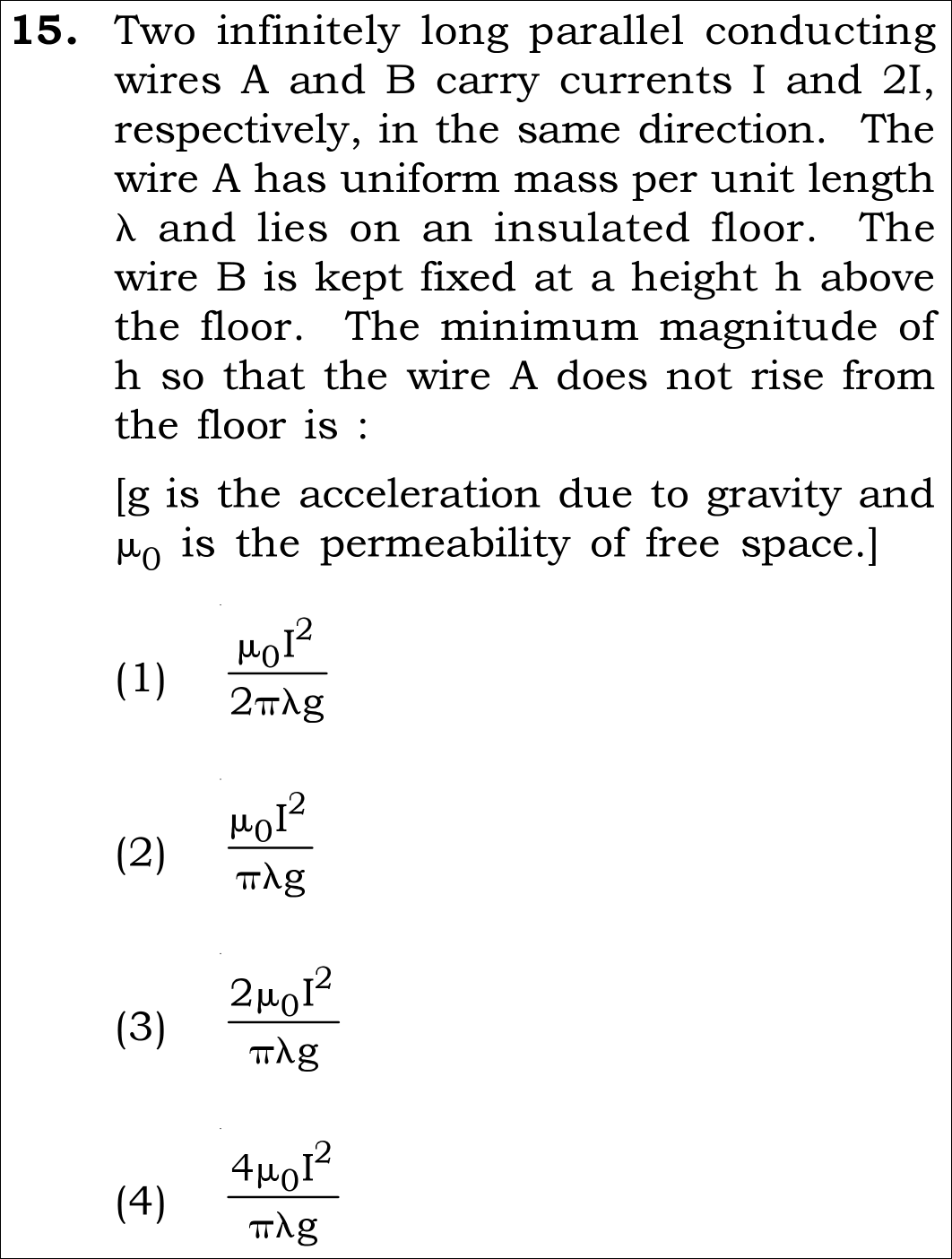
NEET 2026 Physics Question 15: Magnetic Levitation Threshold for Parallel Current-Carrying Wires

Question

Two infinitely long parallel conducting wires A and B carry currents I and 2I, respectively, in the same direction. The wire A has uniform mass per unit length λ and lies on an insulated floor. The wire B is kept fixed at a height h above the floor. The minimum magnitude of h so that the wire A does not rise from the floor is: [g is the acceleration due to gravity and μ₀ is the permeability of free space.]

✓
Verified Against NTA Final Answer Key
Option (2) : h_min = mu_0 * I^2 / (pi * lambda * g)
📚 Magnetic Effects of Current Medium
📋 Given Parameters & Problem Setup
Wire A Current I (resting on insulated floor)
Wire B Current 2I (fixed at height h directly above wire A)
Current Directions Same direction (parallel currents)
Mass per unit length of Wire A lambda kg/m
Condition Wire A does not rise from the floor (Normal force N >= 0)
⚡

The 30-Second Exam Hall Shortcut: ⚡ Ampere Force Balance Shortcut

⏱️ Avoids vector integration.

Equate upward magnetic attraction to downward gravitational force

1 Parallel currents in the SAME direction ATTRACT each other.
2 Wire B pulls wire A upwards with magnetic force per unit length: F_m / L = mu_0 * I_A * I_B / (2pi * h).
3 Substitute currents: F_m / L = mu_0 * (I) * (2I) / (2pi * h) = mu_0 * I^2 / (pi * h).
4 Downward gravity per unit length: F_g / L = lambda * g.
5 For wire A to stay on the floor: F_m / L <= lambda * g ==> mu_0 * I^2 / (pi * h) <= lambda * g.
6 Rearrange for h: h >= mu_0 * I^2 / (pi * lambda * g). Solved in 25 seconds!
🛡️
Why You Can 100% Trust This Shortcut: Ampere's Force Law gives F/L = mu_0*I_1*I_2/(2pi*d). The factor of 2 in wire B's current (2I) exactly cancels the factor of 2 in the 2pi denominator, leaving pi in the denominator.
📐

Step-by-Step Rigorous Workflow & Mathematical Proof

Step 1

Determine the Nature and Magnitude of the Magnetic Force

According to Ampere's force law, two parallel conductors carrying currents in the same direction attract each other. The magnetic force per unit length exerted on wire A by fixed wire B is:

FmL=μ0IAIB2πh=μ0(I)(2I)2πh=μ0I2πh\frac{F_m}{L} = \frac{\mu_0 I_A I_B}{2\pi h} = \frac{\mu_0 (I)(2I)}{2\pi h} = \frac{\mu_0 I^2}{\pi h}
  • • Because wire B is situated vertically above wire A, this attractive magnetic force acts vertically UPWARDS on wire A.
Step 2

Set Up Vertical Force Equilibrium on Wire A

Two vertical forces act on wire A resting on the insulated floor:

∑Fy=N+FmL−λg=0  ⟹  N=λg−μ0I2πh\sum F_y = N + \frac{F_m}{L} - \lambda g = 0 \implies N = \lambda g - \frac{\mu_0 I^2}{\pi h}
  • • N is the normal reaction from the floor per unit length.
  • • Downwards gravitational force per unit length is lambda * g.
Step 3

Apply the Condition for Contact (Does Not Rise)

For wire A not to rise from the floor, normal reaction must be non-negative (N >= 0):

N≥0  ⟹  λg≥μ0I2πh  ⟹  h≥μ0I2πλgN \ge 0 \implies \lambda g \ge \frac{\mu_0 I^2}{\pi h} \implies h \ge \frac{\mu_0 I^2}{\pi \lambda g}
  • • The minimum permissible height is h_{min} = \frac{\mu_0 I^2}{\pi \lambda g}.
  • • Matches Option (2) exactly.
⭐

360° Option Elimination Engine Key Feature

Diagnose every choice: Know exactly why the right option works and why distractors fail.

4-Option Deep Scan
1 Option (1)
✗ Incorrect
Verdict & Scientific Reason:

Omitted factor of 2 in current 2I.

⚠️
Student Fallacy (Why candidates pick this trap): Assumes both wires carry current I, leaving a factor of 2 in the denominator.
Note: Wire B carries 2I, which cancels the 2 in 2pi.
2 Option (2)
✓ 100% Correct
Verdict & Scientific Reason:

100% scientifically exact; confirmed by Official NTA Final Answer Key.

💡
Why this is airtight: Correctly applies Ampere attraction and normal contact equilibrium.
Note: Exact physics.
3 Option (3)
✗ Incorrect
Verdict & Scientific Reason:

Extra factor of 2.

⚠️
Student Fallacy (Why candidates pick this trap): Forgot to divide by 2 from the 2pi denominator of the straight conductor field.
Note: Formula is mu_0*I_1*I_2 / (2pi*h), not mu_0*I_1*I_2 / (pi*h).
4 Option (4)
✗ Incorrect
Verdict & Scientific Reason:

Squared current multiplier.

⚠️
Student Fallacy (Why candidates pick this trap): Squares the current 2I to get 4I^2.
Note: Current product is I * 2I = 2I^2, not (2I)^2 = 4I^2.
⚠️

NTA Trap Alert: Current Product vs Current Squared Confusion

Students often calculate (2I)^2 = 4I^2 instead of I_1 * I_2 = I * 2I = 2I^2, leading to Option (4).

🛡️ How to avoid the -1 mark: Always write the distinct wire currents separately: I_1 = I and I_2 = 2I ==> I_1 * I_2 = 2I^2.
📖

Core NEET Syllabus Standard

NEET UG Physics Core Standards · Moving Charges and Magnetism Standard Benchmark
Core Scientific Principle Tested:

"Magnetic force per unit length between two parallel straight currents: F/L = mu_0 * I_1 * I_2 / (2pi * d). Parallel currents attract; antiparallel repel."

Syllabus Focus: Force Between Two Parallel Current-Carrying Conductors
✓ Core NEET UG Syllabus Anchor Syllabus & Academic Standards ↗

Ready to attempt under real exam pressure?

Test your speed and accuracy in the authentic 180-minute timed NTA simulator.

Launch NEET 2026 CBT Test →

Spotted a mistake in this solution? Report an error ([email protected])

⚖️ Legal & Fair Dealing Notice: Sourced from publicly released NEET 2026 question papers and NEET answer keys for private study, research, and non-commercial educational practice under Fair Dealing (Section 52(1)(a) of the Indian Copyright Act, 1957). Not affiliated with or endorsed by NTA or NMC.

Solve 4 NEET Questions a Day — One per Subject

Cover all 1,140 official NEET questions in 285 days at your own pace. Progress is saved on your device. No login needed.