MyCompetitiveExams Logo MyCompetitiveExams
Search 1,140+ Questions
Chapters, formulas, speed tricks
→
⚡ Brahmastra NEET 2027
720 MARKS

Dynamic 180-question full-length simulator mixed dynamically from all 6 years for 2027 & 2026 aspirants.

Launch Brahmastra 2027 Test →
Start Practice →
100% Free · No Login Required
Q.14 Physics ⭐ 360° Option Elimination Active
Vault ↗

NEET 2026 Physics Question 14 Solution

Topic: Gravitation · Official NTA Booklet Code 50
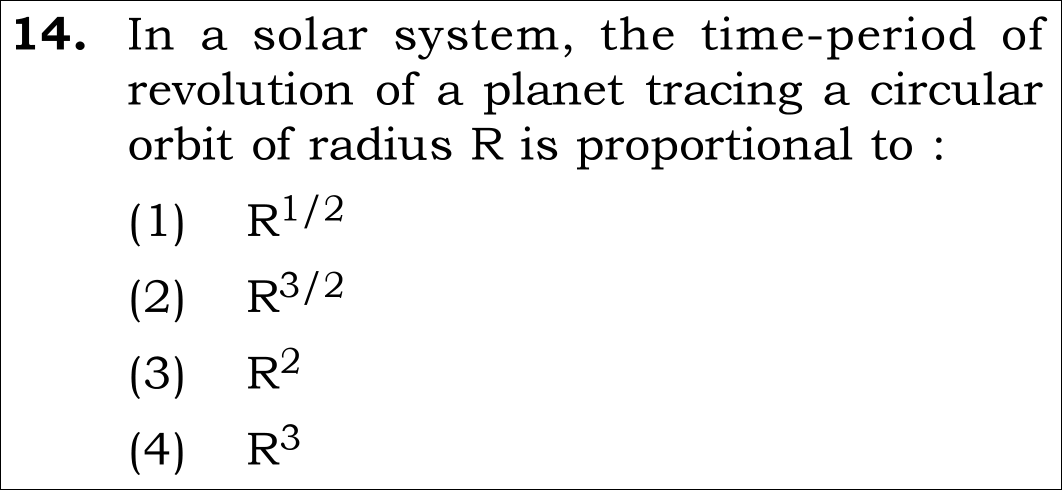
NEET 2026 Physics Question 14: Kepler's Third Law Orbital Period Proportionality to Semi-Major Axis / Radius

Question

In a solar system, the time-period of revolution of a planet tracing a circular orbit of radius R is proportional to:

✓
Verified Against NTA Final Answer Key
Option (2) : T is proportional to R^{3/2}
📚 Gravitation Easy
📋 Given Parameters & Problem Setup
Planetary Orbit Circular orbit of radius R
Time Period Period of revolution T
Governing Law Newton's Law of Universal Gravitation / Kepler's Third Law
⚡

The 30-Second Exam Hall Shortcut: ⚡ Kepler's Harmonic Law Direct Rule

⏱️ Instant recall.

Square of period is proportional to cube of radius

1 State Kepler's 3rd Law: T^2 is proportional to R^3.
2 Take square root on both sides: T is proportional to (R^3)^(1/2) = R^(3/2).
3 Direct identification in 5 seconds!
🛡️
Why You Can 100% Trust This Shortcut: Equating gravitational pull GMm/R^2 to centripetal force m*(2pi/T)^2*R gives T = (2pi / sqrt(GM)) * R^(3/2), proving the power 3/2 rigorously.
📐

Step-by-Step Rigorous Workflow & Mathematical Proof

Step 1

Formulate Dynamic Equilibrium for Circular Planetary Orbit

For a planet of mass m orbiting a star of mass M at radius R, gravitational attraction provides the necessary centripetal force:

Fg=Fc  ⟹  GMmR2=mω2RF_g = F_c \implies \frac{G M m}{R^2} = m \omega^2 R
  • • Mass of the planet m cancels from both sides.
  • • G is the universal gravitational constant, and M is the solar mass.
Step 2

Relate Angular Frequency to Orbital Period

Substitute omega = 2pi / T into the dynamic balance:

GMR3=ω2=(2πT)2=4π2T2\frac{G M}{R^3} = \omega^2 = \left(\frac{2\pi}{T}\right)^2 = \frac{4\pi^2}{T^2}
  • • Cross-multiply to isolate T^2: T^2 = \left(\frac{4\pi^2}{G M}\right) R^3.
  • • This is Kepler's Third Law: T^2 \propto R^3.
Step 3

Extract Proportionality for Time Period T

Take the square root of both sides to obtain the explicit power of R:

T=(2πGM)R3/2  ⟹  T∝R3/2T = \left(\frac{2\pi}{\sqrt{G M}}\right) R^{3/2} \implies T \propto R^{3/2}
  • • The orbital period scales as R^(3/2) (or R^1.5).
  • • Matches Option (2) exactly.
⭐

360° Option Elimination Engine Key Feature

Diagnose every choice: Know exactly why the right option works and why distractors fail.

4-Option Deep Scan
1 Option (1)
✗ Incorrect
Verdict & Scientific Reason:

Applies to pendulum time period, not planetary orbits.

⚠️
Student Fallacy (Why candidates pick this trap): Confuses simple pendulum period T = 2pi*sqrt(L/g) with Kepler's law.
Note: In gravitation, force scales as 1/R^2, which leads to R^(3/2), not R^(1/2).
2 Option (2)
✓ 100% Correct
Verdict & Scientific Reason:

Canonical statement of Kepler's Third Law; confirmed by Official NTA Final Answer Key.

💡
Why this is airtight: Direct derivation from gravitational centripetal equilibrium.
Note: Exact physics.
3 Option (3)
✗ Incorrect
Verdict & Scientific Reason:

Areal velocity confusion.

⚠️
Student Fallacy (Why candidates pick this trap): Confuses Kepler's second law areal parameters with orbital period.
Note: T scales with R^1.5, never R^2.
4 Option (4)
✗ Incorrect
Verdict & Scientific Reason:

Omitted square root.

⚠️
Student Fallacy (Why candidates pick this trap): Remembers T^2 ~ R^3 but forgets to take the square root to isolate T.
Note: T^2 is proportional to R^3, meaning T is proportional to R^(3/2).
⚠️

NTA Trap Alert: Confusing T^2 ~ R^3 with T ~ R^3

Students frequently memorize "Kepler's law relates period and cube of radius" and hastily select R^3 without isolating the power of T.

🛡️ How to avoid the -1 mark: Always isolate the exact requested variable: T = (R^3)^(1/2) = R^(3/2).
📖

Core NEET Syllabus Standard

NEET UG Physics Core Standards · Gravitation Standard Benchmark
Core Scientific Principle Tested:

"Kepler's Third Law (Law of Periods): The square of the time period of revolution of a planet is proportional to the cube of the semi-major axis of its orbit: T^2 = k * R^3."

Syllabus Focus: Kepler's Laws of Planetary Motion
✓ Core NEET UG Syllabus Anchor Syllabus & Academic Standards ↗

Ready to attempt under real exam pressure?

Test your speed and accuracy in the authentic 180-minute timed NTA simulator.

Launch NEET 2026 CBT Test →

Spotted a mistake in this solution? Report an error ([email protected])

⚖️ Legal & Fair Dealing Notice: Sourced from publicly released NEET 2026 question papers and NEET answer keys for private study, research, and non-commercial educational practice under Fair Dealing (Section 52(1)(a) of the Indian Copyright Act, 1957). Not affiliated with or endorsed by NTA or NMC.

Solve 4 NEET Questions a Day — One per Subject

Cover all 1,140 official NEET questions in 285 days at your own pace. Progress is saved on your device. No login needed.