The 30-Second Exam Hall Shortcut: ⚡ Inverse Square Root Scaling
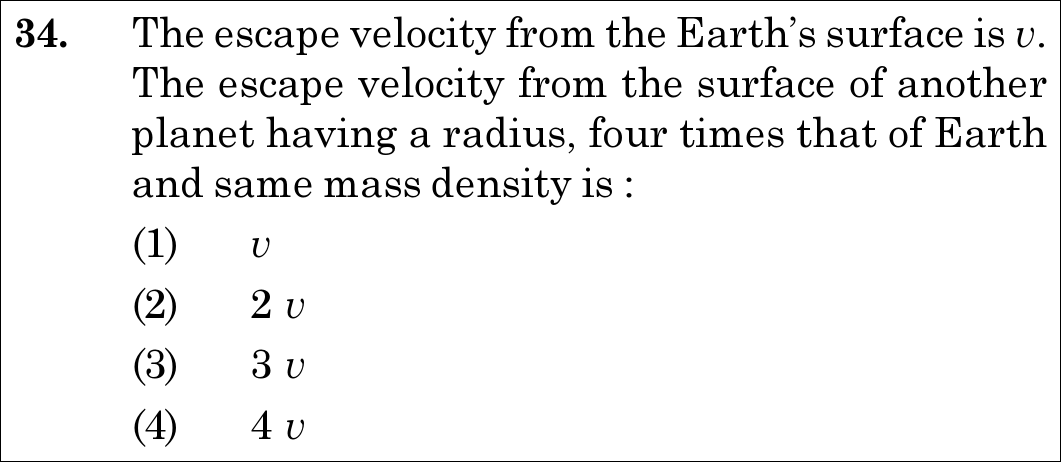
Escape speed is inversely proportional to the square root of radius
Step-by-Step Rigorous Workflow & Mathematical Proof
State the Escape Velocity Formula
Escape velocity from the surface of a spherical celestial body of mass M and radius R is given by conservation of mechanical energy:
- • G is the universal gravitational constant.
- • M is the planet mass, and R is the planetary surface radius.
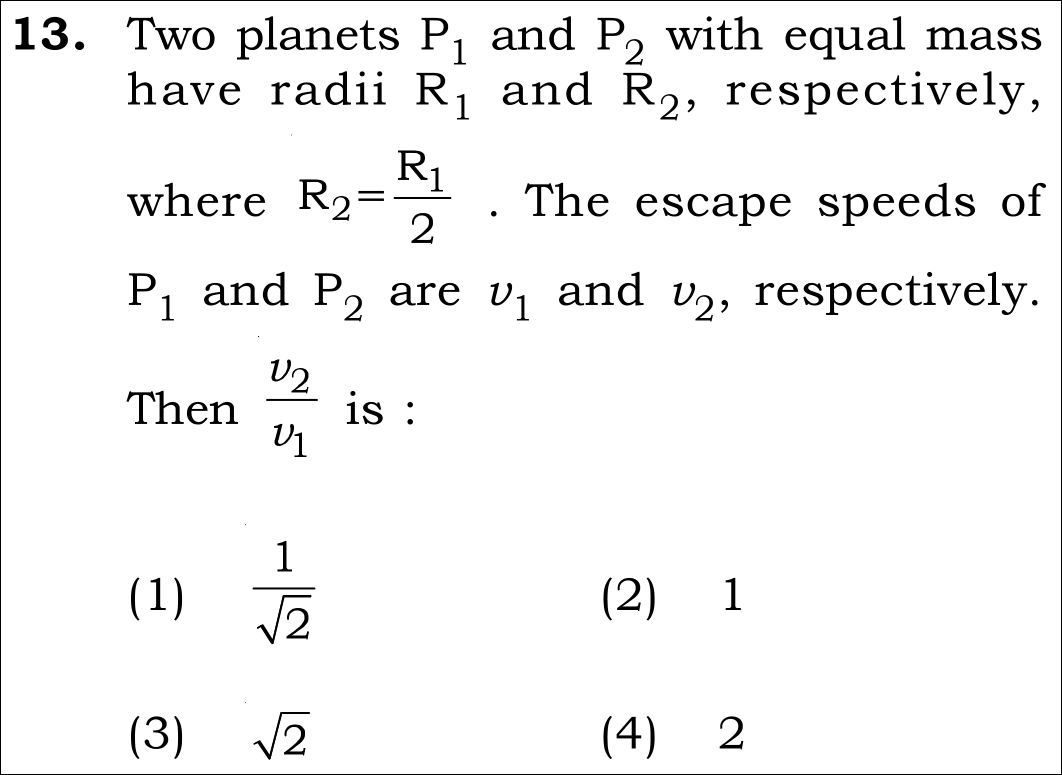
Set Up the Ratio for Planets P_1 and P_2
Since both planets have identical mass M_1 = M_2 = M:
- • Constants 2, G, and M cancel out completely.
Substitute Given Radii and Solve
Substitute R_2 = R_1 / 2 into the square root expression:
- • Confirms v_2 / v_1 = sqrt(2).
- • Matches Option (3) exactly.
360° Option Elimination Engine Key Feature
Diagnose every choice: Know exactly why the right option works and why distractors fail.
Inverted ratio.
Ignores radius dependency.
100% mathematically exact; confirmed by Official NTA Final Answer Key.
Forgot the square root.
NTA Trap Alert: The Linear Radius Scaling Fallacy (Missing Square Root)
Candidates under time pressure often associate "half the radius" with "double the escape speed", forgetting that velocity requires taking the square root of potential energy.
Core NEET Syllabus Standard
"Escape velocity from planet surface: v_e = sqrt(2GM/R) = sqrt(2gR). For fixed mass M, v_e is inversely proportional to sqrt(R)."