MyCompetitiveExams Logo MyCompetitiveExams
Search 1,140+ Questions
Chapters, formulas, speed tricks
→
⚡ Brahmastra NEET 2027
720 MARKS

Dynamic 180-question full-length simulator mixed dynamically from all 6 years for 2027 & 2026 aspirants.

Launch Brahmastra 2027 Test →
Start Practice →
100% Free · No Login Required
Q.40 Physics ⭐ 360° Option Elimination Active
Vault ↗

NEET 2023 Physics Question 40 Solution

Topic: Gravitation · Official NTA Booklet Code G5
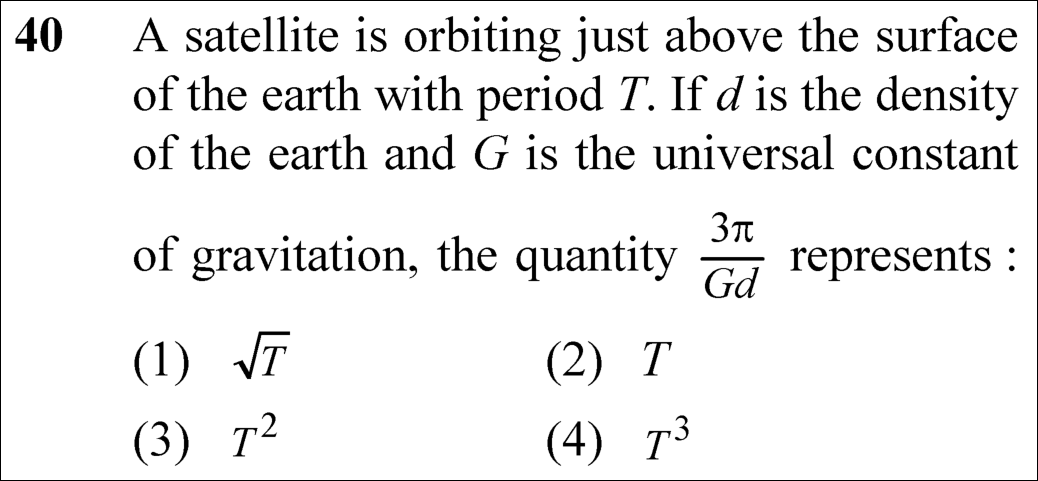
NEET 2023 Physics Question 40: Relation Between Planetary Density and Near-Surface Orbital Period

Question

A satellite is orbiting just above the surface of the earth with period T. If d is the density of the earth and G is the universal constant of gravitation, the quantity 3π/(Gd) represents:

✓
Verified Against NTA Final Answer Key
Option (3) : T²
📚 Gravitation Easy
📋 Given Parameters & Problem Setup
Orbital altitude Just above Earth’s surface (r ≈ R)
Orbital period T
Uniform density of Earth d
Universal gravitational constant G
⚡

The 30-Second Exam Hall Shortcut: ⚡ Satellite Density-Period Fundamental: T² · d = 3π / G

⏱️ Save ~40 seconds

T = 2π√(R³/GM) = √(3π / Gd) ⟹ Squaring gives T² = 3π / (Gd). Thus, 3π / (Gd) represents T² in 10 seconds!

1 Recall the orbital period of a surface satellite: T = 2π √(R / g) = 2π √(R³ / GM).
2 Express mass M in terms of density d: M = Volume × density = (4/3) π R³ d.
3 Substitute M into period: T = 2π √[ R³ / (G · (4/3)π R³ d) ] = 2π √[ 3 / (4π G d) ].
4 Bring 2π inside the radical: √(4π² × 3 / 4πGd) = √(3π / Gd).
5 Square both sides: T² = 3π / (Gd).
6 Therefore, the quantity 3π / (Gd) identically equals T².
7 Select Option (3) T²!
🛡️
Why You Can 100% Trust This Shortcut: Gravitational Dynamics · Kepler’s Third Law for Near-Surface Orbits (The product of planetary mean density and square of near-surface orbital period is a universal constant: d · T² = 3π/G).
📐

Step-by-Step Rigorous Workflow & Mathematical Proof

Step 1

Orbital Velocity and Period of a Near-Surface Satellite

For a satellite orbiting just grazing the surface of a spherical planet of mass M, radius R, and uniform density d, the gravitational attraction provides the necessary centripetal force:

GMmR2=mv02R  ⟹  v0=GMR\frac{G M m}{R^2} = \frac{m v_0^2}{R} \implies v_0 = \sqrt{\frac{G M}{R}}
Step 2

Derivation of Orbital Period Formula

The orbital period T is the circumference of the orbit divided by the orbital velocity:

T=2πRv0=2πRRGM=2πR3GMT = \frac{2\pi R}{v_0} = 2\pi R \sqrt{\frac{R}{G M}} = 2\pi \sqrt{\frac{R^3}{G M}}
Step 3

Substitution of Planet Mass in Terms of Density

For a uniform spherical planet, the mass is given by the product of its spherical volume and density d:

M=43πR3dM = \frac{4}{3}\pi R^3 d
Step 4

Simplification and Isolation of the Target Expression

Substitute M into the period formula and simplify:

T=2πR3G(43πR3d)=2π34πGd=4π2×34πGd=3πGdT = 2\pi \sqrt{\frac{R^3}{G \left(\frac{4}{3}\pi R^3 d\right)}} = 2\pi \sqrt{\frac{3}{4\pi G d}} = \sqrt{\frac{4\pi^2 \times 3}{4\pi G d}} = \sqrt{\frac{3\pi}{G d}}
Step 5

Squaring to Match the Target Quantity

Squaring both sides of the derived relation:

T2=3πGd  ⟹  3πGd represents T2T^2 = \frac{3\pi}{G d} \implies \frac{3\pi}{G d} \text{ represents } T^2
⭐

360° Option Elimination Engine Key Feature

Diagnose every choice: Know exactly why the right option works and why distractors fail.

4-Option Deep Scan
1 (1)
✗ Incorrect
Verdict & Scientific Reason:

Incorrect power of period.

⚠️
Student Fallacy (Why candidates pick this trap): Candidate took square root instead of squaring.
2 (2)
✗ Incorrect
Verdict & Scientific Reason:

T equals √(3π/Gd), not 3π/Gd.

⚠️
Student Fallacy (Why candidates pick this trap): Candidate forgot that the expression inside the square root was T².
3 (3)
✓ 100% Correct
Verdict & Scientific Reason:

Accurate: Squaring T = √(3π/Gd) yields T² = 3π/(Gd).

💡
Why this is airtight: None. Candidate correctly squared both sides.
4 (4)
✗ Incorrect
Verdict & Scientific Reason:

Keplerian power confusion.

⚠️
Student Fallacy (Why candidates pick this trap): Candidate confused Kepler’s T² ∝ R³ rule.
⚠️

NTA Trap Alert: Confusing T with T² (Forgetting the Radical)

The formula for orbital period contains a square root: T = √(3π / Gd). Consequently, (3π / Gd) without the square root equals T², not T (Option 2).

🛡️ How to avoid the -1 mark: Check dimensions: [G] = M⁻¹L³T⁻², [d] = ML⁻³ ⟹ [Gd] = T⁻² ⟹ 1/[Gd] = T²!
📖

Core NEET Syllabus Standard

National Eligibility cum Entrance Test (NEET UG) · Gravitation Standard Benchmark
Core Scientific Principle Tested:

"For a satellite orbiting near planetary surface, T = √(3π / Gd), demonstrating period depends solely on planetary density."

Syllabus Focus: Satellites, Orbital Speed and Period
Preserved in Rationalized Curriculum Syllabus & Academic Standards ↗

Ready to attempt under real exam pressure?

Test your speed and accuracy in the authentic 200-minute timed NTA simulator.

Launch NEET 2023 CBT Test →

Spotted a mistake in this solution? Report an error ([email protected])

⚖️ Legal & Fair Dealing Notice: Sourced from publicly released NEET 2023 question papers and NEET answer keys for private study, research, and non-commercial educational practice under Fair Dealing (Section 52(1)(a) of the Indian Copyright Act, 1957). Not affiliated with or endorsed by NTA or NMC.

Solve 4 NEET Questions a Day — One per Subject

Cover all 1,140 official NEET questions in 285 days at your own pace. Progress is saved on your device. No login needed.