MyCompetitiveExams Logo MyCompetitiveExams
Search 1,140+ Questions
Chapters, formulas, speed tricks
→
⚡ Brahmastra NEET 2027
720 MARKS

Dynamic 180-question full-length simulator mixed dynamically from all 6 years for 2027 & 2026 aspirants.

Launch Brahmastra 2027 Test →
Start Practice →
100% Free · No Login Required
Q.41 Physics ⭐ 360° Option Elimination Active
Vault ↗

NEET 2023 Physics Question 41 Solution

Topic: Alternating Current · Official NTA Booklet Code G5
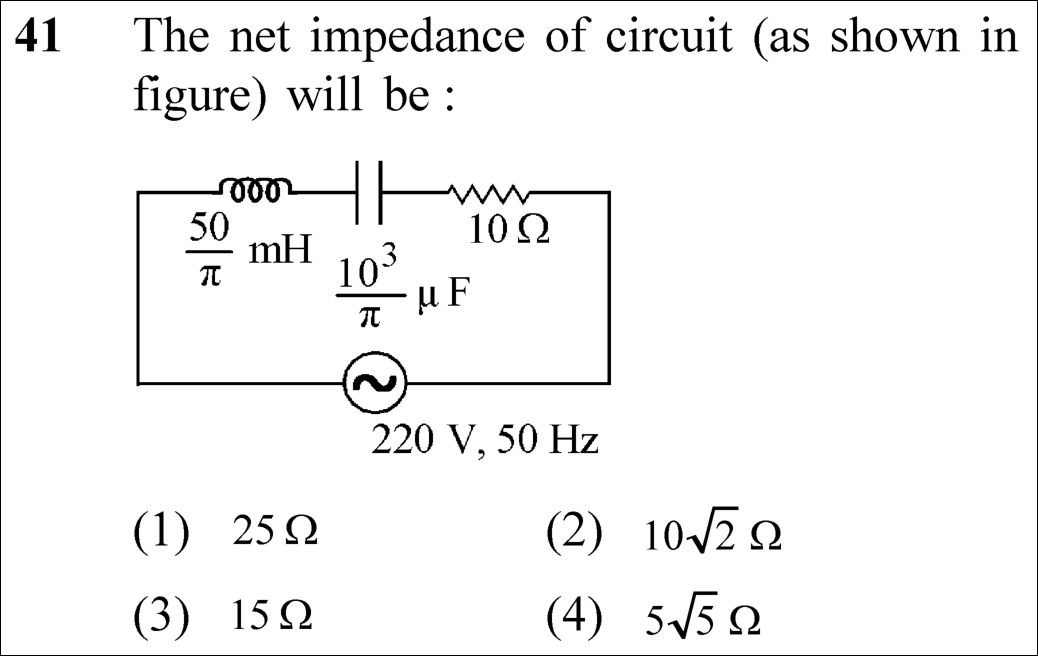
NEET 2023 Physics Question 41: Net Impedance in a Series LCR Resonant Circuit Configuration

Question

The net impedance of circuit (as shown in figure) will be:

✓
Verified Against NTA Final Answer Key
Option (4) : 5√5 Ω
📚 Alternating Current Medium
📋 Given Parameters & Problem Setup
Inductance (L) (50 / π) mH = (50 / π) × 10⁻³ H
Capacitance (C) (10³ / π) μF = (10³ / π) × 10⁻⁶ F = 10⁻³ / π F
Resistance (R) 10 Ω
AC Supply frequency (f) 50 Hz
⚡

The 30-Second Exam Hall Shortcut: ⚡ π Cancellation Hack: ω = 2π(50) = 100π rad/s

⏱️ Save ~50 seconds

X_L = (100π)(50/π × 10⁻³) = 5 Ω. X_C = 1 / [(100π)(10⁻³/π)] = 10 Ω. Net reactance |X_L - X_C| = 5 Ω. Impedance Z = √(10² + 5²) = √125 = 5√5 Ω in 25 seconds!

1 Angular frequency ω = 2π f = 2π(50) = 100π rad/s.
2 Inductive reactance: X_L = ω L = (100π) × [(50/π) × 10⁻³] = 100 × 50 × 10⁻³ = 5 Ω (π cancels!).
3 Capacitive reactance: X_C = 1 / (ω C) = 1 / [100π × (10⁻³/π)] = 1 / (100 × 10⁻³) = 1 / 0.1 = 10 Ω (π cancels!).
4 Net reactance: |X_L - X_C| = |5 - 10| = 5 Ω.
5 Net impedance: Z = √(R² + (X_L - X_C)²) = √(10² + 5²) = √(100 + 25) = √125 = 5√5 Ω.
6 Lock Option (4) 5√5 Ω immediately!
🛡️
Why You Can 100% Trust This Shortcut: Alternating Current · Series LCR Circuit Phasor Analysis (Z = √(R² + (X_L - X_C)²), where X_L = ωL and X_C = 1/(ωC)).
📐

Step-by-Step Rigorous Workflow & Mathematical Proof

Step 1

Determination of Angular Frequency ω

For an AC voltage source operating at a linear frequency of f = 50 Hz, the angular frequency ω is given by:

ω=2πf=2π(50)=100π rad s−1\omega = 2\pi f = 2\pi (50) = 100\pi\text{ rad s}^{-1}
Step 2

Calculation of Inductive Reactance (X_L)

Substitute inductance L = (50/π) mH = (50/π) × 10⁻³ H into the inductive reactance formula:

XL=ωL=(100π)×(50π×10−3)=100×50×10−3=5 ΩX_L = \omega L = (100\pi) \times \left(\frac{50}{\pi} \times 10^{-3}\right) = 100 \times 50 \times 10^{-3} = 5\ \Omega
Step 3

Calculation of Capacitive Reactance (X_C)

Substitute capacitance C = (10³/π) μF = (10⁻³/π) F into the capacitive reactance formula:

XC=1ωC=1(100π)×(10−3π)=1100×10−3=10.1=10 ΩX_C = \frac{1}{\omega C} = \frac{1}{(100\pi) \times \left(\frac{10^{-3}}{\pi}\right)} = \frac{1}{100 \times 10^{-3}} = \frac{1}{0.1} = 10\ \Omega
Step 4

Phasor Combination to Determine Net Impedance (Z)

In a series LCR circuit, resistance and net reactance combine orthogonally in the impedance triangle:

Z=R2+(XL−XC)2=102+(5−10)2=100+(−5)2=100+25=125=55 ΩZ = \sqrt{R^2 + (X_L - X_C)^2} = \sqrt{10^2 + (5 - 10)^2} = \sqrt{100 + (-5)^2} = \sqrt{100 + 25} = \sqrt{125} = 5\sqrt{5}\ \Omega
⭐

360° Option Elimination Engine Key Feature

Diagnose every choice: Know exactly why the right option works and why distractors fail.

4-Option Deep Scan
1 (1)
✗ Incorrect
Verdict & Scientific Reason:

Scalar sum of R + X_L + X_C (10 + 5 + 10 = 25 Ω).

⚠️
Student Fallacy (Why candidates pick this trap): Candidate treated components as simple DC resistors, ignoring phase angles.
2 (2)
✗ Incorrect
Verdict & Scientific Reason:

Result if net reactance were equal to resistance (10 Ω).

⚠️
Student Fallacy (Why candidates pick this trap): Candidate calculated Z = √(10² + 10²) assuming X_L = 0.
3 (3)
✗ Incorrect
Verdict & Scientific Reason:

Scalar addition of R and |X_L - X_C| (10 + 5 = 15 Ω).

⚠️
Student Fallacy (Why candidates pick this trap): Candidate added resistance and reactance linearly without Pythagoras’ theorem.
4 (4)
✓ 100% Correct
Verdict & Scientific Reason:

Accurate impedance: √(10² + 5²) = √125 = 5√5 Ω.

💡
Why this is airtight: None. Candidate executed phasor impedance calculation flawlessly.
⚠️

NTA Trap Alert: Linear Addition of Reactance and Resistance (Choosing 15 Ω or 25 Ω)

Voltages across resistors, inductors, and capacitors are out of phase by 90°. Adding them as DC resistances (10 + 5 = 15 Ω or 10 + 5 + 10 = 25 Ω) is completely incorrect. Impedance requires phasor summation: Z = √(R² + (X_L - X_C)²).

🛡️ How to avoid the -1 mark: Always construct the impedance triangle: Z² = R² + X_net².
📖

Core NEET Syllabus Standard

National Eligibility cum Entrance Test (NEET UG) · Alternating Current Standard Benchmark
Core Scientific Principle Tested:

"Impedance is given by Z = √(R² + (X_L - X_C)²), where reactances subtract due to opposite 180° phase difference."

Syllabus Focus: Series LCR Circuit and Impedance
Preserved in Rationalized Curriculum Syllabus & Academic Standards ↗

Ready to attempt under real exam pressure?

Test your speed and accuracy in the authentic 200-minute timed NTA simulator.

Launch NEET 2023 CBT Test →

Spotted a mistake in this solution? Report an error ([email protected])

⚖️ Legal & Fair Dealing Notice: Sourced from publicly released NEET 2023 question papers and NEET answer keys for private study, research, and non-commercial educational practice under Fair Dealing (Section 52(1)(a) of the Indian Copyright Act, 1957). Not affiliated with or endorsed by NTA or NMC.

Solve 4 NEET Questions a Day — One per Subject

Cover all 1,140 official NEET questions in 285 days at your own pace. Progress is saved on your device. No login needed.