MyCompetitiveExams Logo MyCompetitiveExams
Search 1,140+ Questions
Chapters, formulas, speed tricks
→
⚡ Brahmastra NEET 2027
720 MARKS

Dynamic 180-question full-length simulator mixed dynamically from all 6 years for 2027 & 2026 aspirants.

Launch Brahmastra 2027 Test →
Start Practice →
100% Free · No Login Required
Q.42 Physics ⭐ 360° Option Elimination Active
Vault ↗

NEET 2023 Physics Question 42 Solution

Topic: Atoms · Official NTA Booklet Code G5
NEET 2023 Physics Question 42: Principal Quantum Number Dependence of Orbital Radius

Question

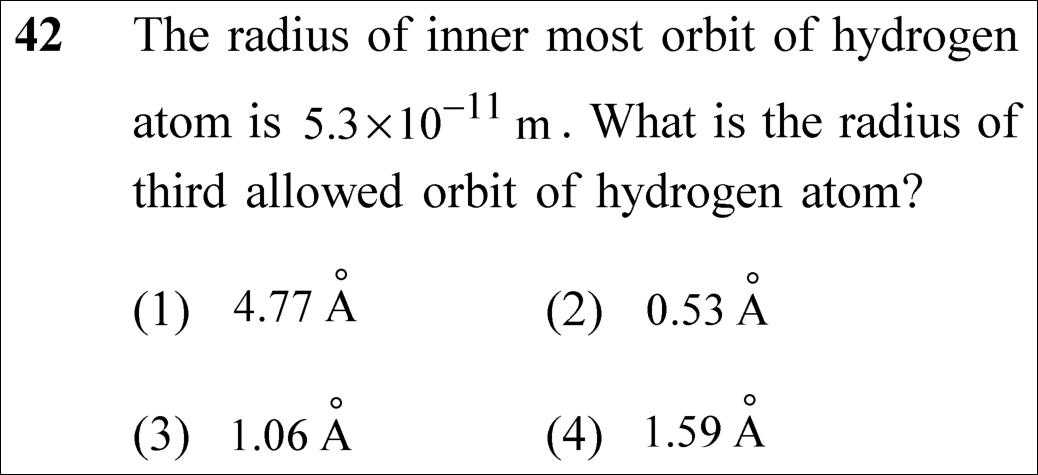
The radius of inner most orbit of hydrogen atom is 5.3×10⁻¹¹ m. What is the radius of third allowed orbit of hydrogen atom?

✓
Verified Against NTA Final Answer Key
Option (1) : 4.77 Å
📚 Atoms Easy
📋 Given Parameters & Problem Setup
First Bohr orbit radius (r₁) 5.3 × 10⁻¹¹ m = 0.53 Å
Target principal quantum number (n) 3 (third allowed orbit)
Atomic number (Z) 1 (Hydrogen atom)
⚡

The 30-Second Exam Hall Shortcut: ⚡ Bohr Radius Quantum Scaling: r_n = r₁ × n²

⏱️ Save ~35 seconds

Radius scales as n²: r₃ = r₁ × 3² = 9 × 0.53 Å = 4.77 Å in 5 seconds!

1 Recall Bohr’s quantization condition: orbital radius r_n ∝ n² / Z.
2 For hydrogen atom, Z = 1, so r_n = r₁ × n².
3 First orbit radius r₁ = 5.3 × 10⁻¹¹ m = 0.53 Å.
4 For the third orbit (n = 3), the scaling factor is n² = 3² = 9.
5 Calculate radius: r₃ = 0.53 Å × 9 = 4.77 Å.
6 Lock Option (1) 4.77 Å instantly!
🛡️
Why You Can 100% Trust This Shortcut: Modern Physics · Bohr Model Postulates (Orbital radius in hydrogen-like systems varies strictly with the square of the principal quantum number: r_n = a₀ n² / Z).
📐

Step-by-Step Rigorous Workflow & Mathematical Proof

Step 1

Bohr’s Formula for Stationary Orbit Radii

According to Bohr’s model of the hydrogen atom, by equating the electrostatic Coulomb attraction to the centripetal force and applying angular momentum quantization L = mvr = nh / 2π, the radius of the n-th stationary orbit is derived as:

rn=ε0n2h2πme2Z=r1⋅n2Zr_n = \frac{\varepsilon_0 n^2 h^2}{\pi m e^2 Z} = r_1 \cdot \frac{n^2}{Z}
Step 2

Identification of Initial Radius and Units

For hydrogen (Z = 1), the radius of the innermost (ground state, n = 1) orbit is given as:

r1=5.3×10⁻¹¹ m=0.53×10⁻¹⁰ m=0.53 A˚r_1 = 5.3 \times 10^{-11}\text{ m} = 0.53 \times 10^{-10}\text{ m} = 0.53\text{ \AA}
Step 3

Application to the Third Allowed Orbit (n = 3)

Setting principal quantum number n = 3:

r3=r1⋅n2=(0.53 A˚)×(3)2=0.53×9 A˚r_3 = r_1 \cdot n^2 = (0.53\text{ \AA}) \times (3)^2 = 0.53 \times 9\text{ \AA}
Step 4

Numerical Evaluation

Multiplying the values:

r3=4.77 A˚r_3 = 4.77\text{ \AA}
⭐

360° Option Elimination Engine Key Feature

Diagnose every choice: Know exactly why the right option works and why distractors fail.

4-Option Deep Scan
1 (1)
✓ 100% Correct
Verdict & Scientific Reason:

Exact radius of third orbit: 9 × 0.53 Å = 4.77 Å.

💡
Why this is airtight: None. Candidate correctly applied the n² scaling.
2 (2)
✗ Incorrect
Verdict & Scientific Reason:

Radius of the first orbit (n = 1), not the third orbit.

⚠️
Student Fallacy (Why candidates pick this trap): Candidate selected ground state radius without scaling.
3 (3)
✗ Incorrect
Verdict & Scientific Reason:

Linear scaling by 2 (0.53 × 2 = 1.06 Å).

⚠️
Student Fallacy (Why candidates pick this trap): Candidate assumed linear dependence on n (r ∝ n).
4 (4)
✗ Incorrect
Verdict & Scientific Reason:

Linear scaling by 3 (0.53 × 3 = 1.59 Å).

⚠️
Student Fallacy (Why candidates pick this trap): Candidate multiplied by n = 3 instead of n² = 9.
⚠️

NTA Trap Alert: Multiplying by n (Linear Scaling) Instead of n²

Many students hastily calculate r₃ = 3 × 0.53 = 1.59 Å (Option 4), confusing the linear scaling of angular momentum (L ∝ n) with the quadratic scaling of orbital radius (r ∝ n²).

🛡️ How to avoid the -1 mark: Remember: Radius scales as n², Velocity scales as 1/n, Energy scales as 1/n².
📖

Core NEET Syllabus Standard

National Eligibility cum Entrance Test (NEET UG) · Atoms Standard Benchmark
Core Scientific Principle Tested:

"The radius of the n-th Bohr orbit is proportional to n²: r_n = r₁ n²."

Syllabus Focus: Bohr Model and Radii of Stationary Orbits
Preserved in Rationalized Curriculum Syllabus & Academic Standards ↗

Ready to attempt under real exam pressure?

Test your speed and accuracy in the authentic 200-minute timed NTA simulator.

Launch NEET 2023 CBT Test →

Spotted a mistake in this solution? Report an error ([email protected])

⚖️ Legal & Fair Dealing Notice: Sourced from publicly released NEET 2023 question papers and NEET answer keys for private study, research, and non-commercial educational practice under Fair Dealing (Section 52(1)(a) of the Indian Copyright Act, 1957). Not affiliated with or endorsed by NTA or NMC.

Solve 4 NEET Questions a Day — One per Subject

Cover all 1,140 official NEET questions in 285 days at your own pace. Progress is saved on your device. No login needed.