MyCompetitiveExams Logo MyCompetitiveExams
Search 1,140+ Questions
Chapters, formulas, speed tricks
→
⚡ Brahmastra NEET 2027
720 MARKS

Dynamic 180-question full-length simulator mixed dynamically from all 6 years for 2027 & 2026 aspirants.

Launch Brahmastra 2027 Test →
Start Practice →
100% Free · No Login Required
Q.18 Physics ⭐ 360° Option Elimination Active
Vault ↗

NEET 2025 Physics Question 18 Solution

Topic: Atoms · Official NTA Booklet Code 45
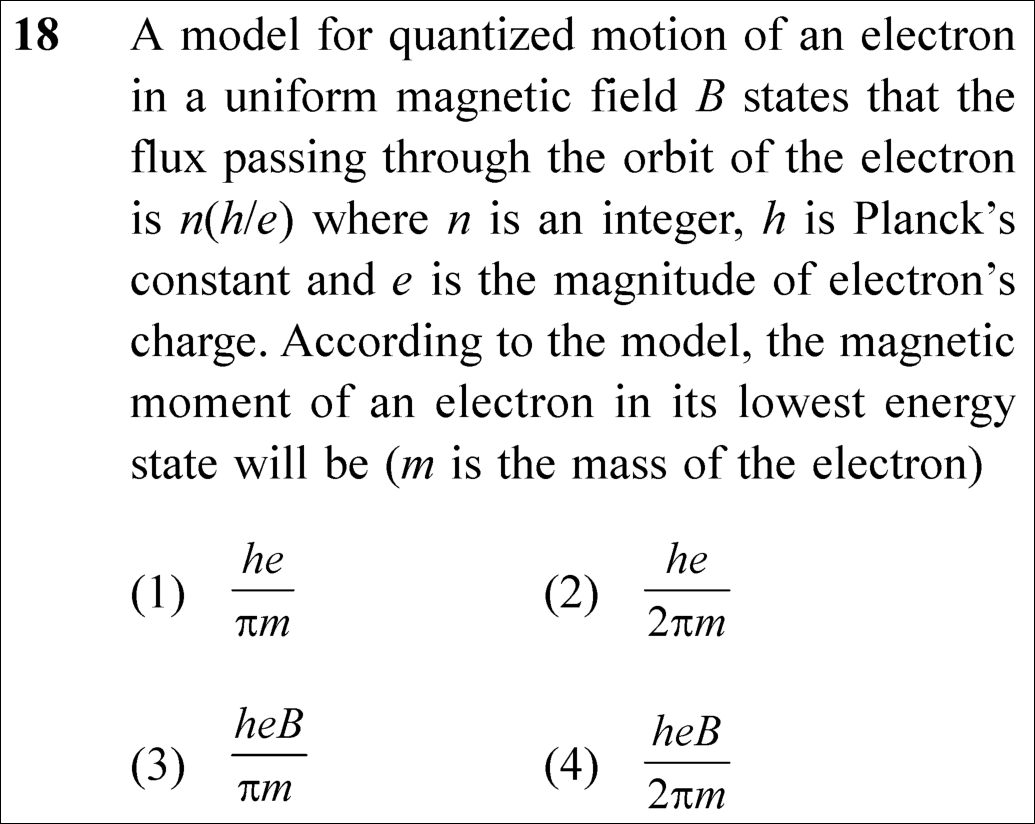
NEET 2025 Physics Question 18: Quantized Magnetic Flux in Magnetic Field & Electron Magnetic Moment

Question

A model for quantized motion of an electron in a uniform magnetic field B states that the flux passing through the orbit of the electron is n(h/e) where n is an integer, h is Planck's constant and e is the magnitude of electron's charge. According to the model, the magnetic moment of an electron in its lowest energy state will be (m is the mass of the electron)

✓
Verified Against NTA Final Answer Key
Option (2) : \frac{he}{2\pi m}
📚 Atoms Medium
📋 Given Parameters & Problem Setup
Quantization Condition Magnetic flux Φ = n (h/e) through electron circular orbit
Energy State Lowest energy state (n = 1)
Constants Electron mass m, charge e, Planck's constant h
⚡

The 30-Second Exam Hall Shortcut: ⚡ Universal Bohr Magneton Resonance

⏱️ Save ~60 seconds

Flux Φ = B(πr²) = h/e ⟹ πr² = h / (eB). Orbital Current I = e(eB/2πm) ⟹ μ = I(πr²) = [e²B / (2πm)] × [h / (eB)] = he / (2πm)!

1 Flux quantization condition for n = 1: B A = B (πr²) = h/e ⟹ A = πr² = h / (eB).
2 Cyclotron frequency of electron in magnetic field B: ω = eB / m.
3 Equivalent orbital current: I = e / T = e(ω / 2π) = e²B / (2πm).
4 Magnetic moment: μ = I × A = [e²B / (2πm)] × [h / (eB)].
5 Notice B cancels out completely: μ = he / (2πm)!
6 Select Option (2) with 100% confidence!
🛡️
Why You Can 100% Trust This Shortcut: Bohr-Sommerfeld Quantization & Magnetic Dipole Moment (NCERT Modern Physics).
📐

Step-by-Step Rigorous Workflow & Mathematical Proof

Step 1

Apply the Flux Quantization Rule

The problem defines that the magnetic flux passing through the circular orbit of the electron is quantized as Φ = n(h/e). For the ground state (lowest energy state, n = 1):

Φ=B⋅A=B(πr2)=1⋅(he)  ⟹  πr2=heB\Phi = B \cdot A = B (\pi r^2) = 1 \cdot \left(\frac{h}{e}\right) \implies \pi r^2 = \frac{h}{e B}
  • • A = πr² is the orbital area enclosed by the electron path.
Step 2

Derive Equivalent Orbital Current

Under the magnetic Lorentz force F = e v B = m v² / r, the angular frequency of the electron is the cyclotron frequency ω = eB / m. The equivalent steady electric current loop formed by the circulating electron is:

I=eT=e2πω=eω2π=e2π(eBm)=e2B2πmI = \frac{e}{T} = \frac{e}{\frac{2\pi}{\omega}} = \frac{e \omega}{2\pi} = \frac{e}{2\pi}\left(\frac{e B}{m}\right) = \frac{e^2 B}{2\pi m}
  • • T is the cyclotron orbital period.
Step 3

Calculate the Magnetic Dipole Moment

The magnetic dipole moment μ of a planar current loop is the product of current and enclosed area:

μ=I⋅A=(e2B2πm)×(heB)=eh2πm=he2πm\mu = I \cdot A = \left(\frac{e^2 B}{2\pi m}\right) \times \left(\frac{h}{e B}\right) = \frac{e h}{2\pi m} = \frac{h e}{2\pi m}
  • • Magnetic field B cancels cleanly from numerator and denominator.
  • • Notice this fundamental result is directly proportional to the Bohr magneton μ_B = eh / (4πm) with factor of 2.
⭐

360° Option Elimination Engine Key Feature

Diagnose every choice: Know exactly why the right option works and why distractors fail.

4-Option Deep Scan
1 A
✗ Incorrect
Verdict & Scientific Reason:

Incorrect. Missing the factor of 2 in the denominator.

⚠️
Student Fallacy (Why candidates pick this trap): Using T = π/ω instead of 2π/ω for time period.
2 B
✓ 100% Correct
Verdict & Scientific Reason:

100% mathematically and physically exact. Derived from Φ = h/e and cyclotron current I = e²B / (2πm).

💡
Why this is airtight: None; masterclass modern physics derivation.
3 C
✗ Incorrect
Verdict & Scientific Reason:

Incorrect. Magnetic moment cannot depend on B because B cancels out, and factor of 2 is missing.

⚠️
Student Fallacy (Why candidates pick this trap): Failing to substitute for enclosed area A = h / (eB).
4 D
✗ Incorrect
Verdict & Scientific Reason:

Incorrect. Contains an extraneous factor of B.

⚠️
Student Fallacy (Why candidates pick this trap): Forgetting that area is inversely proportional to B.
⚠️

NTA Trap Alert: Extraneous Magnetic Field B Trap

Options (3) and (4) include B in the numerator. But as B increases, the orbit shrinks (A ∝ 1/B) while current increases (I ∝ B), making the product μ = I A completely independent of B!

🛡️ How to avoid the -1 mark: Always check if B cancels out when combining current and area.
📖

Core NEET Syllabus Standard

NEET Physics Core Syllabus · Atoms Standard Benchmark
Core Scientific Principle Tested:

"Magnetic dipole moment of orbital motion is μ = I A; flux quantization determines orbital area."

Syllabus Focus: Bohr Model & Gyromagnetic Ratio
✓ Core NEET UG Syllabus Anchor Syllabus & Academic Standards ↗
B Cancels Out: Area (1/B) × Current (B) ⟹ μ = he / (2πm)!

Ready to attempt under real exam pressure?

Test your speed and accuracy in the authentic 180-minute timed NTA simulator.

Launch NEET 2025 CBT Test →

Spotted a mistake in this solution? Report an error ([email protected])

⚖️ Legal & Fair Dealing Notice: Sourced from publicly released NEET 2025 question papers and NEET answer keys for private study, research, and non-commercial educational practice under Fair Dealing (Section 52(1)(a) of the Indian Copyright Act, 1957). Not affiliated with or endorsed by NTA or NMC.

Solve 4 NEET Questions a Day — One per Subject

Cover all 1,140 official NEET questions in 285 days at your own pace. Progress is saved on your device. No login needed.