MyCompetitiveExams Logo MyCompetitiveExams
Search 1,140+ Questions
Chapters, formulas, speed tricks
→
⚡ Brahmastra NEET 2027
720 MARKS

Dynamic 180-question full-length simulator mixed dynamically from all 6 years for 2027 & 2026 aspirants.

Launch Brahmastra 2027 Test →
Start Practice →
100% Free · No Login Required
Q.19 Physics ⭐ 360° Option Elimination Active
Vault ↗

NEET 2025 Physics Question 19 Solution

Topic: Thermal Properties of Matter · Official NTA Booklet Code 45
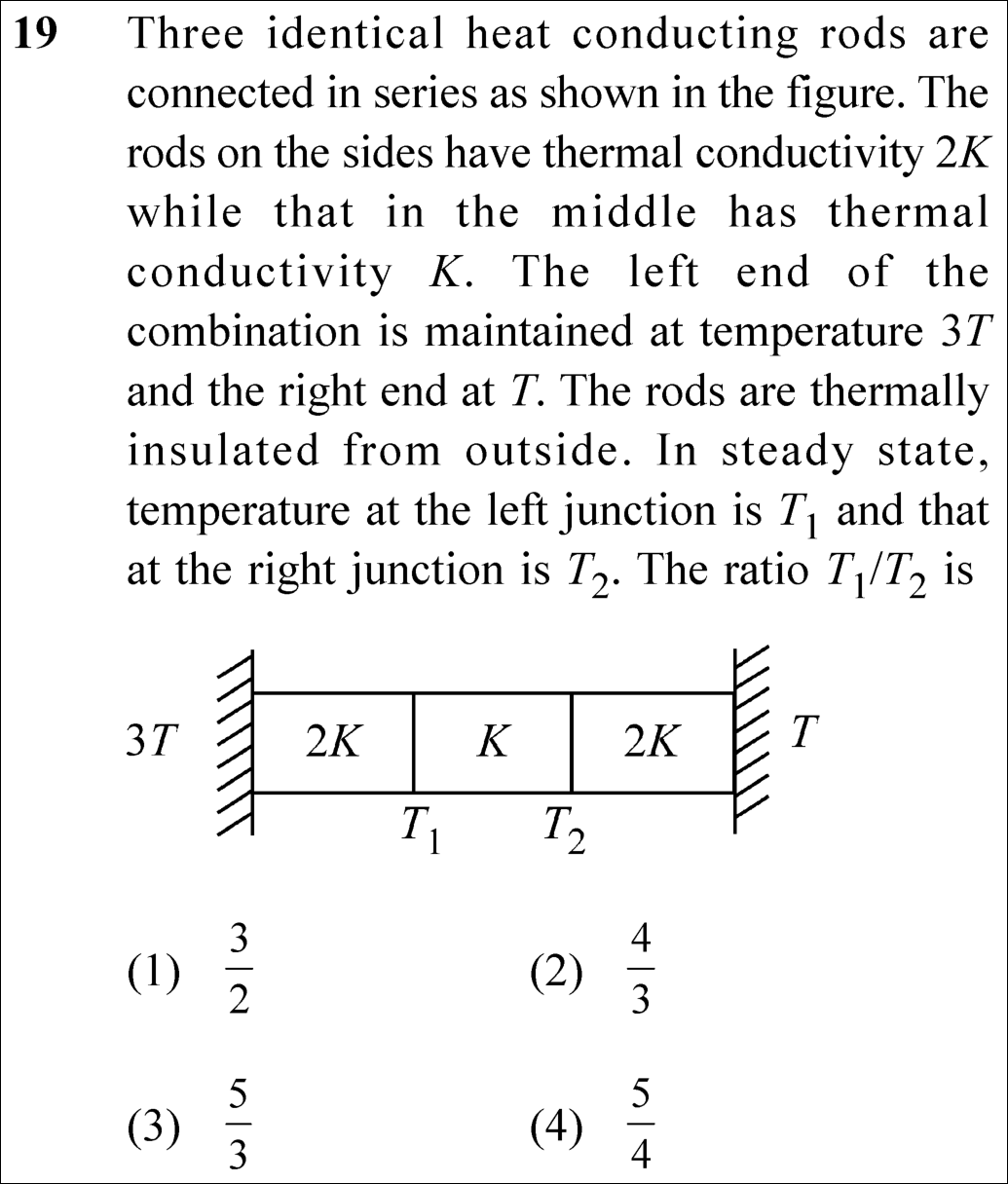
NEET 2025 Physics Question 19: Junction Temperatures and Thermal Resistance Network

Question

Three identical heat conducting rods are connected in series as shown in the figure. The rods on the sides have thermal conductivity 2K while that in the middle has thermal conductivity K. The left end of the combination is maintained at temperature 3T and the right end at T. The rods are thermally insulated from outside. In steady state, temperature at the left junction is T₁ and that at the right junction is T₂. The ratio T₁/T₂ is

✓
Verified Against NTA Final Answer Key
Option (3) : \frac{5}{3}
📚 Thermal Properties of Matter Easy
📋 Given Parameters & Problem Setup
Three Identical Geometry Rods in Series Lengths L, Cross-sectional areas A identical
Conductivities Left rod: 2K, Middle rod: K, Right rod: 2K
Boundary Temperatures Left end: 3T, Right end: T
Junction Temperatures Left junction: T₁, Right junction: T₂
⚡

The 30-Second Exam Hall Shortcut: ⚡ Thermal Resistance Analogy Shortcut

⏱️ Save ~50 seconds

R₁ = R₀/2, R₂ = R₀, R₃ = R₀/2 ⟹ R_total = 2R₀. Drops are ΔT₁ : ΔT₂ : ΔT₃ = 1 : 2 : 1 across total drop 2T ⟹ T₁ = 2.5T, T₂ = 1.5T ⟹ T₁/T₂ = 2.5/1.5 = 5/3!

1 Thermal resistance R = L / (k A). With conductivities 2K, K, 2K, the resistances are in ratio 1/2 : 1 : 1/2 = 1 : 2 : 1.
2 Total temperature difference between ends: ΔT_total = 3T - T = 2T.
3 Dividing 2T in ratio 1 : 2 : 1 (total 4 parts, each part = 2T / 4 = 0.5T):
4 Drop across left rod = 1 × 0.5T = 0.5T ⟹ T₁ = 3T - 0.5T = 2.5T = (5/2) T.
5 Drop across middle rod = 2 × 0.5T = 1.0T ⟹ T₂ = 2.5T - 1.0T = 1.5T = (3/2) T.
6 Ratio T₁ / T₂ = (5/2) / (3/2) = 5/3.
7 Select Option (3) in under 20 seconds!
🛡️
Why You Can 100% Trust This Shortcut: Fourier’s Law & Electrical Analogy for Thermal Conduction (NCERT Physics · Thermal Properties of Matter: H = ΔT / R_th).
📐

Step-by-Step Rigorous Workflow & Mathematical Proof

Step 1

Formulate Thermal Resistances of the Three Rods

Using the thermal resistance formula R_th = L / (k A), let R₀ = L / (K A) denote the thermal resistance of the middle rod:

R1=L(2K)A=R02,R2=LKA=R0,R3=L(2K)A=R02R_1 = \frac{L}{(2K) A} = \frac{R_0}{2}, \quad R_2 = \frac{L}{K A} = R_0, \quad R_3 = \frac{L}{(2K) A} = \frac{R_0}{2}
  • • Total thermal resistance in series: R_total = R₁ + R₂ + R₃ = R₀/2 + R₀ + R₀/2 = 2R₀.
Step 2

Calculate Steady-State Heat Current

In steady state, the same rate of heat flow H passes through all three rods in series:

H=Thot−TcoldRtotal=3T−T2R0=2T2R0=TR0H = \frac{T_{hot} - T_{cold}}{R_{total}} = \frac{3T - T}{2R_0} = \frac{2T}{2R_0} = \frac{T}{R_0}
  • • Heat flow rate H is constant throughout the composite rod.
Step 3

Evaluate Junction Temperatures T₁ and T₂

Apply heat conduction across each individual section:

3T−T1=HR1=(TR0)(R02)=T2  ⟹  T1=3T−0.5T=2.5T=52TT2−T=HR3=(TR0)(R02)=T2  ⟹  T2=T+0.5T=1.5T=32T\begin{aligned} 3T - T_1 &= H R_1 = \left(\frac{T}{R_0}\right)\left(\frac{R_0}{2}\right) = \frac{T}{2} \implies T_1 = 3T - 0.5T = 2.5T = \frac{5}{2}T \\ T_2 - T &= H R_3 = \left(\frac{T}{R_0}\right)\left(\frac{R_0}{2}\right) = \frac{T}{2} \implies T_2 = T + 0.5T = 1.5T = \frac{3}{2}T \end{aligned}
  • • Ratio T₁ / T₂ = (5/2 T) / (3/2 T) = 5/3, corresponding to Option (3).
⭐

360° Option Elimination Engine Key Feature

Diagnose every choice: Know exactly why the right option works and why distractors fail.

4-Option Deep Scan
1 A
✗ Incorrect
Verdict & Scientific Reason:

Incorrect. Corresponds to 1.5, which is T₂/T rather than T₁/T₂.

⚠️
Student Fallacy (Why candidates pick this trap): Calculating T₂ / T instead of T₁ / T₂.
2 B
✗ Incorrect
Verdict & Scientific Reason:

Incorrect. Arithmetic slip assuming equal resistances (R/3 each).

⚠️
Student Fallacy (Why candidates pick this trap): Assuming thermal conductivities were all equal to K.
3 C
✓ 100% Correct
Verdict & Scientific Reason:

100% exact. T₁ = 2.5T, T₂ = 1.5T ⟹ T₁/T₂ = 2.5 / 1.5 = 5/3.

💡
Why this is airtight: None; rigorous thermal network analysis.
4 D
✗ Incorrect
Verdict & Scientific Reason:

Incorrect. Calculation error in finding T₂.

⚠️
Student Fallacy (Why candidates pick this trap): Using T₂ = 2T instead of 1.5T.
⚠️

NTA Trap Alert: Assuming Linear Temperature Gradient Across Entire Rod

The temperature gradient is NOT uniform across the 3 rods because their conductivities differ (2K, K, 2K). The middle rod has half the conductivity, so it has TWICE the temperature drop per unit length!

🛡️ How to avoid the -1 mark: Always use thermal resistance ratios: ΔT ∝ R_th ∝ 1/k.
📖

Core NEET Syllabus Standard

NEET Physics Core Syllabus · Thermal Properties of Matter Standard Benchmark
Core Scientific Principle Tested:

"In steady state, heat current H is constant through all series conductors: H = ΔT / R_th."

Syllabus Focus: Heat Transfer · Conduction in Series
✓ Core NEET UG Syllabus Anchor Syllabus & Academic Standards ↗
Resistances 0.5 : 1 : 0.5 ⟹ Drops 0.5T : T : 0.5T ⟹ 2.5T / 1.5T = 5/3!

Ready to attempt under real exam pressure?

Test your speed and accuracy in the authentic 180-minute timed NTA simulator.

Launch NEET 2025 CBT Test →

Spotted a mistake in this solution? Report an error ([email protected])

⚖️ Legal & Fair Dealing Notice: Sourced from publicly released NEET 2025 question papers and NEET answer keys for private study, research, and non-commercial educational practice under Fair Dealing (Section 52(1)(a) of the Indian Copyright Act, 1957). Not affiliated with or endorsed by NTA or NMC.

Solve 4 NEET Questions a Day — One per Subject

Cover all 1,140 official NEET questions in 285 days at your own pace. Progress is saved on your device. No login needed.