NEET 2026 · Q24 Easy
1
2
3
✓ Key
4
💡 Verified Solution & 30-Second Hack
✓
Verified Against NTA Final Answer Key
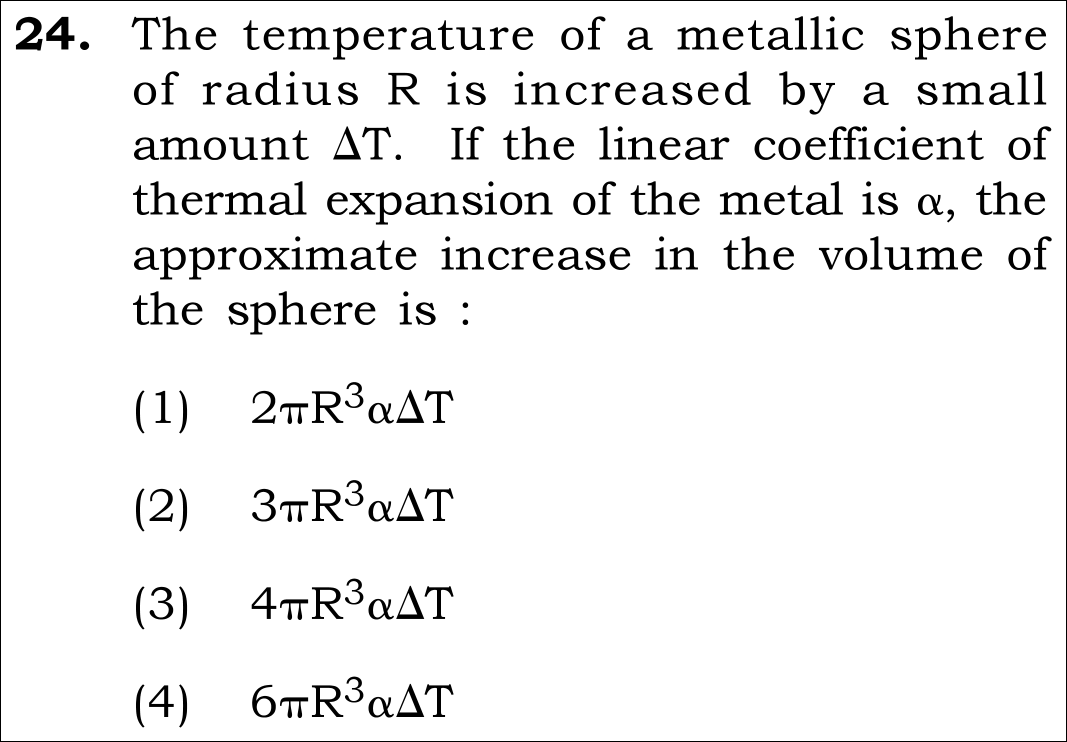
Option (3) : Delta V = 4 * pi * R^3 * alpha * Delta T
📚 Thermal Properties of Matter Easy
📋 Given Parameters & Problem Setup
Body Metallic sphere of radius R
Temperature Increase Small amount Delta T
Linear Expansion Coefficient alpha
Target Quantity Approximate increase in volume Delta V
⚡
⏱️ Eliminates memorization confusion. The 30-Second Exam Hall Shortcut: ⚡ Differential Volume Expansion Rule
Differentiate sphere volume V = (4/3)*pi*R^3 with respect to R!
1 Radius increases by dR = R * alpha * Delta T.
2 Volume of sphere: V = (4/3) * pi * R^3.
3 Differentiate: dV = (4/3) * pi * (3 * R^2 * dR) = 4 * pi * R^2 * dR.
4 Substitute dR: dV = 4 * pi * R^2 * (R * alpha * Delta T) = 4 * pi * R^3 * alpha * Delta T.
5 Notice: The factor 3 cancels cleanly! Instant answer in 10 seconds!
🛡️
Why You Can 100% Trust This Shortcut: Volume expansion coefficient gamma = 3*alpha for isotropic materials. Fractional volume change is Delta V / V = gamma*Delta T = 3*alpha*Delta T. Multiplying by V = (4/3)*pi*R^3 yields Delta V = (4/3)*pi*R^3 * (3*alpha*Delta T) = 4*pi*R^3*alpha*Delta T.
📐
Step-by-Step Rigorous Workflow & Mathematical Proof
Step 1
State the Initial Volume and Volume Expansion Coefficient
For an isotropic metallic sphere of initial radius R:
- • gamma is the coefficient of cubical (volume) expansion, which equals 3 times the linear coefficient alpha.
Step 2
Formulate the Change in Volume
The increase in volume for a small temperature rise Delta T is given by thermal expansion theory:
- • Valid for small temperature increments (Delta T << 1/alpha).
Step 3
Substitute Initial Volume and Simplify
Substitute V = (4/3) * pi * R^3 into the expansion formula:
- • The factor of 3 in the numerator cancels the factor of 3 in the denominator.
- • Leaves the exact result: 4 * pi * R^3 * alpha * Delta T.
- • Matches Option (3) exactly.
⭐
4-Option Deep Scan
360° Option Elimination Engine Key Feature
Diagnose every choice: Know exactly why the right option works and why distractors fail.
1 Option (1)
✗ Incorrect Verdict & Scientific Reason:
Uses areal expansion coefficient beta = 2*alpha.
⚠️
Student Fallacy (Why candidates pick this trap): Confuses volume expansion with surface area expansion (using factor 2 instead of 3).
Note: Volume expansion uses gamma = 3*alpha, not 2*alpha.
2 Option (2)
✗ Incorrect Verdict & Scientific Reason:
Arithmetic factor error.
⚠️
Student Fallacy (Why candidates pick this trap): Drops the factor 4 from (4/3)*pi*R^3.
Note: Sphere volume has a factor of 4: (4/3)*pi*R^3.
3 Option (3)
✓ 100% Correct Verdict & Scientific Reason:
100% mathematically exact; confirmed by Official NTA Final Answer Key.
💡
Why this is airtight: Flawless execution of gamma = 3*alpha and volume formula.
Note: Exact thermal physics.
4 Option (4)
✗ Incorrect Verdict & Scientific Reason:
Spurious factor of 6.
⚠️
Student Fallacy (Why candidates pick this trap): Multiplies by 2 again or uses diameter instead of radius.
Note: Factor is exactly 4.
⚠️
NTA Trap Alert: Forgetting gamma = 3*alpha
Students who use Delta V = V * alpha * Delta T calculate (4/3)*pi*R^3*alpha*Delta T and get confused because it is not in the options.
🛡️ How to avoid the -1 mark: Always remember: Linear = alpha; Superficial/Area = 2*alpha; Cubical/Volume = 3*alpha!
📖
Core NEET Syllabus Standard
NEET UG Physics Core Standards · Thermal Properties of Matter Standard Benchmark
Core Scientific Principle Tested:
"For an isotropic solid, gamma = 3*alpha. Fractional volume change is dV/V = 3*alpha*dT."
Syllabus Focus: Thermal Expansion of Solids (Linear, Area, and Volume)
✓ Core NEET UG Syllabus Anchor Syllabus & Academic Standards ↗