MyCompetitiveExams Logo MyCompetitiveExams
Search 1,140+ Questions
Chapters, formulas, speed tricks
→
⚡ Brahmastra NEET 2027
720 MARKS

Dynamic 180-question full-length simulator mixed dynamically from all 6 years for 2027 & 2026 aspirants.

Launch Brahmastra 2027 Test →
Start Practice →
100% Free · No Login Required
Q.13 Physics ⭐ 360° Option Elimination Active
Vault ↗

NEET 2026 Physics Question 13 Solution

Topic: Gravitation · Official NTA Booklet Code 50
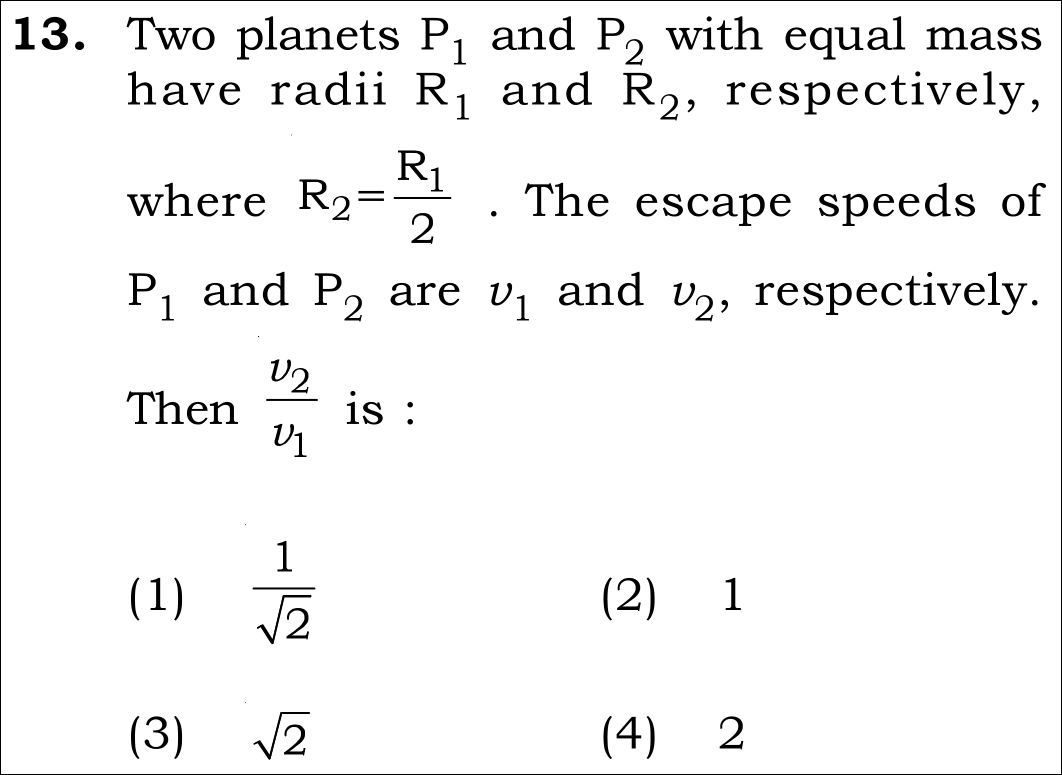
NEET 2026 Physics Question 13: Escape Speed Ratio for Equal-Mass Planets with Different Radii

Question

Two planets P₁ and P₂ with equal mass have radii R₁ and R₂, respectively, where R₂ = R₁/2. The escape speeds of P₁ and P₂ are v₁ and v₂, respectively. Then v₂/v₁ is:

✓
Verified Against NTA Final Answer Key
Option (3) : v_2 / v_1 = sqrt(2)
📚 Gravitation Easy
📋 Given Parameters & Problem Setup
Masses of Planets M_1 = M_2 = M (equal mass)
Radii of Planets R_2 = R_1 / 2
Escape Speeds v_1 for P_1, and v_2 for P_2
Target Ratio v_2 / v_1
⚡

The 30-Second Exam Hall Shortcut: ⚡ Inverse Square Root Scaling

⏱️ Instant mental math saves 45 seconds.

Escape speed is inversely proportional to the square root of radius

1 Fundamental formula: v_e = sqrt(2*G*M / R).
2 Since masses are identical: v_e is proportional to 1 / sqrt(R).
3 Form the ratio: v_2 / v_1 = sqrt(R_1 / R_2).
4 Given R_2 = R_1 / 2 ==> R_1 / R_2 = 2.
5 v_2 / v_1 = sqrt(2). Solved in 10 seconds!
🛡️
Why You Can 100% Trust This Shortcut: Escape velocity is derived from energy conservation: (1/2)*m*v_e^2 = G*M*m / R. The required kinetic energy scales as 1/R, so speed scales as 1/sqrt(R).
📐

Step-by-Step Rigorous Workflow & Mathematical Proof

Step 1

State the Escape Velocity Formula

Escape velocity from the surface of a spherical celestial body of mass M and radius R is given by conservation of mechanical energy:

12mve2−GMmR=0  ⟹  ve=2GMR\frac{1}{2} m v_e^2 - \frac{G M m}{R} = 0 \implies v_e = \sqrt{\frac{2 G M}{R}}
  • • G is the universal gravitational constant.
  • • M is the planet mass, and R is the planetary surface radius.
Step 2

Set Up the Ratio for Planets P_1 and P_2

Since both planets have identical mass M_1 = M_2 = M:

v2v1=2GMR22GMR1=R1R2\frac{v_2}{v_1} = \frac{\sqrt{\frac{2 G M}{R_2}}}{\sqrt{\frac{2 G M}{R_1}}} = \sqrt{\frac{R_1}{R_2}}
  • • Constants 2, G, and M cancel out completely.
Step 3

Substitute Given Radii and Solve

Substitute R_2 = R_1 / 2 into the square root expression:

v2v1=R1R1/2=2\frac{v_2}{v_1} = \sqrt{\frac{R_1}{R_1 / 2}} = \sqrt{2}
  • • Confirms v_2 / v_1 = sqrt(2).
  • • Matches Option (3) exactly.
⭐

360° Option Elimination Engine Key Feature

Diagnose every choice: Know exactly why the right option works and why distractors fail.

4-Option Deep Scan
1 Option (1)
✗ Incorrect
Verdict & Scientific Reason:

Inverted ratio.

⚠️
Student Fallacy (Why candidates pick this trap): Computes v_1 / v_2 instead of requested ratio v_2 / v_1.
Note: Always re-read the target fraction: numerator is planet 2, denominator is planet 1.
2 Option (2)
✗ Incorrect
Verdict & Scientific Reason:

Ignores radius dependency.

⚠️
Student Fallacy (Why candidates pick this trap): Assumes equal mass implies equal escape speed.
Note: A smaller planet concentrates mass more tightly, creating a deeper potential well.
3 Option (3)
✓ 100% Correct
Verdict & Scientific Reason:

100% mathematically exact; confirmed by Official NTA Final Answer Key.

💡
Why this is airtight: Flawless application of inverse square root radius proportionality.
Note: Exact physics.
4 Option (4)
✗ Incorrect
Verdict & Scientific Reason:

Forgot the square root.

⚠️
Student Fallacy (Why candidates pick this trap): Assumes v_e is inversely proportional to R instead of sqrt(R): v_2 / v_1 = R_1 / R_2 = 2.
Note: Energy scales with 1/R; velocity scales with 1/sqrt(R).
⚠️

NTA Trap Alert: The Linear Radius Scaling Fallacy (Missing Square Root)

Candidates under time pressure often associate "half the radius" with "double the escape speed", forgetting that velocity requires taking the square root of potential energy.

🛡️ How to avoid the -1 mark: Always remember: Kinetic energy K ~ v^2 ~ 1/R ==> v ~ 1/sqrt(R).
📖

Core NEET Syllabus Standard

NEET UG Physics Core Standards · Gravitation Standard Benchmark
Core Scientific Principle Tested:

"Escape velocity from planet surface: v_e = sqrt(2GM/R) = sqrt(2gR). For fixed mass M, v_e is inversely proportional to sqrt(R)."

Syllabus Focus: Escape Speed & Gravitational Potential Energy
✓ Core NEET UG Syllabus Anchor Syllabus & Academic Standards ↗

Ready to attempt under real exam pressure?

Test your speed and accuracy in the authentic 180-minute timed NTA simulator.

Launch NEET 2026 CBT Test →

Spotted a mistake in this solution? Report an error ([email protected])

⚖️ Legal & Fair Dealing Notice: Sourced from publicly released NEET 2026 question papers and NEET answer keys for private study, research, and non-commercial educational practice under Fair Dealing (Section 52(1)(a) of the Indian Copyright Act, 1957). Not affiliated with or endorsed by NTA or NMC.

Solve 4 NEET Questions a Day — One per Subject

Cover all 1,140 official NEET questions in 285 days at your own pace. Progress is saved on your device. No login needed.