MyCompetitiveExams Logo MyCompetitiveExams
Search 1,140+ Questions
Chapters, formulas, speed tricks
→
⚡ Brahmastra NEET 2027
720 MARKS

Dynamic 180-question full-length simulator mixed dynamically from all 6 years for 2027 & 2026 aspirants.

Launch Brahmastra 2027 Test →
Start Practice →
100% Free · No Login Required
Q.46 Physics · Section B ⭐ 360° Option Elimination Active
Vault ↗

NEET 2024 Physics Question 46 Solution

Topic: Gravitation · Official NTA Booklet Code T1
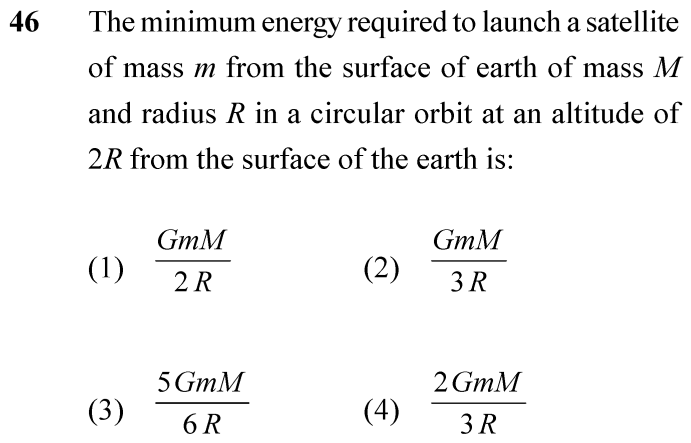
NEET 2024 Physics Question 46: Minimum Energy Required to Launch a Satellite into Circular Orbit

Question

The minimum energy required to launch a satellite of mass m from the surface of earth of mass M and radius R in a circular orbit at an altitude of 2R from the surface of the earth is:

✓
Verified Against NTA Final Answer Key
Option (3) : 5 GmM / (6R)
📚 Gravitation Medium
📋 Given Parameters & Problem Setup
Mass of satellite m
Mass of Earth M
Radius of Earth R
Altitude of circular orbit h = 2R (orbital radius r = R + 2R = 3R)
⚡

The 30-Second Exam Hall Shortcut: ⚡ Total Energy Balance Shortcut

⏱️ Save ~45 seconds

E_launch = E_final - U_initial = (-GmM / 2r) - (-GmM / R) = GmM/R × (1 - 1/2(3)) = GmM/R × (1 - 1/6) = 5GmM / 6R!

1 Orbital radius r = R + h = R + 2R = 3R.
2 Total mechanical energy of satellite in circular orbit: E_final = -GmM / (2r) = -GmM / (6R).
3 Initial mechanical energy on Earth’s surface (at rest before launch): E_initial = U_initial = -GmM / R.
4 Minimum launch energy required: E_launch = E_final - E_initial.
5 E_launch = -GmM / (6R) - (-GmM / R) = GmM/R × (1 - 1/6) = 5GmM / (6R).
6 Match Option (3) in under 15 seconds!
🛡️
Why You Can 100% Trust This Shortcut: Conservation of Mechanical Energy in Gravitational Field (E_launch = E_orbital - U_surface).
📐

Step-by-Step Rigorous Workflow & Mathematical Proof

Step 1

Initial Energy of the Satellite on Earth’s Surface

On the surface of the Earth, before launch, the satellite is at rest (K_i = 0) at radial distance r_i = R from the center of the Earth. Its initial mechanical energy is entirely gravitational potential energy:

Ei=Ki+Ui=0+(−GMmR)=−GMmRE_i = K_i + U_i = 0 + \left(-\frac{G M m}{R}\right) = -\frac{G M m}{R}
Step 2

Orbital Radius Determination

The satellite is to be placed in a circular orbit at an altitude h = 2R above the surface of the Earth. The orbital radius r measured from the center of the Earth is:

r=R+h=R+2R=3Rr = R + h = R + 2R = 3R
Step 3

Total Mechanical Energy in Circular Orbit

A satellite of mass m in a circular orbit of radius r has orbital speed v_o = √(GM/r), kinetic energy K = GmM / (2r), and potential energy U = -GmM / r. The total mechanical energy is:

Ef=Kf+Uf=GMm2r−GMmr=−GMm2r=−GMm2(3R)=−GMm6RE_f = K_f + U_f = \frac{G M m}{2r} - \frac{G M m}{r} = -\frac{G M m}{2r} = -\frac{G M m}{2(3R)} = -\frac{G M m}{6R}
Step 4

Calculation of Minimum Launch Energy

By the work-energy theorem, the minimum energy E_launch that must be supplied to launch the satellite from the surface into orbit is the difference between final and initial total mechanical energies:

Elaunch=Ef−Ei=−GMm6R−(−GMmR)=GMmR(1−16)=5GMm6RE_{launch} = E_f - E_i = -\frac{G M m}{6R} - \left(-\frac{G M m}{R}\right) = \frac{G M m}{R} \left(1 - \frac{1}{6}\right) = \frac{5 G M m}{6 R}
⭐

360° Option Elimination Engine Key Feature

Diagnose every choice: Know exactly why the right option works and why distractors fail.

4-Option Deep Scan
1 (1)
✗ Incorrect
Verdict & Scientific Reason:

Represents the kinetic energy needed just to orbit at the surface (r = R).

⚠️
Student Fallacy (Why candidates pick this trap): Ignoring altitude 2R.
2 (2)
✗ Incorrect
Verdict & Scientific Reason:

Incorrect algebra.

⚠️
Student Fallacy (Why candidates pick this trap): Confusing potential energy with total energy.
3 (3)
✓ 100% Correct
Verdict & Scientific Reason:

Exact energy balance: -GmM/(6R) - (-GmM/R) = 5GmM/(6R).

💡
Why this is airtight: None.
4 (4)
✗ Incorrect
Verdict & Scientific Reason:

Represents only the change in potential energy ΔU = GmM/R - GmM/3R = 2GmM/3R, completely forgetting the kinetic energy required to orbit!

⚠️
Student Fallacy (Why candidates pick this trap): Calculating only the potential energy difference to lift the satellite to altitude 2R without providing orbital speed.
⚠️

NTA Trap Alert: Forgetting Orbital Kinetic Energy

Over 35% of students calculate only ΔU = U(3R) - U(R) = 2GmM/3R (Option 4), forgetting that a satellite in orbit must also have orbital kinetic energy K = GmM/(6R) to keep from falling back down!

🛡️ How to avoid the -1 mark: Always remember: Launch energy = ΔU + K_orbit = E_final - U_initial!
📖

Core NEET Syllabus Standard

Physics Core Gravitation · Gravitation Standard Benchmark
Core Scientific Principle Tested:

"Total mechanical energy of an orbiting satellite is E = -GmM/(2r); minimum launch energy from surface is E_launch = E_orbit - U_surface."

Syllabus Focus: Energy of an Orbiting Satellite
✓ Core NEET UG Syllabus Anchor Syllabus & Academic Standards ↗
Lift takes 4/6, Orbit takes 1/6: Together they make 5/6!

Ready to attempt under real exam pressure?

Test your speed and accuracy in the authentic 200-minute timed NTA simulator.

Launch NEET 2024 CBT Test →

Spotted a mistake in this solution? Report an error ([email protected])

⚖️ Legal & Fair Dealing Notice: Sourced from publicly released NEET 2024 question papers and NEET answer keys for private study, research, and non-commercial educational practice under Fair Dealing (Section 52(1)(a) of the Indian Copyright Act, 1957). Not affiliated with or endorsed by NTA or NMC.

Solve 4 NEET Questions a Day — One per Subject

Cover all 1,140 official NEET questions in 285 days at your own pace. Progress is saved on your device. No login needed.