NEET 2023 Physics Question 15 Solution
Question
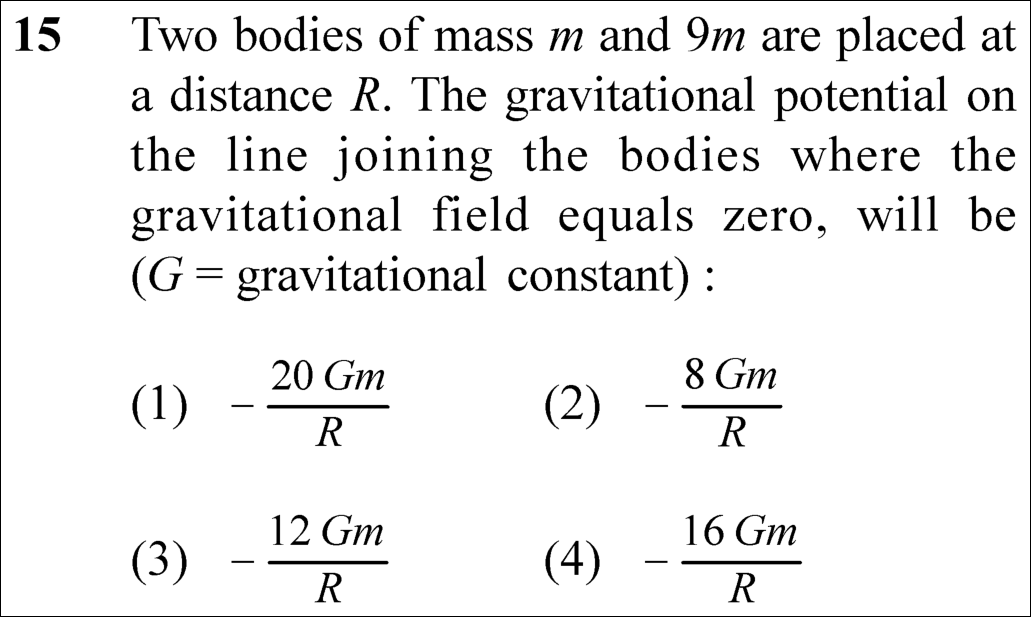
Two bodies of mass m and 9m are placed at a distance R. The gravitational potential on the line joining the bodies where the gravitational field equals zero, will be (G = gravitational constant):
Dynamic 180-question full-length simulator mixed dynamically from all 6 years for 2027 & 2026 aspirants.
Two bodies of mass m and 9m are placed at a distance R. The gravitational potential on the line joining the bodies where the gravitational field equals zero, will be (G = gravitational constant):
Neutral distance from m is x = R / (1 + √(9m/m)) = R / (1 + 3) = R/4! Potential V = -Gm/(R/4) - 9Gm/(3R/4) = -4 - 12 = -16 Gm/R in 20 seconds!
Let the neutral point P be located at distance x from mass m and (R - x) from mass 9m along the line joining them. At P, the net gravitational field is zero:
Taking the square root on both sides (since distance must lie between the masses):
The distances from the respective masses are:
Gravitational potential is a scalar quantity. The total potential V at point P is the algebraic sum of the potentials due to m and 9m:
Diagnose every choice: Know exactly why the right option works and why distractors fail.
Overestimates negative potential magnitude.
Underestimates potential magnitude.
Represents only the contribution of the larger 9m mass, ignoring mass m.
Accurate value: scalar sum of -4 Gm/R and -12 Gm/R at the neutral point.
Hasty students write x / (R - x) = 1/9 instead of taking the square root 1/3. This places x at R/10 and leads to completely wrong potentials.
"Gravitational field is a vector (E = -dV/dr), while potential is an additive negative scalar (V = -GM/r)."
Test your speed and accuracy in the authentic 200-minute timed NTA simulator.
Spotted a mistake in this solution? Report an error ([email protected])
Cover all 1,140 official NEET questions in 285 days at your own pace. Progress is saved on your device. No login needed.