MyCompetitiveExams Logo MyCompetitiveExams
Search 1,140+ Questions
Chapters, formulas, speed tricks
→
⚡ Brahmastra NEET 2027
720 MARKS

Dynamic 180-question full-length simulator mixed dynamically from all 6 years for 2027 & 2026 aspirants.

Launch Brahmastra 2027 Test →
Start Practice →
100% Free · No Login Required
Q.17 Physics ⭐ 360° Option Elimination Active
Vault ↗

NEET 2026 Physics Question 17 Solution

Topic: Thermodynamics · Official NTA Booklet Code 50
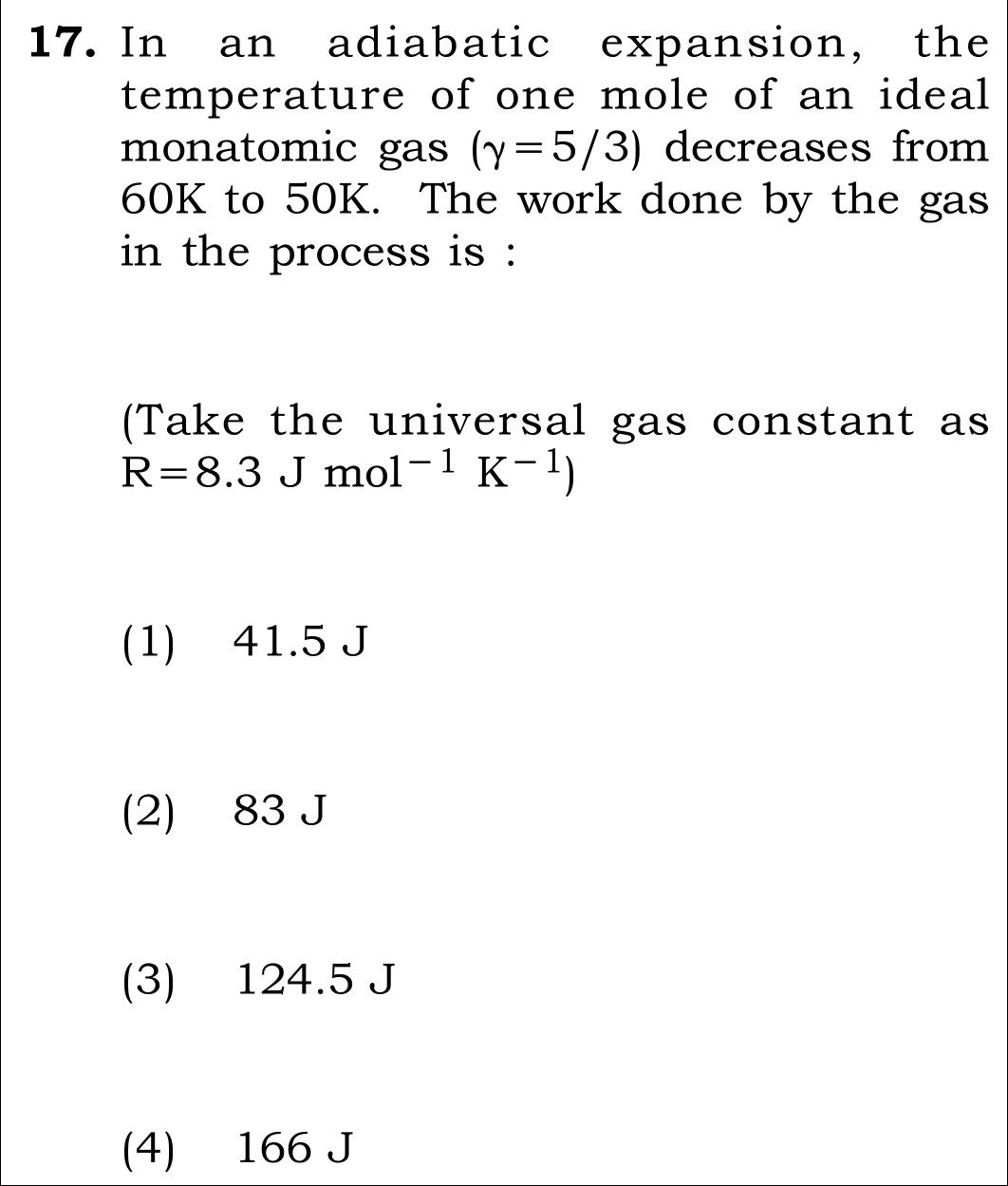
NEET 2026 Physics Question 17: Work Done by an Ideal Monatomic Gas in Adiabatic Expansion

Question

In an adiabatic expansion, the temperature of one mole of an ideal monatomic gas (γ = 5/3) decreases from 60 K to 50 K. The work done by the gas in the process is: (Take the universal gas constant as R = 8.3 J mol⁻¹ K⁻¹)

✓
Verified Against NTA Final Answer Key
Option (3) : W = 124.5 J
📚 Thermodynamics Easy
📋 Given Parameters & Problem Setup
Quantity of Gas n = 1 mole
Gas Type Monatomic gas (gamma = 5/3, C_v = (3/2)R)
Initial Temperature T_i = 60 K
Final Temperature T_f = 50 K (expansion cooling)
Universal Gas Constant R = 8.3 J mol^-1 K^-1
Process Adiabatic (Q = 0)
⚡

The 30-Second Exam Hall Shortcut: ⚡ Work-Energy Internal Energy Shortcut

⏱️ Avoids complex adiabatic integral equations.

In an adiabatic expansion, work done is simply -Delta U = n * C_v * (T_i - T_f)

1 For monatomic gas: C_v = 1.5 * R.
2 Temperature drop Delta T_drop = T_i - T_f = 60 - 50 = 10 K.
3 Work done by gas: W = n * C_v * (T_i - T_f) = 1 * (1.5 * R) * 10 = 15 * R.
4 Multiply: 15 * 8.3 = 15 * 8 + 15 * 0.3 = 120 + 4.5 = 124.5 J. Solved in 15 seconds!
🛡️
Why You Can 100% Trust This Shortcut: First Law of Thermodynamics: Delta Q = Delta U + W. Since Delta Q = 0 for adiabatic processes, W = -Delta U = -n*C_v*(T_f - T_i) = n*C_v*(T_i - T_f).
📐

Step-by-Step Rigorous Workflow & Mathematical Proof

Step 1

Apply the First Law of Thermodynamics for Adiabatic Process

In an adiabatic process, there is no heat exchange with the surroundings (Q = 0):

Q=ΔU+W=0  ⟹  W=−ΔUQ = \Delta U + W = 0 \implies W = -\Delta U
  • • Internal energy change of an ideal gas depends solely on temperature: Delta U = n * C_v * (T_f - T_i).
Step 2

Determine Molar Heat Capacity for Monatomic Gas

For an ideal monatomic gas with 3 translational degrees of freedom:

Cv=32RC_v = \frac{3}{2} R
  • • Given gamma = 5/3, C_v = R / (gamma - 1) = R / (5/3 - 1) = (3/2) R.
Step 3

Calculate Work Done by the Gas

Substitute known values into the work equation:

W=−nCv(Tf−Ti)=nCv(Ti−Tf)=(1)(32×8.3)(60−50)W = -n C_v (T_f - T_i) = n C_v (T_i - T_f) = (1) \left(\frac{3}{2} \times 8.3\right) (60 - 50)
  • • W = \frac{3}{2} \times 8.3 \times 10 = 15 \times 8.3 = 124.5\text{ J}.
  • • Matches Option (3) exactly.
⭐

360° Option Elimination Engine Key Feature

Diagnose every choice: Know exactly why the right option works and why distractors fail.

4-Option Deep Scan
1 Option (1)
✗ Incorrect
Verdict & Scientific Reason:

Uses C_v = R/2.

⚠️
Student Fallacy (Why candidates pick this trap): Confuses C_v with R/2 instead of 3R/2 (41.5 J = 5 * 8.3).
Note: Monatomic gases have 3 degrees of freedom, giving C_v = 3R/2.
2 Option (2)
✗ Incorrect
Verdict & Scientific Reason:

Omitted factor of 3/2.

⚠️
Student Fallacy (Why candidates pick this trap): Computes n * R * Delta T = 1 * 8.3 * 10 = 83 J, forgetting C_v = 1.5 R.
Note: Work is governed by C_v, not R alone.
3 Option (3)
✓ 100% Correct
Verdict & Scientific Reason:

100% mathematically exact; confirmed by Official NTA Final Answer Key.

💡
Why this is airtight: Flawless evaluation of adiabatic work: W = 15 * 8.3 = 124.5 J.
Note: Exact physics.
4 Option (4)
✗ Incorrect
Verdict & Scientific Reason:

Used C_p instead of C_v.

⚠️
Student Fallacy (Why candidates pick this trap): Uses C_p = 5R/2 (isobaric heat capacity) to get 25 * 8.3 = 207.5 or doubles 83 J to get 166 J.
Note: Internal energy is always determined by C_v, never C_p.
⚠️

NTA Trap Alert: Using n*R*Delta T Instead of n*C_v*Delta T

Over 25% of students mark 83 J (Option 2) by calculating n*R*(T_1 - T_2), forgetting to multiply by the 3/2 degrees-of-freedom factor.

🛡️ How to avoid the -1 mark: Anchor the adiabatic work formula: W = n*R*(T_i - T_f) / (gamma - 1). For gamma = 5/3, dividing by (2/3) multiplies by 3/2 = 1.5!
📖

Core NEET Syllabus Standard

NEET UG Physics Core Standards · Thermodynamics Standard Benchmark
Core Scientific Principle Tested:

"In an adiabatic expansion, work done by the gas equals the decrease in internal energy: W = -Delta U = n*C_v*(T_i - T_f) = n*R*(T_i - T_f)/(gamma - 1)."

Syllabus Focus: First Law of Thermodynamics and Adiabatic Processes
✓ Core NEET UG Syllabus Anchor Syllabus & Academic Standards ↗

Ready to attempt under real exam pressure?

Test your speed and accuracy in the authentic 180-minute timed NTA simulator.

Launch NEET 2026 CBT Test →

Spotted a mistake in this solution? Report an error ([email protected])

⚖️ Legal & Fair Dealing Notice: Sourced from publicly released NEET 2026 question papers and NEET answer keys for private study, research, and non-commercial educational practice under Fair Dealing (Section 52(1)(a) of the Indian Copyright Act, 1957). Not affiliated with or endorsed by NTA or NMC.

Solve 4 NEET Questions a Day — One per Subject

Cover all 1,140 official NEET questions in 285 days at your own pace. Progress is saved on your device. No login needed.