MyCompetitiveExams Logo MyCompetitiveExams
Search 1,140+ Questions
Chapters, formulas, speed tricks
→
⚡ Brahmastra NEET 2027
720 MARKS

Dynamic 180-question full-length simulator mixed dynamically from all 6 years for 2027 & 2026 aspirants.

Launch Brahmastra 2027 Test →
Start Practice →
100% Free · No Login Required
Q.65 Chemistry ⭐ 360° Option Elimination Active
Vault ↗

NEET 2025 Chemistry Question 65 Solution

Topic: Chemical Thermodynamics & Kinetics · Official NTA Booklet Code 45
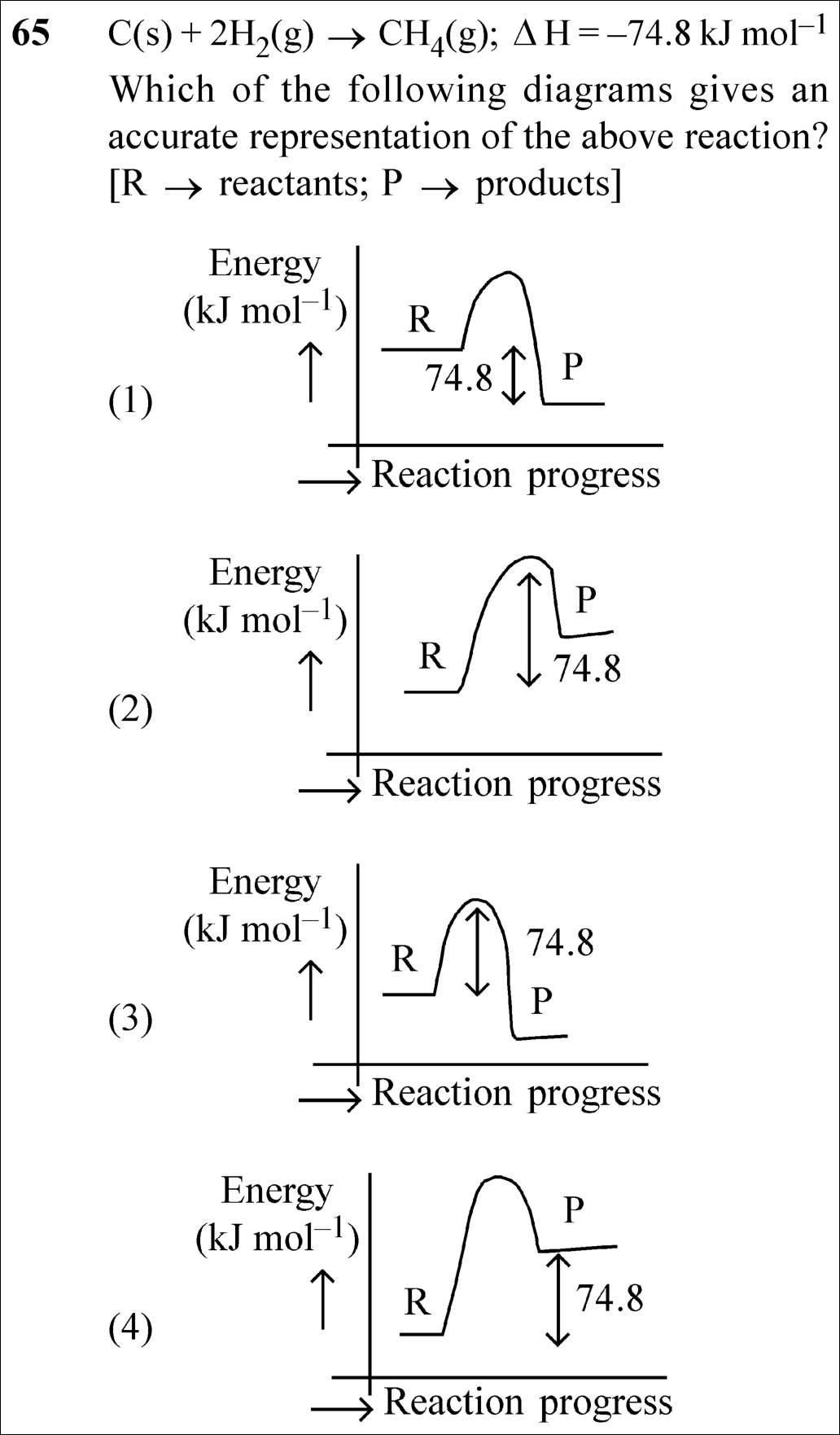
NEET 2025 Chemistry Question 65: Potential Energy Coordinate Representation of an Exothermic Reaction

Question

C(s) + 2H₂(g) → CH₄(g); ΔH = −74.8 kJ mol⁻¹. Which of the following diagrams gives an accurate representation of the above reaction? [R → reactants; P → products]

✓
Verified Against NTA Final Answer Key
Option (1) : Diagram (1) [Reactants R at higher energy than Products P, with ΔH = 74.8 kJ/mol representing the R-to-P level difference]
📚 Chemical Thermodynamics & Kinetics Easy
📋 Given Parameters & Problem Setup
Chemical Equation C(s) + 2H₂(g) → CH₄(g)
Reaction Enthalpy (ΔH) -74.8 kJ mol⁻¹ (Exothermic reaction)
⚡

The 30-Second Exam Hall Shortcut: ⚡ Exothermic Energy Profile Rule

⏱️ Save ~30 seconds

ΔH is NEGATIVE (-74.8 kJ/mol) ⟹ EXOTHERMIC! Products P must be LOWER in energy than Reactants R (H_P < H_R). The energy difference between level R and level P is ΔH = 74.8 kJ/mol! Diagram (1) shows exactly this!

1 Examine sign of ΔH: ΔH = -74.8 kJ/mol (negative ⟹ exothermic reaction).
2 Rule for exothermic reactions: Heat is released, so final enthalpy of products is lower than initial enthalpy of reactants: H_P < H_R.
3 Eliminate diagrams (2) and (4) where Products P are shown at higher energy than Reactants R (endothermic).
4 Compare diagram (1) vs diagram (3):
5 In diagram (1), 74.8 is labeled as the vertical difference between reactant level R and product level P (which is ΔH).
6 In diagram (3), 74.8 is labeled as the height from R to the transition state peak (which is Activation Energy E_a, not ΔH!).
7 Therefore, only diagram (1) accurately represents the reaction.
8 Select Option (1) in under 10 seconds!
🛡️
Why You Can 100% Trust This Shortcut: Reaction Energetics & Activation Energy Profiles (NCERT Chemistry · Chemical Thermodynamics & Kinetics).
📐

Step-by-Step Rigorous Workflow & Mathematical Proof

Step 1

Determine Thermodynamic Nature of the Reaction

The given enthalpy change for the formation of methane is negative:

ΔH=Hproducts−Hreactants=−74.8 kJ⋅mol−1<0\Delta H = H_{products} - H_{reactants} = -74.8\text{ kJ}\cdot\text{mol}^{-1} < 0
  • • Because ΔH is negative, the reaction is strictly exothermic.
  • • Reactants (R) have higher potential energy than Products (P).
Step 2

Eliminate Endothermic Energy Profiles

In diagrams (2) and (4), the product level P is higher than the reactant level R (H_P > H_R), which represents an endothermic process (ΔH > 0):

HP>HR  ⟹  ΔH>0(Incorrect for this reaction)H_P > H_R \implies \Delta H > 0 \quad (\text{Incorrect for this reaction})
  • • Diagrams (2) and (4) are ruled out immediately.
Step 3

Distinguish Reaction Enthalpy (ΔH) from Activation Energy (E_a)

Examine the labeling of the 74.8 kJ/mol magnitude in diagrams (1) and (3):

ΔH=∣HP−HR∣=74.8 kJ⋅mol−1,Ea=Hactivated complex−HR\Delta H = |H_P - H_R| = 74.8\text{ kJ}\cdot\text{mol}^{-1}, \quad E_a = H_{activated\,complex} - H_R
  • • In diagram (3), the arrow 74.8 is drawn between the reactant baseline and the peak of the activation barrier, which incorrectly labels activation energy as ΔH.
  • • In diagram (1), the double-headed arrow 74.8 correctly spans the energy gap between the reactant plateau (R) and the product plateau (P).
  • • Thus diagram (1) is the only accurate representation, matching Option (1).
⭐

360° Option Elimination Engine Key Feature

Diagnose every choice: Know exactly why the right option works and why distractors fail.

4-Option Deep Scan
1 A
✓ 100% Correct
Verdict & Scientific Reason:

100% correct. Correctly portrays an exothermic reaction with H_P < H_R and ΔH = 74.8 between R and P.

💡
Why this is airtight: None; precise interpretation of potential energy diagrams.
2 B
✗ Incorrect
Verdict & Scientific Reason:

Incorrect. Shows an endothermic reaction (P higher than R).

⚠️
Student Fallacy (Why candidates pick this trap): Failing to recognize negative ΔH as exothermic.
3 C
✗ Incorrect
Verdict & Scientific Reason:

Incorrect. Confuses activation energy E_a with reaction enthalpy ΔH.

⚠️
Student Fallacy (Why candidates pick this trap): Labeling the energy barrier height as ΔH.
4 D
✗ Incorrect
Verdict & Scientific Reason:

Incorrect. Shows an endothermic reaction profile.

⚠️
Student Fallacy (Why candidates pick this trap): Confusing endothermic and exothermic profiles.
⚠️

NTA Trap Alert: Labeling Activation Barrier as ΔH (Diagram 3 Trap)

Diagram 3 has products lower than reactants (exothermic), but labels the peak height as 74.8! ΔH is ALWAYS the net difference between initial reactant level and final product level, NEVER the barrier height!

🛡️ How to avoid the -1 mark: Remember: ΔH = Level(R) - Level(P); Activation Energy = Peak - Level(R).
📖

Core NEET Syllabus Standard

NEET Chemistry Core Syllabus · Chemical Thermodynamics Standard Benchmark
Core Scientific Principle Tested:

"For exothermic reactions, H_products < H_reactants, and ΔH is the energy gap between the two states."

Syllabus Focus: Exothermic Reactions & Enthalpy Profiles
✓ Core NEET UG Syllabus Anchor Syllabus & Academic Standards ↗
Exo means Exit: Products drop lower, and ΔH is the gap between R and P (Diagram 1)!

Ready to attempt under real exam pressure?

Test your speed and accuracy in the authentic 180-minute timed NTA simulator.

Launch NEET 2025 CBT Test →

Spotted a mistake in this solution? Report an error ([email protected])

⚖️ Legal & Fair Dealing Notice: Sourced from publicly released NEET 2025 question papers and NEET answer keys for private study, research, and non-commercial educational practice under Fair Dealing (Section 52(1)(a) of the Indian Copyright Act, 1957). Not affiliated with or endorsed by NTA or NMC.

Solve 4 NEET Questions a Day — One per Subject

Cover all 1,140 official NEET questions in 285 days at your own pace. Progress is saved on your device. No login needed.