NEET 2021 Zoology Question 165 Solution
Question
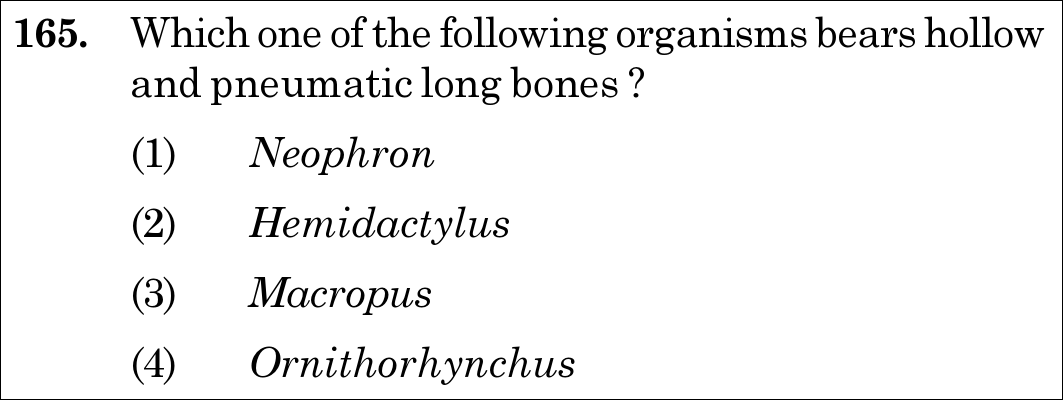
Which one of the following organisms bears hollow and pneumatic long bones?
- (1)Neophron
- (2)Hemidactylus
- (3)Macropus
- (4)Ornithorhynchus
Dynamic 180-question full-length simulator mixed dynamically from all 6 years for 2027 & 2026 aspirants.
Which one of the following organisms bears hollow and pneumatic long bones?
Pneumatic (hollow, air-cavity containing) bones are the hallmark flight adaptation of Class Aves. Neophron is the vulture (bird). Hemidactylus is a wall lizard (reptile), Macropus is the kangaroo (mammal), and Ornithorhynchus is the platypus (mammal). Match Option (1) instantly!
Birds (Class Aves) exhibit numerous anatomical specializations designed to minimize weight during flight: - The endoskeleton is fully ossified (bony). - The long bones are hollow and contain air cavities (pneumatic bones) connected to auxiliary respiratory air sacs. - This skeletal adaptation significantly reduces specific gravity while maintaining structural tensile strength under aerodynamic loading. - Pneumatic bones are unique to Class Aves among extant vertebrate classes.
- (1) *Neophron* (Vulture): A true avian genus belonging to Class Aves. Possesses pneumatic bones. - (2) *Hemidactylus* (Wall lizard): Class Reptilia. Possesses solid, non-pneumatic bones. - (3) *Macropus* (Kangaroo): Class Mammalia (metatherian marsupial). Possesses heavy, marrow-filled non-pneumatic bones adapted for saltatory bipedal locomotion. - (4) *Ornithorhynchus* (Platypus): Class Mammalia (prototherian monotreme). Possesses dense solid bones.
Diagnose every choice: Know exactly why the right option works and why distractors fail.
Correct. Neophron (vulture) is a bird (Class Aves), which canonically possesses hollow pneumatic bones with air cavities.
Incorrect. Hemidactylus is the common wall lizard (Reptilia) and lacks pneumatic bones.
Incorrect. Macropus (kangaroo) is a mammal with dense, marrow-filled limb bones.
Incorrect. Ornithorhynchus (duck-billed platypus) is an oviparous mammal; despite having a duck-like beak, its bones are mammalian (dense and solid).
Because Ornithorhynchus lays eggs and has a leathery beak, many students confuse it with birds. It is an egg-laying mammal (Prototheria) and does NOT possess pneumatic bones.
"Class Aves has pneumatic (hollow, air-filled) long bones; Neophron (vulture) is an avian representative."
Test your speed and accuracy in the authentic 200-minute timed NTA simulator.
Spotted a mistake in this solution? Report an error ([email protected])
Cover all 1,140 official NEET questions in 285 days at your own pace. Progress is saved on your device. No login needed.