MyCompetitiveExams Logo MyCompetitiveExams
Search 1,140+ Questions
Chapters, formulas, speed tricks
→
⚡ Brahmastra NEET 2027
720 MARKS

Dynamic 180-question full-length simulator mixed dynamically from all 6 years for 2027 & 2026 aspirants.

Launch Brahmastra 2027 Test →
Start Practice →
100% Free · No Login Required
Q.174 Zoology ⭐ 360° Option Elimination Active
Vault ↗

NEET 2021 Zoology Question 174 Solution

Topic: Body Fluids and Circulation · Official NTA Booklet Code M1
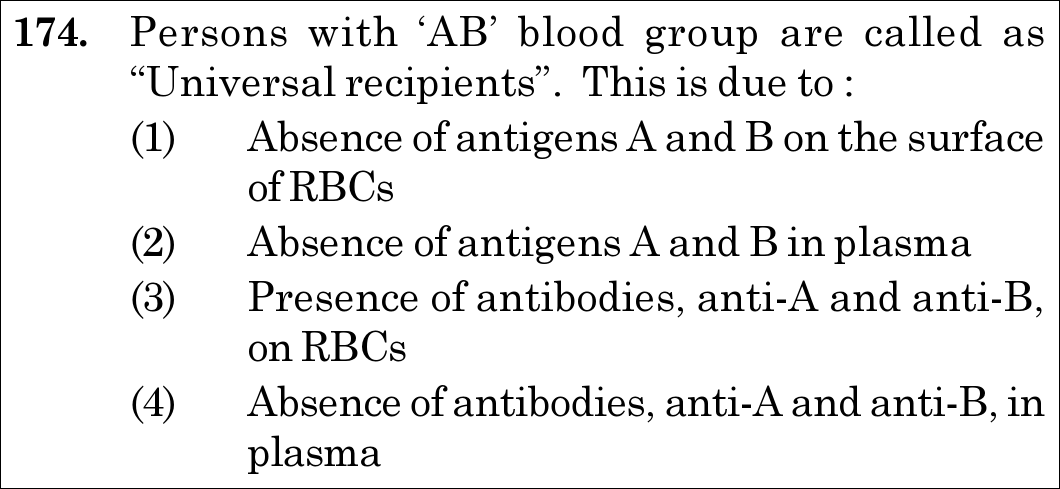
NEET 2021 Zoology Question 174: AB Blood Group as Universal Recipient: Absence of Plasma Antibodies

Question

Persons with 'AB' blood group are called as "Universal recipients". This is due to:

  1. (1)Absence of antigens A and B on the surface of RBCs
  2. (2)Absence of antigens A and B in plasma
  3. (3)Presence of antibodies, anti-A and anti-B, on RBCs
  4. (4)Absence of antibodies, anti-A and anti-B, in plasma
✓
Verified Against NTA Final Answer Key
Option (4) : Absence of antibodies, anti-A and anti-B, in plasma
📚 Body Fluids and Circulation Easy
📋 Given Parameters & Problem Setup
Phenotype AB Blood Group
Clinical Title Universal Recipient
Question Objective Identify the immunological basis for being a universal recipient
⚡

The 30-Second Exam Hall Shortcut: ⚡ "AB Group = Has A & B Antigens on RBCs, ZERO Antibodies in Plasma"

⏱️ Save ~20 seconds

Because AB blood individuals produce NEITHER anti-A NOR anti-B antibodies in their blood plasma, foreign transfused RBCs carrying A or B antigens will not be agglutinated or destroyed. Thus, absence of plasma antibodies enables universal reception!

1 Recall Landsteiner rule: Antigens reside on RBC membranes; Antibodies reside in blood plasma.
2 Blood group AB profile: - Surface Antigens: Both Antigen A and Antigen B present. - Plasma Antibodies: Neither anti-A nor anti-B (absent!).
3 Transfusion compatibility: Without recipient antibodies, donor RBCs are not attacked.
4 Match Option (4): "Absence of antibodies, anti-A and anti-B, in plasma".
🛡️
Why You Can 100% Trust This Shortcut: NCERT Biology · Body Fluids and Circulation (Blood Groups: Persons with AB group can accept blood from persons with AB as well as the other groups of blood. Therefore, such persons are called universal recipients because they have both A and B antigens on RBCs but no antibodies in plasma).
📐

Step-by-Step Rigorous Workflow & Mathematical Proof

Step 1

Immunological Profile of ABO Blood Groups

The ABO blood group system is governed by surface oligosaccharide antigens on red blood cell membranes and naturally occurring isoantibodies in blood plasma: - Group A: Antigen A on RBCs; anti-B antibody in plasma. - Group B: Antigen B on RBCs; anti-A antibody in plasma. - Group AB: Both Antigen A and Antigen B on RBCs; NEITHER anti-A nor anti-B antibodies in plasma. - Group O: No A or B antigens on RBCs; both anti-A and anti-B antibodies in plasma.

Group AB  ⟹  {RBC Surface:Antigens A and B PresentBlood Plasma:Anti-A and Anti-B Antibodies ABSENT\text{Group AB} \implies \begin{cases} \textbf{RBC Surface:} & \text{Antigens A and B Present} \\[3pt] \textbf{Blood Plasma:} & \text{Anti-A and Anti-B Antibodies } \mathbf{ABSENT} \end{cases}
Step 2

Mechanism of Universal Reception

When donor blood is transfused, the critical clinical danger is agglutination and haemolysis of the donor RBCs by antibodies present in the recipient's plasma. Because an individual with blood group AB has zero circulating anti-A and anti-B antibodies, transfused erythrocytes of type A, B, AB, or O encounter no opposing agglutinins, allowing safe transfusion without immune destruction.

⭐

360° Option Elimination Engine Key Feature

Diagnose every choice: Know exactly why the right option works and why distractors fail.

4-Option Deep Scan
1 1
✗ Incorrect
Verdict & Scientific Reason:

Incorrect. Absence of antigens on RBCs defines blood group O (universal donor), not blood group AB.

⚠️
Student Fallacy (Why candidates pick this trap): Confusing blood group O (no antigens on RBC) with blood group AB (no antibodies in plasma).
2 2
✗ Incorrect
Verdict & Scientific Reason:

Incorrect. Antigens are membrane-bound surface proteins/glycolipids on erythrocytes, not plasma solutes.

⚠️
Student Fallacy (Why candidates pick this trap): Confusing the anatomical compartments of antigens (RBC surface) and antibodies (plasma).
3 3
✗ Incorrect
Verdict & Scientific Reason:

Incorrect. Antibodies are soluble immunoglobulins in plasma, not surface receptors on RBCs.

⚠️
Student Fallacy (Why candidates pick this trap): Conflating antigens and antibodies.
4 4
✓ 100% Correct
Verdict & Scientific Reason:

Correct. Lacking both anti-A and anti-B antibodies in plasma prevents agglutination of any incoming donor red blood cells.

💡
Why this is airtight: None. Candidate accurately pairs the absence of antibodies in recipient plasma with universal recipient status.
⚠️

NTA Trap Alert: Antigen vs Antibody Compartment Inversion Trap

Options 1 and 2 swap antigens onto plasma or eliminate them from RBCs. Students rushing through the exam frequently read "absence of..." and pick Option 1, inadvertently selecting the feature of blood group O.

🛡️ How to avoid the -1 mark: Remember: Universal Donor (O) = Zero Antigens on RBC; Universal Recipient (AB) = Zero Antibodies in Plasma.
📖

Core NEET Syllabus Standard

NEET / NCERT Biology · Body Fluids and Circulation Standard Benchmark
Core Scientific Principle Tested:

"Persons with AB blood group are universal recipients because their plasma lacks both anti-A and anti-B antibodies."

Syllabus Focus: ABO Blood Grouping
✓ Core NEET UG Syllabus Anchor Syllabus & Academic Standards ↗

Ready to attempt under real exam pressure?

Test your speed and accuracy in the authentic 200-minute timed NTA simulator.

Launch NEET 2021 CBT Test →

Spotted a mistake in this solution? Report an error ([email protected])

⚖️ Legal & Fair Dealing Notice: Sourced from publicly released NEET 2021 question papers and NEET answer keys for private study, research, and non-commercial educational practice under Fair Dealing (Section 52(1)(a) of the Indian Copyright Act, 1957). Not affiliated with or endorsed by NTA or NMC.

Solve 4 NEET Questions a Day — One per Subject

Cover all 1,140 official NEET questions in 285 days at your own pace. Progress is saved on your device. No login needed.