MyCompetitiveExams Logo MyCompetitiveExams
Search 1,140+ Questions
Chapters, formulas, speed tricks
→
⚡ Brahmastra NEET 2027
720 MARKS

Dynamic 180-question full-length simulator mixed dynamically from all 6 years for 2027 & 2026 aspirants.

Launch Brahmastra 2027 Test →
Start Practice →
100% Free · No Login Required
Q.112 Botany ⭐ 360° Option Elimination Active
Vault ↗

NEET 2025 Botany Question 112 Solution

Topic: Body Fluids and Circulation · Official NTA Booklet Code 45
NEET 2025 Botany Question 112: Intrinsic, Neural, and Endocrine Regulation of the Heart

Question

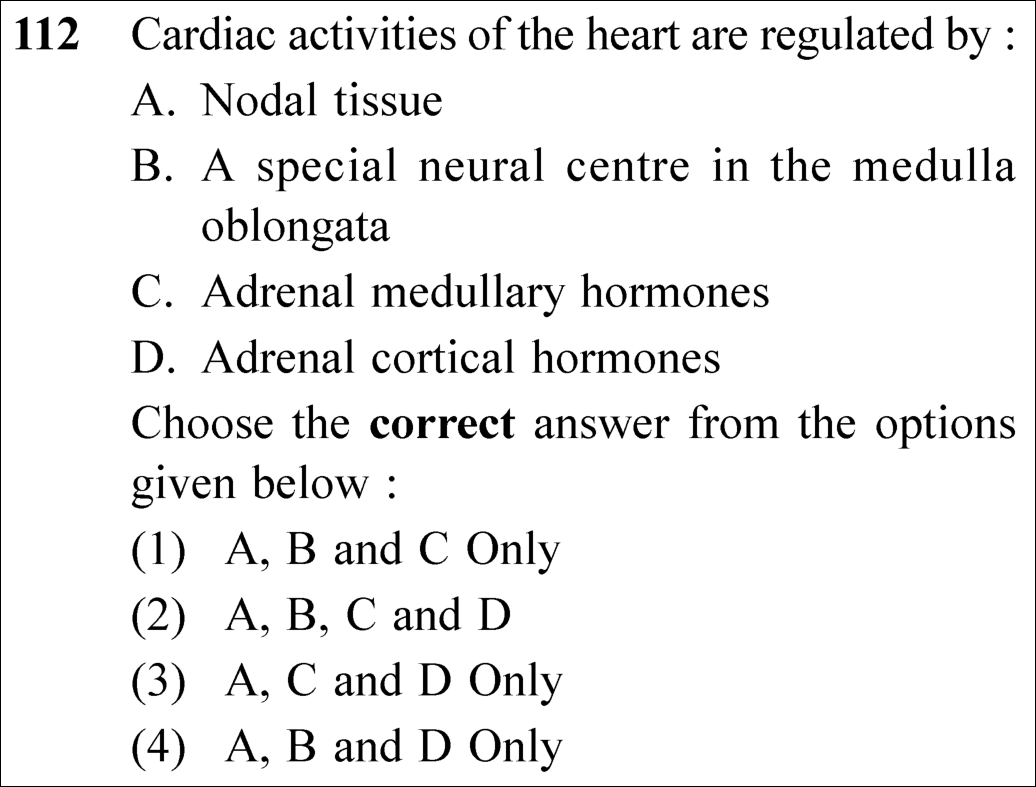
Cardiac activities of the heart are regulated by: A. Nodal tissue B. A special neural centre in the medulla oblongata C. Adrenal medullary hormones D. Adrenal cortical hormones Choose the correct answer from the options given below:

  1. (1)A, B and C Only
  2. (2)A,B, C and D
  3. (3)A, C and D Only
  4. (4)A, B and D Only
✓
Verified Against NTA Final Answer Key
Option (1) : A, B and C Only
📚 Body Fluids and Circulation Easy
📋 Given Parameters & Problem Setup
Regulatory Mechanism A Nodal tissue
Regulatory Mechanism B A special neural centre in the medulla oblongata
Regulatory Mechanism C Adrenal medullary hormones
Regulatory Mechanism D Adrenal cortical hormones
⚡

The 30-Second Exam Hall Shortcut: ⚡ Cardiac Regulation Triad Fingerprint

⏱️ Save ~25 seconds

Heart rate regulated by: 1. Nodal tissue (SA node, auto-regulation myogenic), 2. Medulla oblongata (ANS sympathetic/parasympathetic), 3. Adrenal MEDULLA (epinephrine/norepinephrine)! Cortex is NOT in cardiac regulation triad!

1 Recall NCERT Section "Regulation of Cardiac Activity":
2 - Statement A: Nodal tissue auto-regulates heart intrinsically (myogenic). [CORRECT]
3 - Statement B: Special neural centre in medulla oblongata regulates heart through ANS. [CORRECT]
4 - Statement C: Adrenal medullary hormones (adrenaline/noradrenaline) increase heart rate and cardiac output. [CORRECT]
5 - Statement D: Adrenal cortical hormones (cortisol/aldosterone) regulate water-electrolyte balance and carbohydrates, not direct cardiac regulation. [INCORRECT]
6 A, B, and C Only are correct!
7 Select Option (1) immediately!
🛡️
Why You Can 100% Trust This Shortcut: Electrocardiogram (ECG) Deflections (NCERT Biology · Body Fluids and Circulation: P-wave represents atrial depolarisation).
📐

Step-by-Step Rigorous Workflow & Mathematical Proof

Step 1

Intrinsic (Auto-regulatory) Control by Nodal Musculature

Normal activities of the human heart are regulated intrinsically, i.e., auto-regulated by specialized cardiac muscle tissues called nodal tissue (Sinoatrial node, Atrioventricular node, bundle of His, Purkinje fibers). Hence, human heart is termed myogenic. Thus, Statement A is correct.

Step 2

Extrinsic Neural Regulation via Medulla Oblongata

A special neural center in the medulla oblongata moderates cardiac function through the autonomic nervous system (ANS):

  • • Sympathetic neural signals increase the rate of heartbeat, the strength of ventricular contraction, and thereby the cardiac output.
  • • Parasympathetic neural signals (via vagus nerve) decrease the rate of heartbeat, speed of action potential conduction, and cardiac output.
  • • Thus, Statement B is correct.
Step 3

Endocrine Regulation: Adrenal Medulla vs Cortex

Hormonal regulation of heart rate:

  • • Adrenal medullary hormones (epinephrine and norepinephrine / catecholamines) act during emergency / fight-or-flight states to significantly increase the rate of heartbeat, stroke volume, and cardiac output. Thus, Statement C is correct.
  • • Adrenal cortical hormones (glucocorticoids like cortisol and mineralocorticoids like aldosterone) are involved in carbohydrate metabolism, anti-inflammatory responses, and electrolyte balance (Na⁺/water retention in renal tubules), not direct cardiac pacing. Thus, Statement D is incorrect.
Step 4

Conclusion

Only A, B, and C are true regulators of cardiac activities according to the canonical NCERT text.

Regulation=A (Nodal)+B (Medulla)+C (Adrenal Medullary)\text{Regulation} = \text{A (Nodal)} + \text{B (Medulla)} + \text{C (Adrenal Medullary)}
⭐

360° Option Elimination Engine Key Feature

Diagnose every choice: Know exactly why the right option works and why distractors fail.

4-Option Deep Scan
1 A
✓ 100% Correct
Verdict & Scientific Reason:

100% correct. Matches the verbatim NCERT triad of cardiac regulation.

💡
Why this is airtight: None; precise physiological recall.
2 B
✗ Incorrect
Verdict & Scientific Reason:

Incorrect. Includes adrenal cortical hormones (D), which do not directly regulate cardiac activity.

⚠️
Student Fallacy (Why candidates pick this trap): Failing to distinguish adrenal medulla from adrenal cortex.
3 C
✗ Incorrect
Verdict & Scientific Reason:

Incorrect. Omits the critical neural center in the medulla oblongata (B) and improperly includes D.

⚠️
Student Fallacy (Why candidates pick this trap): Missing neural control of the heart.
4 D
✗ Incorrect
Verdict & Scientific Reason:

Incorrect. Omits adrenal medullary hormones (C) and includes cortical hormones (D).

⚠️
Student Fallacy (Why candidates pick this trap): Swapping medullary and cortical secretions.
⚠️

NTA Trap Alert: Adrenal Medullary vs Adrenal Cortical Hormones

The adrenal MEDULLA secretes adrenaline (epinephrine) which directly accelerates cardiac output. The adrenal CORTEX secretes steroids (aldosterone, cortisol). Never confuse medullary hormones with cortical hormones!

🛡️ How to avoid the -1 mark: Medulla = Adrenaline = Heart beat booster. Cortex = Steroids (sugar/salt balance).
📖

Core NEET Syllabus Standard

NEET Biology Core Syllabus · Body Fluids and Circulation Standard Benchmark
Core Scientific Principle Tested:

"Cardiac activities are regulated intrinsically by nodal tissue, neurally by medulla oblongata via ANS, and hormonally by adrenal medullary hormones."

Syllabus Focus: Regulation of Cardiac Activity
✓ Core NEET UG Syllabus Anchor Syllabus & Academic Standards ↗
N-M-M: Nodal tissue, Medulla oblongata, Medullary adrenal hormones!

Ready to attempt under real exam pressure?

Test your speed and accuracy in the authentic 180-minute timed NTA simulator.

Launch NEET 2025 CBT Test →

Spotted a mistake in this solution? Report an error ([email protected])

⚖️ Legal & Fair Dealing Notice: Sourced from publicly released NEET 2025 question papers and NEET answer keys for private study, research, and non-commercial educational practice under Fair Dealing (Section 52(1)(a) of the Indian Copyright Act, 1957). Not affiliated with or endorsed by NTA or NMC.

Solve 4 NEET Questions a Day — One per Subject

Cover all 1,140 official NEET questions in 285 days at your own pace. Progress is saved on your device. No login needed.