MyCompetitiveExams Logo MyCompetitiveExams
Search 1,140+ Questions
Chapters, formulas, speed tricks
→
⚡ Brahmastra NEET 2027
720 MARKS

Dynamic 180-question full-length simulator mixed dynamically from all 6 years for 2027 & 2026 aspirants.

Launch Brahmastra 2027 Test →
Start Practice →
100% Free · No Login Required
Q.115 Botany ⭐ 360° Option Elimination Active
Vault ↗

NEET 2026 Botany Question 115 Solution

Topic: Body Fluids and Circulation · Official NTA Booklet Code 50
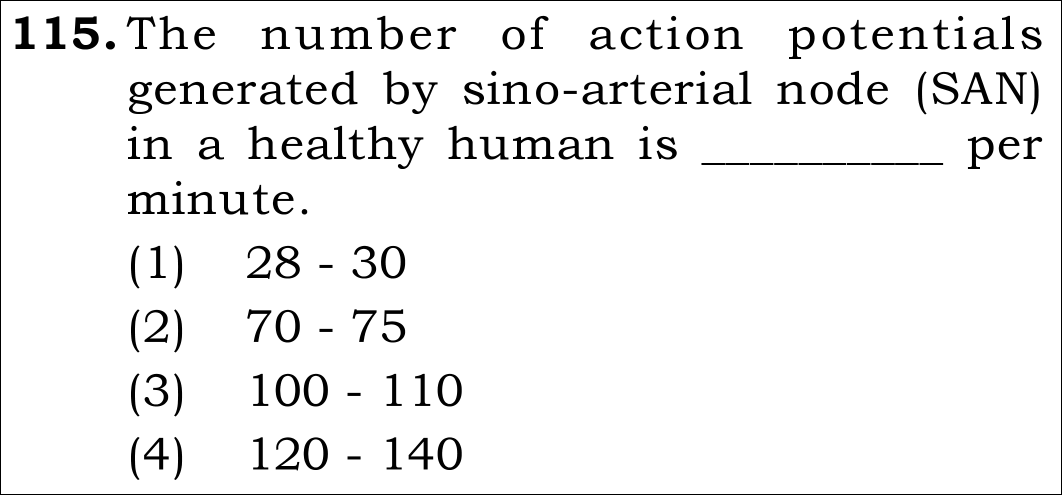
NEET 2026 Botany Question 115: Nodal Musculature & Pacemaker Activity of Sino-atrial Node (SAN)

Question

The number of action potentials generated by sino-arterial node (SAN) in a healthy human is ___ per minute.

✓
Verified Against NTA Final Answer Key
Option (2) : 70 - 75
📚 Body Fluids and Circulation Easy
📋 Given Parameters & Problem Setup
Anatomical Structure Sino-atrial node (SAN) / pacemaker of the human heart
Physiological Quantity Action potentials generated per minute under resting condition
⚡

The 30-Second Exam Hall Shortcut: ⚡ Resting Heart Rate Match

⏱️ Save ~40 seconds

SAN Action Potentials = Normal Heartbeat = 70–75 beats/min!

1 Recall that SAN sets the pace of the heart because it generates the highest frequency of spontaneous action potentials.
2 Normal resting heart rate is 72 beats/min, which reflects the SAN rate of 70–75 per minute.
3 Look at Option (2): 70 - 75.
4 Mark Option (2) in 3 seconds!
🛡️
Why You Can 100% Trust This Shortcut: NCERT Biology · Photosynthesis in Higher Plants (Historical Experiments: Joseph Priestley bell jar and mint plant experiment).
📐

Step-by-Step Rigorous Workflow & Mathematical Proof

Step 1

Electrophysiology of Cardiac Pacemaker

A specialized cardiac musculature called nodal tissue is distributed in the heart. A patch of this tissue called the Sino-atrial node (SAN) is located in the upper right corner of the right atrium.

SAN=Pacemaker of the human heart\text{SAN} = \text{Pacemaker of the human heart}
  • • Nodal cells possess inherent autorhythmicity (spontaneous diastolic depolarization) without external neural innervation.
Step 2

Quantify Action Potential Generation Rate

Different parts of the conducting system can generate action potentials at different inherent frequencies: SAN generates 70–75 min⁻¹, AVN generates 40–60 min⁻¹, and Purkinje fibers generate 20–40 min⁻¹. Because SAN possesses the highest intrinsic rate, it commands heart contraction.

FrequencySAN=70−75 action potentials⋅min−1\text{Frequency}_{\text{SAN}} = 70 - 75 \text{ action potentials} \cdot \text{min}^{-1}
  • • Dictates the average resting human heart rate of ~72 beats per minute.
Step 3

Evaluate Options

Option (1) gives 28-30 (characteristic of severe heart block / slow Purkinje rhythm). Option (3) gives 100-110 (tachycardia). Option (4) gives 120-140 (strenuous exercise). The basal rate is 70-75.

Correct Value=70−75  ⟹  Option (2)\text{Correct Value} = \mathbf{70 - 75} \implies \text{Option (2)}
  • • Matches official NTA final answer key Option B / (2).
⭐

360° Option Elimination Engine Key Feature

Diagnose every choice: Know exactly why the right option works and why distractors fail.

4-Option Deep Scan
1 A
✗ Incorrect
Verdict & Scientific Reason:

Incorrect. Represents ectopic ventricular/Purkinje fiber intrinsic firing rate.

⚠️
Student Fallacy (Why candidates pick this trap): Confusing pacemaker rate with lower conducting system fallback rate.
2 B
✓ 100% Correct
Verdict & Scientific Reason:

100% accurate. Canonical NCERT rate of SAN autorhythmicity.

💡
Why this is airtight: None; standard direct recall.
3 C
✗ Incorrect
Verdict & Scientific Reason:

Incorrect. Represents sinus tachycardia, not normal resting generation.

⚠️
Student Fallacy (Why candidates pick this trap): Overestimating resting rate.
4 D
✗ Incorrect
Verdict & Scientific Reason:

Incorrect. Exceeds standard physiological baseline.

⚠️
Student Fallacy (Why candidates pick this trap): Confusing normal rate with systolic pressure or exertion pulse.
⚠️

NTA Trap Alert: Typo in Official Exam Paper

The NEET question paper misprinted "sino-atrial node" as "sino-arterial node". Students should never get distracted by obvious typographical errors in anatomy names.

🛡️ How to avoid the -1 mark: Recognize the acronym (SAN) and focus on the physiological concept tested.
📖

Core NEET Syllabus Standard

NEET Biology Core Syllabus · Body Fluids and Circulation Standard Benchmark
Core Scientific Principle Tested:

"The sino-atrial node (SAN) generates 70–75 action potentials per minute, establishing it as the primary pacemaker of the mammalian heart."

Syllabus Focus: Circulatory Pathways - Cardiac Cycle and Nodal Tissue
✓ Core NEET UG Syllabus Anchor Syllabus & Academic Standards ↗
SAN sets the pulse alive: exactly seventy to seventy-five!

Ready to attempt under real exam pressure?

Test your speed and accuracy in the authentic 180-minute timed NTA simulator.

Launch NEET 2026 CBT Test →

Spotted a mistake in this solution? Report an error ([email protected])

⚖️ Legal & Fair Dealing Notice: Sourced from publicly released NEET 2026 question papers and NEET answer keys for private study, research, and non-commercial educational practice under Fair Dealing (Section 52(1)(a) of the Indian Copyright Act, 1957). Not affiliated with or endorsed by NTA or NMC.

Solve 4 NEET Questions a Day — One per Subject

Cover all 1,140 official NEET questions in 285 days at your own pace. Progress is saved on your device. No login needed.