MyCompetitiveExams Logo MyCompetitiveExams
Search 1,140+ Questions
Chapters, formulas, speed tricks
→
⚡ Brahmastra NEET 2027
720 MARKS

Dynamic 180-question full-length simulator mixed dynamically from all 6 years for 2027 & 2026 aspirants.

Launch Brahmastra 2027 Test →
Start Practice →
100% Free · No Login Required
Q.114 Botany ⭐ 360° Option Elimination Active
Vault ↗

NEET 2026 Botany Question 114 Solution

Topic: Photosynthesis in Higher Plants · Official NTA Booklet Code 50
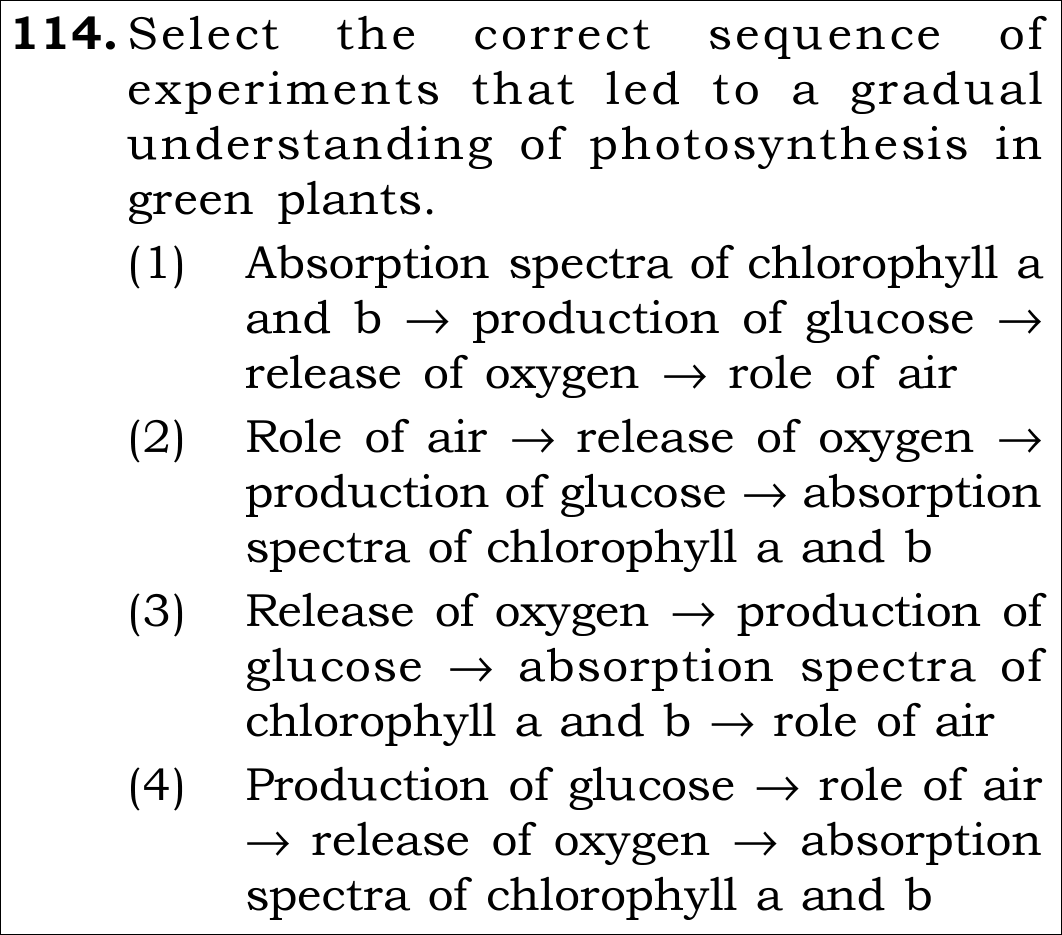
NEET 2026 Botany Question 114: Chronological Sequence of Classic Photosynthesis Experiments

Question

Select the correct sequence of experiments that led to a gradual understanding of photosynthesis in green plants.

✓
Verified Against NTA Final Answer Key
Option (2) : Role of air → release of oxygen → production of glucose → absorption spectra of chlorophyll a and b
📚 Photosynthesis in Higher Plants Medium
📋 Given Parameters & Problem Setup
Topic Historical experiments elucidating photosynthesis
Key Scientists Involved Joseph Priestley (1770), Jan Ingenhousz (1779), Julius von Sachs (1854), T.W. Engelmann (1888)
⚡

The 30-Second Exam Hall Shortcut: ⚡ Scientist Timeline Hack

⏱️ Save ~45 seconds

Priestley (Air) -> Ingenhousz (Oxygen) -> Sachs (Glucose) -> Engelmann (Spectra)!

1 Joseph Priestley (1770) discovered the essential role of air in plant growth.
2 Jan Ingenhousz (1779) proved that only green parts in sunlight release oxygen.
3 Julius von Sachs (1854) proved that green plant parts produce glucose stored as starch.
4 T.W. Engelmann (1888) used a prism and Cladophora to plot the first action/absorption spectra of chlorophylls.
5 Order: Role of air -> release of oxygen -> production of glucose -> absorption spectra.
6 Matches Option (2) directly in under 10 seconds!
🛡️
Why You Can 100% Trust This Shortcut: NCERT Biology · Photosynthesis in Higher Plants (Historical Experiments: Joseph Priestley bell jar and mint plant experiment).
📐

Step-by-Step Rigorous Workflow & Mathematical Proof

Step 1

Milestone 1: Joseph Priestley (1770) - Role of Air

In 1770, Joseph Priestley performed bell jar experiments with a burning candle, a mouse, and a mint plant. He demonstrated that plants restore to the air whatever breathing animals and burning candles remove, establishing the fundamental role of air.

1770:Priestley  ⟹  Role of air in plant growth1770: \text{Priestley} \implies \text{Role of air in plant growth}
  • • Priestley later discovered oxygen in 1774.
Step 2

Milestone 2: Jan Ingenhousz (1779) - Release of Oxygen

Jan Ingenhousz placed an aquatic plant (Hydrilla) in bright sunlight and darkness. He observed that in sunlight, small gas bubbles formed around green parts, but not in the dark. He identified these bubbles as oxygen, proving that sunlight and green tissues are required for oxygen release.

1779:Ingenhousz  ⟹  Sunlight dependent release of oxygen1779: \text{Ingenhousz} \implies \text{Sunlight dependent release of oxygen}
  • • Confirmed that green parts release oxygen gas.
Step 3

Milestone 3: Julius von Sachs (1854) - Production of Glucose

In 1854, Julius von Sachs provided evidence that when plants grow, they synthesize glucose, which is stored as starch. He also showed that chlorophyll is housed inside special bodies (later termed chloroplasts).

1854:Sachs  ⟹  Production of glucose and storage as starch1854: \text{Sachs} \implies \text{Production of glucose and storage as starch}
  • • Established the primary organic product of photosynthesis.
Step 4

Milestone 4: T.W. Engelmann (1888) - Action & Absorption Spectra

Using a glass prism to split white light into spectral components, T.W. Engelmann illuminated a green alga (Cladophora) placed in a suspension of aerobic bacteria. The bacteria accumulated in blue and red light zones, plotting the first action spectrum resembling the absorption spectra of chlorophyll a and b.

1888:Engelmann  ⟹  Action and absorption spectra of chlorophyll a and b1888: \text{Engelmann} \implies \text{Action and absorption spectra of chlorophyll } a \text{ and } b
  • • First experimental action spectrum of photosynthesis.
Step 5

Chronological Assembly

Combining the milestones sequentially: Role of air (1770) -> Release of oxygen (1779) -> Production of glucose (1854) -> Absorption spectra of chlorophyll a and b (1888). This matches Option (2).

Sequence=Air→Oxygen→Glucose→Absorption Spectra  ⟹  Option (2)\text{Sequence} = \text{Air} \rightarrow \text{Oxygen} \rightarrow \text{Glucose} \rightarrow \text{Absorption Spectra} \implies \text{Option (2)}
  • • Matches official NTA final answer key Option B / (2).
⭐

360° Option Elimination Engine Key Feature

Diagnose every choice: Know exactly why the right option works and why distractors fail.

4-Option Deep Scan
1 A
✗ Incorrect
Verdict & Scientific Reason:

Incorrect. Exactly reverses chronological history (lists 1888 before 1770).

⚠️
Student Fallacy (Why candidates pick this trap): Reverse order fallacy.
2 B
✓ 100% Correct
Verdict & Scientific Reason:

100% historically accurate sequence according to NCERT textbook section 13.1.

💡
Why this is airtight: None; solid chronological command.
3 C
✗ Incorrect
Verdict & Scientific Reason:

Incorrect. Places Priestley (role of air) at the very end.

⚠️
Student Fallacy (Why candidates pick this trap): Ignoring Priestley’s pioneer 1770 experiment.
4 D
✗ Incorrect
Verdict & Scientific Reason:

Incorrect. Places Sachs (1854) before Priestley (1770).

⚠️
Student Fallacy (Why candidates pick this trap): Scrambled historical timeline.
⚠️

NTA Trap Alert: Swapping Priestley and Ingenhousz

Students frequently confuse Joseph Priestley (who discovered that air was restored by plants) with Jan Ingenhousz (who showed that sunlight and green parts specifically release oxygen bubbles).

🛡️ How to avoid the -1 mark: Remember alphabetical and chronological order: P (Priestley - Pure Air) came before I (Ingenhousz - Illuminated bubbles).
📖

Core NEET Syllabus Standard

NEET Biology Core Syllabus · Photosynthesis in Higher Plants Standard Benchmark
Core Scientific Principle Tested:

"Photosynthesis understanding advanced through Priestley (air) -> Ingenhousz (light & oxygen) -> Sachs (glucose/starch) -> Engelmann (prism action spectrum)."

Syllabus Focus: Early Experiments
✓ Core NEET UG Syllabus Anchor Syllabus & Academic Standards ↗
P-I-S-E: Priestley (Air) -> Ingenhousz (Oxygen) -> Sachs (Sugar) -> Engelmann (Emission spectra)!

Ready to attempt under real exam pressure?

Test your speed and accuracy in the authentic 180-minute timed NTA simulator.

Launch NEET 2026 CBT Test →

Spotted a mistake in this solution? Report an error ([email protected])

⚖️ Legal & Fair Dealing Notice: Sourced from publicly released NEET 2026 question papers and NEET answer keys for private study, research, and non-commercial educational practice under Fair Dealing (Section 52(1)(a) of the Indian Copyright Act, 1957). Not affiliated with or endorsed by NTA or NMC.

Solve 4 NEET Questions a Day — One per Subject

Cover all 1,140 official NEET questions in 285 days at your own pace. Progress is saved on your device. No login needed.