MyCompetitiveExams Logo MyCompetitiveExams
Search 1,140+ Questions
Chapters, formulas, speed tricks
→
⚡ Brahmastra NEET 2027
720 MARKS

Dynamic 180-question full-length simulator mixed dynamically from all 6 years for 2027 & 2026 aspirants.

Launch Brahmastra 2027 Test →
Start Practice →
100% Free · No Login Required
🌿 Botany 🔥 High-Yield Core Topic (~3–4 Qs/Year)

NEET Photosynthesis in Higher Plants Previous Year Questions with Solutions

Complete repository of official NTA NEET questions for Photosynthesis in Higher Plants from 2020 to 2026. Every question includes 30-second elimination tricks, step-by-step NCERT solutions, option-by-option traps, and official answer keys.

17 Questions 6 Exam Years (2026, 2025, 2024, 2023, 2021, 2020) 13 Easy · 4 Medium · 0 Challenging
NEET 2026 · Q100 Medium
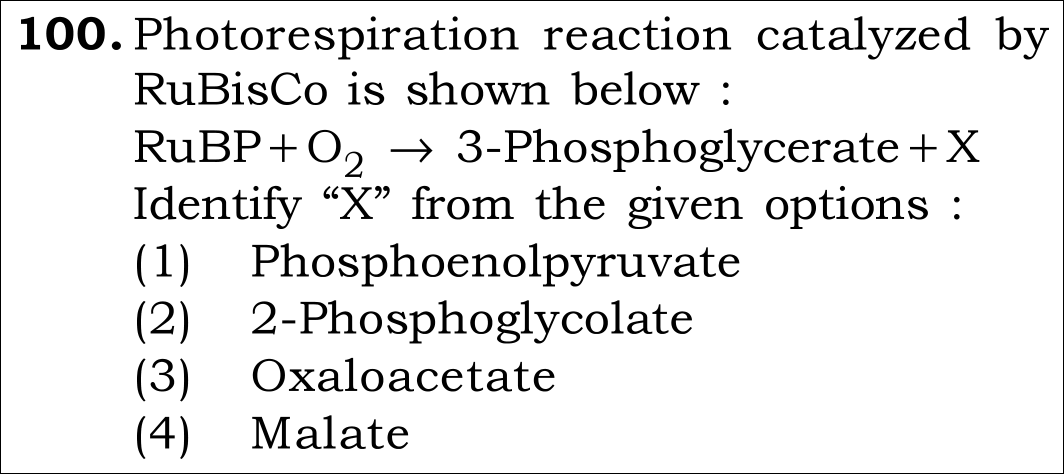
Official NEET 2026 Question 100 - Photosynthesis in Higher Plants
1
2 ✓ Key
3
4
💡 Verified Solution & 30-Second Hack
✓
Verified Against NTA Final Answer Key
Option (2) : 2-Phosphoglycolate
📚 Photosynthesis in Higher Plants Medium
📋 Given Parameters & Problem Setup
Reaction RuBP + O₂ → 3-Phosphoglycerate (PGA) + X
Enzyme RuBisCO acting as an oxygenase
Substrate Ribulose-1,5-bisphosphate (RuBP, 5-carbon compound)
⚡

The 30-Second Exam Hall Shortcut: ⚡ Carbon Balance in Photorespiration: 5C = 3C + 2C

⏱️ Save ~50 seconds

5-carbon RuBP splits into one 3C (PGA) and one 2C (Phosphoglycolate)!

1 Count carbon atoms: RuBP has 5 carbons.
2 In presence of O₂, RuBisCO oxygenates RuBP.
3 The products must total 5 carbons: One 3-carbon molecule is 3-Phosphoglycerate (PGA).
4 The remaining molecule X must have 5 - 3 = 2 carbons!
5 A 2-carbon phosphorylated intermediate is 2-PHOSPHOGLYCOLATE!
6 Option (2) is 2-Phosphoglycolate! Pick Option (2) in 10 seconds flat!
🛡️
Why You Can 100% Trust This Shortcut: NCERT Photosynthesis verbatim: When RuBisCO binds O₂, RuBP binds with O₂ to form one molecule of phosphoglycerate and phosphoglycolate (2 Carbon) in a pathway called photorespiration.
📐

Step-by-Step Rigorous Workflow & Mathematical Proof

Step 1

Understand the Dual Activity of RuBisCO

RuBisCO (Ribulose bisphosphate carboxylase-oxygenase) is the most abundant enzyme in the biosphere. Its active site can bind both CO₂ and O₂ competitively: - When CO₂/O₂ ratio is high, it acts as a carboxylase, fixing CO₂ into two 3C molecules (3-PGA) in the Calvin cycle. - When O₂ concentration is high and CO₂ is low, it acts as an oxygenase, initiating the photorespiratory C₂ cycle.

RuBisCO: Carboxylase Activity vs Oxygenase Activity\text{RuBisCO: Carboxylase Activity vs Oxygenase Activity}
  • • Photorespiration does not produce ATP or sugars and wastes fixed carbon.
Step 2

Formulate the RuBisCO Oxygenase Reaction

In the chloroplast stroma, RuBisCO oxygenates RuBP (5-carbon) with molecular oxygen to cleave it into one 3-carbon molecule and one 2-carbon molecule:

RuBP (5C)+O2→RuBisCO (oxygenase)3-Phosphoglycerate (3C)+2-Phosphoglycolate (2C) [X]\text{RuBP (5C)} + \text{O}_2 \xrightarrow{\text{RuBisCO (oxygenase)}} \text{3-Phosphoglycerate (3C)} + \text{2-Phosphoglycolate (2C) } [\mathbf{X}]
  • • 3-Phosphoglycerate (PGA) enters the Calvin cycle.
  • • 2-Phosphoglycolate is dephosphorylated to glycolate and transported to peroxisomes and mitochondria for carbon salvage.
Step 3

Identify Molecule X from the Options

1. Phosphoenolpyruvate (PEP): 3-carbon CO₂ acceptor in C₄ pathway. 2. 2-Phosphoglycolate: 2-carbon photorespiratory product (X). 3. Oxaloacetate (OAA): 4-carbon organic acid in C₄ pathway / TCA cycle. 4. Malate: 4-carbon dicarboxylic acid in C₄ pathway.

X=2-Phosphoglycolate\mathbf{X} = \text{2-Phosphoglycolate}
  • • Matches Option (2).
⭐

360° Option Elimination Engine Key Feature

Diagnose every choice: Know exactly why the right option works and why distractors fail.

4-Option Deep Scan
1 A
✗ Incorrect
Verdict & Scientific Reason:

Incorrect. Phosphoenolpyruvate (PEP) is the primary CO₂ acceptor in C₄ plants, not a product of RuBP oxygenation.

⚠️
Student Fallacy (Why candidates pick this trap): Confusing C₄ cycle substrates with photorespiratory products.
2 B
✓ 100% Correct
Verdict & Scientific Reason:

Exact match with the canonical photorespiration reaction: 5C RuBP + O₂ → 3C PGA + 2C Phosphoglycolate.

💡
Why this is airtight: None; textbook mastery of the C₂ photorespiration pathway.
3 C
✗ Incorrect
Verdict & Scientific Reason:

Incorrect. Oxaloacetate (OAA) is a 4-carbon acid produced by PEP carboxylase in C₄ photosynthesis.

⚠️
Student Fallacy (Why candidates pick this trap): Mistaking C₄ first stable product for photorespiratory product.
4 D
✗ Incorrect
Verdict & Scientific Reason:

Incorrect. Malate is a 4-carbon transport acid in C₄ plants.

⚠️
Student Fallacy (Why candidates pick this trap): Confusing C₄ malate shuttle with photorespiration.
⚠️

NTA Trap Alert: Confusing Photorespiration (C₂) with C₄ Photosynthesis

Students frequently confuse products of photorespiration (Phosphoglycolate, 2C) with products of C₄ Hatch-Slack cycle (Oxaloacetate and Malate, 4C).

🛡️ How to avoid the -1 mark: Photorespiration is the C₂ cycle: it creates the 2-carbon compound Phosphoglycolate!
📖

Core NEET Syllabus Standard

NEET Biology Core Syllabus · Photosynthesis in Higher Plants Standard Benchmark
Core Scientific Principle Tested:

"Oxygenation of RuBP by RuBisCO yields one molecule of 3-PGA and one molecule of 2-phosphoglycolate."
Syllabus Focus: Photorespiration - RuBisCO oxygenase reaction and C₂ cycle
✓ Core NEET UG Syllabus Anchor Syllabus & Academic Standards ↗
Oxygen hits RuBP: 3 carbons go to PGA, 2 carbons leave as Phosphoglycolate!
NEET 2026 · Q102 Easy
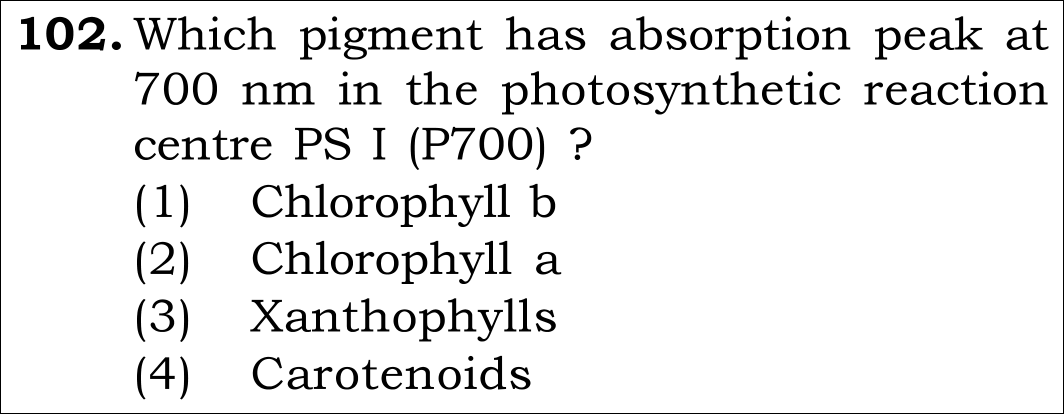
Official NEET 2026 Question 102 - Photosynthesis in Higher Plants
1 Chlorophyll b
2 Chlorophyll a ✓ Key
3 Xanthophylls
4 Carotenoids
💡 Verified Solution & 30-Second Hack
✓
Verified Against NTA Final Answer Key
Option (2) : Chlorophyll a
📚 Photosynthesis in Higher Plants Easy
📋 Given Parameters & Problem Setup
Photosystem PS I (Photosystem I / P700)
Absorption Peak 700 nm in the red region
Target Pigment acting as the reaction centre
⚡

The 30-Second Exam Hall Shortcut: ⚡ The Chief Photosynthetic Pigment Rule

⏱️ Save ~40 seconds

Reaction centres of BOTH PS I (P700) and PS II (P680) are ALWAYS Chlorophyll a!

1 In green plants, the reaction centre is formed by a single molecule of CHLOROPHYLL A.
2 In PS I: Chlorophyll a has an absorption peak at 700 nm (P700).
3 In PS II: Chlorophyll a has an absorption peak at 680 nm (P680).
4 Chlorophyll b, xanthophylls, and carotenoids are merely accessory antenna pigments that transfer energy to Chlorophyll a.
5 Option (2) is Chlorophyll a! Pick Option (2) in 5 seconds!
🛡️
Why You Can 100% Trust This Shortcut: NCERT Photosynthesis verbatim: The reaction centre is different in both the photosystems. In PS I the reaction centre chlorophyll a has an absorption peak at 700 nm, hence is called P700.
📐

Step-by-Step Rigorous Workflow & Mathematical Proof

Step 1

Structure of the Light Harvesting Complex (LHC)

Photosystems are composed of two functional parts: 1. Antenna complex (LHC): Hundreds of accessory pigment molecules (Chlorophyll b, xanthophylls, carotenoids) bound to proteins that harvest light of various wavelengths and transfer energy by resonance. 2. Reaction Centre: A unique single molecule of Chlorophyll a that traps excitation energy and ejects high-energy electrons into the electron transport chain.

Reaction Centre≡Single molecule of Chlorophyll a\text{Reaction Centre} \equiv \text{Single molecule of Chlorophyll } a
  • • Chlorophyll a is the essential primary photosynthetic pigment.
Step 2

Contrast PS I (P700) and PS II (P680)

The protein environment alters the absorption maxima of the reaction centre chlorophyll a in the two photosystems: - In PS I: Reaction centre chlorophyll a has an absorption maximum at 700 nm (designated P700). - In PS II: Reaction centre chlorophyll a has an absorption maximum at 680 nm (designated P680).

PS I Reaction Centre=Chlorophyll a  (λmax=700 nm)\text{PS I Reaction Centre} = \text{Chlorophyll } a \; (\lambda_{\text{max}} = 700\text{ nm})
  • • Chlorophyll a is the unique pigment forming P700.
Step 3

Conclusion

Chlorophyll a has the absorption peak at 700 nm in the reaction centre PS I (P700).

Matches Option (2)\text{Matches Option (2)}
  • • Matches Option (2).
⭐

360° Option Elimination Engine Key Feature

Diagnose every choice: Know exactly why the right option works and why distractors fail.

4-Option Deep Scan
1 A
✗ Incorrect
Verdict & Scientific Reason:

Incorrect. Chlorophyll b is an accessory pigment with absorption maxima in blue (~450 nm) and red-orange (~640 nm); it never acts as a reaction centre.

⚠️
Student Fallacy (Why candidates pick this trap): Confusing accessory chlorophyll b with reaction centre chlorophyll a.
2 B
✓ 100% Correct
Verdict & Scientific Reason:

Exact match with NCERT: Chlorophyll a is the universal reaction centre of PS I (P700) and PS II (P680).

💡
Why this is airtight: None; textbook mastery of photosynthetic systems.
3 C
✗ Incorrect
Verdict & Scientific Reason:

Incorrect. Xanthophylls are yellow accessory pigments that protect chlorophyll a from photo-oxidation.

⚠️
Student Fallacy (Why candidates pick this trap): Assuming accessory pigments act as reaction centres.
4 D
✗ Incorrect
Verdict & Scientific Reason:

Incorrect. Carotenoids are shield pigments that transfer absorbed photons to chlorophyll a.

⚠️
Student Fallacy (Why candidates pick this trap): Thinking carotenoids absorb at 700 nm.
⚠️

NTA Trap Alert: Thinking Chlorophyll b is the Reaction Centre for One of the Photosystems

Students sometimes guess that since there are two photosystems (PS I and PS II), one must use Chlorophyll a and the other Chlorophyll b. Both PS I and PS II use CHLOROPHYLL A as their reaction centre!

🛡️ How to avoid the -1 mark: Chlorophyll a is the King: It is the reaction centre for BOTH PS I (700 nm) and PS II (680 nm).
📖

Core NEET Syllabus Standard

NEET Biology Core Syllabus · Photosynthesis in Higher Plants Standard Benchmark
Core Scientific Principle Tested:

"Chlorophyll a forms the reaction centre: P700 in PS I and P680 in PS II."

Syllabus Focus: Light reactions - The electron transport chain and Photosystems I and II
✓ Core NEET UG Syllabus Anchor Syllabus & Academic Standards ↗
Chlorophyll a is always King: P680 and P700 under its wing!
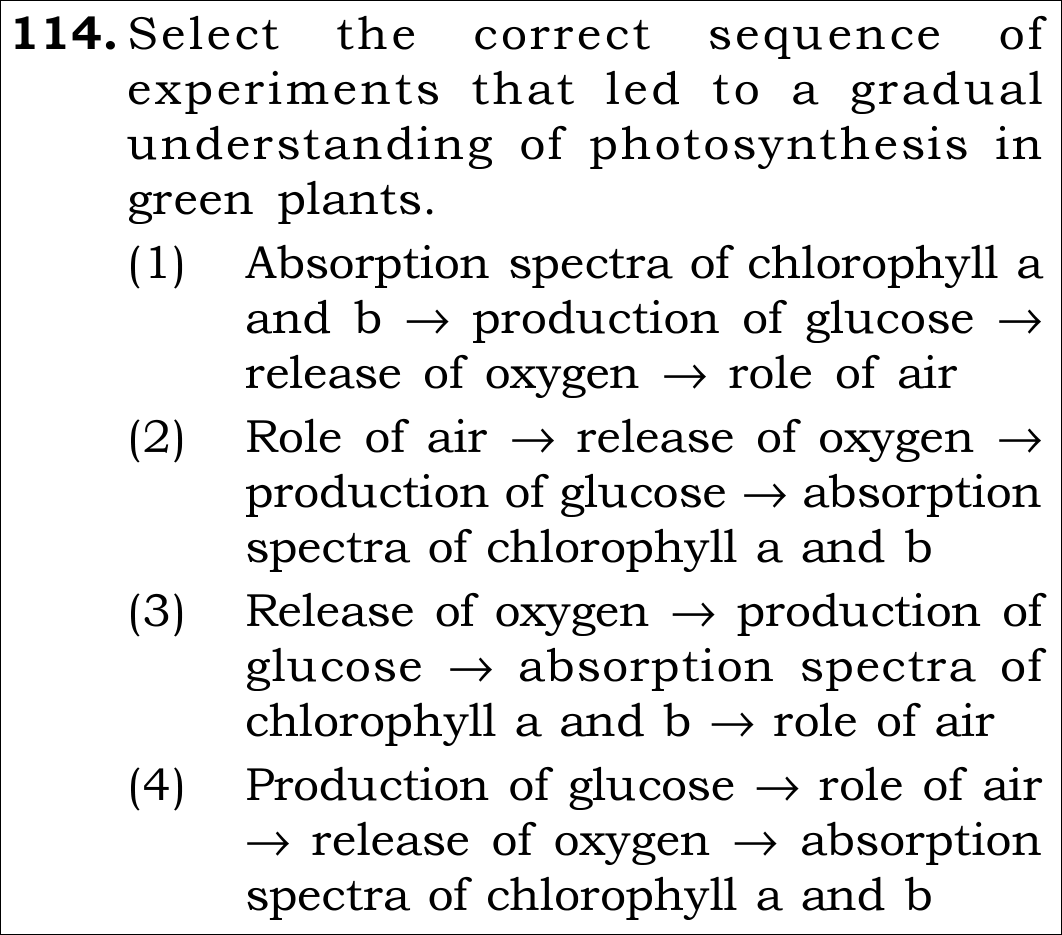
NEET 2026 · Q114 Medium
Official NEET 2026 Question 114 - Photosynthesis in Higher Plants
1
2 ✓ Key
3
4
💡 Verified Solution & 30-Second Hack
✓
Verified Against NTA Final Answer Key
Option (2) : Role of air → release of oxygen → production of glucose → absorption spectra of chlorophyll a and b
📚 Photosynthesis in Higher Plants Medium
📋 Given Parameters & Problem Setup
Topic Historical experiments elucidating photosynthesis
Key Scientists Involved Joseph Priestley (1770), Jan Ingenhousz (1779), Julius von Sachs (1854), T.W. Engelmann (1888)
⚡

The 30-Second Exam Hall Shortcut: ⚡ Scientist Timeline Hack

⏱️ Save ~45 seconds

Priestley (Air) -> Ingenhousz (Oxygen) -> Sachs (Glucose) -> Engelmann (Spectra)!

1 Joseph Priestley (1770) discovered the essential role of air in plant growth.
2 Jan Ingenhousz (1779) proved that only green parts in sunlight release oxygen.
3 Julius von Sachs (1854) proved that green plant parts produce glucose stored as starch.
4 T.W. Engelmann (1888) used a prism and Cladophora to plot the first action/absorption spectra of chlorophylls.
5 Order: Role of air -> release of oxygen -> production of glucose -> absorption spectra.
6 Matches Option (2) directly in under 10 seconds!
🛡️
Why You Can 100% Trust This Shortcut: NCERT Biology · Photosynthesis in Higher Plants (Historical Experiments: Joseph Priestley bell jar and mint plant experiment).
📐

Step-by-Step Rigorous Workflow & Mathematical Proof

Step 1

Milestone 1: Joseph Priestley (1770) - Role of Air

In 1770, Joseph Priestley performed bell jar experiments with a burning candle, a mouse, and a mint plant. He demonstrated that plants restore to the air whatever breathing animals and burning candles remove, establishing the fundamental role of air.

1770:Priestley  ⟹  Role of air in plant growth1770: \text{Priestley} \implies \text{Role of air in plant growth}
  • • Priestley later discovered oxygen in 1774.
Step 2

Milestone 2: Jan Ingenhousz (1779) - Release of Oxygen

Jan Ingenhousz placed an aquatic plant (Hydrilla) in bright sunlight and darkness. He observed that in sunlight, small gas bubbles formed around green parts, but not in the dark. He identified these bubbles as oxygen, proving that sunlight and green tissues are required for oxygen release.

1779:Ingenhousz  ⟹  Sunlight dependent release of oxygen1779: \text{Ingenhousz} \implies \text{Sunlight dependent release of oxygen}
  • • Confirmed that green parts release oxygen gas.
Step 3

Milestone 3: Julius von Sachs (1854) - Production of Glucose

In 1854, Julius von Sachs provided evidence that when plants grow, they synthesize glucose, which is stored as starch. He also showed that chlorophyll is housed inside special bodies (later termed chloroplasts).

1854:Sachs  ⟹  Production of glucose and storage as starch1854: \text{Sachs} \implies \text{Production of glucose and storage as starch}
  • • Established the primary organic product of photosynthesis.
Step 4

Milestone 4: T.W. Engelmann (1888) - Action & Absorption Spectra

Using a glass prism to split white light into spectral components, T.W. Engelmann illuminated a green alga (Cladophora) placed in a suspension of aerobic bacteria. The bacteria accumulated in blue and red light zones, plotting the first action spectrum resembling the absorption spectra of chlorophyll a and b.

1888:Engelmann  ⟹  Action and absorption spectra of chlorophyll a and b1888: \text{Engelmann} \implies \text{Action and absorption spectra of chlorophyll } a \text{ and } b
  • • First experimental action spectrum of photosynthesis.
Step 5

Chronological Assembly

Combining the milestones sequentially: Role of air (1770) -> Release of oxygen (1779) -> Production of glucose (1854) -> Absorption spectra of chlorophyll a and b (1888). This matches Option (2).

Sequence=Air→Oxygen→Glucose→Absorption Spectra  ⟹  Option (2)\text{Sequence} = \text{Air} \rightarrow \text{Oxygen} \rightarrow \text{Glucose} \rightarrow \text{Absorption Spectra} \implies \text{Option (2)}
  • • Matches official NTA final answer key Option B / (2).
⭐

360° Option Elimination Engine Key Feature

Diagnose every choice: Know exactly why the right option works and why distractors fail.

4-Option Deep Scan
1 A
✗ Incorrect
Verdict & Scientific Reason:

Incorrect. Exactly reverses chronological history (lists 1888 before 1770).

⚠️
Student Fallacy (Why candidates pick this trap): Reverse order fallacy.
2 B
✓ 100% Correct
Verdict & Scientific Reason:

100% historically accurate sequence according to NCERT textbook section 13.1.

💡
Why this is airtight: None; solid chronological command.
3 C
✗ Incorrect
Verdict & Scientific Reason:

Incorrect. Places Priestley (role of air) at the very end.

⚠️
Student Fallacy (Why candidates pick this trap): Ignoring Priestley’s pioneer 1770 experiment.
4 D
✗ Incorrect
Verdict & Scientific Reason:

Incorrect. Places Sachs (1854) before Priestley (1770).

⚠️
Student Fallacy (Why candidates pick this trap): Scrambled historical timeline.
⚠️

NTA Trap Alert: Swapping Priestley and Ingenhousz

Students frequently confuse Joseph Priestley (who discovered that air was restored by plants) with Jan Ingenhousz (who showed that sunlight and green parts specifically release oxygen bubbles).

🛡️ How to avoid the -1 mark: Remember alphabetical and chronological order: P (Priestley - Pure Air) came before I (Ingenhousz - Illuminated bubbles).
📖

Core NEET Syllabus Standard

NEET Biology Core Syllabus · Photosynthesis in Higher Plants Standard Benchmark
Core Scientific Principle Tested:

"Photosynthesis understanding advanced through Priestley (air) -> Ingenhousz (light & oxygen) -> Sachs (glucose/starch) -> Engelmann (prism action spectrum)."

Syllabus Focus: Early Experiments
✓ Core NEET UG Syllabus Anchor Syllabus & Academic Standards ↗
P-I-S-E: Priestley (Air) -> Ingenhousz (Oxygen) -> Sachs (Sugar) -> Engelmann (Emission spectra)!
NEET 2026 · Q116 Easy
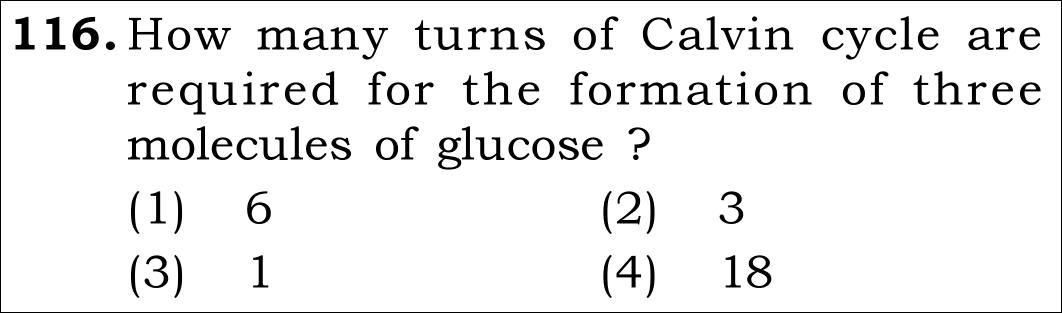
Official NEET 2026 Question 116 - Photosynthesis in Higher Plants
1 6
2 3
3 1
4 18 ✓ Key
💡 Verified Solution & 30-Second Hack
✓
Verified Against NTA Final Answer Key
Option (4) : 18
📚 Photosynthesis in Higher Plants Easy
📋 Given Parameters & Problem Setup
Target Output 3 molecules of glucose (C₆H₁₂O₆)
Carbon Atoms per Glucose 6 carbon atoms
CO₂ Fixed per Calvin Cycle Turn 1 CO₂ molecule (1 carbon atom)
⚡

The 30-Second Exam Hall Shortcut: ⚡ 6 Turns per Glucose Rule

⏱️ Save ~40 seconds

1 Glucose = 6 Calvin Turns; 3 Glucose = 3 × 6 = 18 Turns!

1 Recall: Each turn of the Calvin cycle fixes 1 molecule of CO₂.
2 To form 1 molecule of hexose glucose (6 carbons), 6 turns of the cycle are required.
3 For 3 molecules of glucose: 3 × 6 = 18 turns.
4 Look at Option (4): 18. Instant selection in under 5 seconds!
🛡️
Why You Can 100% Trust This Shortcut: NCERT Biology · Photosynthesis in Higher Plants (Calvin Cycle: 6 turns of Calvin cycle are required for 1 molecule of glucose).
📐

Step-by-Step Rigorous Workflow & Mathematical Proof

Step 1

Calvin Cycle Mechanism and Carbon Fixation

The Calvin cycle consists of three primary stages: Carboxylation (catalyzed by RuBisCO), Reduction, and Regeneration of RuBP. Each single cycle incorporates and fixes 1 molecule of inorganic carbon dioxide (CO₂).

1 Turn of Calvin Cycle  ⟹  1 CO2 fixed1\text{ Turn of Calvin Cycle} \implies 1\text{ CO}_2\text{ fixed}
  • • Glucose has the molecular formula C₆H₁₂O₆, containing 6 carbon atoms.
Step 2

Calculate Cycles for One Molecule of Glucose

Because each turn brings in only 1 carbon atom, 6 separate turns of the cycle are mandatory to fix 6 carbon atoms and yield 1 net molecule of glucose.

1 Glucose (6C)  ⟹  6 Turns of Calvin Cycle1\text{ Glucose (6C)} \implies 6\text{ Turns of Calvin Cycle}
  • • Requires 18 ATP and 12 NADPH for 1 glucose.
Step 3

Calculate Cycles for Three Molecules of Glucose

For 3 complete molecules of glucose, the number of required turns scales proportionately:

Total Turns=3×6=18 turns\text{Total Turns} = 3 \times 6 = 18\text{ turns}
  • • Total CO₂ fixed = 18 molecules.
  • • Total ATP consumed = 18 × 3 = 54 ATP.
  • • Total NADPH consumed = 18 × 2 = 36 NADPH.
Step 4

Evaluate Options

Option (1) is 6 (turns for 1 glucose); Option (2) is 3 (number of glucose molecules requested); Option (3) is 1; Option (4) is 18. The correct choice is Option (4).

Correct Option=18  [Option (4)]\text{Correct Option} = \mathbf{18} \; [\text{Option (4)}]
  • • Matches official NTA final answer key Option D / (4).
⭐

360° Option Elimination Engine Key Feature

Diagnose every choice: Know exactly why the right option works and why distractors fail.

4-Option Deep Scan
1 A
✗ Incorrect
Verdict & Scientific Reason:

Incorrect. 6 turns produce only 1 molecule of glucose, not 3.

⚠️
Student Fallacy (Why candidates pick this trap): Ignoring the coefficient "three" in the question stem.
2 B
✗ Incorrect
Verdict & Scientific Reason:

Incorrect. 3 turns fix only 3 CO₂ molecules, yielding half a triose phosphate (1/2 glucose).

⚠️
Student Fallacy (Why candidates pick this trap): Equating 1 turn directly to 1 glucose molecule.
3 C
✗ Incorrect
Verdict & Scientific Reason:

Incorrect. 1 turn fixes only 1 CO₂.

⚠️
Student Fallacy (Why candidates pick this trap): Complete misunderstanding of dark reaction stoichiometry.
4 D
✓ 100% Correct
Verdict & Scientific Reason:

100% mathematically and physiologically accurate: 3 × 6 = 18 turns.

💡
Why this is airtight: None; flawless multi-step stoichiometric calculation.
⚠️

NTA Trap Alert: Reading "Glucose" but Forgetting "Three Molecules"

A notorious NTA trick is embedding a multiplier ("three molecules") while students have memorized "6 turns for glucose" on reflex, causing them to hurriedly circle 6 (Option 1).

🛡️ How to avoid the -1 mark: Always circle given quantities in the question stem: "three molecules" -> 3 × 6 = 18.
📖

Core NEET Syllabus Standard

NEET Biology Core Syllabus · Photosynthesis in Higher Plants Standard Benchmark
Core Scientific Principle Tested:

"Fixation of each CO₂ requires one cycle turn. Synthesis of one hexose requires 6 turns; synthesis of n hexoses requires 6n turns."

Syllabus Focus: The Calvin Cycle - Energy and Stoichiometry
✓ Core NEET UG Syllabus Anchor Syllabus & Academic Standards ↗
Six turns per sweet glucose scene: for three full sugars, count eighteen!
NEET 2026 · Q122 Medium
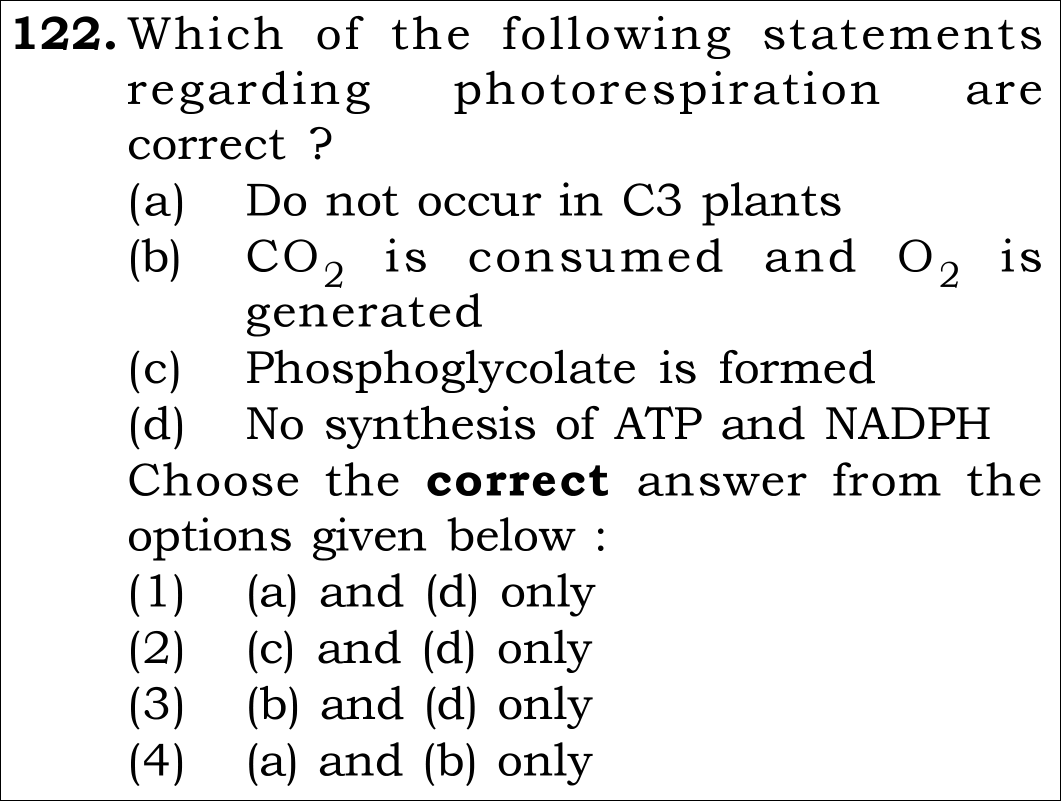
Official NEET 2026 Question 122 - Photosynthesis in Higher Plants
1
2 ✓ Key
3
4
💡 Verified Solution & 30-Second Hack
✓
Verified Against NTA Final Answer Key
Option (2) : (c) and (d) only
📚 Photosynthesis in Higher Plants Medium
📋 Given Parameters & Problem Setup
Metabolic Pathway Photorespiration (C₂ / glycolate pathway)
Statements Evaluated (a) Do not occur in C3 plants, (b) CO₂ is consumed and O₂ is generated, (c) Phosphoglycolate is formed, (d) No synthesis of ATP and NADPH
⚡

The 30-Second Exam Hall Shortcut: ⚡ Photorespiration Fact-Check

⏱️ Save ~40 seconds

Photorespiration occurs IN C₃ plants and WASTES energy with NO ATP/NADPH formed!

1 Examine (a): Claims it does NOT occur in C₃ plants. False! Photorespiration is characteristic of C₃ plants and absent in C₄ plants.
2 Examine (b): Claims CO₂ is consumed and O₂ generated. False! It uses O₂ and releases CO₂ (hence "respiration").
3 Examine (c): RuBisCO oxygenase reaction forms 1 PGA + 1 2-Phosphoglycolate (2C compound). True!
4 Examine (d): No synthesis of ATP or NADPH occurs; ATP is actually consumed. True!
5 Correct statements: (c) and (d) only -> Option (2)!
6 Mark Option (2) in under 10 seconds.
🛡️
Why You Can 100% Trust This Shortcut: NCERT Biology · Photosynthesis in Higher Plants (C4 Pathway / Hatch-Slack: Initial CO2 acceptor is Phosphoenolpyruvate PEP in mesophyll).
📐

Step-by-Step Rigorous Workflow & Mathematical Proof

Step 1

Evaluate Statement (a): Occurrence in Plants

Photorespiration occurs prominently in C₃ plants when RuBisCO binds oxygen instead of carbon dioxide under high temperature, high O₂ concentration, and low CO₂ concentration. In contrast, C₄ plants have evolved a CO₂-concentrating mechanism (Kranz anatomy) which prevents photorespiration. Thus, statement (a) is definitively false.

Photorespiration∈C3 plants(Absent in C4 plants)  ⟹  (a) is FALSE\text{Photorespiration} \in C_3\text{ plants} \quad (\text{Absent in } C_4\text{ plants}) \implies \text{(a) is FALSE}
  • • Eliminates Option (1) and Option (4).
Step 2

Evaluate Statement (b): Gas Exchange Direction

In photorespiration, RuBisCO functions as an oxygenase, consuming oxygen (O₂) and releasing carbon dioxide (CO₂). Statement (b) claims that "CO₂ is consumed and O₂ is generated", which is the exact opposite (normal photosynthesis). Hence, statement (b) is false.

Photorespiration:O2 consumed⟶CO2 released  ⟹  (b) is FALSE\text{Photorespiration}: \text{O}_2\text{ consumed} \longrightarrow \text{CO}_2\text{ released} \implies \text{(b) is FALSE}
  • • Eliminates Option (3).
Step 3

Evaluate Statement (c): Formation of Phosphoglycolate

When RuBisCO oxygenates ribulose-1,5-bisphosphate (RuBP), the 5-carbon substrate is cleaved into one molecule of 3-carbon phosphoglycerate (3-PGA) and one molecule of 2-carbon 2-phosphoglycolate.

RuBP (5C)+O2→RuBisCO (Oxygenase)3-PGA (3C)+2-Phosphoglycolate (2C)\text{RuBP (5C)} + \text{O}_2 \xrightarrow{\text{RuBisCO (Oxygenase)}} \text{3-PGA (3C)} + \mathbf{2\text{-Phosphoglycolate (2C)}}
  • • Statement (c) is factually correct.
Step 4

Evaluate Statement (d): Energetics of Pathway

NCERT states verbatim: "In the photorespiratory pathway, there is neither synthesis of sugars, nor of ATP. Rather it results in the release of CO₂ with the utilization of ATP. There is also no synthesis of NADPH." Therefore, statement (d) is factually correct.

ATP, NADPH synthesis=0(Wasteful ATP consumption occurs)  ⟹  (d) is TRUE\text{ATP, NADPH synthesis} = 0 \quad (\text{Wasteful ATP consumption occurs}) \implies \text{(d) is TRUE}
  • • Photorespiration is a biologically wasteful process.
Step 5

Conclusion

Statements (c) and (d) are correct, while (a) and (b) are false. The correct option is Option (2).

Correct Statements=(c) and (d) only  ⟹  Option (2)\text{Correct Statements} = \mathbf{(c) \text{ and } (d) \text{ only}} \implies \text{Option (2)}
  • • Matches official NTA final answer key Option B / (2).
⭐

360° Option Elimination Engine Key Feature

Diagnose every choice: Know exactly why the right option works and why distractors fail.

4-Option Deep Scan
1 A
✗ Incorrect
Verdict & Scientific Reason:

Incorrect. Statement (a) is false because photorespiration is rampant in C₃ plants.

⚠️
Student Fallacy (Why candidates pick this trap): Confusing C₃ with C₄ plants.
2 B
✓ 100% Correct
Verdict & Scientific Reason:

100% accurate. 2-Phosphoglycolate is formed and no ATP or NADPH is synthesized.

💡
Why this is airtight: None; precise understanding of C₂ cycle biochemistry.
3 C
✗ Incorrect
Verdict & Scientific Reason:

Incorrect. Statement (b) reverses gas exchange (it consumes O₂ and releases CO₂).

⚠️
Student Fallacy (Why candidates pick this trap): Confusing photorespiration gas exchange with Calvin cycle.
4 D
✗ Incorrect
Verdict & Scientific Reason:

Completely incorrect; pairs the two unequivocally false statements.

⚠️
Student Fallacy (Why candidates pick this trap): Total conceptual reversal.
⚠️

NTA Trap Alert: The C3 vs C4 Inversion

C₄ plants avoid photorespiration by maintaining high CO₂ around RuBisCO in bundle sheath cells. Students frequently mix up C₃ and C₄ plants in assertion/statement questions.

🛡️ How to avoid the -1 mark: Rule: C₄ says "NO" to photorespiration; C₃ suffers from it!
📖

Core NEET Syllabus Standard

NEET Biology Core Syllabus · Photosynthesis in Higher Plants Standard Benchmark
Core Scientific Principle Tested:

"In C₃ plants, oxygenation of RuBP forms 3-PGA and phosphoglycolate without producing ATP, NADPH, or sugars."

Syllabus Focus: Photorespiration
✓ Core NEET UG Syllabus Anchor Syllabus & Academic Standards ↗
Photorespiration: Phosphoglycolate appears, but ATP and NADPH disappear!
NEET 2025 · Q122 Easy
Official NEET 2025 Question 122 - Photosynthesis in Higher Plants
1
2 ✓ Key
3
4
💡 Verified Solution & 30-Second Hack
✓
Verified Against NTA Final Answer Key
Option (2) : A-III, B-I, C-II, D-IV
📚 Photosynthesis in Higher Plants Easy
📋 Given Parameters & Problem Setup
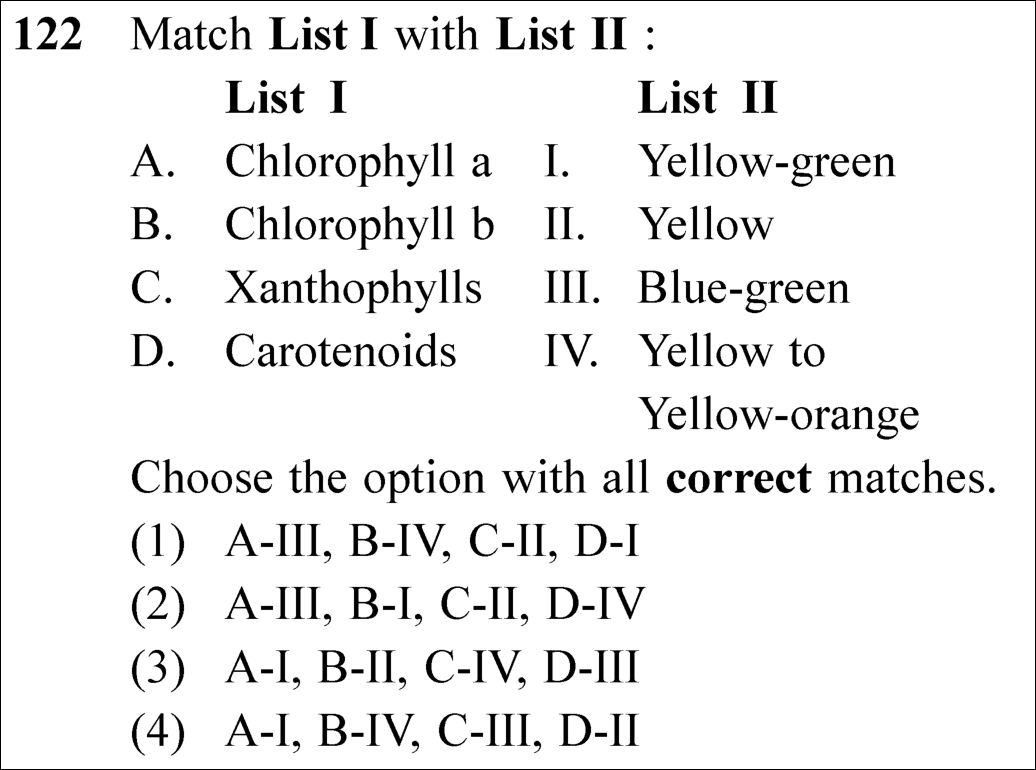
List I (Pigment Names) A. Chlorophyll a, B. Chlorophyll b, C. Xanthophylls, D. Carotenoids
List II (Chromatogram Colours) I. Yellow-green, II. Yellow, III. Blue-green, IV. Yellow to Yellow-orange
⚡

The 30-Second Exam Hall Shortcut: ⚡ Photosynthetic Pigment Colours Fingerprint

⏱️ Save ~25 seconds

Chl a = Blue-green (III); Chl b = Yellow-green (I); Xanthophyll = Yellow (II); Carotenoids = Yellow to yellow-orange (IV)!

1 Recall the NCERT chromatography colour table verbatim:
2 - Chlorophyll a: Bright or Blue-green (A -> III).
3 - Chlorophyll b: Yellow-green (B -> I).
4 - Xanthophylls: Yellow (C -> II).
5 - Carotenoids: Yellow to yellow-orange (D -> IV).
6 Unique matching sequence: A-III, B-I, C-II, D-IV (Option 2)!
7 Solved in under 10 seconds!
🛡️
Why You Can 100% Trust This Shortcut: Light Reaction & Photophosphorylation Pigments (NCERT Biology · Photosynthesis in Higher Plants: Reaction centre P680 and P700).
📐

Step-by-Step Rigorous Workflow & Mathematical Proof

Step 1

Chromatographic Separation of Photosynthetic Pigments

When leaf pigments are separated via paper chromatography, four distinct pigment bands appear based on their polarity and absorption properties:

  • • Chlorophyll a: The primary photosynthetic reaction center pigment; appears bright or blue-green in the chromatogram. Hence, A matches III.
  • • Chlorophyll b: An accessory antenna pigment; appears yellow-green in the chromatogram. Hence, B matches I.
  • • Xanthophylls: Oxygenated carotenoid accessory pigments; appear distinct yellow in the chromatogram. Hence, C matches II.
  • • Carotenoids: Pure hydrocarbon carotenes and related pigments; appear yellow to yellow-orange in the chromatogram. Hence, D matches IV.
Step 2

Formulating the Matching Code

Consolidating the four pigment-color associations:

  • • A (Chlorophyll a) -> III (Blue-green)
  • • B (Chlorophyll b) -> I (Yellow-green)
  • • C (Xanthophylls) -> II (Yellow)
  • • D (Carotenoids) -> IV (Yellow to Yellow-orange)
Step 3

Conclusion

The code A-III, B-I, C-II, D-IV uniquely corresponds to Option (2).

Code: A-III,  B-I,  C-II,  D-IV\text{Code: } A\text{-III}, \; B\text{-I}, \; C\text{-II}, \; D\text{-IV}
⭐

360° Option Elimination Engine Key Feature

Diagnose every choice: Know exactly why the right option works and why distractors fail.

4-Option Deep Scan
1 A
✗ Incorrect
Verdict & Scientific Reason:

Incorrect. Swaps chlorophyll b with carotenoids.

⚠️
Student Fallacy (Why candidates pick this trap): Confusing yellow-green with yellow-orange.
2 B
✓ 100% Correct
Verdict & Scientific Reason:

100% correct. Matches every photosynthetic pigment with its exact NCERT chromatogram colour.

💡
Why this is airtight: None; pristine knowledge of photosynthetic pigments.
3 C
✗ Incorrect
Verdict & Scientific Reason:

Incorrect. Assigns yellow-green to chlorophyll a and blue-green to carotenoids.

⚠️
Student Fallacy (Why candidates pick this trap): Flipping green and orange hues completely.
4 D
✗ Incorrect
Verdict & Scientific Reason:

Incorrect. Scrambled color associations.

⚠️
Student Fallacy (Why candidates pick this trap): Random guessing.
⚠️

NTA Trap Alert: Chlorophyll a vs Chlorophyll b Chromatogram Tint

Both chlorophylls are green, but Chl a is BLUE-green, whereas Chl b is YELLOW-green. Xanthophyll is pure YELLOW, while Carotenoids are YELLOW-ORANGE (think of carrot orange!).

🛡️ How to avoid the -1 mark: Chl a has "a" for "Aqua/Blue-green"; Carotenoid has "Carrot" for Yellow-orange.
📖

Core NEET Syllabus Standard

NEET Biology Core Syllabus · Photosynthesis in Higher Plants Standard Benchmark
Core Scientific Principle Tested:

"Chlorophyll a is blue-green, chlorophyll b is yellow-green, xanthophylls are yellow, and carotenoids are yellow to yellow-orange."

Syllabus Focus: How Many Types of Pigments are Involved in Photosynthesis?
✓ Core NEET UG Syllabus Anchor Syllabus & Academic Standards ↗
a = Aqua-green (Blue-green), b = Bright Yellow-green, X = Xanthic Yellow, C = Carrot Orange!
NEET 2025 · Q171 Easy
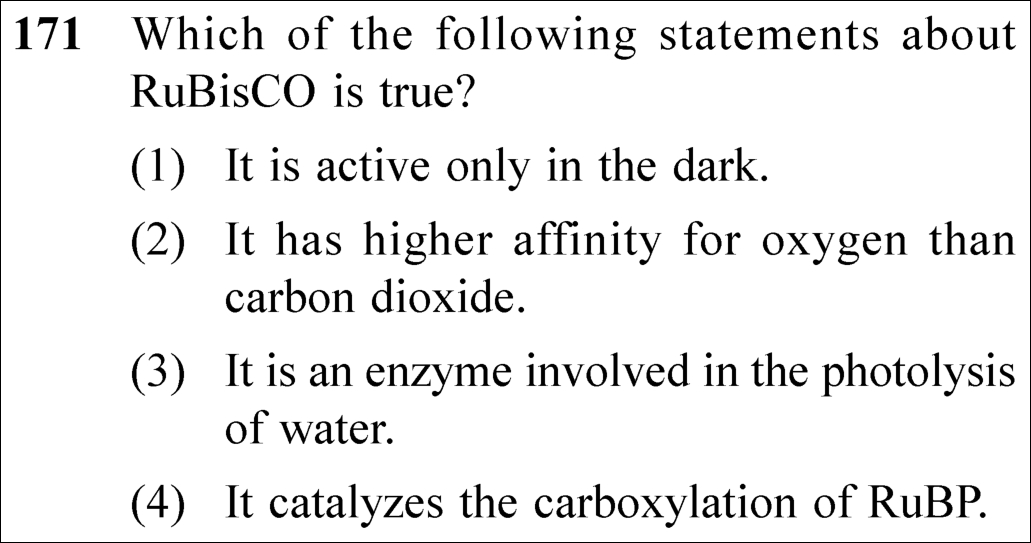
Official NEET 2025 Question 171 - Photosynthesis in Higher Plants
1 It is active only in the dark.
2 It has higher affinity for oxygen than carbon dioxide.
3 It is an enzyme involved in the photolysis of water.
4 It catalyzes the carboxylation of RuBP. ✓ Key
💡 Verified Solution & 30-Second Hack
✓
Verified Against NTA Final Answer Key
Option (4) : It catalyzes the carboxylation of RuBP.
📚 Photosynthesis in Higher Plants Easy
📋 Given Parameters & Problem Setup
Target Enzyme RuBisCO (Ribulose-1,5-bisphosphate carboxylase-oxygenase)
Question Which statement is TRUE?
⚡

The 30-Second Exam Hall Shortcut: ⚡ RuBisCO Biochemical Profile Fingerprint

⏱️ Save ~20 seconds

RuBisCO = Ribulose-1,5-bisphosphate Carboxylase-Oxygenase! Its primary photosynthetic function in the Calvin cycle is CARBOXYLATION OF RuBP to yield two molecules of 3-PGA! Option (4) is TRUE!

1 Evaluate each statement against NCERT Section 13.7.1 & 13.8:
2 - Option (1): Active only in dark? FALSE! Calvin cycle occurs in light; RuBisCO is light-activated by stromal pH/Mg²⁺ and depends on ATP/NADPH.
3 - Option (2): Higher affinity for O₂ than CO₂? FALSE! "RuBisCO has a much greater affinity for CO₂ than for O₂."
4 - Option (3): Involved in photolysis of water? FALSE! Photolysis occurs in PS-II (Oxygen Evolving Complex with Mn²⁺, Ca²⁺, Cl⁻).
5 - Option (4): Catalyzes carboxylation of RuBP? TRUE! RuBP+CO2+H2O→RuBisCO2×3-PGA\text{RuBP} + \text{CO}_2 + \text{H}_2\text{O} \xrightarrow{\text{RuBisCO}} 2 \times \text{3-PGA}.
6 Select Option (4)!
🛡️
Why You Can 100% Trust This Shortcut: Calvin Cycle Carbon Fixation Reactions (NCERT Biology · Photosynthesis in Higher Plants: RuBisCO carboxylation of RuBP).
📐

Step-by-Step Rigorous Workflow & Mathematical Proof

Step 1

Biochemical Identity of RuBisCO

Ribulose-1,5-bisphosphate carboxylase-oxygenase (RuBisCO) is the most abundant enzyme on Earth, located in the chloroplast stroma of autotrophs:

  • • It possesses bifunctional catalytic capacity: it can act as both a carboxylase and an oxygenase.
  • • Under normal physiological conditions, RuBisCO exhibits a significantly higher affinity for CO2\text{CO}_2 than for O2\text{O}_2.
Step 2

The Carboxylation Step in the Calvin Cycle

The primary physiological reaction catalyzed by RuBisCO:

  • • Carboxylation is the most crucial step of the Calvin (C3C_3) cycle.
  • • RuBisCO catalyzes the addition of one molecule of CO2\text{CO}_2 to the 5-carbon acceptor ribulose-1,5-bisphosphate (RuBP).
  • • The unstable 6-carbon intermediate immediately cleaves into two molecules of 3-phosphoglyceric acid (3-PGA), the first stable product of C3C_3 photosynthesis.
  • • Hence, statement (4) is undeniably TRUE.
Step 3

Refutation of False Distractors

Analyzing why options 1, 2, and 3 are scientifically incorrect:

  • • Statement (1): RuBisCO is inactive in the dark; it requires light-driven stromal alkalinization and Mg2+Mg^{2+} influx.
  • • Statement (2): NCERT explicitly clarifies that RuBisCO has a much greater affinity for CO2\text{CO}_2 than for O2\text{O}_2; oxygenase activity (photorespiration) occurs only when CO2:O2\text{CO}_2:\text{O}_2 ratio decreases.
  • • Statement (3): Photolysis of water (2H2O→4H++4e−+O22\text{H}_2\text{O} \rightarrow 4\text{H}^+ + 4e^- + \text{O}_2) is catalyzed by the water-splitting complex associated with Photosystem II on the luminal side of the thylakoid membrane, completely independent of RuBisCO.
Step 4

Conclusion

The only true statement is that RuBisCO catalyzes the carboxylation of RuBP, matching Option (4).

RuBP (5C)+CO2→RuBisCO2×3-PGA (3C)\text{RuBP (5C)} + \text{CO}_2 \xrightarrow{\text{RuBisCO}} 2 \times \text{3-PGA (3C)}
⭐

360° Option Elimination Engine Key Feature

Diagnose every choice: Know exactly why the right option works and why distractors fail.

4-Option Deep Scan
1 A
✗ Incorrect
Verdict & Scientific Reason:

Incorrect. RuBisCO is light-activated and active during daytime to coordinate with light reactions.

⚠️
Student Fallacy (Why candidates pick this trap): Mistaking the "dark reactions" misnomer as meaning the enzyme functions only at night.
2 B
✗ Incorrect
Verdict & Scientific Reason:

Incorrect. RuBisCO has a far higher affinity for CO₂ than for O₂.

⚠️
Student Fallacy (Why candidates pick this trap): Assuming photorespiration occurs because affinity for O₂ is higher.
3 C
✗ Incorrect
Verdict & Scientific Reason:

Incorrect. Water photolysis is mediated by the oxygen-evolving manganese complex in PS-II.

⚠️
Student Fallacy (Why candidates pick this trap): Confusing carbon fixation enzymes with thylakoid light-reaction complexes.
4 D
✓ 100% Correct
Verdict & Scientific Reason:

100% correct. Direct verbatim NCERT fact: RuBisCO catalyzes the carboxylation of RuBP in the Calvin cycle.

💡
Why this is airtight: None; pristine knowledge of photosynthesis.
⚠️

NTA Trap Alert: The "Dark Reaction" Misconception

Students often think enzymes of the Calvin cycle (like RuBisCO) are "active only in the dark" because it was called the "Dark reaction". NCERT clarifies: Calvin cycle depends directly on products of light reaction (ATP & NADPH) and RuBisCO is active in the light!

🛡️ How to avoid the -1 mark: RuBisCO works in the light; its job is carboxylation of RuBP.
📖

Core NEET Syllabus Standard

NEET Biology Core Syllabus · Photosynthesis in Higher Plants Standard Benchmark
Core Scientific Principle Tested:

"RuBisCO catalyzes the carboxylation of ribulose-1,5-bisphosphate (RuBP) to form 3-phosphoglycerate."

Syllabus Focus: The Calvin Cycle · Carboxylation Step
✓ Core NEET UG Syllabus Anchor Syllabus & Academic Standards ↗
RuBP + CO₂ = Carboxylation by RuBisCO!
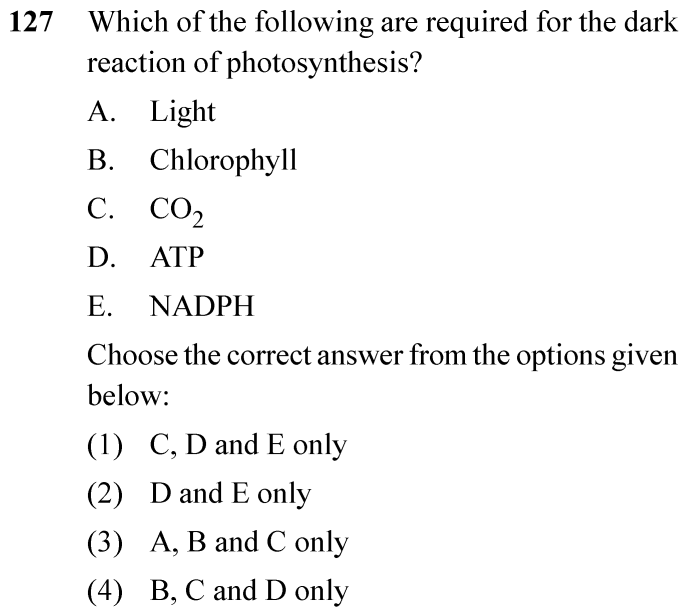
NEET 2024 · Q127 Easy
Official NEET 2024 Question 127 - Photosynthesis in Higher Plants
1 ✓ Key
2
3
4
💡 Verified Solution & 30-Second Hack
✓
Verified Against NTA Final Answer Key
Option (1) : C, D and E only
📚 Photosynthesis in Higher Plants Easy
📋 Given Parameters & Problem Setup
Pathway Dark reaction (biosynthetic phase / Calvin cycle) of photosynthesis
Candidate Inputs A: Light; B: Chlorophyll; C: CO2; D: ATP; E: NADPH
⚡

The 30-Second Exam Hall Shortcut: ⚡ Biosynthetic Phase Essential Inputs

⏱️ Save ~25 seconds

The dark reaction directly assimilates CO₂ (C) using assimilatory power generated during light reaction: ATP (D) and NADPH (E)! Light (A) is not directly required!

1 Dark reaction (Calvin cycle) is enzymatically driven in the stroma.
2 It synthesizes sugars from CO₂ (C).
3 It consumes chemical energy generated by light reaction: ATP (D) and NADPH (E).
4 Direct light (A) is not required (hence "dark reaction").
5 Chlorophyll (B) is located in thylakoid membranes for light harvesting, not a soluble stromal reactant for dark reaction.
6 Thus, directly required reactants are C, D and E only -> Option (1) / A.
🛡️
Why You Can 100% Trust This Shortcut: NCERT Biology · Photosynthesis in Higher Plants (The Biosynthetic Phase)
📐

Step-by-Step Rigorous Workflow & Mathematical Proof

Step 1

Understand the Light vs Dark Reaction Coupling

Photosynthesis consists of two phases: light reactions (photochemical phase) occurring in thylakoids, producing ATP, NADPH, and O₂; and dark reactions (biosynthetic phase) occurring in the stroma, where sugars are synthesized.

Step 2

Identify Inputs of the Biosynthetic Phase

The dark reaction does not directly require light. It requires: 1. Atmospheric carbon dioxide (CO2CO_2) as the carbon source (C). 2. ATPATP to supply energy for reduction and regeneration (D). 3. NADPHNADPH to supply reducing equivalents (H+H^+ and electrons) for reduction of 3-PGA to G3P (E).

Step 3

Conclude Required Set

C, D, and E are the indispensable chemical requirements, corresponding to Option (1).

⭐

360° Option Elimination Engine Key Feature

Diagnose every choice: Know exactly why the right option works and why distractors fail.

4-Option Deep Scan
1 (1)
✓ 100% Correct
Verdict & Scientific Reason:

CO₂, ATP, and NADPH are the specific chemical reactants utilized during the Calvin cycle in the stroma.

💡
Why this is airtight: None.
2 (2)
✗ Incorrect
Verdict & Scientific Reason:

Omits NADPH (E), which is mandatory for the reduction phase of PGA.

⚠️
Student Fallacy (Why candidates pick this trap): Omits NADPH (E), which is mandatory for the reduction phase of PGA.
3 (3)
✗ Incorrect
Verdict & Scientific Reason:

Dark reactions do not directly require light (A) or thylakoid chlorophyll (B).

⚠️
Student Fallacy (Why candidates pick this trap): Dark reactions do not directly require light (A) or thylakoid chlorophyll (B).
4 (4)
✗ Incorrect
Verdict & Scientific Reason:

Omits CO₂ (C), without which carbon fixation cannot take place.

⚠️
Student Fallacy (Why candidates pick this trap): Omits CO₂ (C), without which carbon fixation cannot take place.
⚠️

NTA Trap Alert: Role of Chlorophyll in Stroma

Assuming chlorophyll is directly needed in the stroma for dark reaction enzymes.

🛡️ How to avoid the -1 mark: Chlorophyll traps light in thylakoids to make ATP/NADPH; it plays no direct enzymatic role in the stromal Calvin cycle.
📖

Core NEET Syllabus Standard

Biology Core Botany · Photosynthesis in Higher Plants Standard Benchmark
Core Scientific Principle Tested:

"The products of light reaction are ATP, NADPH and O2... The phase of photosynthesis that results in the synthesis of food (sugar) is called the biosynthetic phase. This process does not directly depend on the presence of light but is dependent on the products of the light reaction, i.e., ATP and NADPH, besides CO2 and H2O."

Syllabus Focus: Substrates and Energy Intermediates for the Dark Reaction (Calvin Cycle)
✓ Core NEET UG Syllabus Anchor Syllabus & Academic Standards ↗
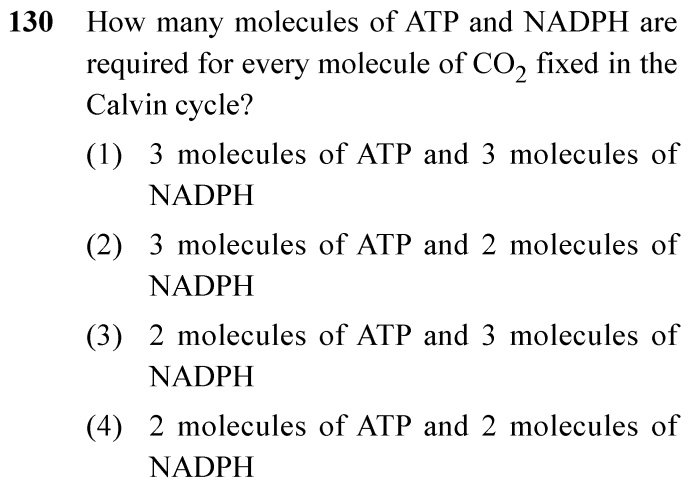
NEET 2024 · Q130 Easy
Official NEET 2024 Question 130 - Photosynthesis in Higher Plants
1
2 ✓ Key
3
4
💡 Verified Solution & 30-Second Hack
✓
Verified Against NTA Final Answer Key
Option (2) : 3 molecules of ATP and 2 molecules of NADPH
📚 Photosynthesis in Higher Plants Easy
📋 Given Parameters & Problem Setup
Metabolic Pathway Calvin Cycle (C3 pathway)
Unit Reaction Per molecule of CO2 fixed into carbohydrate
⚡

The 30-Second Exam Hall Shortcut: ⚡ Calvin Cycle Energy Balance Formula

⏱️ Save ~20 seconds

Per CO₂ fixed: 2 ATP + 2 NADPH in Reduction, plus 1 ATP in Regeneration = 3 ATP and 2 NADPH! For 1 Glucose (6 CO₂), it is 18 ATP and 12 NADPH!

1 Recall the three stages of Calvin cycle per CO₂ fixed:
2 Carboxylation: 0 ATP, 0 NADPH.
3 Reduction: 2 ATP + 2 NADPH consumed per 2 molecules of 3-PGA converted to G3P.
4 Regeneration: 1 ATP consumed to regenerate RuBP.
5 Total per single CO₂ fixed = 3 ATP and 2 NADPH.
6 Select Option (2) / B.
🛡️
Why You Can 100% Trust This Shortcut: NCERT Biology · Photosynthesis in Higher Plants (The Calvin Cycle)
📐

Step-by-Step Rigorous Workflow & Mathematical Proof

Step 1

Break Down Calvin Cycle Steps

The Calvin cycle proceeds in three stages: 1. Carboxylation: RuBP (5C5C) binds CO2CO_2 via RuBisCO to form two molecules of 3-PGA (3C3C). No ATP or NADPH is consumed.

Step 2

Calculate Energy in Reduction and Regeneration

2. Reduction: Two molecules of ATP for phosphorylation and two of NADPH for reduction are consumed per CO2CO_2 molecule fixed. 3. Regeneration: Regeneration of the CO2CO_2 acceptor molecule RuBP requires one phosphorylation step using one ATP. Total Energy Consumed per CO2CO_2: Total ATP=2+1=3  molecules\text{Total ATP} = 2 + 1 = 3\;\text{molecules} Total NADPH=2  molecules\text{Total NADPH} = 2\;\text{molecules}

Step 3

Verify Overall Glucose Balance

To produce 1 molecule of hexose glucose (C6H12O6C_6H_{12}O_6), six turns of the cycle are required, consuming 6×3=18  ATP6 \times 3 = 18\;ATP and 6×2=12  NADPH6 \times 2 = 12\;NADPH, perfectly matching NCERT Table 13.1.

⭐

360° Option Elimination Engine Key Feature

Diagnose every choice: Know exactly why the right option works and why distractors fail.

4-Option Deep Scan
1 (1)
✗ Incorrect
Verdict & Scientific Reason:

Inverts the numbers; NADPH needed is 2, while ATP needed is 3.

⚠️
Student Fallacy (Why candidates pick this trap): Inverts the numbers; NADPH needed is 2, while ATP needed is 3.
2 (2)
✓ 100% Correct
Verdict & Scientific Reason:

Accurately quantifies 3 ATP (2 reduction + 1 regeneration) and 2 NADPH per fixed CO₂.

💡
Why this is airtight: None.
3 (3)
✗ Incorrect
Verdict & Scientific Reason:

Considers only the reduction step, omitting the 1 ATP required for RuBP regeneration.

⚠️
Student Fallacy (Why candidates pick this trap): Considers only the reduction step, omitting the 1 ATP required for RuBP regeneration.
4 (4)
✗ Incorrect
Verdict & Scientific Reason:

Overestimates NADPH consumption; only 2 molecules are reduced per CO₂.

⚠️
Student Fallacy (Why candidates pick this trap): Overestimates NADPH consumption; only 2 molecules are reduced per CO₂.
⚠️

NTA Trap Alert: Omitting RuBP Regeneration ATP

Counting only the reduction phase (2 ATP and 2 NADPH) and forgetting the regeneration of RuBP.

🛡️ How to avoid the -1 mark: Always remember the complete cycle requires 3 ATP (2 in reduction + 1 in regeneration) and 2 NADPH per CO₂ fixed.
📖

Core NEET Syllabus Standard

Biology Core Botany · Photosynthesis in Higher Plants Standard Benchmark
Core Scientific Principle Tested:

"For every CO2 molecule entering the Calvin cycle, 3 molecules of ATP and 2 of NADPH are required. It is probably to meet this difference in number of ATP and NADPH used in the dark reaction that the cyclic phosphorylation takes place."

Syllabus Focus: ATP and NADPH Consumption per CO2 Fixed in the C3 Pathway
✓ Core NEET UG Syllabus Anchor Syllabus & Academic Standards ↗
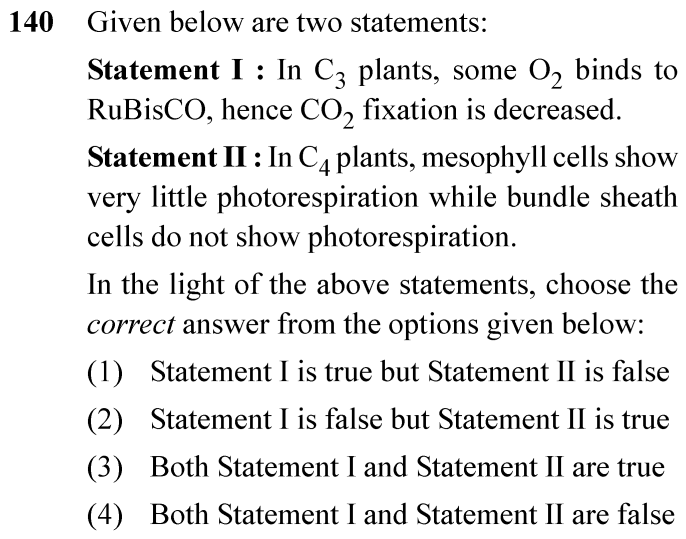
NEET 2024 · Q140 Medium
Official NEET 2024 Question 140 - Photosynthesis in Higher Plants
1 ✓ Key
2
3
4
💡 Verified Solution & 30-Second Hack
✓
Verified Against NTA Final Answer Key
Option (1) : Statement I is true but Statement II is false
📚 Photosynthesis in Higher Plants Medium
📋 Given Parameters & Problem Setup
Statement I In C3 plants, some O2 binds to RuBisCO, hence CO2 fixation is decreased.
Statement II In C4 plants, mesophyll cells show very little photorespiration while bundle sheath cells do not show photorespiration.
⚡

The 30-Second Exam Hall Shortcut: ⚡ C4 Photorespiration Absolute Rule

⏱️ Save ~30 seconds

Photorespiration does NOT occur at all in C4 plants (not "very little in mesophyll")! RuBisCO is completely absent in C4 mesophyll cells! Statement II is false; Statement I is true!

1 Statement I: In C3 plants, RuBisCO has an oxygenase activity; binding of O₂ decreases CO₂ fixation and initiates photorespiration -> TRUE.
2 Statement II: In C4 plants, mesophyll cells lack RuBisCO entirely (PEPcase fixes CO₂), so photorespiration cannot occur in mesophyll; bundle sheath cells have high CO₂ around RuBisCO, completely eliminating photorespiration. Thus, photorespiration is completely absent in C4 plants -> Statement II is FALSE!
3 Conclusion: Statement I is true but Statement II is false -> Option (1) / A.
🛡️
Why You Can 100% Trust This Shortcut: NCERT Biology · Photosynthesis in Higher Plants (Photorespiration in C3 and C4 Plants)
📐

Step-by-Step Rigorous Workflow & Mathematical Proof

Step 1

Evaluate Statement I (C3 Oxygenase Activity)

RuBisCO is the most abundant enzyme in the world and has an active site that can bind both CO2CO_2 and O2O_2. In C3C_3 plants, some O2O_2 binds to RuBisCO, and hence CO2CO_2 fixation is decreased. The RuBP instead of being converted to 2 molecules of PGA binds with O2O_2 to form one molecule of phosphoglycerate and one molecule of phosphoglycolate. Statement I is true.

Step 2

Evaluate Statement II (C4 Photorespiration Absence)

In C4C_4 plants photorespiration does not occur. This is because they have a mechanism that increases the concentration of CO2CO_2 at the enzyme site. In C4C_4 plants, mesophyll cells completely lack RuBisCO (they possess PEPcase); therefore, photorespiration cannot happen in mesophyll cells. When C4C_4 acids from mesophyll cells are broken down in bundle sheath cells, CO2CO_2 is released, ensuring that RuBisCO functions exclusively as a carboxylase. Thus, photorespiration is zero in both cell types. Statement II is false.

Step 3

Select Matching Option

Statement I is true but Statement II is false, matching Option (1).

⭐

360° Option Elimination Engine Key Feature

Diagnose every choice: Know exactly why the right option works and why distractors fail.

4-Option Deep Scan
1 (1)
✓ 100% Correct
Verdict & Scientific Reason:

Statement I correctly describes RuBisCO oxygenation in C3 plants; Statement II falsely claims mesophyll cells show photorespiration in C4 plants.

💡
Why this is airtight: None.
2 (2)
✗ Incorrect
Verdict & Scientific Reason:

Statement I is true and Statement II is false.

⚠️
Student Fallacy (Why candidates pick this trap): Statement I is true and Statement II is false.
3 (3)
✗ Incorrect
Verdict & Scientific Reason:

Statement II is false because C4 plants do not exhibit photorespiration at all.

⚠️
Student Fallacy (Why candidates pick this trap): Statement II is false because C4 plants do not exhibit photorespiration at all.
4 (4)
✗ Incorrect
Verdict & Scientific Reason:

Statement I is factually correct.

⚠️
Student Fallacy (Why candidates pick this trap): Statement I is factually correct.
⚠️

NTA Trap Alert: Assuming "A Little" Photorespiration Occurs in C4

Thinking photorespiration happens at low rates in mesophyll of C4 plants.

🛡️ How to avoid the -1 mark: RuBisCO is entirely absent in C4 mesophyll cells, making photorespiration physically impossible there.
📖

Core NEET Syllabus Standard

Biology Core Botany · Photosynthesis in Higher Plants Standard Benchmark
Core Scientific Principle Tested:

"In C3 plants some O2 does bind to RuBisCO, and hence CO2 fixation is decreased... In C4 plants photorespiration does not occur. This is because they have a mechanism that increases the concentration of CO2 at the enzyme site."

Syllabus Focus: Photorespiration in C3 Plants vs Lack of Photorespiration in C4 Plants
✓ Core NEET UG Syllabus Anchor Syllabus & Academic Standards ↗
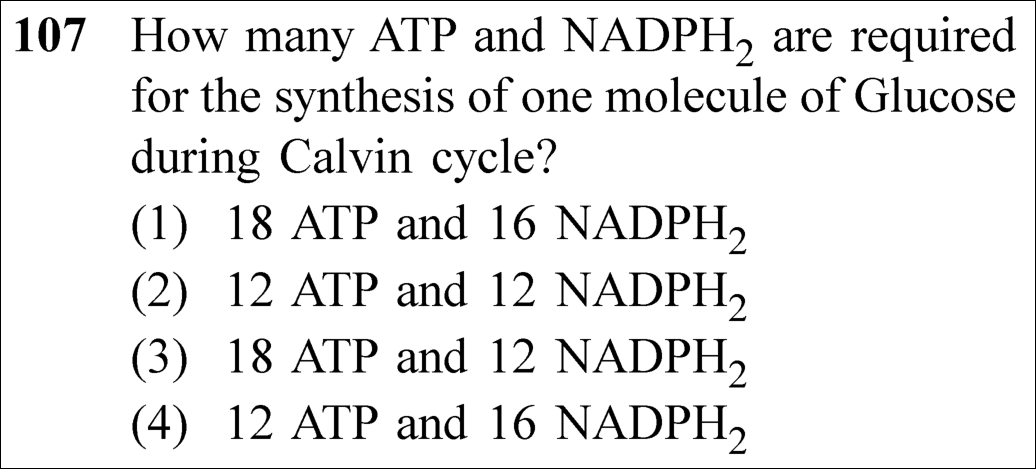
NEET 2023 · Q107 Easy
Official NEET 2023 Question 107 - Photosynthesis in Higher Plants
1
2
3 ✓ Key
4
💡 Verified Solution & 30-Second Hack
✓
Verified Against NTA Final Answer Key
Option (3) : 18 ATP and 12 NADPH₂
📚 Photosynthesis in Higher Plants Easy
📋 Given Parameters & Problem Setup
Pathway Calvin Cycle (C3C_3 pathway)
Target Product 1 molecule of Glucose (C6H12O6C_6H_{12}O_6)
CO2 Fixed 6 molecules of CO2CO_2
⚡

The 30-Second Exam Hall Shortcut: ⚡ 3:2 Ratio Multiplied by 6 Rule

⏱️ Save ~25 seconds

Fixing 1 CO2CO_2 requires 3 ATP and 2 NADPHNADPH. To synthesize 1 glucose (6 carbons6 \text{ carbons}), simply multiply the energetic cost by 6: 6×3=18 ATP6 \times 3 = 18\text{ ATP} and 6×2=12 NADPH6 \times 2 = 12\text{ NADPH}!

1 Per CO2CO_2 fixed: 2 ATP in reduction + 1 ATP in RuBP regeneration = 3 ATP.
2 Per CO2CO_2 fixed: 2 NADPH in reduction = 2 NADPH.
3 For 1 glucose (C6H12O6C_6H_{12}O_6): 6 cycles required.
4 Total ATP = 6×3=18 ATP6 \times 3 = 18\text{ ATP}.
5 Total NADPH = 6×2=12 NADPH26 \times 2 = 12\text{ NADPH}_2.
6 Select Option (3) 18 ATP and 12 NADPH2.
🛡️
Why You Can 100% Trust This Shortcut: Canonical NCERT Photosynthesis Calvin cycle biochemical stoichiometry.
📐

Step-by-Step Rigorous Workflow & Mathematical Proof

Step 1

Calvin Cycle Phases and Energy Consumption per CO2

For each single molecule of CO2CO_2 entering the cycle, energy is consumed in two specific steps:

Reduction:2 molecules of 3-PGA→2 ATP +2 NADPH2 Triose-PRegeneration:Triose-P→1 ATP1 RuBPNet per CO2:3 ATPand2 NADPH\begin{aligned} \text{\textbf{Reduction:}} & \quad 2\text{ molecules of 3-PGA} \xrightarrow{2\text{ ATP } + 2\text{ NADPH}} 2\text{ Triose-P} \\[4pt] \text{\textbf{Regeneration:}} & \quad \text{Triose-P} \xrightarrow{1\text{ ATP}} 1\text{ RuBP} \\[4pt] \hline \text{\textbf{Net per }} CO_2: & \quad \mathbf{3\text{ ATP}} \quad \text{and} \quad \mathbf{2\text{ NADPH}} \end{aligned}
Step 2

Stoichiometry for One Hexose Molecule

Synthesis of one net molecule of glucose (C6H12O6C_6H_{12}O_6) requires 6 complete turns of the Calvin cycle fixing 6 CO2CO_2 molecules:

Total ATP=6×3=18 ATPTotal NADPH2=6×2=12 NADPH2\begin{aligned} \text{Total ATP} &= 6 \times 3 = \mathbf{18\text{ ATP}} \\[4pt] \text{Total NADPH}_2 &= 6 \times 2 = \mathbf{12\text{ NADPH}_2} \end{aligned}
Step 3

Overall Balance Sheet

The net input/output equation for glucose synthesis in the dark reaction is:

6CO2+18ATP+12NADPH⟶C6H12O6+18ADP+18Pi+12NADP+6CO_2 + 18\text{ATP} + 12\text{NADPH} \longrightarrow C_6H_{12}O_6 + 18\text{ADP} + 18\text{P}_i + 12\text{NADP}^+
⭐

360° Option Elimination Engine Key Feature

Diagnose every choice: Know exactly why the right option works and why distractors fail.

4-Option Deep Scan
1 1
✗ Incorrect
Verdict & Scientific Reason:

NADPH count is overstated; only 12 NADPH are required for reduction of 12 molecules of 3-PGA.

⚠️
Student Fallacy (Why candidates pick this trap): Arbitrarily inflating NADPH counts without balancing the 2 per CO2 reduction step.
2 2
✗ Incorrect
Verdict & Scientific Reason:

Under-counts ATP by omitting the 6 ATP consumed in RuBP regeneration.

⚠️
Student Fallacy (Why candidates pick this trap): Accounting only for the reduction phase (12 ATP) and forgetting RuBP regeneration (6 ATP).
3 3
✓ 100% Correct
Verdict & Scientific Reason:

Exact stoichiometric balance: 18 ATP (12 reduction + 6 regeneration) and 12 NADPH2 (reduction).

💡
Why this is airtight: None; rigorous biochemical stoichiometry.
4 4
✗ Incorrect
Verdict & Scientific Reason:

Both values are incorrect.

⚠️
Student Fallacy (Why candidates pick this trap): Confusing light reaction non-cyclic photophosphorylation ratios with Calvin cycle requirements.
⚠️

NTA Trap Alert: Omitting RuBP Regeneration ATP Trap

Many students only count the 2 ATP used per CO2CO_2 during the reduction of 3-PGA to G-3-P (totaling 12 ATP) and completely forget the 1 ATP per CO2CO_2 required to regenerate RuBP (totaling 6 ATP).

🛡️ How to avoid the -1 mark: Always remember: 3 ATP per CO2 (2 in reduction + 1 in regeneration). 6 x 3 = 18 ATP!
📖

Core NEET Syllabus Standard

NCERT Biology · Photosynthesis in Higher Plants Standard Benchmark
Core Scientific Principle Tested:

"For every CO2 molecule entering the Calvin cycle, 3 molecules of ATP and 2 of NADPH are required. To make one molecule of glucose, 6 turns of the cycle are required, consuming 18 ATP and 12 NADPH."

Syllabus Focus: The Calvin Cycle
✓ Core NEET UG Syllabus Anchor Syllabus & Academic Standards ↗
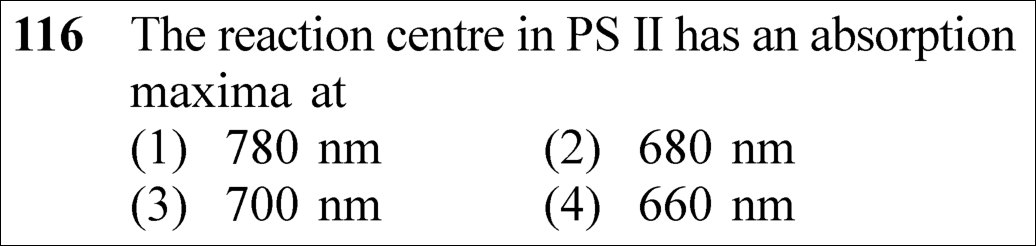
NEET 2023 · Q116 Easy
Official NEET 2023 Question 116 - Photosynthesis in Higher Plants
1 780 nm
2 680 nm ✓ Key
3 700 nm
4 660 nm
💡 Verified Solution & 30-Second Hack
✓
Verified Against NTA Final Answer Key
Option (2) : 680 nm
📚 Photosynthesis in Higher Plants Easy
📋 Given Parameters & Problem Setup
Photosystem Photosystem II (PS II)
Reaction Centre Chlorophyll a molecule
⚡

The 30-Second Exam Hall Shortcut: ⚡ PS II = P680 vs. PS I = P700 Rule

⏱️ Save ~20 seconds

The reaction centre chlorophyll a of PS II absorbs light maximally at 680 nm (called P680), whereas the reaction centre of PS I absorbs maximally at 700 nm (called P700)!

1 Photosystem I has reaction centre P700P_{700} (peak at 700 nm in red spectrum).
2 Photosystem II has reaction centre P680P_{680} (peak at 680 nm in red spectrum).
3 The prompt asks specifically for PS II.
4 Match Option (2) 680 nm directly.
🛡️
Why You Can 100% Trust This Shortcut: Canonical NCERT Photosynthesis photochemical reaction centre biophysics.
📐

Step-by-Step Rigorous Workflow & Mathematical Proof

Step 1

Organization of the Light Harvesting Complex (LHC)

Photosystems comprise hundreds of pigment molecules bound to proteins forming antennae that funnel excitation energy to a unique single chlorophyll aa reaction centre:

Photosystem=Antenna Pigments (LHC)+Core Reaction Centre (Chlorophyll a)\text{Photosystem} = \text{Antenna Pigments (LHC)} + \text{Core Reaction Centre (Chlorophyll } a)
Step 2

Spectroscopic Absorption Maxima

The two photosystems are designated based on the red absorption peak wavelength of their respective reaction centre chlorophyll aa molecules:

PS II:Reaction centre P680  ⟹  λmax⁡=680 nm (Red Light)PS I:Reaction centre P700  ⟹  λmax⁡=700 nm (Far-Red Light)\begin{aligned} \text{\textbf{PS II:}} & \quad \text{Reaction centre } \mathbf{P_{680}} \implies \lambda_{\max} = \mathbf{680\text{ nm (Red Light)}} \\[4pt] \text{PS I:} & \quad \text{Reaction centre } P_{700} \implies \lambda_{\max} = 700\text{ nm (Far-Red Light)} \end{aligned}
Step 3

Verbatim NCERT Confirmation

NCERT states verbatim: "In PS II the reaction centre chlorophyll a has an absorption peak at 680 nm, and is called P680."

⭐

360° Option Elimination Engine Key Feature

Diagnose every choice: Know exactly why the right option works and why distractors fail.

4-Option Deep Scan
1 1
✗ Incorrect
Verdict & Scientific Reason:

780 nm lies in the near-infrared region, outside the photosynthetically active radiation (PAR, 400-700 nm) spectrum of oxygenic phototrophs.

⚠️
Student Fallacy (Why candidates pick this trap): Conflating bacterial infrared bacteriochlorophyll peaks with plant PS II.
2 2
✓ 100% Correct
Verdict & Scientific Reason:

Exact NCERT peak absorption wavelength for the chlorophyll a reaction centre of PS II (P680P_{680}).

💡
Why this is airtight: None; textbook verbatim.
3 3
✗ Incorrect
Verdict & Scientific Reason:

700 nm is the absorption peak of Photosystem I (P700P_{700}), not Photosystem II.

⚠️
Student Fallacy (Why candidates pick this trap): Inverting the photosystem labels (confusing PS I with PS II).
4 4
✗ Incorrect
Verdict & Scientific Reason:

660 nm is the absorption peak for the red-absorbing form of phytochrome (PrP_r), not the PS II reaction centre.

⚠️
Student Fallacy (Why candidates pick this trap): Confusing phytochrome photobiology with photosynthetic photosystems.
⚠️

NTA Trap Alert: PS I vs. PS II Numbering Inversion Trap

PS II acts first in non-cyclic electron transport (Z-scheme), but was discovered second, causing students to associate PS II with 700 nm and PS I with 680 nm.

🛡️ How to avoid the -1 mark: Remember: PS II operates at the shorter wavelength: P680P_{680}. PS I operates at the longer wavelength: P700P_{700}.
📖

Core NEET Syllabus Standard

NCERT Biology · Photosynthesis in Higher Plants Standard Benchmark
Core Scientific Principle Tested:

"In PS II the reaction centre chlorophyll a has an absorption peak at 680 nm, and is called P680."

Syllabus Focus: The Electron Transport System (Light Reaction)
✓ Core NEET UG Syllabus Anchor Syllabus & Academic Standards ↗
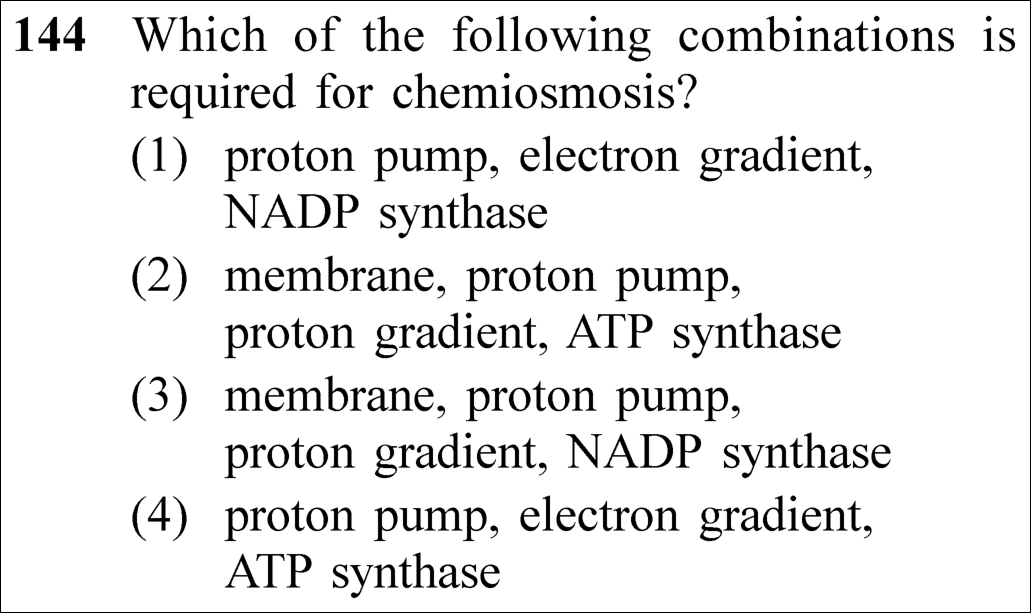
NEET 2023 · Q144 Easy
Official NEET 2023 Question 144 - Photosynthesis in Higher Plants
1 proton pump, electron gradient, NADP synthase
2 membrane, proton pump, proton gradient, ATP synthase ✓ Key
3 membrane, proton pump, proton gradient, NADP synthase
4 proton pump, electron gradient, ATP synthase
💡 Verified Solution & 30-Second Hack
✓
Verified Against NTA Final Answer Key
Option (2) : membrane, proton pump, proton gradient, ATP synthase
📚 Photosynthesis in Higher Plants Easy
📋 Given Parameters & Problem Setup
Biophysical Process Chemiosmosis (Mitchell's Chemiosmotic Hypothesis)
Criterion Combination of essential biological components
⚡

The 30-Second Exam Hall Shortcut: ⚡ Chemiosmosis Quartet: Membrane + Pump + Gradient + ATP Synthase

⏱️ Save ~20 seconds

Verbatim NCERT Chemiosmotic Hypothesis declaration: "Chemiosmosis requires a membrane, a proton pump, a proton gradient and ATP synthase!" Instant 5-second answer!

1 Recall the four essential pillars of Mitchell's chemiosmotic hypothesis:
2 (i) A membrane (impermeable thylakoid or inner mitochondrial membrane).
3 (ii) A proton pump (ETS complexes pumping H+ into lumen/intermembrane space).
4 (iii) A proton gradient (pH and electrochemical gradient across the membrane).
5 (iv) ATP synthase (CF0−CF1CF_0-CF_1 or F0−F1F_0-F_1 channel and catalytic headpiece).
6 Select Option (2) membrane, proton pump, proton gradient, ATP synthase.
🛡️
Why You Can 100% Trust This Shortcut: Canonical NCERT Photosynthesis Mitchell chemiosmotic model components.
📐

Step-by-Step Rigorous Workflow & Mathematical Proof

Step 1

The Four Fundamental Components of Chemiosmosis

Peter Mitchell's chemiosmotic mechanism explains phosphorylation in both chloroplasts and mitochondria through four cooperative structures:

Chemiosmotic Apparatus={1.Intact Membrane(creates closed compartment)2.Proton Pump(active translocators in ETS)3.Proton Gradient (\DeltapH)(high [H+] inside)4.ATP Synthase(F0/CF0 channel +F1/CF1 head)\text{Chemiosmotic Apparatus} = \begin{cases} \mathbf{1.} & \text{\textbf{Intact Membrane}} \quad (\text{creates closed compartment}) \\[3pt] \mathbf{2.} & \text{\textbf{Proton Pump}} \quad (\text{active translocators in ETS}) \\[3pt] \mathbf{3.} & \text{\textbf{Proton Gradient (}\Delta\text{pH)}} \quad (\text{high } [H^+] \text{ inside}) \\[3pt] \mathbf{4.} & \text{\textbf{ATP Synthase}} \quad (F_0/CF_0 \text{ channel } + F_1/CF_1 \text{ head}) \end{cases}
Step 2

Verbatim NCERT Reference

NCERT explicitly states: "Chemiosmosis requires a membrane, a proton pump, a proton gradient and ATP synthase. Energy is used to pump protons across a membrane, to create a gradient or a high concentration of protons within the thylakoid lumen."

Step 3

Elimination of Distractor Components

NADP reductase (not "NADP synthase") is a peripheral stroma-facing enzyme facilitating NADP+ reduction, but is not the motor of chemiosmotic ATP synthesis. An "electron gradient" does not drive ATP synthase; the proton-motive force drives it.

⭐

360° Option Elimination Engine Key Feature

Diagnose every choice: Know exactly why the right option works and why distractors fail.

4-Option Deep Scan
1 1
✗ Incorrect
Verdict & Scientific Reason:

Chemiosmosis requires a proton gradient (not electron gradient) and ATP synthase (not NADP synthase).

⚠️
Student Fallacy (Why candidates pick this trap): Confusing electron transport with the driving proton-motive force.
2 2
✓ 100% Correct
Verdict & Scientific Reason:

Verbatim NCERT quote listing the four essential components required for chemiosmosis.

💡
Why this is airtight: None; textbook verbatim.
3 3
✗ Incorrect
Verdict & Scientific Reason:

Chemiosmotic ATP generation requires ATP synthase, not NADP synthase.

⚠️
Student Fallacy (Why candidates pick this trap): Misreading ATP synthase as NADP synthase.
4 4
✗ Incorrect
Verdict & Scientific Reason:

Lacks the indispensable membrane barrier and misidentifies the proton gradient as an electron gradient.

⚠️
Student Fallacy (Why candidates pick this trap): Overlooking the fundamental necessity of an intact coupling membrane.
⚠️

NTA Trap Alert: ATP Synthase vs. NADP Synthase Reading Trap

Options 1 and 3 substitute "NADP synthase" in place of "ATP synthase", preying on students reading quickly through repetitive lists.

🛡️ How to avoid the -1 mark: Always check the final enzyme: chemiosmosis makes ATP, so it MUST be ATP synthase!
📖

Core NEET Syllabus Standard

NCERT Biology · Photosynthesis in Higher Plants Standard Benchmark
Core Scientific Principle Tested:

"Chemiosmosis requires a membrane, a proton pump, a proton gradient and ATP synthase."

Syllabus Focus: Chemiosmotic Hypothesis
✓ Core NEET UG Syllabus Anchor Syllabus & Academic Standards ↗
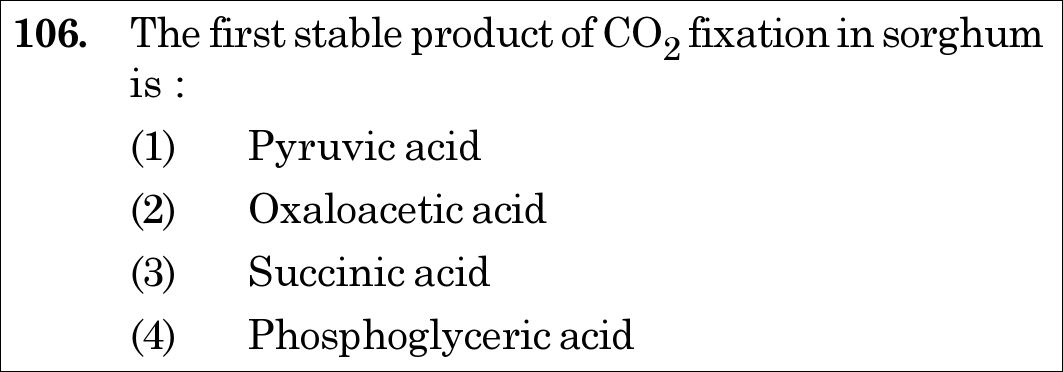
NEET 2021 · Q106 Easy
Official NEET 2021 Question 106 - Photosynthesis in Higher Plants
1 Pyruvic acid
2 Oxaloacetic acid ✓ Key
3 Succinic acid
4 Phosphoglyceric acid
💡 Verified Solution & 30-Second Hack
✓
Verified Against NTA Final Answer Key
Option (2) : Oxaloacetic acid
📚 Photosynthesis in Higher Plants Easy
📋 Given Parameters & Problem Setup
Plant Type Sorghum (C4 monocot cereal)
Biochemical Parameter First stable product of CO2 fixation
⚡

The 30-Second Exam Hall Shortcut: ⚡ Sorghum = C4 Plant   ⟹  \implies 4-Carbon OAA (Oxaloacetic Acid)

⏱️ Save ~20 seconds

Sorghum is a classical C4 plant (along with Maize and Sugarcane). Primary CO2 fixation in mesophyll cells is catalyzed by PEP carboxylase yielding the 4-carbon organic acid Oxaloacetic acid (OAA) as the first stable product! In C3 plants, it is 3-PGA. Match Option (2)!

1 Identify the plant: Sorghum (*Sorghum bicolor*) is a tropical monocot that utilizes the C4 Hatch-Slack pathway.
2 Primary acceptor in mesophyll is Phosphoenolpyruvate (PEP, 3-carbon).
3 Reaction: PEP+HCO3−→PEPcaseOxaloacetic acid (OAA, 4-carbon)\text{PEP} + \text{HCO}_3^- \xrightarrow{\text{PEPcase}} \text{Oxaloacetic acid (OAA, 4-carbon)}.
4 Match Option (2).
🛡️
Why You Can 100% Trust This Shortcut: Canonical NCERT Photosynthesis in Higher Plants on C4 Pathway.
📐

Step-by-Step Rigorous Workflow & Mathematical Proof

Step 1

Classification of Sorghum as a C4 Plant

Plants exhibiting the Kranz anatomy and the Hatch-Slack pathway are termed C4C_4 plants. Classical examples include maize, sugarcane, and sorghum.

Step 2

Initial Carboxylation Reaction in Mesophyll Cells

The primary acceptor of CO2CO_2 is phosphoenolpyruvate (PEPPEP), a 3-carbon compound present in the mesophyll cells. The enzyme responsible is PEPPEP carboxylase (PEPcasePEPcase):

Phosphoenolpyruvate (3C)+HCO3−+H2O→PEP carboxylaseOxaloacetic acid (OAA, 4C)+H3PO4\text{Phosphoenolpyruvate (3C)} + \text{HCO}_3^- + \text{H}_2\text{O} \xrightarrow{\text{PEP carboxylase}} \mathbf{\text{Oxaloacetic acid (OAA, 4C)}} + \text{H}_3\text{PO}_4
Step 3

Subsequent Metabolism of OAA

OAA (oxaloacetate) is rapidly reduced to other 4-carbon dicarboxylic acids like malic acid or aspartic acid in the mesophyll cells before transport to bundle sheath cells.

⭐

360° Option Elimination Engine Key Feature

Diagnose every choice: Know exactly why the right option works and why distractors fail.

4-Option Deep Scan
1 1
✗ Incorrect
Verdict & Scientific Reason:

Pyruvic acid (pyruvate, 3C) is formed after decarboxylation in bundle sheath cells and transported back to regenerate PEP.

⚠️
Student Fallacy (Why candidates pick this trap): Confusing the regenerated precursor with the initial carboxylation product.
2 2
✓ 100% Correct
Verdict & Scientific Reason:

Oxaloacetic acid (OAA, 4C) is the initial, first stable product of CO2 fixation in C4 plants like sorghum.

💡
Why this is airtight: None. Fundamental textbook fact.
3 3
✗ Incorrect
Verdict & Scientific Reason:

Succinic acid is a 4-carbon intermediate of the Krebs cycle in cellular respiration, not the product of photosynthetic CO2 fixation.

⚠️
Student Fallacy (Why candidates pick this trap): Mistaking a citric acid cycle intermediate for a photosynthetic pathway intermediate.
4 4
✗ Incorrect
Verdict & Scientific Reason:

3-Phosphoglyceric acid (3-PGA, 3C) is the first stable product in C3 plants (Calvin cycle), not in C4 plants like sorghum.

⚠️
Student Fallacy (Why candidates pick this trap): Overlooking that sorghum is a C4 plant, thereby reflexively picking 3-PGA (the C3 product).
⚠️

NTA Trap Alert: Plant Identity Overlook: Sorghum is C4, Not C3

Candidates who fail to recognize Sorghum as a C4 plant automatically choose 3-Phosphoglyceric acid (3-PGA), the first stable product of C3 plants.

🛡️ How to avoid the -1 mark: Commit to memory the major C4 trio tested in NEET: Maize, Sugarcane, and Sorghum   ⟹  \implies First product is always OAA (4C).
📖

Core NEET Syllabus Standard

NEET / NCERT Biology · Photosynthesis in Higher Plants Standard Benchmark
Core Scientific Principle Tested:

"In C4 plants, the initial stable product of CO2 fixation is oxaloacetic acid (OAA), a 4-carbon organic acid."

Syllabus Focus: The C4 Pathway (Hatch and Slack Pathway)
✓ Core NEET UG Syllabus Anchor Syllabus & Academic Standards ↗
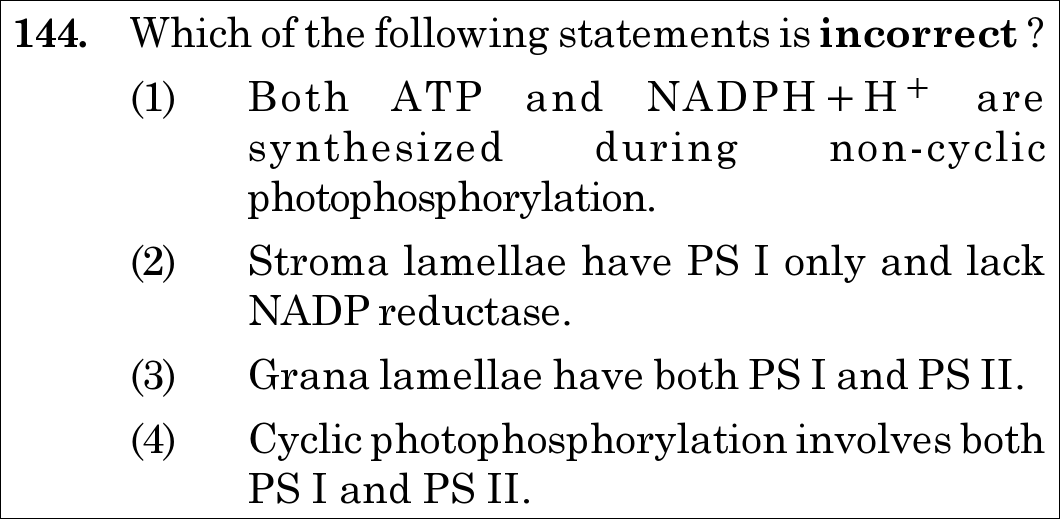
NEET 2021 · Q144 Easy
Official NEET 2021 Question 144 - Photosynthesis in Higher Plants
1 Both ATP and NADPH+H+ are synthesized during non-cyclic photophosphorylation.
2 Stroma lamellae have PS I only and lack NADP reductase.
3 Grana lamellae have both PS I and PS II.
4 Cyclic photophosphorylation involves both PS I and PS II. ✓ Key
💡 Verified Solution & 30-Second Hack
✓
Verified Against NTA Final Answer Key
Option (4) : Cyclic photophosphorylation involves both PS I and PS II.
📚 Photosynthesis in Higher Plants Easy
📋 Given Parameters & Problem Setup
Process Light reaction of photosynthesis
Target Identify the statement that is INCORRECT
⚡

The 30-Second Exam Hall Shortcut: ⚡ Cyclic Photophosphorylation Involves ONLY PS I, Never PS II!

⏱️ Save ~20 seconds

Non-cyclic photophosphorylation (Z-scheme) involves BOTH PS II and PS I. Cyclic photophosphorylation occurs when only PS I is functional (e.g., in stroma lamellae which lack PS II and NADP reductase). Claiming cyclic photophosphorylation involves both PS I and PS II is factually wrong! Match Option (4)!

1 Check Statement (1): Non-cyclic photophosphorylation produces both ATP and NADPH + H+   ⟹  \implies TRUE.
2 Check Statement (2): Stroma lamellae possess PS I only and lack PS II and NADP reductase   ⟹  \implies TRUE.
3 Check Statement (3): Grana lamellae appressed membranes possess both PS I and PS II   ⟹  \implies TRUE.
4 Check Statement (4): Cyclic photophosphorylation involves both PS I and PS II   ⟹  \implies FALSE (it operates solely with PS I).
5 Match Option (4).
🛡️
Why You Can 100% Trust This Shortcut: Canonical NCERT Photosynthesis in Higher Plants on Cyclic Photophosphorylation.
📐

Step-by-Step Rigorous Workflow & Mathematical Proof

Step 1

Mechanism of Cyclic Photophosphorylation

When light of wavelength beyond 680 nm680\text{ nm} is available, or when stroma lamellae lack PS II and NADP reductase, only Photosystem I (P700P_{700}) operates in a closed cycle:

PS I (P700)→hνe−→Primary AcceptorCytochrome b6f complex→PlastocyaninPS I (P700)+ATP\text{PS I } (P_{700}) \xrightarrow{h\nu} e^- \xrightarrow{\text{Primary Acceptor}} \text{Cytochrome } b_6f \text{ complex} \xrightarrow{\text{Plastocyanin}} \text{PS I } (P_{700}) + \mathbf{\text{ATP}}
Step 2

Contrast with Non-Cyclic Photophosphorylation

- Non-cyclic photophosphorylation (Z-scheme): Involves both Photosystems II (P680P_{680}) and I (P700P_{700}) operating in series, generating both ATP and NADPH+H+NADPH + H^+, with photolysis of water. - Cyclic photophosphorylation: Involves only PS I. Electrons cycle back to the reaction center, synthesizing solely ATP without NADPHNADPH production or water splitting.

Step 3

Evaluation of Statement (4)

Statement (4) asserts that "cyclic photophosphorylation involves both PS I and PS II". This is incorrect because PS II does not participate in cyclic electron flow.

⭐

360° Option Elimination Engine Key Feature

Diagnose every choice: Know exactly why the right option works and why distractors fail.

4-Option Deep Scan
1 1
✗ Incorrect
Verdict & Scientific Reason:

This statement is TRUE. The non-cyclic Z-scheme generates both assimilatory powers (ATP and NADPH).

⚠️
Student Fallacy (Why candidates pick this trap): Selecting a true statement instead of the incorrect claim.
2 2
✗ Incorrect
Verdict & Scientific Reason:

This statement is TRUE. Stroma thylakoids lack PS II and NADP reductase, performing only cyclic photophosphorylation.

⚠️
Student Fallacy (Why candidates pick this trap): Thinking stroma lamellae contain both photosystems.
3 3
✗ Incorrect
Verdict & Scientific Reason:

This statement is TRUE. Granal thylakoid membranes contain both PS I and PS II.

⚠️
Student Fallacy (Why candidates pick this trap): Thinking grana lamellae are restricted to PS II.
4 4
✓ 100% Correct
Verdict & Scientific Reason:

This statement is FALSE (and hence the correct answer). Cyclic photophosphorylation involves ONLY PS I.

💡
Why this is airtight: None. Clean recognition of the photosystem requirement.
⚠️

NTA Trap Alert: Cyclic vs Non-Cyclic Photosystem Inversion Trap

Non-cyclic = BOTH PS I and PS II; Cyclic = PS I ONLY. Memorize this exact dichotomy.

🛡️ How to avoid the -1 mark: Cycle = 1 loop   ⟹  \implies PS I only.
📖

Core NEET Syllabus Standard

NEET / NCERT Biology · Photosynthesis in Higher Plants Standard Benchmark
Core Scientific Principle Tested:

"When only PS I is functional, the electron is circulated within the photosystem and the phosphorylation occurs due to cyclic flow of electrons. The stroma lamellae membranes lack PS II as well as NADP reductase enzyme."

Syllabus Focus: The Light Reaction: Cyclic and Non-cyclic Photophosphorylation
✓ Core NEET UG Syllabus Anchor Syllabus & Academic Standards ↗
NEET 2020 · Q42 Easy
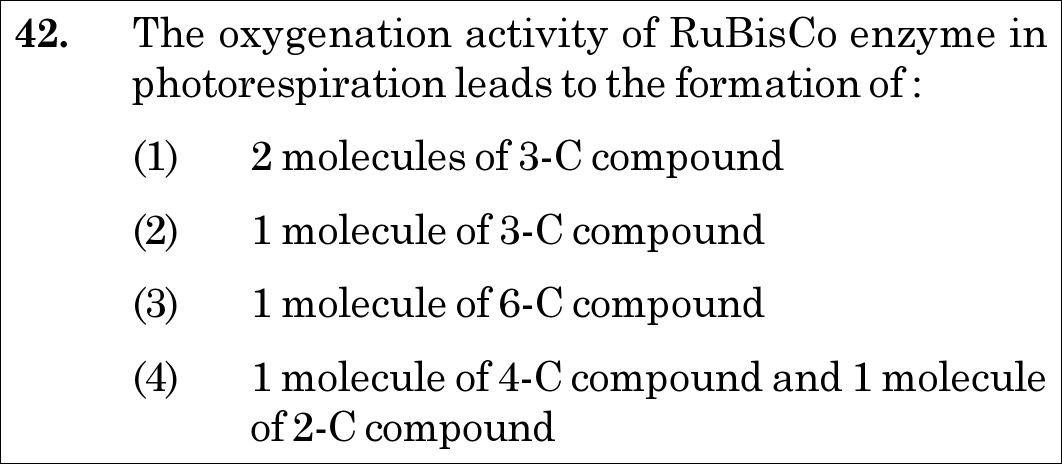
Official NEET 2020 Question 42 - Photosynthesis in Higher Plants
1 2 molecules of 3-C compound
2 1 molecule of 3-C compound ✓ Key
3 1 molecule of 6-C compound
4 1 molecule of 4-C compound and 1 molecule of 2-C compound
💡 Verified Solution & 30-Second Hack
✓
Verified Against NTA Final Answer Key
Option (2) : 1 molecule of 3-C compound
📚 Photosynthesis in Higher Plants Easy
📋 Given Parameters & Problem Setup
Enzyme Activity Oxygenase activity of RuBisCO in photorespiration
Substrate RuBP (5-Carbon compound) + O2
Question Objective Determine the molecular yield and carbon composition of the products
⚡

The 30-Second Exam Hall Shortcut: ⚡ "RuBP (5C) + O2 -> 1 PGA (3C) + 1 Phosphoglycolate (2C)!"

⏱️ 35 seconds

During photorespiration, RuBisCO oxygenates RuBP (5C) into ONE 3-carbon molecule (3-PGA) and ONE 2-carbon molecule (phosphoglycolate). Look at the options: Option (2) specifies "1 molecule of 3-C compound". Mark Option (2) in 10 seconds!

1 Carboxylation: 1 RuBP (5C) + CO2 (1C) -> TWO molecules of 3-PGA (3C each).
2 Oxygenation: 1 RuBP (5C) + O2 -> ONE 3-PGA (3C) + ONE Phosphoglycolate (2C).
3 Thus, oxygenation leads to the formation of 1 molecule of 3-C compound (Option 2).
🛡️
Why You Can 100% Trust This Shortcut: NCERT Biology · Plant Physiology: Photosynthesis in Higher Plants (Photorespiration)
📐

Step-by-Step Rigorous Workflow & Mathematical Proof

Step 1

Recall Dual Activity of RuBisCO

RuBisCO (Ribulose-1,5-bisphosphate carboxylase-oxygenase) has an active site that can bind both CO2 and O2 competitively. In C3 plants, when O2 concentration is high and CO2 is low, RuBisCO acts as an oxygenase.

Step 2

Stoichiometry of Oxygenation Reaction

In the oxygenase reaction: RuBP (5C)+O2→RuBisCO3-PGA (3C)+Phosphoglycolate (2C)\text{RuBP (5C)} + \text{O}_2 \xrightarrow{\text{RuBisCO}} \text{3-PGA (3C)} + \text{Phosphoglycolate (2C)} Instead of forming two molecules of 3-PGA as in normal carboxylation, it yields exactly ONE molecule of a 3-C compound (3-PGA) and ONE molecule of a 2-C compound (2-phosphoglycolate).

Step 3

Evaluate the Options

Option (1) describes carboxylation (2 molecules of 3-C compound). Option (2) correctly states "1 molecule of 3-C compound". Options (3) and (4) propose stoichiometries incompatible with the 5-carbon skeleton of RuBP.

Step 4

Conclude Option 2

Therefore, the oxygenation activity of RuBisCO enzyme directly results in the formation of 1 molecule of a 3-carbon compound.

⭐

360° Option Elimination Engine Key Feature

Diagnose every choice: Know exactly why the right option works and why distractors fail.

4-Option Deep Scan
1 A
✗ Incorrect
Verdict & Scientific Reason:

Incorrect; two molecules of 3-PGA are produced during carboxylation (CO2 fixation) in the Calvin cycle, not during oxygenation.

⚠️
Student Fallacy (Why candidates pick this trap): Habitually remembering the standard Calvin cycle carboxylation step and overlooking that oxygenation is specified.
2 B
✓ 100% Correct
Verdict & Scientific Reason:

Factually exact; oxygenation of 5-C RuBP yields 1 molecule of 3-PGA (3-C) along with 1 molecule of 2-phosphoglycolate (2-C).

💡
Why this is airtight: Some students hesitate because the 2-C product is not mentioned, but the statement itself is completely true and correct.
3 C
✗ Incorrect
Verdict & Scientific Reason:

Incorrect; no stable 6-C compound is formed; even the transient 6-C intermediate of carboxylation hydrolyzes immediately.

⚠️
Student Fallacy (Why candidates pick this trap): Assuming RuBP (5C) joins with something to yield an intact hexose.
4 D
✗ Incorrect
Verdict & Scientific Reason:

Incorrect; 4 + 2 = 6 carbons, but RuBP contains only 5 carbons (plus O2 adds zero carbons).

⚠️
Student Fallacy (Why candidates pick this trap): Failing to balance carbon conservation (5C cannot yield 4C + 2C).
⚠️

NTA Trap Alert: Carbon Conservation Check

RuBP has 5 carbons! When reacting with O2 (which has 0 carbons), total carbon must remain 5: 3 carbons (3-PGA) + 2 carbons (phosphoglycolate) = 5 carbons. Never pick an option totaling 6 carbons!

🛡️ How to avoid the -1 mark: Count carbons: 5C RuBP + O2 -> 3C (PGA) + 2C (phosphoglycolate). Exactly 1 molecule of 3-C compound is formed!
📖

Core NEET Syllabus Standard

Botany · Photosynthesis in Higher Plants Standard Benchmark
Core Scientific Principle Tested:

""

Syllabus Focus: Photorespiration: RuBisCO Oxygenase Activity and Products
✓ Core NEET UG Syllabus Anchor Syllabus & Academic Standards ↗
NEET 2020 · Q65 Easy
Official NEET 2020 Question 65 - Photosynthesis in Higher Plants
1 PS-II to Cytb6f complex ✓ Key
2 Cytb6f complex to PS-I
3 PS-I to NADP+
4 PS-I to ATP synthase
💡 Verified Solution & 30-Second Hack
✓
Verified Against NTA Final Answer Key
Option (1) : PS-II to Cytb6f complex
📚 Photosynthesis in Higher Plants Easy
📋 Given Parameters & Problem Setup
Process Light reaction of photosynthesis (Z-scheme non-cyclic photophosphorylation)
Mobile Electron Carrier Plastoquinone (PQ)
Question Objective Identify which electron transfer step is facilitated by plastoquinone
⚡

The 30-Second Exam Hall Shortcut: ⚡ "Plastoquinone (PQ) Bridges PS-II to Cytb6f Complex!"

⏱️ 20 seconds

In the thylakoid membrane, photoexcited electrons from PS-II (P680) are accepted by pheophytin and passed to Plastoquinone (PQ). Reduced plastoquinol (PQH2) diffuses across the lipid bilayer and transfers electrons to the Cytochrome b6f complex! Mark Option (1) in 5 seconds.

1 Trace Z-scheme sequence: PS-II (P680) -> Pheophytin -> Plastoquinone (PQ) -> Cytochrome b6f -> Plastocyanin (PC) -> PS-I (P700).
2 Plastoquinone specifically transfers electrons from PS-II to Cytb6f complex.
3 Select Option (1).
🛡️
Why You Can 100% Trust This Shortcut: NCERT Biology · Plant Physiology: Photosynthesis in Higher Plants (The Electron Transport)
📐

Step-by-Step Rigorous Workflow & Mathematical Proof

Step 1

Excitation of PS-II

When Photosystem II absorbs red light at 680 nm, electrons in chlorophyll a become excited and jump into an orbit farther from the atomic nucleus. These electrons are picked up by a primary electron acceptor (pheophytin).

Step 2

Role of Plastoquinone as Mobile Carrier

From pheophytin, electrons are transferred to plastoquinone (PQ), a mobile lipid-soluble quinone embedded within the thylakoid lipid bilayer. Plastoquinone picks up protons from the stroma to form PQH2.

Step 3

Transfer to Cytochrome b6f Complex

PQH2 transfers its electrons to the multi-subunit Cytochrome b6f complex while translocating protons across the thylakoid membrane into the lumen, generating a proton gradient.

Step 4

Complete the Electron Path

From Cyt b6f, electrons are carried by Plastocyanin (a copper-containing mobile protein) to PS-I. Thus, Plastoquinone uniquely facilitates electron transfer from PS-II to Cyt b6f complex.

⭐

360° Option Elimination Engine Key Feature

Diagnose every choice: Know exactly why the right option works and why distractors fail.

4-Option Deep Scan
1 A
✓ 100% Correct
Verdict & Scientific Reason:

Factually exact; plastoquinone transfers electrons from the primary acceptor of PS-II down to the Cytochrome b6f complex.

💡
Why this is airtight: None; core pathway in the Z-scheme.
2 B
✗ Incorrect
Verdict & Scientific Reason:

Incorrect; electron transfer from Cytochrome b6f to PS-I is carried out by Plastocyanin (PC), not plastoquinone.

⚠️
Student Fallacy (Why candidates pick this trap): Confusing Plastoquinone (PQ) with Plastocyanin (PC).
3 C
✗ Incorrect
Verdict & Scientific Reason:

Incorrect; electron transfer from PS-I to NADP+ is mediated by ferredoxin (Fd) and ferredoxin-NADP+ reductase (FNR).

⚠️
Student Fallacy (Why candidates pick this trap): Confusing terminal electron reduction with intermediate quinone transport.
4 D
✗ Incorrect
Verdict & Scientific Reason:

Incorrect; ATP synthase synthesizes ATP driven by the proton motive force (chemiosmosis), not via direct electron transfer from PS-I.

⚠️
Student Fallacy (Why candidates pick this trap): Mixing up electron transport chain with ATP synthesis mechanics.
⚠️

NTA Trap Alert: Plastoquinone (PQ) vs Plastocyanin (PC)

Plastoquinone (PQ) moves electrons from PS-II to Cyt b6f. Plastocyanin (PC) moves electrons from Cyt b6f to PS-I.

🛡️ How to avoid the -1 mark: Mnemonic: "PQ is between PS-II and Cyt; PC is between Cyt and PS-I" (Q comes before C in the chain!).
📖

Core NEET Syllabus Standard

Zoology · Photosynthesis in Higher Plants Standard Benchmark
Core Scientific Principle Tested:

""

Syllabus Focus: Z-Scheme Electron Transport: Plastoquinone Shuttles Electrons from PS-II to Cytochrome b6f
✓ Core NEET UG Syllabus Anchor Syllabus & Academic Standards ↗

Solve 4 NEET Questions a Day — One per Subject

Cover all 1,140 official NEET questions in 285 days at your own pace. Progress is saved on your device. No login needed.