MyCompetitiveExams Logo MyCompetitiveExams
Search 1,140+ Questions
Chapters, formulas, speed tricks
→
⚡ Brahmastra NEET 2027
720 MARKS

Dynamic 180-question full-length simulator mixed dynamically from all 6 years for 2027 & 2026 aspirants.

Launch Brahmastra 2027 Test →
Start Practice →
100% Free · No Login Required
Q.100 Botany ⭐ 360° Option Elimination Active
Vault ↗

NEET 2026 Botany Question 100 Solution

Topic: Photosynthesis in Higher Plants · Official NTA Booklet Code 50
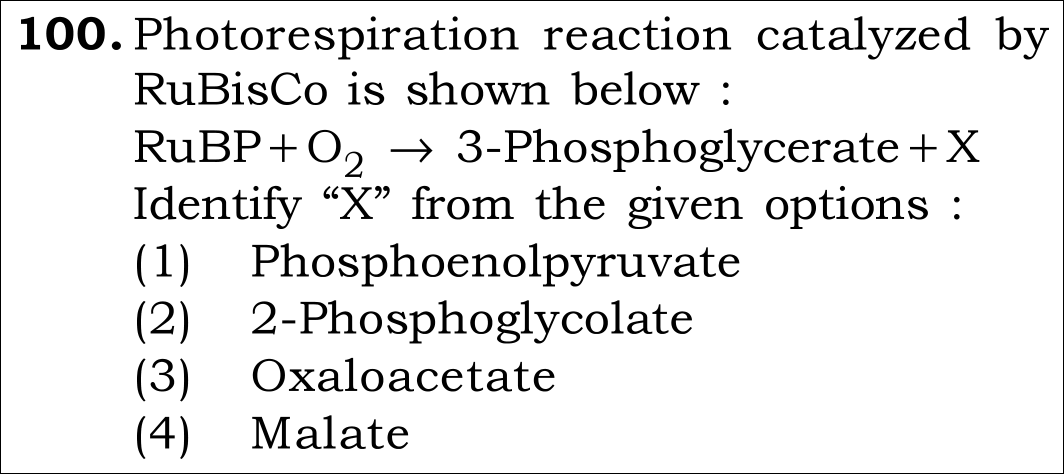
NEET 2026 Botany Question 100: RuBisCO Oxygenase Catalysis & Identification of 2-Phosphoglycolate

Question

Photorespiration reaction catalyzed by RuBisCo is shown below: RuBP + O₂ → 3-Phosphoglycerate + X. Identify "X" from the given options:

✓
Verified Against NTA Final Answer Key
Option (2) : 2-Phosphoglycolate
📚 Photosynthesis in Higher Plants Medium
📋 Given Parameters & Problem Setup
Reaction RuBP + O₂ → 3-Phosphoglycerate (PGA) + X
Enzyme RuBisCO acting as an oxygenase
Substrate Ribulose-1,5-bisphosphate (RuBP, 5-carbon compound)
⚡

The 30-Second Exam Hall Shortcut: ⚡ Carbon Balance in Photorespiration: 5C = 3C + 2C

⏱️ Save ~50 seconds

5-carbon RuBP splits into one 3C (PGA) and one 2C (Phosphoglycolate)!

1 Count carbon atoms: RuBP has 5 carbons.
2 In presence of O₂, RuBisCO oxygenates RuBP.
3 The products must total 5 carbons: One 3-carbon molecule is 3-Phosphoglycerate (PGA).
4 The remaining molecule X must have 5 - 3 = 2 carbons!
5 A 2-carbon phosphorylated intermediate is 2-PHOSPHOGLYCOLATE!
6 Option (2) is 2-Phosphoglycolate! Pick Option (2) in 10 seconds flat!
🛡️
Why You Can 100% Trust This Shortcut: NCERT Photosynthesis verbatim: When RuBisCO binds O₂, RuBP binds with O₂ to form one molecule of phosphoglycerate and phosphoglycolate (2 Carbon) in a pathway called photorespiration.
📐

Step-by-Step Rigorous Workflow & Mathematical Proof

Step 1

Understand the Dual Activity of RuBisCO

RuBisCO (Ribulose bisphosphate carboxylase-oxygenase) is the most abundant enzyme in the biosphere. Its active site can bind both CO₂ and O₂ competitively: - When CO₂/O₂ ratio is high, it acts as a carboxylase, fixing CO₂ into two 3C molecules (3-PGA) in the Calvin cycle. - When O₂ concentration is high and CO₂ is low, it acts as an oxygenase, initiating the photorespiratory C₂ cycle.

RuBisCO: Carboxylase Activity vs Oxygenase Activity\text{RuBisCO: Carboxylase Activity vs Oxygenase Activity}
  • • Photorespiration does not produce ATP or sugars and wastes fixed carbon.
Step 2

Formulate the RuBisCO Oxygenase Reaction

In the chloroplast stroma, RuBisCO oxygenates RuBP (5-carbon) with molecular oxygen to cleave it into one 3-carbon molecule and one 2-carbon molecule:

RuBP (5C)+O2→RuBisCO (oxygenase)3-Phosphoglycerate (3C)+2-Phosphoglycolate (2C) [X]\text{RuBP (5C)} + \text{O}_2 \xrightarrow{\text{RuBisCO (oxygenase)}} \text{3-Phosphoglycerate (3C)} + \text{2-Phosphoglycolate (2C) } [\mathbf{X}]
  • • 3-Phosphoglycerate (PGA) enters the Calvin cycle.
  • • 2-Phosphoglycolate is dephosphorylated to glycolate and transported to peroxisomes and mitochondria for carbon salvage.
Step 3

Identify Molecule X from the Options

1. Phosphoenolpyruvate (PEP): 3-carbon CO₂ acceptor in C₄ pathway. 2. 2-Phosphoglycolate: 2-carbon photorespiratory product (X). 3. Oxaloacetate (OAA): 4-carbon organic acid in C₄ pathway / TCA cycle. 4. Malate: 4-carbon dicarboxylic acid in C₄ pathway.

X=2-Phosphoglycolate\mathbf{X} = \text{2-Phosphoglycolate}
  • • Matches Option (2).
⭐

360° Option Elimination Engine Key Feature

Diagnose every choice: Know exactly why the right option works and why distractors fail.

4-Option Deep Scan
1 A
✗ Incorrect
Verdict & Scientific Reason:

Incorrect. Phosphoenolpyruvate (PEP) is the primary CO₂ acceptor in C₄ plants, not a product of RuBP oxygenation.

⚠️
Student Fallacy (Why candidates pick this trap): Confusing C₄ cycle substrates with photorespiratory products.
2 B
✓ 100% Correct
Verdict & Scientific Reason:

Exact match with the canonical photorespiration reaction: 5C RuBP + O₂ → 3C PGA + 2C Phosphoglycolate.

💡
Why this is airtight: None; textbook mastery of the C₂ photorespiration pathway.
3 C
✗ Incorrect
Verdict & Scientific Reason:

Incorrect. Oxaloacetate (OAA) is a 4-carbon acid produced by PEP carboxylase in C₄ photosynthesis.

⚠️
Student Fallacy (Why candidates pick this trap): Mistaking C₄ first stable product for photorespiratory product.
4 D
✗ Incorrect
Verdict & Scientific Reason:

Incorrect. Malate is a 4-carbon transport acid in C₄ plants.

⚠️
Student Fallacy (Why candidates pick this trap): Confusing C₄ malate shuttle with photorespiration.
⚠️

NTA Trap Alert: Confusing Photorespiration (C₂) with C₄ Photosynthesis

Students frequently confuse products of photorespiration (Phosphoglycolate, 2C) with products of C₄ Hatch-Slack cycle (Oxaloacetate and Malate, 4C).

🛡️ How to avoid the -1 mark: Photorespiration is the C₂ cycle: it creates the 2-carbon compound Phosphoglycolate!
📖

Core NEET Syllabus Standard

NEET Biology Core Syllabus · Photosynthesis in Higher Plants Standard Benchmark
Core Scientific Principle Tested:

"Oxygenation of RuBP by RuBisCO yields one molecule of 3-PGA and one molecule of 2-phosphoglycolate."

Syllabus Focus: Photorespiration - RuBisCO oxygenase reaction and C₂ cycle
✓ Core NEET UG Syllabus Anchor Syllabus & Academic Standards ↗
Oxygen hits RuBP: 3 carbons go to PGA, 2 carbons leave as Phosphoglycolate!

Ready to attempt under real exam pressure?

Test your speed and accuracy in the authentic 180-minute timed NTA simulator.

Launch NEET 2026 CBT Test →

Spotted a mistake in this solution? Report an error ([email protected])

⚖️ Legal & Fair Dealing Notice: Sourced from publicly released NEET 2026 question papers and NEET answer keys for private study, research, and non-commercial educational practice under Fair Dealing (Section 52(1)(a) of the Indian Copyright Act, 1957). Not affiliated with or endorsed by NTA or NMC.

Solve 4 NEET Questions a Day — One per Subject

Cover all 1,140 official NEET questions in 285 days at your own pace. Progress is saved on your device. No login needed.