MyCompetitiveExams Logo MyCompetitiveExams
Search 1,140+ Questions
Chapters, formulas, speed tricks
→
⚡ Brahmastra NEET 2027
720 MARKS

Dynamic 180-question full-length simulator mixed dynamically from all 6 years for 2027 & 2026 aspirants.

Launch Brahmastra 2027 Test →
Start Practice →
100% Free · No Login Required
Q.65 Zoology ⭐ 360° Option Elimination Active
Vault ↗

NEET 2020 Zoology Question 65 Solution

Topic: Photosynthesis in Higher Plants · Official NTA Booklet Code E1
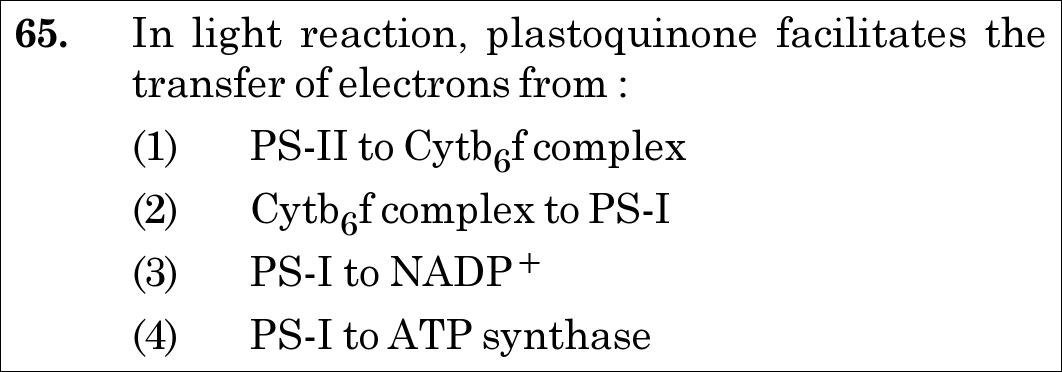
NEET 2020 Zoology Question 65: Z-Scheme Electron Transport: Plastoquinone Shuttles Electrons from PS-II to Cytochrome b6f

Question

In light reaction, plastoquinone facilitates the transfer of electrons from:

  1. (1)PS-II to Cytb6f complex
  2. (2)Cytb6f complex to PS-I
  3. (3)PS-I to NADP+
  4. (4)PS-I to ATP synthase
✓
Verified Against NTA Final Answer Key
Option (1) : PS-II to Cytb6f complex
📚 Photosynthesis in Higher Plants Easy
📋 Given Parameters & Problem Setup
Process Light reaction of photosynthesis (Z-scheme non-cyclic photophosphorylation)
Mobile Electron Carrier Plastoquinone (PQ)
Question Objective Identify which electron transfer step is facilitated by plastoquinone
⚡

The 30-Second Exam Hall Shortcut: ⚡ "Plastoquinone (PQ) Bridges PS-II to Cytb6f Complex!"

⏱️ 20 seconds

In the thylakoid membrane, photoexcited electrons from PS-II (P680) are accepted by pheophytin and passed to Plastoquinone (PQ). Reduced plastoquinol (PQH2) diffuses across the lipid bilayer and transfers electrons to the Cytochrome b6f complex! Mark Option (1) in 5 seconds.

1 Trace Z-scheme sequence: PS-II (P680) -> Pheophytin -> Plastoquinone (PQ) -> Cytochrome b6f -> Plastocyanin (PC) -> PS-I (P700).
2 Plastoquinone specifically transfers electrons from PS-II to Cytb6f complex.
3 Select Option (1).
🛡️
Why You Can 100% Trust This Shortcut: NCERT Biology · Plant Physiology: Photosynthesis in Higher Plants (The Electron Transport)
📐

Step-by-Step Rigorous Workflow & Mathematical Proof

Step 1

Excitation of PS-II

When Photosystem II absorbs red light at 680 nm, electrons in chlorophyll a become excited and jump into an orbit farther from the atomic nucleus. These electrons are picked up by a primary electron acceptor (pheophytin).

Step 2

Role of Plastoquinone as Mobile Carrier

From pheophytin, electrons are transferred to plastoquinone (PQ), a mobile lipid-soluble quinone embedded within the thylakoid lipid bilayer. Plastoquinone picks up protons from the stroma to form PQH2.

Step 3

Transfer to Cytochrome b6f Complex

PQH2 transfers its electrons to the multi-subunit Cytochrome b6f complex while translocating protons across the thylakoid membrane into the lumen, generating a proton gradient.

Step 4

Complete the Electron Path

From Cyt b6f, electrons are carried by Plastocyanin (a copper-containing mobile protein) to PS-I. Thus, Plastoquinone uniquely facilitates electron transfer from PS-II to Cyt b6f complex.

⭐

360° Option Elimination Engine Key Feature

Diagnose every choice: Know exactly why the right option works and why distractors fail.

4-Option Deep Scan
1 A
✓ 100% Correct
Verdict & Scientific Reason:

Factually exact; plastoquinone transfers electrons from the primary acceptor of PS-II down to the Cytochrome b6f complex.

💡
Why this is airtight: None; core pathway in the Z-scheme.
2 B
✗ Incorrect
Verdict & Scientific Reason:

Incorrect; electron transfer from Cytochrome b6f to PS-I is carried out by Plastocyanin (PC), not plastoquinone.

⚠️
Student Fallacy (Why candidates pick this trap): Confusing Plastoquinone (PQ) with Plastocyanin (PC).
3 C
✗ Incorrect
Verdict & Scientific Reason:

Incorrect; electron transfer from PS-I to NADP+ is mediated by ferredoxin (Fd) and ferredoxin-NADP+ reductase (FNR).

⚠️
Student Fallacy (Why candidates pick this trap): Confusing terminal electron reduction with intermediate quinone transport.
4 D
✗ Incorrect
Verdict & Scientific Reason:

Incorrect; ATP synthase synthesizes ATP driven by the proton motive force (chemiosmosis), not via direct electron transfer from PS-I.

⚠️
Student Fallacy (Why candidates pick this trap): Mixing up electron transport chain with ATP synthesis mechanics.
⚠️

NTA Trap Alert: Plastoquinone (PQ) vs Plastocyanin (PC)

Plastoquinone (PQ) moves electrons from PS-II to Cyt b6f. Plastocyanin (PC) moves electrons from Cyt b6f to PS-I.

🛡️ How to avoid the -1 mark: Mnemonic: "PQ is between PS-II and Cyt; PC is between Cyt and PS-I" (Q comes before C in the chain!).
📖

Core NEET Syllabus Standard

Zoology · Photosynthesis in Higher Plants Standard Benchmark
Core Scientific Principle Tested:

""

Syllabus Focus: Z-Scheme Electron Transport: Plastoquinone Shuttles Electrons from PS-II to Cytochrome b6f
✓ Core NEET UG Syllabus Anchor Syllabus & Academic Standards ↗

Ready to attempt under real exam pressure?

Test your speed and accuracy in the authentic 180-minute timed NTA simulator.

Launch NEET 2020 CBT Test →

Spotted a mistake in this solution? Report an error ([email protected])

⚖️ Legal & Fair Dealing Notice: Sourced from publicly released NEET 2020 question papers and NEET answer keys for private study, research, and non-commercial educational practice under Fair Dealing (Section 52(1)(a) of the Indian Copyright Act, 1957). Not affiliated with or endorsed by NTA or NMC.

Solve 4 NEET Questions a Day — One per Subject

Cover all 1,140 official NEET questions in 285 days at your own pace. Progress is saved on your device. No login needed.