MyCompetitiveExams Logo MyCompetitiveExams
Search 1,140+ Questions
Chapters, formulas, speed tricks
→
⚡ Brahmastra NEET 2027
720 MARKS

Dynamic 180-question full-length simulator mixed dynamically from all 6 years for 2027 & 2026 aspirants.

Launch Brahmastra 2027 Test →
Start Practice →
100% Free · No Login Required
Q.88 Chemistry ⭐ 360° Option Elimination Active
Vault ↗

NEET 2021 Chemistry Question 88 Solution

Topic: Classification of Elements and Periodicity in Properties · Official NTA Booklet Code M1
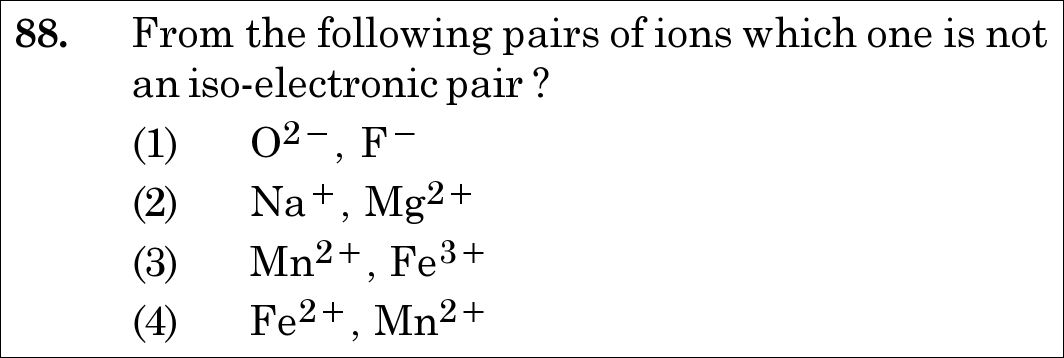
NEET 2021 Chemistry Question 88: Isoelectronic Species: Identification of Non-Isoelectronic Ionic Pair

Question

From the following pairs of ions which one is not an iso-electronic pair?

✓
Verified Against NTA Final Answer Key
Option (4) : Fe2+, Mn2+
📚 Classification of Elements and Periodicity in Properties Easy
📋 Given Parameters & Problem Setup
Pair 1 O2-, F-
Pair 2 Na+, Mg2+
Pair 3 Mn2+, Fe3+
Pair 4 Fe2+, Mn2+
⚡

The 30-Second Exam Hall Shortcut: ⚡ Fast Electron Count: Fe²⁺ = 24 e⁻ vs. Mn²⁺ = 23 e⁻!

⏱️ Save ~15 seconds

Isoelectronic species contain the exact same number of total electrons. For Fe2+Fe^{2+}, electrons =26−2=24= 26 - 2 = 24. For Mn2+Mn^{2+}, electrons =25−2=23= 25 - 2 = 23. Since 24≠2324 \neq 23, Fe2+,Mn2+Fe^{2+}, Mn^{2+} is NOT an isoelectronic pair! All other pairs have identical electron counts: O2−/F−O^{2-}/F^- (10), Na+/Mg2+Na^+/Mg^{2+} (10), and Mn2+/Fe3+Mn^{2+}/Fe^{3+} (23). Match Option (4)!

1 Isoelectronic definition: Equal total number of electrons.
2 Pair (1): O2−(8+2=10e−)O^{2-} (8+2 = 10 e^-) and F−(9+1=10e−)  ⟹  F^- (9+1 = 10 e^-) \implies Isoelectronic.
3 Pair (2): Na+(11−1=10e−)Na^+ (11-1 = 10 e^-) and Mg2+(12−2=10e−)  ⟹  Mg^{2+} (12-2 = 10 e^-) \implies Isoelectronic.
4 Pair (3): Mn2+(25−2=23e−)Mn^{2+} (25-2 = 23 e^-) and Fe3+(26−3=23e−)  ⟹  Fe^{3+} (26-3 = 23 e^-) \implies Isoelectronic.
5 Pair (4): Fe2+(26−2=24e−)Fe^{2+} (26-2 = 24 e^-) and Mn2+(25−2=23e−)  ⟹  Mn^{2+} (25-2 = 23 e^-) \implies NOT isoelectronic (24≠2324 \neq 23).
6 Match Option (4).
🛡️
Why You Can 100% Trust This Shortcut: Canonical definition of isoelectronic species from NCERT Periodic Properties.
📐

Step-by-Step Rigorous Workflow & Mathematical Proof

Step 1

Definition of Isoelectronic Ions

Isoelectronic ions are ions of different chemical elements that possess the identical total number of electrons and identical ground-state electronic configurations.

Step 2

Calculating Electron Counts for Pairs (1), (2), and (3)

- Pair 1 (O2−,F−O^{2-}, F^-): - Oxygen (Z=8Z=8): 8−(−2)=10 electrons8 - (-2) = 10\text{ electrons} - Fluorine (Z=9Z=9): 9−(−1)=10 electrons9 - (-1) = 10\text{ electrons} (Isoelectronic, Neon configuration [Ne][Ne]) - Pair 2 (Na+,Mg2+Na^+, Mg^{2+}): - Sodium (Z=11Z=11): 11−1=10 electrons11 - 1 = 10\text{ electrons} - Magnesium (Z=12Z=12): 12−2=10 electrons12 - 2 = 10\text{ electrons} (Isoelectronic, Neon configuration [Ne][Ne]) - Pair 3 (Mn2+,Fe3+Mn^{2+}, Fe^{3+}): - Manganese (Z=25Z=25): 25−2=23 electrons25 - 2 = 23\text{ electrons} ([Ar]3d5[Ar]3d^5) - Iron (Z=26Z=26): 26−3=23 electrons26 - 3 = 23\text{ electrons} ([Ar]3d5[Ar]3d^5) (Isoelectronic, both half-filled d5d^5)

Step 3

Evaluating Pair (4): Fe2+ and Mn2+

Calculate electrons for iron(II) and manganese(II): - Fe2+Fe^{2+} (Z=26Z = 26): 26−2=24 electrons26 - 2 = 24\text{ electrons} ([Ar]3d6[Ar]3d^6) - Mn2+Mn^{2+} (Z=25Z = 25): 25−2=23 electrons25 - 2 = 23\text{ electrons} ([Ar]3d5[Ar]3d^5) Because 24≠2324 \neq 23, this pair does not have the same number of electrons and is NOT an isoelectronic pair.

e−(Fe2+)=24≠e−(Mn2+)=23  ⟹  NOT isoelectronice^-(Fe^{2+}) = 24 \neq e^-(Mn^{2+}) = 23 \implies \mathbf{\text{NOT isoelectronic}}
⭐

360° Option Elimination Engine Key Feature

Diagnose every choice: Know exactly why the right option works and why distractors fail.

4-Option Deep Scan
1 1
✗ Incorrect
Verdict & Scientific Reason:

Isoelectronic pair (both have 10 electrons).

⚠️
Student Fallacy (Why candidates pick this trap): Assuming anion-anion pairs cannot be isoelectronic.
2 2
✗ Incorrect
Verdict & Scientific Reason:

Isoelectronic pair (both have 10 electrons).

⚠️
Student Fallacy (Why candidates pick this trap): Assuming different group cations have different electron counts.
3 3
✗ Incorrect
Verdict & Scientific Reason:

Isoelectronic pair (both have 23 electrons, [Ar]3d5[Ar]3d^5).

⚠️
Student Fallacy (Why candidates pick this trap): Missing that 25−2=2325-2 = 23 equals 26−3=2326-3 = 23.
4 4
✓ 100% Correct
Verdict & Scientific Reason:

NOT isoelectronic: Fe2+Fe^{2+} has 24 electrons while Mn2+Mn^{2+} has 23 electrons.

💡
Why this is airtight: None; precise electron counting.
⚠️

NTA Trap Alert: Same Charge Assumption Trap (Mn2+ vs Fe2+)

Students who see identical charges (+2+2 on both Fe and Mn) assume they might be isoelectronic, while suspecting Mn2+Mn^{2+} and Fe3+Fe^{3+} (Option 3) because of different charges. Since atomic numbers differ by 1 (Fe=26,Mn=25Fe=26, Mn=25), identical +2+2 charges guarantee DIFFERENT electron counts (24≠2324 \neq 23).

🛡️ How to avoid the -1 mark: Same charge on adjacent elements   ⟹  \implies NEVER isoelectronic! Different charges can compensate: 26−3=25−2=2326-3 = 25-2 = 23.
📖

Core NEET Syllabus Standard

NCERT Chemistry · Classification of Elements and Periodicity in Properties Standard Benchmark
Core Scientific Principle Tested:

"Isoelectronic species have the same number of electrons. Fe2+ (24 electrons) and Mn2+ (23 electrons) are not isoelectronic."

Syllabus Focus: Periodic Trends in Physical Properties (Isoelectronic Species)
✓ Core NEET UG Syllabus Anchor Syllabus & Academic Standards ↗

Ready to attempt under real exam pressure?

Test your speed and accuracy in the authentic 200-minute timed NTA simulator.

Launch NEET 2021 CBT Test →

Spotted a mistake in this solution? Report an error ([email protected])

⚖️ Legal & Fair Dealing Notice: Sourced from publicly released NEET 2021 question papers and NEET answer keys for private study, research, and non-commercial educational practice under Fair Dealing (Section 52(1)(a) of the Indian Copyright Act, 1957). Not affiliated with or endorsed by NTA or NMC.

Solve 4 NEET Questions a Day — One per Subject

Cover all 1,140 official NEET questions in 285 days at your own pace. Progress is saved on your device. No login needed.