MyCompetitiveExams Logo MyCompetitiveExams
Search 1,140+ Questions
Chapters, formulas, speed tricks
→
⚡ Brahmastra NEET 2027
720 MARKS

Dynamic 180-question full-length simulator mixed dynamically from all 6 years for 2027 & 2026 aspirants.

Launch Brahmastra 2027 Test →
Start Practice →
100% Free · No Login Required
Q.47 Chemistry ⭐ 360° Option Elimination Active
Vault ↗

NEET 2025 Chemistry Question 47 Solution

Topic: Classification of Elements and Periodicity in Properties · Official NTA Booklet Code 45
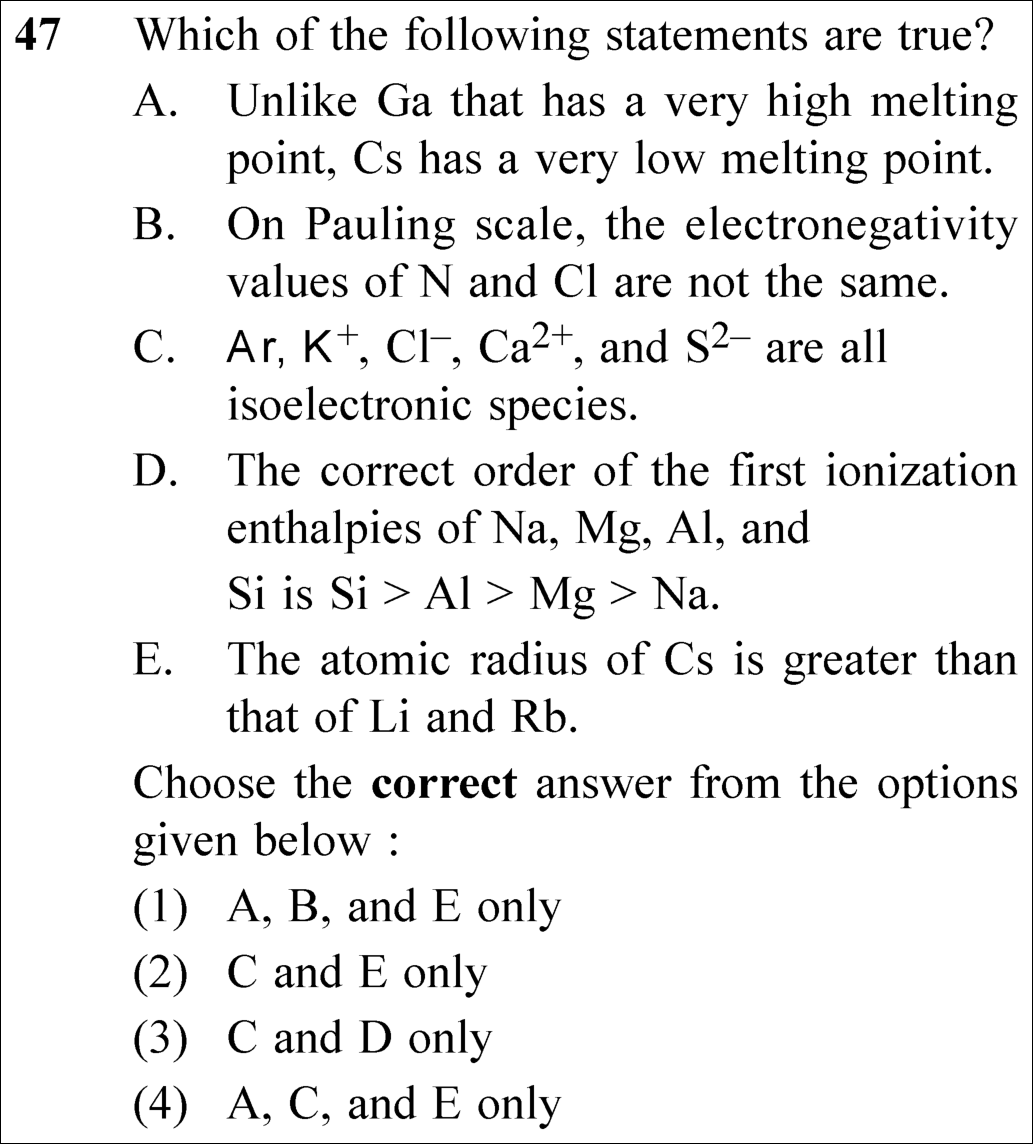
NEET 2025 Chemistry Question 47: Truth Value of Statements on Melting Point, Electronegativity, Isoelectronic Ions & IE Trends

Question

Which of the following statements are true? A. Unlike Ga that has a very high melting point, Cs has a very low melting point. B. On Pauling scale, the electronegativity values of N and Cl are not the same. C. Ar, K⁺, Cl⁻, Ca²⁺, and S²⁻ are all isoelectronic species. D. The correct order of the first ionization enthalpies of Na, Mg, Al, and Si is Si > Al > Mg > Na. E. The atomic radius of Cs is greater than that of Li and Rb. Choose the correct answer from the options given below:

✓
Verified Against NTA Final Answer Key
Option (2) : C and E only
📚 Classification of Elements and Periodicity in Properties Medium
📋 Given Parameters & Problem Setup
Statement A Unlike Ga that has a very high melting point, Cs has a very low melting point.
Statement B On Pauling scale, the electronegativity values of N and Cl are not the same.
Statement C Ar, K+, Cl-, Ca2+, and S2- are all isoelectronic species.
Statement D The correct order of the first ionization enthalpies of Na, Mg, Al, and Si is Si > Al > Mg > Na.
Statement E The atomic radius of Cs is greater than that of Li and Rb.
⚡

The 30-Second Exam Hall Shortcut: ⚡ NCERT Periodic Counter-Fact Eliminator

⏱️ Save ~60 seconds

Ga melts in your hand (mp 303 K = 30°C, very low!) ⟹ A is FALSE! Both N and Cl have Pauling EN = 3.0 (identical!) ⟹ B is FALSE! Mg has full 3s² ⟹ Mg > Al ⟹ D is FALSE! Only C and E remain!

1 Check Statement A: Ga (303 K) and Cs (302 K) BOTH have unusually low melting points (liquid during summer). A claims Ga has very high mp ⟹ FALSE!
2 Eliminate options containing A: Options (1) and (4) are discarded instantly.
3 Check Statement B: On Pauling’s scale, both Nitrogen and Chlorine have the identical electronegativity value of 3.0. B claims they are not the same ⟹ FALSE!
4 Check Statement D: Due to stable filled 3s² subshell, Mg has higher IE₁ than Al (Mg = 737 kJ/mol, Al = 577 kJ/mol). The true order is Si > Mg > Al > Na. D claims Si > Al > Mg > Na ⟹ FALSE!
5 Eliminate Option (3) which includes D.
6 Only Option (2) (C and E only) survives!
7 Verify C: Ar(18), K+(18), Cl-(18), Ca2+(18), S2-(18) all have 18 electrons (isoelectronic, TRUE).
8 Verify E: Down Group 1, atomic radius increases: Li < Na < K < Rb < Cs (TRUE).
🛡️
Why You Can 100% Trust This Shortcut: Periodic Trends in Atomic and Ionic Radii (NCERT Chemistry · Classification of Elements and Periodicity in Properties).
📐

Step-by-Step Rigorous Workflow & Mathematical Proof

Step 1

Evaluate Statements A and B (Physical Properties & Electronegativity)

Analyze the canonical NCERT data for Gallium, Caesium, and Pauling electronegativities:

Tmp(Ga)=303 K (30∘C),Tmp(Cs)=302 K (29∘C)T_{mp}(\text{Ga}) = 303\text{ K} \,(30^\circ\text{C}), \quad T_{mp}(\text{Cs}) = 302\text{ K} \,(29^\circ\text{C})
  • • Both Ga and Cs have exceptionally LOW melting points and exist as liquids at room temperature during summer. Statement A is FALSE.
  • • Pauling scale values: EN(N) = 3.0 and EN(Cl) = 3.0. Their electronegativity values ARE identical. Statement B is FALSE.
Step 2

Evaluate Statement C (Isoelectronic Species)

Count the total number of electrons in each chemical species:

e−(Ar)=18,  e−(K+)=19−1=18,  e−(Cl−)=17+1=18,  e−(Ca2+)=20−2=18,  e−(S2−)=16+2=18e^-(\text{Ar}) = 18, \; e^-(\text{K}^+) = 19 - 1 = 18, \; e^-(\text{Cl}^-) = 17 + 1 = 18, \; e^-(\text{Ca}^{2+}) = 20 - 2 = 18, \; e^-(\text{S}^{2-}) = 16 + 2 = 18
  • • All species have exactly 18 electrons and are therefore isoelectronic. Statement C is TRUE.
Step 3

Evaluate Statements D and E (Ionization Enthalpy & Atomic Radius)

Examine electronic configuration effects on ionization enthalpy and group trends in atomic radius:

IE1:  Na (496)<Al (577)<Mg (737)<Si (786 kJ/mol)\text{IE}_1: \; \text{Na}\,(496) < \text{Al}\,(577) < \text{Mg}\,(737) < \text{Si}\,(786\text{ kJ/mol})
  • • Mg ([Ne]3s²) has a fully filled 3s orbital with greater penetration than the 3p electron of Al ([Ne]3s² 3p¹), so IE₁(Mg) > IE₁(Al). Statement D is FALSE.
  • • Down the alkali metal group (Group 1), atomic radius increases monotonically with increasing principal quantum number: r(Li) < r(Na) < r(K) < r(Rb) < r(Cs). Statement E is TRUE.
  • • Conclusion: C and E only are true, matching Option (2).
⭐

360° Option Elimination Engine Key Feature

Diagnose every choice: Know exactly why the right option works and why distractors fail.

4-Option Deep Scan
1 A
✗ Incorrect
Verdict & Scientific Reason:

Incorrect. Both A (Ga has low mp, not high) and B (N and Cl have same EN = 3.0) are false.

⚠️
Student Fallacy (Why candidates pick this trap): Believing Ga has a high melting point and N/Cl have different EN.
2 B
✓ 100% Correct
Verdict & Scientific Reason:

100% correct. C is isoelectronic (18e) and E follows group 1 atomic radius trend (Cs > Rb > Li).

💡
Why this is airtight: None; rigorous NCERT factual mastery.
3 C
✗ Incorrect
Verdict & Scientific Reason:

Incorrect. Statement D is false because Mg > Al in first ionization enthalpy.

⚠️
Student Fallacy (Why candidates pick this trap): Ignoring the stable 3s² fully-filled configuration of Mg over Al.
4 D
✗ Incorrect
Verdict & Scientific Reason:

Incorrect. Statement A is false.

⚠️
Student Fallacy (Why candidates pick this trap): Failing to recall the famously low melting point of Gallium.
⚠️

NTA Trap Alert: The Gallium Melting Point & Mg vs Al Ionization Trap

Gallium has an abnormally low melting point (30°C) due to its crystal structure of Ga₂ molecules, yet students often confuse it with Boron (high mp). Also, Mg > Al in IE₁ is the most common periodic trend trap in competitive exams.

🛡️ How to avoid the -1 mark: Remember: Ga melts on your palm! And s-penetration makes Mg > Al in IE₁.
📖

Core NEET Syllabus Standard

NEET Chemistry Core Syllabus · Classification of Elements and Periodicity in Properties Standard Benchmark
Core Scientific Principle Tested:

"Isoelectronic species have identical electron count; IE₁(Mg) > IE₁(Al); Pauling EN of N = Cl = 3.0."

Syllabus Focus: Periodic Trends in Chemical and Physical Properties
✓ Core NEET UG Syllabus Anchor Syllabus & Academic Standards ↗
Ga melts in your hand, N and Cl equal 3.0, Mg beats Al in IE ⟹ C & E only!

Ready to attempt under real exam pressure?

Test your speed and accuracy in the authentic 180-minute timed NTA simulator.

Launch NEET 2025 CBT Test →

Spotted a mistake in this solution? Report an error ([email protected])

⚖️ Legal & Fair Dealing Notice: Sourced from publicly released NEET 2025 question papers and NEET answer keys for private study, research, and non-commercial educational practice under Fair Dealing (Section 52(1)(a) of the Indian Copyright Act, 1957). Not affiliated with or endorsed by NTA or NMC.

Solve 4 NEET Questions a Day — One per Subject

Cover all 1,140 official NEET questions in 285 days at your own pace. Progress is saved on your device. No login needed.