MyCompetitiveExams Logo MyCompetitiveExams
Search 1,140+ Questions
Chapters, formulas, speed tricks
→
⚡ Brahmastra NEET 2027
720 MARKS

Dynamic 180-question full-length simulator mixed dynamically from all 6 years for 2027 & 2026 aspirants.

Launch Brahmastra 2027 Test →
Start Practice →
100% Free · No Login Required
Q.70 Chemistry ⭐ 360° Option Elimination Active
Vault ↗

NEET 2026 Chemistry Question 70 Solution

Topic: Classification of Elements and Periodicity in Properties · Official NTA Booklet Code 50
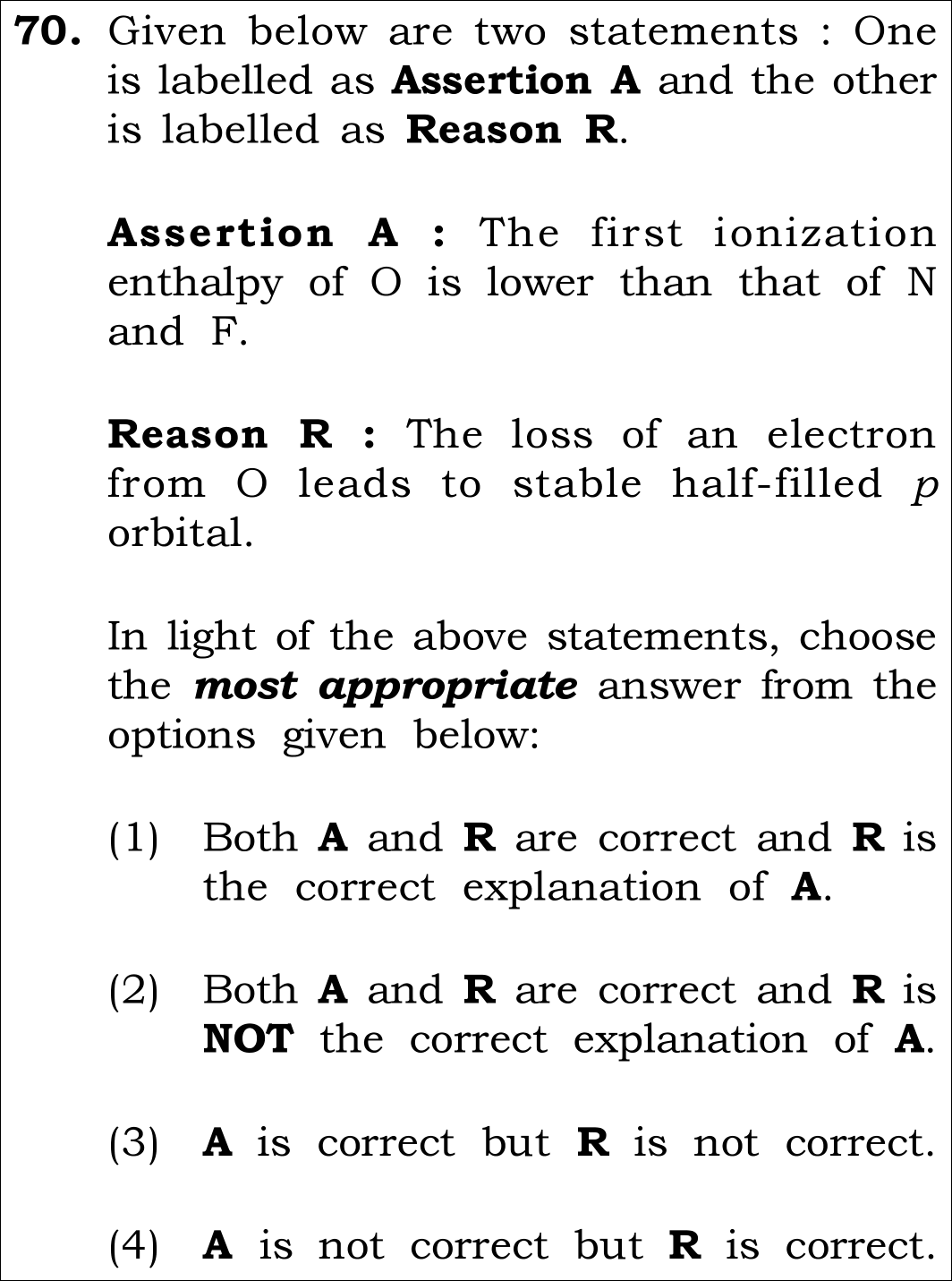
NEET 2026 Chemistry Question 70: Anomalous First Ionization Enthalpy of Oxygen vs Nitrogen & Fluorine

Question

Given below are two statements: One is labelled as Assertion A and the other is labelled as Reason R. Assertion A: The first ionization enthalpy of O is lower than that of N and F. Reason R: The loss of an electron from O leads to stable half-filled p orbital. In light of the above statements, choose the most appropriate answer from the options given below:

  1. (1)Both A and R are correct and R is the correct explanation of A.
  2. (2)Both A and R are correct and R is NOT the correct explanation of A.
  3. (3)A is correct but R is not correct.
  4. (4)A is not correct but R is correct.
✓
Verified Against NTA Final Answer Key
Option (1) : Both A and R are correct and R is the correct explanation of A.
📚 Classification of Elements and Periodicity in Properties Easy
📋 Given Parameters & Problem Setup
Assertion (A) The first ionization enthalpy of O is lower than that of N and F.
Reason (R) The loss of an electron from O leads to stable half-filled p orbital.
⚡

The 30-Second Exam Hall Shortcut: ⚡ Half-Filled Stability & Electron Pairing Penalty

⏱️ Save ~40 seconds

Oxygen is 2p⁴: losing 1 electron relieves pairing repulsion and yields a rock-solid half-filled 2p³ subshell!

1 Electronic configurations: N is 2s² 2p³ (stable half-filled); O is 2s² 2p⁴; F is 2s² 2p⁵.
2 Ionization values: N = 1402 kJ/mol, O = 1314 kJ/mol, F = 1681 kJ/mol.
3 Assertion A: O is indeed lower than BOTH N and F -> TRUE.
4 Reason R: In oxygen (2p⁴), two electrons share the same 2p_x orbital. Repulsion between these paired electrons makes it easier to remove one electron, resulting in a stable half-filled 2p³ configuration -> TRUE.
5 Does R explain A? Yes, the extra stability of 2p³ and release of pairing energy directly explains the dip in IE! Option (1) is locked!
🛡️
Why You Can 100% Trust This Shortcut: NCERT Periodicity textbook core concept: Oxygen has a lower first ionization enthalpy than nitrogen because removing an electron from 2p⁴ gives a stable half-filled 2p³ subshell.
📐

Step-by-Step Rigorous Workflow & Mathematical Proof

Step 1

Analyze Assertion A (Ionization Enthalpy Comparison)

Across the second period from left to right, first ionization enthalpy generally increases with increasing nuclear charge. However, oxygen has an anomalous dip: - Nitrogen (Z = 7): Δ_i H₁ = 1402 kJ mol⁻¹ - Oxygen (Z = 8): Δ_i H₁ = 1314 kJ mol⁻¹ - Fluorine (Z = 9): Δ_i H₁ = 1681 kJ mol⁻¹ Thus, Δ_i H₁ of O is lower than that of both N and F.

ΔiH1(N)>ΔiH1(O)<ΔiH1(F)\Delta_i H_1(\text{N}) > \Delta_i H_1(\text{O}) < \Delta_i H_1(\text{F})
  • • Assertion A is factually correct.
Step 2

Analyze Reason R (Electronic Origin of the Anomaly)

Examine the valence electron configurations: - Nitrogen: [He] 2s² 2p_x¹ 2p_y¹ 2p_z¹ (half-filled p subshell, highly stable, high exchange energy). - Oxygen: [He] 2s² 2p_x² 2p_y¹ 2p_z¹ (contains one pair of electrons in the 2p_x orbital). In oxygen, the two electrons in the 2p_x orbital repel each other strongly. Removing one electron relieves this interelectronic repulsion and produces the symmetric, exchange-stabilized half-filled 2p³ configuration of O⁺.

O (2s22p4)→−e−O+(2s22p3)(Stable half-filled subshell)\text{O } (2s^2 2p^4) \xrightarrow{-e^-} \text{O}^+ (2s^2 2p^3) \quad (\text{Stable half-filled subshell})
  • • Reason R is factually correct.
Step 3

Evaluate Reason as the Proper Scientific Explanation

Because the product ion O⁺ achieves a stable half-filled subshell and interelectronic repulsion in 2p⁴ is relieved, less energy is required to ionize oxygen than nitrogen. Therefore, Reason R directly explains Assertion A.

Both A and R are correct and R is the correct explanation of A (Option 1)\text{Both A and R are correct and R is the correct explanation of A (Option 1)}
  • • Matches Option (1).
⭐

360° Option Elimination Engine Key Feature

Diagnose every choice: Know exactly why the right option works and why distractors fail.

4-Option Deep Scan
1 A
✓ 100% Correct
Verdict & Scientific Reason:

Exact scientific justification matching NCERT Periodicity curriculum.

💡
Why this is airtight: None; textbook mastery of atomic structure anomalies.
2 B
✗ Incorrect
Verdict & Scientific Reason:

Incorrect. R is the precise cause of the anomalous ionization dip.

⚠️
Student Fallacy (Why candidates pick this trap): Failing to link electronic configuration stability to ionization energy magnitude.
3 C
✗ Incorrect
Verdict & Scientific Reason:

Incorrect. Reason R correctly states that O⁺ has a stable half-filled 2p³ subshell.

⚠️
Student Fallacy (Why candidates pick this trap): Doubting the stability of half-filled subshells.
4 D
✗ Incorrect
Verdict & Scientific Reason:

Incorrect. Assertion A is a well-established experimental fact.

⚠️
Student Fallacy (Why candidates pick this trap): Assuming ionization energy strictly increases across a period without exceptions.
⚠️

NTA Trap Alert: Assuming Ionization Energy Increases Strictly Across a Period

The periodic trend of increasing ionization energy has two hallmark exceptions in the second period: B < Be (due to 2s² penetration) and O < N (due to 2p³ half-filled stability).

🛡️ How to avoid the -1 mark: Remember: Nitrogen (2p³) is harder to ionize than Oxygen (2p⁴)!
📖

Core NEET Syllabus Standard

NEET Chemistry Core Syllabus · Classification of Elements and Periodicity in Properties Standard Benchmark
Core Scientific Principle Tested:

"Half-filled and completely filled subshells possess extra stability; electron pairing in 2p increases repulsion."

Syllabus Focus: Periodic trends in ionization enthalpy and electronic configuration stability
✓ Core NEET UG Syllabus Anchor Syllabus & Academic Standards ↗
Nitrogen holds its three tight; Oxygen drops its fourth without a fight!

Ready to attempt under real exam pressure?

Test your speed and accuracy in the authentic 180-minute timed NTA simulator.

Launch NEET 2026 CBT Test →

Spotted a mistake in this solution? Report an error ([email protected])

⚖️ Legal & Fair Dealing Notice: Sourced from publicly released NEET 2026 question papers and NEET answer keys for private study, research, and non-commercial educational practice under Fair Dealing (Section 52(1)(a) of the Indian Copyright Act, 1957). Not affiliated with or endorsed by NTA or NMC.

Solve 4 NEET Questions a Day — One per Subject

Cover all 1,140 official NEET questions in 285 days at your own pace. Progress is saved on your device. No login needed.