MyCompetitiveExams Logo MyCompetitiveExams
Search 1,140+ Questions
Chapters, formulas, speed tricks
→
⚡ Brahmastra NEET 2027
720 MARKS

Dynamic 180-question full-length simulator mixed dynamically from all 6 years for 2027 & 2026 aspirants.

Launch Brahmastra 2027 Test →
Start Practice →
100% Free · No Login Required
🧪 Chemistry ⭐ High Weightage (~2–3 Qs/Year)

NEET Classification of Elements and Periodicity in Properties Previous Year Questions with Solutions

Complete repository of official NTA NEET questions for Classification of Elements and Periodicity in Properties from 2020 to 2026. Every question includes 30-second elimination tricks, step-by-step NCERT solutions, option-by-option traps, and official answer keys.

10 Questions 6 Exam Years (2026, 2025, 2024, 2023, 2021, 2020) 9 Easy · 1 Medium · 0 Challenging
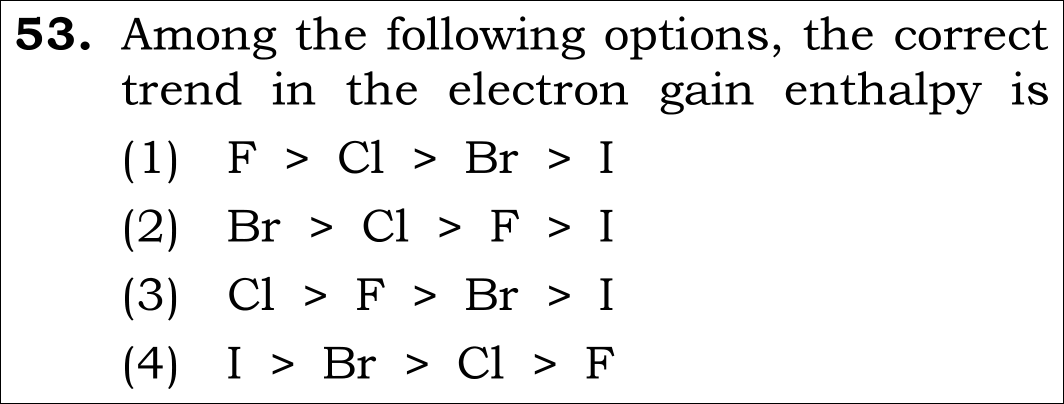
NEET 2026 · Q53 Easy
Official NEET 2026 Question 53 - Classification of Elements and Periodicity in Properties
1
2
3 ✓ Key
4
💡 Verified Solution & 30-Second Hack
✓
Verified Against NTA Final Answer Key
Option (3) : Cl > F > Br > I
📚 Classification of Elements and Periodicity in Properties Easy
📋 Given Parameters & Problem Setup
Elements Halogens: F, Cl, Br, I (Group 17)
Property Electron gain enthalpy magnitude (tendency to accept an electron)
⚡

The 30-Second Exam Hall Shortcut: ⚡ The 2p Interelectronic Repulsion Anomaly

⏱️ Save ~45 seconds

Chlorine beats Fluorine in electron gain enthalpy due to compact 2p crowding in F!

1 Down the group, atomic size increases, so electron gain enthalpy generally becomes less negative.
2 Crucial Exception: Fluorine is extremely small; adding an electron into the compact 2p orbital creates significant interelectronic repulsion.
3 Chlorine has a larger 3p orbital that accommodates the added electron with minimal repulsion.
4 Therefore: Magnitude of negative electron gain enthalpy is Cl > F > Br > I.
5 Pick Option (3) immediately in 10 seconds!
🛡️
Why You Can 100% Trust This Shortcut: Standard NCERT values: Cl (-349 kJ/mol) > F (-328 kJ/mol) > Br (-325 kJ/mol) > I (-295 kJ/mol).
📐

Step-by-Step Rigorous Workflow & Mathematical Proof

Step 1

Definition of Electron Gain Enthalpy

Electron gain enthalpy (Δ_eg H) is the enthalpy change when an isolated gaseous atom in its ground state gains an electron to form a gaseous uninegative ion. For halogens, this process is highly exothermic.

X(g)+e−⟶X−(g)+ΔegH\text{X}(g) + e^- \longrightarrow \text{X}^-(g) + \Delta_{\text{eg}}H
  • • Negative Δ_eg H indicates energy release.
  • • Trend question compares magnitude (exothermicity).
Step 2

Explain the Fluorine-Chlorine Anomaly

Although electronegativity decreases uniformly from F to I, the electron gain enthalpy of fluorine is unexpectedly less negative than that of chlorine. In fluorine (n=2), the incoming electron enters the compact 2p subshell where it experiences strong repulsive forces from the other seven valence electrons. In chlorine (n=3), the incoming electron enters the larger 3p subshell where interelectronic repulsions are substantially weaker.

Size: 2pF≪3pCl  ⟹  Interelectronic repulsion in 2pF>3pCl\text{Size: } 2p_{\text{F}} \ll 3p_{\text{Cl}} \implies \text{Interelectronic repulsion in } 2p_{\text{F}} > 3p_{\text{Cl}}
  • • Δ_eg H of Cl = -349 kJ mol⁻¹.
  • • Δ_eg H of F = -328 kJ mol⁻¹.
Step 3

Establish the Complete Halogen Series

Beyond chlorine, as we descend to bromine and iodine, the increase in atomic size and nuclear shielding causes electron affinity to steadily decrease.

∣ΔegH∣:Cl (349)>F (328)>Br (325)>I (295)[in kJ mol−1]|\Delta_{\text{eg}}H|: \text{Cl } (349) > \text{F } (328) > \text{Br } (325) > \text{I } (295) \quad [\text{in kJ mol}^{-1}]
  • • Trend: Cl > F > Br > I.
  • • Matches Option (3).
⭐

360° Option Elimination Engine Key Feature

Diagnose every choice: Know exactly why the right option works and why distractors fail.

4-Option Deep Scan
1 A
✗ Incorrect
Verdict & Scientific Reason:

Incorrect. This is the trend for electronegativity, but fails for electron gain enthalpy due to the 2p repulsion anomaly.

⚠️
Student Fallacy (Why candidates pick this trap): Confusing electronegativity with electron gain enthalpy.
2 B
✗ Incorrect
Verdict & Scientific Reason:

Incorrect. Bromine does not have a higher electron affinity than chlorine.

⚠️
Student Fallacy (Why candidates pick this trap): Arbitrary ranking of halogens.
3 C
✓ 100% Correct
Verdict & Scientific Reason:

Scientifically accurate, reflecting the standard NCERT anomalous halogen order.

💡
Why this is airtight: None; textbook precision.
4 D
✗ Incorrect
Verdict & Scientific Reason:

Incorrect. Completely inverted order.

⚠️
Student Fallacy (Why candidates pick this trap): Thinking electron affinity increases down the group.
⚠️

NTA Trap Alert: Confusing Electronegativity with Electron Gain Enthalpy

Electronegativity measures bonded atom attraction (F > Cl > Br > I). Electron gain enthalpy measures isolated gaseous ion formation, where chlorine wins because fluorine is too tightly packed.

🛡️ How to avoid the -1 mark: Remember: Fluorine is the most electronegative, but Chlorine is the electron gain champion!
📖

Core NEET Syllabus Standard

NEET Chemistry Core Syllabus · Classification of Elements and Periodicity in Properties Standard Benchmark
Core Scientific Principle Tested:

"Interelectronic repulsions in the small 2p subshell make Δ_eg H of fluorine less negative than that of chlorine."
Syllabus Focus: Periodic trends in chemical properties - Electron Gain Enthalpy
✓ Core NEET UG Syllabus Anchor Syllabus & Academic Standards ↗
Chlorine grabs electrons cleanest: Cl > F > Br > I is the keenest!
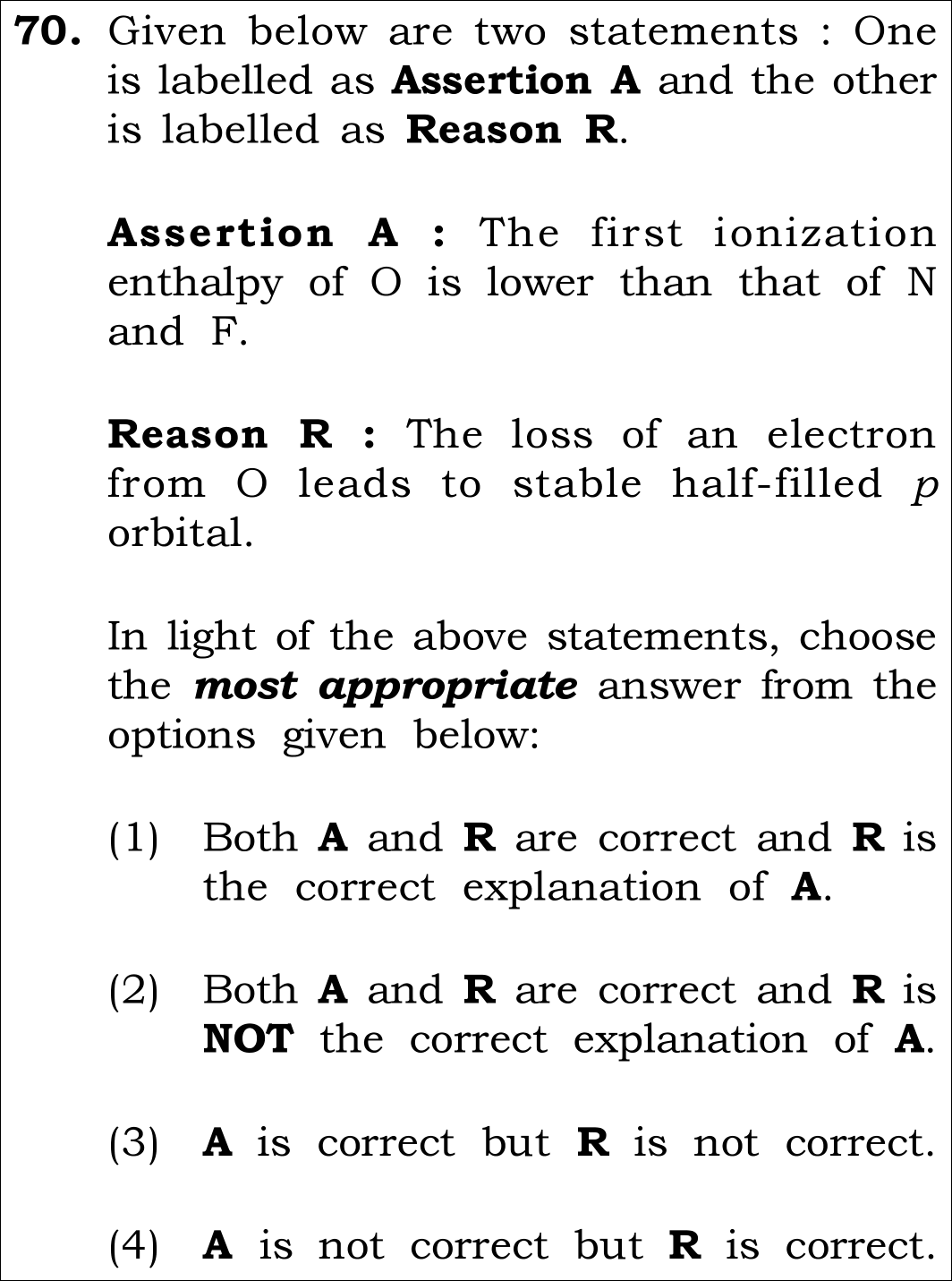
NEET 2026 · Q70 Easy
Official NEET 2026 Question 70 - Classification of Elements and Periodicity in Properties
1 Both A and R are correct and R is the correct explanation of A. ✓ Key
2 Both A and R are correct and R is NOT the correct explanation of A.
3 A is correct but R is not correct.
4 A is not correct but R is correct.
💡 Verified Solution & 30-Second Hack
✓
Verified Against NTA Final Answer Key
Option (1) : Both A and R are correct and R is the correct explanation of A.
📚 Classification of Elements and Periodicity in Properties Easy
📋 Given Parameters & Problem Setup
Assertion (A) The first ionization enthalpy of O is lower than that of N and F.
Reason (R) The loss of an electron from O leads to stable half-filled p orbital.
⚡

The 30-Second Exam Hall Shortcut: ⚡ Half-Filled Stability & Electron Pairing Penalty

⏱️ Save ~40 seconds

Oxygen is 2p⁴: losing 1 electron relieves pairing repulsion and yields a rock-solid half-filled 2p³ subshell!

1 Electronic configurations: N is 2s² 2p³ (stable half-filled); O is 2s² 2p⁴; F is 2s² 2p⁵.
2 Ionization values: N = 1402 kJ/mol, O = 1314 kJ/mol, F = 1681 kJ/mol.
3 Assertion A: O is indeed lower than BOTH N and F -> TRUE.
4 Reason R: In oxygen (2p⁴), two electrons share the same 2p_x orbital. Repulsion between these paired electrons makes it easier to remove one electron, resulting in a stable half-filled 2p³ configuration -> TRUE.
5 Does R explain A? Yes, the extra stability of 2p³ and release of pairing energy directly explains the dip in IE! Option (1) is locked!
🛡️
Why You Can 100% Trust This Shortcut: NCERT Periodicity textbook core concept: Oxygen has a lower first ionization enthalpy than nitrogen because removing an electron from 2p⁴ gives a stable half-filled 2p³ subshell.
📐

Step-by-Step Rigorous Workflow & Mathematical Proof

Step 1

Analyze Assertion A (Ionization Enthalpy Comparison)

Across the second period from left to right, first ionization enthalpy generally increases with increasing nuclear charge. However, oxygen has an anomalous dip: - Nitrogen (Z = 7): Δ_i H₁ = 1402 kJ mol⁻¹ - Oxygen (Z = 8): Δ_i H₁ = 1314 kJ mol⁻¹ - Fluorine (Z = 9): Δ_i H₁ = 1681 kJ mol⁻¹ Thus, Δ_i H₁ of O is lower than that of both N and F.

ΔiH1(N)>ΔiH1(O)<ΔiH1(F)\Delta_i H_1(\text{N}) > \Delta_i H_1(\text{O}) < \Delta_i H_1(\text{F})
  • • Assertion A is factually correct.
Step 2

Analyze Reason R (Electronic Origin of the Anomaly)

Examine the valence electron configurations: - Nitrogen: [He] 2s² 2p_x¹ 2p_y¹ 2p_z¹ (half-filled p subshell, highly stable, high exchange energy). - Oxygen: [He] 2s² 2p_x² 2p_y¹ 2p_z¹ (contains one pair of electrons in the 2p_x orbital). In oxygen, the two electrons in the 2p_x orbital repel each other strongly. Removing one electron relieves this interelectronic repulsion and produces the symmetric, exchange-stabilized half-filled 2p³ configuration of O⁺.

O (2s22p4)→−e−O+(2s22p3)(Stable half-filled subshell)\text{O } (2s^2 2p^4) \xrightarrow{-e^-} \text{O}^+ (2s^2 2p^3) \quad (\text{Stable half-filled subshell})
  • • Reason R is factually correct.
Step 3

Evaluate Reason as the Proper Scientific Explanation

Because the product ion O⁺ achieves a stable half-filled subshell and interelectronic repulsion in 2p⁴ is relieved, less energy is required to ionize oxygen than nitrogen. Therefore, Reason R directly explains Assertion A.

Both A and R are correct and R is the correct explanation of A (Option 1)\text{Both A and R are correct and R is the correct explanation of A (Option 1)}
  • • Matches Option (1).
⭐

360° Option Elimination Engine Key Feature

Diagnose every choice: Know exactly why the right option works and why distractors fail.

4-Option Deep Scan
1 A
✓ 100% Correct
Verdict & Scientific Reason:

Exact scientific justification matching NCERT Periodicity curriculum.

💡
Why this is airtight: None; textbook mastery of atomic structure anomalies.
2 B
✗ Incorrect
Verdict & Scientific Reason:

Incorrect. R is the precise cause of the anomalous ionization dip.

⚠️
Student Fallacy (Why candidates pick this trap): Failing to link electronic configuration stability to ionization energy magnitude.
3 C
✗ Incorrect
Verdict & Scientific Reason:

Incorrect. Reason R correctly states that O⁺ has a stable half-filled 2p³ subshell.

⚠️
Student Fallacy (Why candidates pick this trap): Doubting the stability of half-filled subshells.
4 D
✗ Incorrect
Verdict & Scientific Reason:

Incorrect. Assertion A is a well-established experimental fact.

⚠️
Student Fallacy (Why candidates pick this trap): Assuming ionization energy strictly increases across a period without exceptions.
⚠️

NTA Trap Alert: Assuming Ionization Energy Increases Strictly Across a Period

The periodic trend of increasing ionization energy has two hallmark exceptions in the second period: B < Be (due to 2s² penetration) and O < N (due to 2p³ half-filled stability).

🛡️ How to avoid the -1 mark: Remember: Nitrogen (2p³) is harder to ionize than Oxygen (2p⁴)!
📖

Core NEET Syllabus Standard

NEET Chemistry Core Syllabus · Classification of Elements and Periodicity in Properties Standard Benchmark
Core Scientific Principle Tested:

"Half-filled and completely filled subshells possess extra stability; electron pairing in 2p increases repulsion."

Syllabus Focus: Periodic trends in ionization enthalpy and electronic configuration stability
✓ Core NEET UG Syllabus Anchor Syllabus & Academic Standards ↗
Nitrogen holds its three tight; Oxygen drops its fourth without a fight!
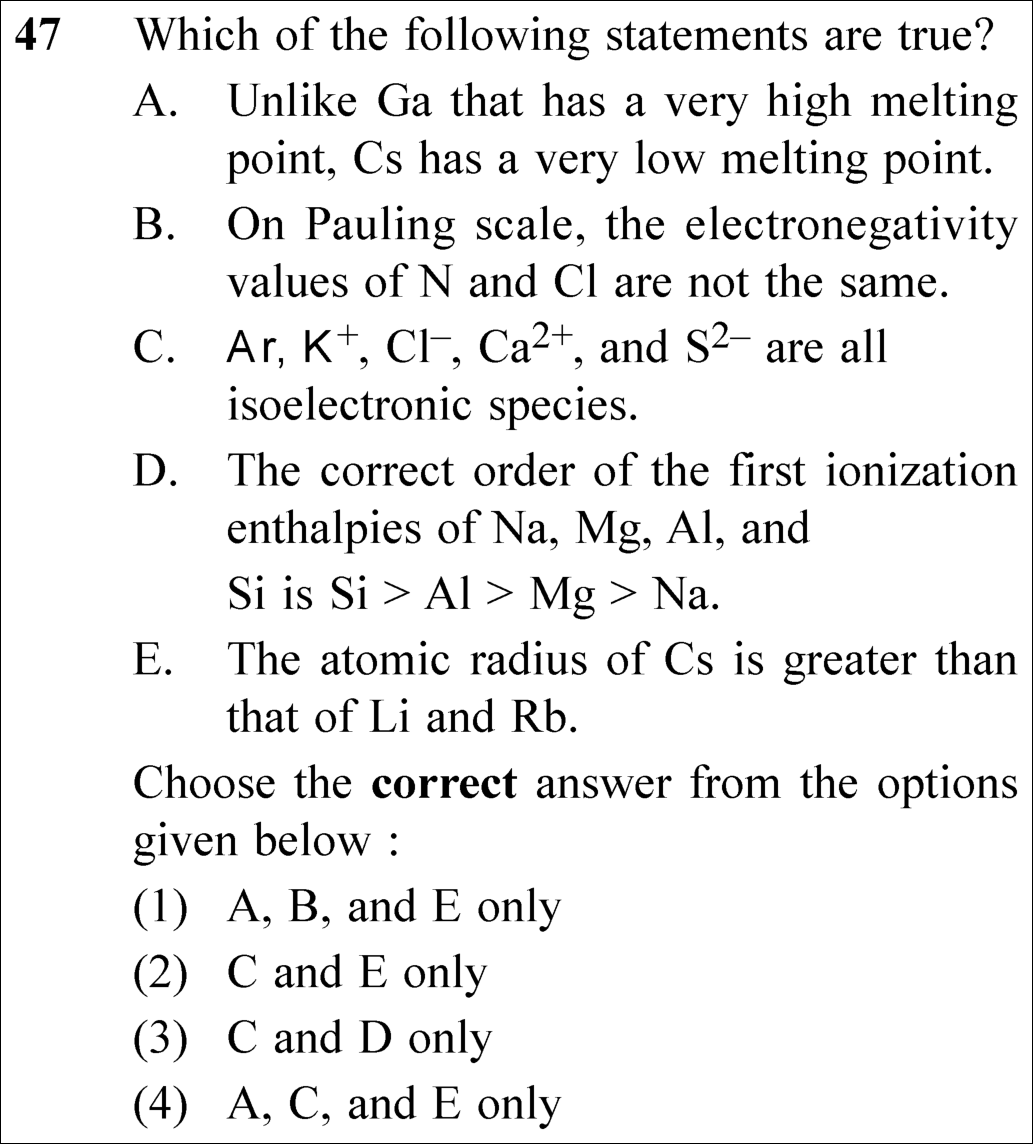
NEET 2025 · Q47 Medium
Official NEET 2025 Question 47 - Classification of Elements and Periodicity in Properties
1
2 ✓ Key
3
4
💡 Verified Solution & 30-Second Hack
✓
Verified Against NTA Final Answer Key
Option (2) : C and E only
📚 Classification of Elements and Periodicity in Properties Medium
📋 Given Parameters & Problem Setup
Statement A Unlike Ga that has a very high melting point, Cs has a very low melting point.
Statement B On Pauling scale, the electronegativity values of N and Cl are not the same.
Statement C Ar, K+, Cl-, Ca2+, and S2- are all isoelectronic species.
Statement D The correct order of the first ionization enthalpies of Na, Mg, Al, and Si is Si > Al > Mg > Na.
Statement E The atomic radius of Cs is greater than that of Li and Rb.
⚡

The 30-Second Exam Hall Shortcut: ⚡ NCERT Periodic Counter-Fact Eliminator

⏱️ Save ~60 seconds

Ga melts in your hand (mp 303 K = 30°C, very low!) ⟹ A is FALSE! Both N and Cl have Pauling EN = 3.0 (identical!) ⟹ B is FALSE! Mg has full 3s² ⟹ Mg > Al ⟹ D is FALSE! Only C and E remain!

1 Check Statement A: Ga (303 K) and Cs (302 K) BOTH have unusually low melting points (liquid during summer). A claims Ga has very high mp ⟹ FALSE!
2 Eliminate options containing A: Options (1) and (4) are discarded instantly.
3 Check Statement B: On Pauling’s scale, both Nitrogen and Chlorine have the identical electronegativity value of 3.0. B claims they are not the same ⟹ FALSE!
4 Check Statement D: Due to stable filled 3s² subshell, Mg has higher IE₁ than Al (Mg = 737 kJ/mol, Al = 577 kJ/mol). The true order is Si > Mg > Al > Na. D claims Si > Al > Mg > Na ⟹ FALSE!
5 Eliminate Option (3) which includes D.
6 Only Option (2) (C and E only) survives!
7 Verify C: Ar(18), K+(18), Cl-(18), Ca2+(18), S2-(18) all have 18 electrons (isoelectronic, TRUE).
8 Verify E: Down Group 1, atomic radius increases: Li < Na < K < Rb < Cs (TRUE).
🛡️
Why You Can 100% Trust This Shortcut: Periodic Trends in Atomic and Ionic Radii (NCERT Chemistry · Classification of Elements and Periodicity in Properties).
📐

Step-by-Step Rigorous Workflow & Mathematical Proof

Step 1

Evaluate Statements A and B (Physical Properties & Electronegativity)

Analyze the canonical NCERT data for Gallium, Caesium, and Pauling electronegativities:

Tmp(Ga)=303 K (30∘C),Tmp(Cs)=302 K (29∘C)T_{mp}(\text{Ga}) = 303\text{ K} \,(30^\circ\text{C}), \quad T_{mp}(\text{Cs}) = 302\text{ K} \,(29^\circ\text{C})
  • • Both Ga and Cs have exceptionally LOW melting points and exist as liquids at room temperature during summer. Statement A is FALSE.
  • • Pauling scale values: EN(N) = 3.0 and EN(Cl) = 3.0. Their electronegativity values ARE identical. Statement B is FALSE.
Step 2

Evaluate Statement C (Isoelectronic Species)

Count the total number of electrons in each chemical species:

e−(Ar)=18,  e−(K+)=19−1=18,  e−(Cl−)=17+1=18,  e−(Ca2+)=20−2=18,  e−(S2−)=16+2=18e^-(\text{Ar}) = 18, \; e^-(\text{K}^+) = 19 - 1 = 18, \; e^-(\text{Cl}^-) = 17 + 1 = 18, \; e^-(\text{Ca}^{2+}) = 20 - 2 = 18, \; e^-(\text{S}^{2-}) = 16 + 2 = 18
  • • All species have exactly 18 electrons and are therefore isoelectronic. Statement C is TRUE.
Step 3

Evaluate Statements D and E (Ionization Enthalpy & Atomic Radius)

Examine electronic configuration effects on ionization enthalpy and group trends in atomic radius:

IE1:  Na (496)<Al (577)<Mg (737)<Si (786 kJ/mol)\text{IE}_1: \; \text{Na}\,(496) < \text{Al}\,(577) < \text{Mg}\,(737) < \text{Si}\,(786\text{ kJ/mol})
  • • Mg ([Ne]3s²) has a fully filled 3s orbital with greater penetration than the 3p electron of Al ([Ne]3s² 3p¹), so IE₁(Mg) > IE₁(Al). Statement D is FALSE.
  • • Down the alkali metal group (Group 1), atomic radius increases monotonically with increasing principal quantum number: r(Li) < r(Na) < r(K) < r(Rb) < r(Cs). Statement E is TRUE.
  • • Conclusion: C and E only are true, matching Option (2).
⭐

360° Option Elimination Engine Key Feature

Diagnose every choice: Know exactly why the right option works and why distractors fail.

4-Option Deep Scan
1 A
✗ Incorrect
Verdict & Scientific Reason:

Incorrect. Both A (Ga has low mp, not high) and B (N and Cl have same EN = 3.0) are false.

⚠️
Student Fallacy (Why candidates pick this trap): Believing Ga has a high melting point and N/Cl have different EN.
2 B
✓ 100% Correct
Verdict & Scientific Reason:

100% correct. C is isoelectronic (18e) and E follows group 1 atomic radius trend (Cs > Rb > Li).

💡
Why this is airtight: None; rigorous NCERT factual mastery.
3 C
✗ Incorrect
Verdict & Scientific Reason:

Incorrect. Statement D is false because Mg > Al in first ionization enthalpy.

⚠️
Student Fallacy (Why candidates pick this trap): Ignoring the stable 3s² fully-filled configuration of Mg over Al.
4 D
✗ Incorrect
Verdict & Scientific Reason:

Incorrect. Statement A is false.

⚠️
Student Fallacy (Why candidates pick this trap): Failing to recall the famously low melting point of Gallium.
⚠️

NTA Trap Alert: The Gallium Melting Point & Mg vs Al Ionization Trap

Gallium has an abnormally low melting point (30°C) due to its crystal structure of Ga₂ molecules, yet students often confuse it with Boron (high mp). Also, Mg > Al in IE₁ is the most common periodic trend trap in competitive exams.

🛡️ How to avoid the -1 mark: Remember: Ga melts on your palm! And s-penetration makes Mg > Al in IE₁.
📖

Core NEET Syllabus Standard

NEET Chemistry Core Syllabus · Classification of Elements and Periodicity in Properties Standard Benchmark
Core Scientific Principle Tested:

"Isoelectronic species have identical electron count; IE₁(Mg) > IE₁(Al); Pauling EN of N = Cl = 3.0."

Syllabus Focus: Periodic Trends in Chemical and Physical Properties
✓ Core NEET UG Syllabus Anchor Syllabus & Academic Standards ↗
Ga melts in your hand, N and Cl equal 3.0, Mg beats Al in IE ⟹ C & E only!
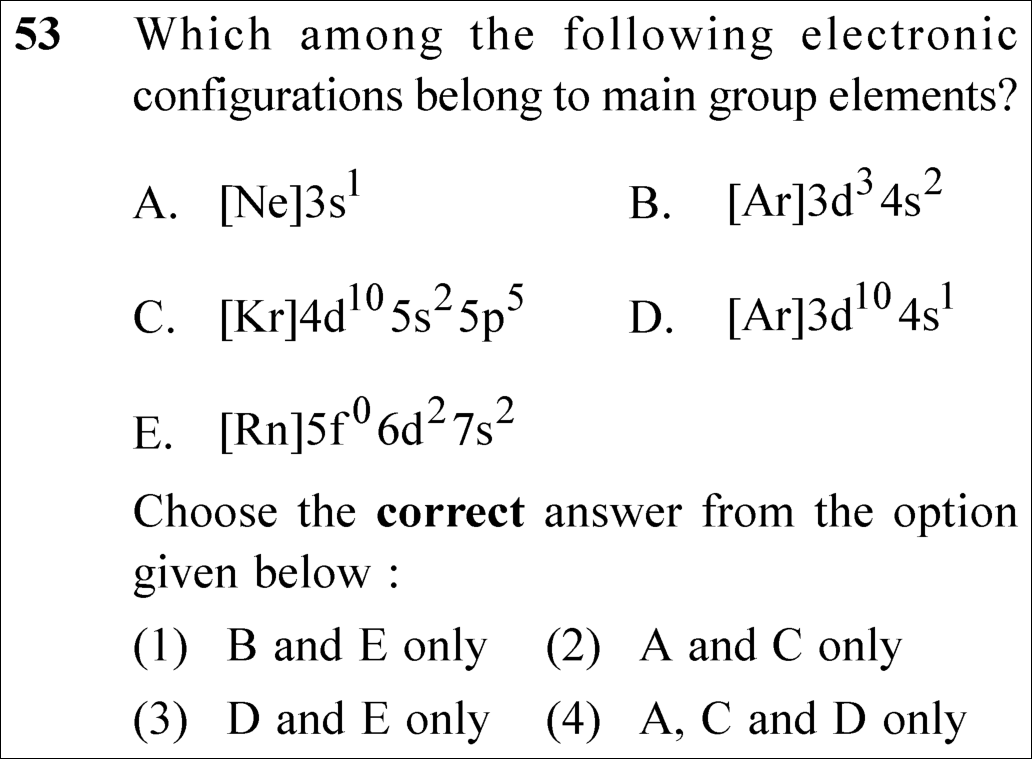
NEET 2025 · Q53 Easy
Official NEET 2025 Question 53 - Classification of Elements and Periodicity in Properties
1
2 ✓ Key
3
4
💡 Verified Solution & 30-Second Hack
✓
Verified Against NTA Final Answer Key
Option (2) : A and C only
📚 Classification of Elements and Periodicity in Properties Easy
📋 Given Parameters & Problem Setup
Configuration A [Ne] 3s¹
Configuration B [Ar] 3d³ 4s²
Configuration C [Kr] 4d¹⁰ 5s² 5p⁵
Configuration D [Ar] 3d¹⁰ 4s¹
Configuration E [Rn] 5f⁰ 6d² 7s²
⚡

The 30-Second Exam Hall Shortcut: ⚡ Main Group = s-block or p-block Only

⏱️ Save ~30 seconds

Main group (representative) elements are EXCLUSIVELY s-block and p-block elements! Configuration A is s-block ([Ne]3s¹). Configuration C is p-block (5p⁵). B and D are d-block transition metals; E is actinoid! ⟹ A and C only!

1 Definition: Main Group Elements (also called Representative Elements) are elements whose valence electrons are in s or p orbitals (s-block and p-block).
2 Identify A: [Ne] 3s¹ = Sodium (Group 1, s-block) ⟹ MAIN GROUP.
3 Identify B: [Ar] 3d³ 4s² = Vanadium (Group 5, d-block transition metal) ⟹ NOT main group.
4 Identify C: [Kr] 4d¹⁰ 5s² 5p⁵ = Iodine (Group 17, p-block halogen) ⟹ MAIN GROUP.
5 Identify D: [Ar] 3d¹⁰ 4s¹ = Copper (Group 11, d-block transition metal) ⟹ NOT main group.
6 Identify E: [Rn] 5f⁰ 6d² 7s² = Thorium (Actinoid series) ⟹ NOT main group.
7 Thus, main group elements are A and C only!
8 Select Option (2) in under 10 seconds!
🛡️
Why You Can 100% Trust This Shortcut: IUPAC Periodic Classification of Elements (NCERT Chemistry · Classification of Elements and Periodicity in Properties).
📐

Step-by-Step Rigorous Workflow & Mathematical Proof

Step 1

Canonical Definition of Main Group Elements

In modern chemistry and the NCERT curriculum, "Main Group Elements" (or "Representative Elements") are defined strictly as elements belonging to the s-block (Groups 1 and 2) and the p-block (Groups 13 to 18):

Main Group=s-block (ns1−2)∪p-block (ns2np1−6)\text{Main Group} = s\text{-block } (ns^{1-2}) \cup p\text{-block } (ns^2 np^{1-6})
  • • d-block elements are transition elements, and f-block elements are inner transition elements.
Step 2

Classify Configurations A, B, and C

Identify the block and identity of configurations A, B, and C:

A:[Ne]3s1  ⟹  Na (s-block, Group 1)  ⟹  Main GroupA: [\text{Ne}] 3s^1 \implies \text{Na (s-block, Group 1)} \implies \text{Main Group}
  • • B: [Ar] 3d³ 4s² ⟹ Vanadium (d-block, Group 5, transition metal). Not main group.
  • • C: [Kr] 4d¹⁰ 5s² 5p⁵ ⟹ Iodine (p-block, Group 17, halogen). Main Group.
Step 3

Classify Configurations D and E

Identify the block and identity of configurations D and E:

D:[Ar]3d104s1  ⟹  Cu (d-block, Group 11),E:[Rn]5f06d27s2  ⟹  Th (Actinoid)D: [\text{Ar}] 3d^{10} 4s^1 \implies \text{Cu (d-block, Group 11)}, \quad E: [\text{Rn}] 5f^0 6d^2 7s^2 \implies \text{Th (Actinoid)}
  • • Neither D nor E is a main group element.
  • • Therefore, only configurations A and C belong to main group elements, matching Option (2).
⭐

360° Option Elimination Engine Key Feature

Diagnose every choice: Know exactly why the right option works and why distractors fail.

4-Option Deep Scan
1 A
✗ Incorrect
Verdict & Scientific Reason:

Incorrect. B is a d-block transition metal and E is an actinoid.

⚠️
Student Fallacy (Why candidates pick this trap): Confusing transition and inner transition metals with main group.
2 B
✓ 100% Correct
Verdict & Scientific Reason:

100% correct. A ([Ne]3s¹) is s-block and C ([Kr]4d¹⁰ 5s² 5p⁵) is p-block.

💡
Why this is airtight: None; rigorous periodic classification.
3 C
✗ Incorrect
Verdict & Scientific Reason:

Incorrect. D is Copper (d-block) and E is Thorium.

⚠️
Student Fallacy (Why candidates pick this trap): Thinking filled d¹⁰ makes Cu a main group element.
4 D
✗ Incorrect
Verdict & Scientific Reason:

Incorrect. Includes Copper (D), which is a transition element.

⚠️
Student Fallacy (Why candidates pick this trap): Falsely considering Group 11 as representative.
⚠️

NTA Trap Alert: Treating Copper ([Ar] 3d¹⁰ 4s¹) as a Main Group Element

Some students see 4s¹ in Copper and think it is an s-block alkali metal! But Copper’s differentiating valence electrons reside in the 3d subshell; it is an official Group 11 transition element!

🛡️ How to avoid the -1 mark: Check the block: s-block (Gr 1-2) & p-block (Gr 13-18) are main group; d and f are not!
📖

Core NEET Syllabus Standard

NEET Chemistry Core Syllabus · Classification of Elements and Periodicity in Properties Standard Benchmark
Core Scientific Principle Tested:

"Representative or Main Group elements comprise s-block and p-block elements."

Syllabus Focus: Electronic Configurations and Types of Elements (s, p, d, f blocks)
✓ Core NEET UG Syllabus Anchor Syllabus & Academic Standards ↗
Main Group = s & p only: A ([Ne]3s¹) and C (5p⁵) ⟹ A & C only!
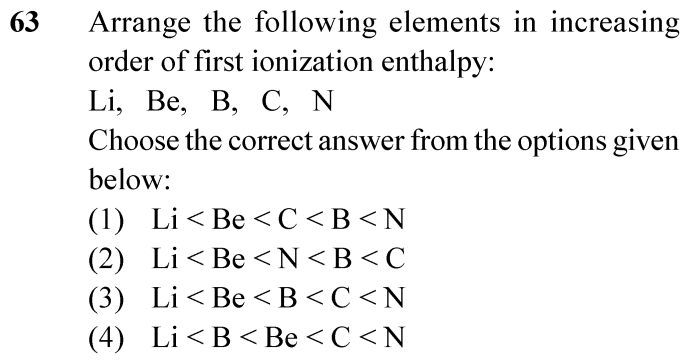
NEET 2024 · Q63 Easy
Official NEET 2024 Question 63 - Classification of Elements and Periodicity in Properties
1
2
3
4 ✓ Key
💡 Verified Solution & 30-Second Hack
✓
Verified Against NTA Final Answer Key
Option (4) : Li < B < Be < C < N
📚 Classification of Elements and Periodicity in Properties Easy
📋 Given Parameters & Problem Setup
Elements Li, Be, B, C, N (Period 2)
Required order Increasing order of first ionization enthalpy (Δ_i H_1)
⚡

The 30-Second Exam Hall Shortcut: ⚡ Period 2 Ionization Enthalpy Anomaly Rule

⏱️ Save ~30 seconds

Across Period 2, IE generally increases with Z_eff, BUT Be (2s² full subshell) > B (2s² 2p¹ single outer p-electron)! Order: Li < B < Be < C < N!

1 General periodic trend across Period 2: IE increases from left to right.
2 Check subshell stability anomaly between Be (Z=4) and B (Z=5):
3 - Be: 1s² 2s² (fully filled stable 2s subshell, high penetration).
4 - B: 1s² 2s² 2p¹ (electron removed from higher energy 2p orbital, easily shielded by 2s).
5 - Hence, IE of Be (899 kJ/mol) > IE of B (801 kJ/mol)!
6 For C (Z=6, 1086 kJ/mol) and N (Z=7, 1402 kJ/mol half-filled 2p³), IE continues increasing.
7 Ascending sequence: Li (520) < B (801) < Be (899) < C (1086) < N (1402).
8 Option (4) in 5 seconds!
🛡️
Why You Can 100% Trust This Shortcut: NCERT Chemistry · Classification of Elements and Periodicity in Properties (Ionization enthalpy anomalies: Be vs B and N vs O).
📐

Step-by-Step Rigorous Workflow & Mathematical Proof

Step 1

Electronic Configurations of Period 2 Elements

Writing ground-state electronic configurations: - Li (Z = 3): 1s² 2s¹ - Be (Z = 4): 1s² 2s² (completely filled 2s orbital) - B (Z = 5): 1s² 2s² 2p¹ - C (Z = 6): 1s² 2s² 2p² - N (Z = 7): 1s² 2s² 2p³ (half-filled, stable 2p subshell)

Be: [He] 2s2;B: [He] 2s2 2p1\text{Be: } [\text{He}]\,2s^2; \quad \text{B: } [\text{He}]\,2s^2\,2p^1
Step 2

Explanation of the Beryllium versus Boron Anomaly

Although nuclear charge increases from Be (+4) to B (+5), the 2p electron in boron is shielded from the nucleus by the inner 2s electrons and occupies a higher energy level than 2s electrons. Furthermore, removing an electron from Be disrupts a completely filled 2s² subshell with greater penetration power. As a consequence, it requires less energy to remove the 2p¹ electron of boron than the 2s² electron of beryllium:

ΔiH1(Be)=899  kJ/mol>ΔiH1(B)=801  kJ/mol\Delta_i H_1(\text{Be}) = 899\;\text{kJ/mol} > \Delta_i H_1(\text{B}) = 801\;\text{kJ/mol}
Step 3

Comprehensive Ordering Across the Period

Comparing all values: - Li: 520 kJ/mol - B: 801 kJ/mol - Be: 899 kJ/mol - C: 1086 kJ/mol - N: 1402 kJ/mol Arranging in strictly increasing order:

Li<B<Be<C<N\text{Li} < \text{B} < \text{Be} < \text{C} < \text{N}
⭐

360° Option Elimination Engine Key Feature

Diagnose every choice: Know exactly why the right option works and why distractors fail.

4-Option Deep Scan
1 (1)
✗ Incorrect
Verdict & Scientific Reason:

Places B after C, which completely violates effective nuclear charge trends.

⚠️
Student Fallacy (Why candidates pick this trap): Random placement of boron.
2 (2)
✗ Incorrect
Verdict & Scientific Reason:

Places N before B and C.

⚠️
Student Fallacy (Why candidates pick this trap): Misunderstanding nitrogen’s half-filled extra stability.
3 (3)
✗ Incorrect
Verdict & Scientific Reason:

Classic straight-line periodic trend trap ignoring the 2s² penetration anomaly between Be and B.

⚠️
Student Fallacy (Why candidates pick this trap): Assuming ionization enthalpy increases monotonically across a period without subshell exceptions.
4 (4)
✓ 100% Correct
Verdict & Scientific Reason:

Correctly accounts for the Be > B subshell anomaly.

💡
Why this is airtight: None.
⚠️

NTA Trap Alert: Option (3) Monotonic Trend Trap

Option (3) arranges elements strictly by atomic number (Li < Be < B < C < N). This is the most common trap in periodic properties questions!

🛡️ How to avoid the -1 mark: Always flag the two famous Period 2 anomalies: Be > B (full 2s² vs 2p¹) and N > O (half-filled 2p³ vs 2p⁴).
📖

Core NEET Syllabus Standard

Chemistry Core Inorganic Chemistry · Classification of Elements and Periodicity in Properties Standard Benchmark
Core Scientific Principle Tested:

"First ionization enthalpy generally increases across a period, but Be is higher than B because the 2s electron has higher penetration and belongs to a completely filled subshell."

Syllabus Focus: Periodic Trends in Chemical Properties: Ionization Enthalpy
✓ Core NEET UG Syllabus Anchor Syllabus & Academic Standards ↗
Boron dips below Beryllium’s full shell: Li < B < Be < C < N rings the bell!
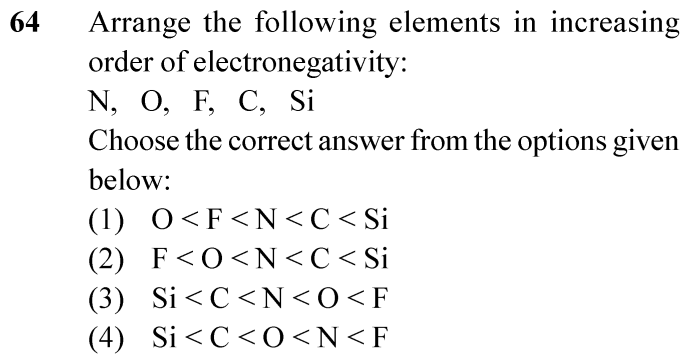
NEET 2024 · Q64 Easy
Official NEET 2024 Question 64 - Classification of Elements and Periodicity in Properties
1
2
3 ✓ Key
4
💡 Verified Solution & 30-Second Hack
✓
Verified Against NTA Final Answer Key
Option (3) : Si < C < N < O < F
📚 Classification of Elements and Periodicity in Properties Easy
📋 Given Parameters & Problem Setup
Elements to arrange N, O, F, C, Si
Required order Increasing order of electronegativity (Pauling scale)
⚡

The 30-Second Exam Hall Shortcut: ⚡ Pauling Electronegativity Ladder Hack

⏱️ Save ~30 seconds

FON Cl N Br I C S H P Si! Flourine is king (4.0), Oxygen is 3.5, Nitrogen is 3.0, Carbon is 2.5, Silicon is 1.8 -> Si < C < N < O < F!

1 Electronegativity increases across a period (left to right) and decreases down a group.
2 Second period non-metals: C (2.5) < N (3.0) < O (3.5) < F (4.0).
3 Silicon (Si) lies in Period 3 directly below Carbon (Group 14). Since electronegativity decreases down the group: Si (1.8) < C (2.5).
4 Combining both trends: Si < C < N < O < F.
5 Match Option (3) in 3 seconds!
🛡️
Why You Can 100% Trust This Shortcut: NCERT Chemistry · Classification of Elements and Periodicity in Properties (Electronegativity trends and Pauling scale values).
📐

Step-by-Step Rigorous Workflow & Mathematical Proof

Step 1

Periodic Trends in Electronegativity

Electronegativity is the qualitative measure of an atom’s ability in a chemical compound to attract shared electrons towards itself. Across a period, increasing effective nuclear charge and decreasing atomic radius attract valence electrons more strongly. Down a group, increased shielding and greater atomic radius reduce electronegativity.

χ∝Zeffr\chi \propto \frac{Z_{eff}}{r}
Step 2

Evaluation of Values on the Pauling Scale

On the Pauling electronegativity scale: - Silicon (Si, Period 3, Group 14): χ = 1.8 - Carbon (C, Period 2, Group 14): χ = 2.5 - Nitrogen (N, Period 2, Group 15): χ = 3.0 - Oxygen (O, Period 2, Group 16): χ = 3.5 - Fluorine (F, Period 2, Group 17): χ = 4.0 (most electronegative element in the periodic table)

χ(Si)=1.8<χ(C)=2.5<χ(N)=3.0<χ(O)=3.5<χ(F)=4.0\chi(\text{Si}) = 1.8 < \chi(\text{C}) = 2.5 < \chi(\text{N}) = 3.0 < \chi(\text{O}) = 3.5 < \chi(\text{F}) = 4.0
Step 3

Ordering

Arranging in strictly increasing order yields: Si < C < N < O < F, perfectly matching Option (3).

Si<C<N<O<F\text{Si} < \text{C} < \text{N} < \text{O} < \text{F}
⭐

360° Option Elimination Engine Key Feature

Diagnose every choice: Know exactly why the right option works and why distractors fail.

4-Option Deep Scan
1 (1)
✗ Incorrect
Verdict & Scientific Reason:

Completely inverted and chaotic order.

⚠️
Student Fallacy (Why candidates pick this trap): Scrambled order.
2 (2)
✗ Incorrect
Verdict & Scientific Reason:

Completely reverses the order (decreasing instead of increasing).

⚠️
Student Fallacy (Why candidates pick this trap): Reading "increasing order" as decreasing order.
3 (3)
✓ 100% Correct
Verdict & Scientific Reason:

Exact monotonic increasing order based on Pauling values (1.8 < 2.5 < 3.0 < 3.5 < 4.0).

💡
Why this is airtight: None.
4 (4)
✗ Incorrect
Verdict & Scientific Reason:

Inverts nitrogen and oxygen.

⚠️
Student Fallacy (Why candidates pick this trap): Thinking nitrogen is more electronegative than oxygen.
⚠️

NTA Trap Alert: Decreasing vs Increasing Direction

Option (2) gives F > O > N > C > Si in reverse order. Always verify the inequality signs: "increasing" requires the smallest on the left (<).

🛡️ How to avoid the -1 mark: Double check the "<" signs: Si is least electronegative, Fluorine is most electronegative.
📖

Core NEET Syllabus Standard

Chemistry Core Inorganic Chemistry · Classification of Elements and Periodicity in Properties Standard Benchmark
Core Scientific Principle Tested:

"Electronegativity increases across a period from left to right and decreases down a group; Fluorine is the most electronegative element."

Syllabus Focus: Periodic Trends: Electronegativity
✓ Core NEET UG Syllabus Anchor Syllabus & Academic Standards ↗
Si climbs to C, then FON takes the lead: Si < C < N < O < F indeed!
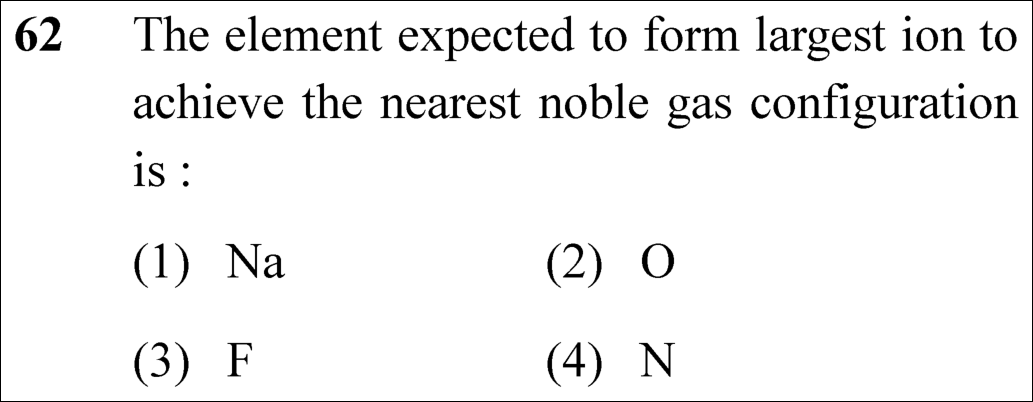
NEET 2023 · Q62 Easy
Official NEET 2023 Question 62 - Classification of Elements and Periodicity in Properties
1 Na
2 O
3 F
4 N ✓ Key
💡 Verified Solution & 30-Second Hack
✓
Verified Against NTA Final Answer Key
Option (4) : N
📚 Classification of Elements and Periodicity in Properties Easy
📋 Given Parameters & Problem Setup
Elements tested Na, O, F, N
Condition Ion formed to achieve nearest noble gas configuration (Neon, 10 e⁻)
Resulting isoelectronic ions Na⁺, O²⁻, F⁻, N³⁻
⚡

The 30-Second Exam Hall Shortcut: ⚡ Isoelectronic Radius Rule: Radius ∝ 1 / Nuclear Charge (Z)

⏱️ Save ~30 seconds

All form 10-electron ions: Na⁺ (Z=11), F⁻ (Z=9), O²⁻ (Z=8), N³⁻ (Z=7). Smallest nuclear charge (Z=7) has weakest hold on electrons ⟹ N³⁻ is LARGEST in 5 seconds!

1 Determine the stable noble-gas ion formed by each element:
2 - Na (Z = 11) loses 1 e⁻ ⟶ Na⁺ (10 electrons).
3 - F (Z = 9) gains 1 e⁻ ⟶ F⁻ (10 electrons).
4 - O (Z = 8) gains 2 e⁻ ⟶ O²⁻ (10 electrons).
5 - N (Z = 7) gains 3 e⁻ ⟶ N³⁻ (10 electrons).
6 All four ions are isoelectronic with Neon (10 electrons).
7 In an isoelectronic series, ionic radius is inversely proportional to atomic number Z: Radius ∝ 1 / Z.
8 Nitrogen has the lowest nuclear charge (Z = 7 protons pulling on 10 electrons).
9 Therefore, N³⁻ experiences the lowest Z_eff and expands to the largest ionic radius (171 pm).
10 Lock Option (4) N immediately!
🛡️
Why You Can 100% Trust This Shortcut: Periodic Properties · Isoelectronic Series Trends (In isoelectronic species, the greater the negative charge or smaller the nuclear charge, the larger the ionic radius: r ∝ 1/Z).
📐

Step-by-Step Rigorous Workflow & Mathematical Proof

Step 1

Formation of Nearest Noble Gas Configurations

Each element attains the electron configuration of the nearest noble gas (Neon, 1s² 2s² 2p⁶, total 10 electrons) by gaining or losing electrons:

Na (Z=11)⟶Na++e−(10 e−)F (Z=9)+e−⟶F−(10 e−)O (Z=8)+2e−⟶O2−(10 e−)N (Z=7)+3e−⟶N3−(10 e−)\begin{aligned} \text{Na } (Z=11) &\longrightarrow \text{Na}^+ + e^- \quad (10\ e^-) \\[4pt] \text{F } (Z=9) + e^- &\longrightarrow \text{F}^- \quad (10\ e^-) \\[4pt] \text{O } (Z=8) + 2e^- &\longrightarrow \text{O}^{2-} \quad (10\ e^-) \\[4pt] \text{N } (Z=7) + 3e^- &\longrightarrow \text{N}^{3-} \quad (10\ e^-) \end{aligned}
Step 2

Effective Nuclear Charge (Z_eff) Comparison

All four resulting ions possess the identical number of electrons (10), but differing nuclear charges (number of protons Z in the nucleus):

Nuclear charge Z:Na+(11)>F−(9)>O2−(8)>N3−(7)\text{Nuclear charge } Z: \quad \text{Na}^+ (11) > \text{F}^- (9) > \text{O}^{2-} (8) > \text{N}^{3-} (7)
Step 3

Determination of Ionic Radius Hierarchy

As nuclear charge decreases, the inward electrostatic pull on the 10 electrons weakens and interelectronic repulsions dominate, causing the electron cloud to expand. Consequently, ionic radius increases with decreasing Z:

r(N3−)>r(O2−)>r(F−)>r(Na+)r(\text{N}^{3-}) > r(\text{O}^{2-}) > r(\text{F}^-) > r(\text{Na}^+)
Step 4

Conclusion

Nitrogen forms the N³⁻ ion (radius ≈ 171 pm), which is the largest among all ions in this isoelectronic group.

r(N3−)=171 pm(Largest ion)r(\text{N}^{3-}) = 171\text{ pm} \quad (\text{Largest ion})
⭐

360° Option Elimination Engine Key Feature

Diagnose every choice: Know exactly why the right option works and why distractors fail.

4-Option Deep Scan
1 (1)
✗ Incorrect
Verdict & Scientific Reason:

Forms Na⁺, which has the HIGHEST nuclear charge (Z=11) and is the SMALLEST ion (102 pm).

⚠️
Student Fallacy (Why candidates pick this trap): Candidate confused atomic size (Na atom is largest) with ionic size of its noble gas ion (Na⁺ is smallest).
2 (2)
✗ Incorrect
Verdict & Scientific Reason:

Forms O²⁻ (radius 140 pm), which is smaller than N³⁻.

⚠️
Student Fallacy (Why candidates pick this trap): Candidate overlooked that N³⁻ has higher negative charge and lower Z.
3 (3)
✗ Incorrect
Verdict & Scientific Reason:

Forms F⁻ (radius 133 pm), which is smaller than O²⁻ and N³⁻.

⚠️
Student Fallacy (Why candidates pick this trap): Candidate confused electronegativity with ionic size.
4 (4)
✓ 100% Correct
Verdict & Scientific Reason:

Accurate: Forms N³⁻ with the lowest nuclear charge (Z=7) and highest negative charge, resulting in the largest ionic radius (171 pm).

💡
Why this is airtight: None. Candidate correctly analyzed the isoelectronic series.
⚠️

NTA Trap Alert: Selecting Na by Looking at Atomic Radius Instead of Ionic Radius

As a neutral atom, Sodium (Period 3) is much larger than neutral Nitrogen (Period 2). But the question explicitly asks for the ION formed to achieve noble gas configuration! Na forms a cation (Na⁺, losing its 3s shell, r = 102 pm), whereas N forms an anion (N³⁻, expanding to r = 171 pm).

🛡️ How to avoid the -1 mark: Always compare the IONS: Anions swell due to electron repulsions, cations shrink due to loss of shell and increased Z/e ratio.
📖

Core NEET Syllabus Standard

National Eligibility cum Entrance Test (NEET UG) · Classification of Elements and Periodicity in Properties Standard Benchmark
Core Scientific Principle Tested:

"In isoelectronic ions, the radius increases with the decrease in nuclear charge (or increase in negative charge): N³⁻ > O²⁻ > F⁻ > Na⁺."

Syllabus Focus: Periodic Trends in Properties – Ionic Radii
Preserved in Rationalized Curriculum Syllabus & Academic Standards ↗
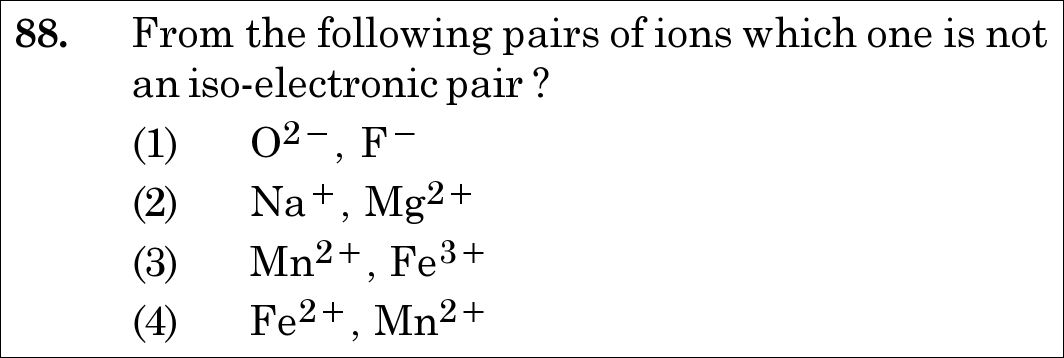
NEET 2021 · Q88 Easy
Official NEET 2021 Question 88 - Classification of Elements and Periodicity in Properties
1
2
3
4 ✓ Key
💡 Verified Solution & 30-Second Hack
✓
Verified Against NTA Final Answer Key
Option (4) : Fe2+, Mn2+
📚 Classification of Elements and Periodicity in Properties Easy
📋 Given Parameters & Problem Setup
Pair 1 O2-, F-
Pair 2 Na+, Mg2+
Pair 3 Mn2+, Fe3+
Pair 4 Fe2+, Mn2+
⚡

The 30-Second Exam Hall Shortcut: ⚡ Fast Electron Count: Fe²⁺ = 24 e⁻ vs. Mn²⁺ = 23 e⁻!

⏱️ Save ~15 seconds

Isoelectronic species contain the exact same number of total electrons. For Fe2+Fe^{2+}, electrons =26−2=24= 26 - 2 = 24. For Mn2+Mn^{2+}, electrons =25−2=23= 25 - 2 = 23. Since 24≠2324 \neq 23, Fe2+,Mn2+Fe^{2+}, Mn^{2+} is NOT an isoelectronic pair! All other pairs have identical electron counts: O2−/F−O^{2-}/F^- (10), Na+/Mg2+Na^+/Mg^{2+} (10), and Mn2+/Fe3+Mn^{2+}/Fe^{3+} (23). Match Option (4)!

1 Isoelectronic definition: Equal total number of electrons.
2 Pair (1): O2−(8+2=10e−)O^{2-} (8+2 = 10 e^-) and F−(9+1=10e−)  ⟹  F^- (9+1 = 10 e^-) \implies Isoelectronic.
3 Pair (2): Na+(11−1=10e−)Na^+ (11-1 = 10 e^-) and Mg2+(12−2=10e−)  ⟹  Mg^{2+} (12-2 = 10 e^-) \implies Isoelectronic.
4 Pair (3): Mn2+(25−2=23e−)Mn^{2+} (25-2 = 23 e^-) and Fe3+(26−3=23e−)  ⟹  Fe^{3+} (26-3 = 23 e^-) \implies Isoelectronic.
5 Pair (4): Fe2+(26−2=24e−)Fe^{2+} (26-2 = 24 e^-) and Mn2+(25−2=23e−)  ⟹  Mn^{2+} (25-2 = 23 e^-) \implies NOT isoelectronic (24≠2324 \neq 23).
6 Match Option (4).
🛡️
Why You Can 100% Trust This Shortcut: Canonical definition of isoelectronic species from NCERT Periodic Properties.
📐

Step-by-Step Rigorous Workflow & Mathematical Proof

Step 1

Definition of Isoelectronic Ions

Isoelectronic ions are ions of different chemical elements that possess the identical total number of electrons and identical ground-state electronic configurations.

Step 2

Calculating Electron Counts for Pairs (1), (2), and (3)

- Pair 1 (O2−,F−O^{2-}, F^-): - Oxygen (Z=8Z=8): 8−(−2)=10 electrons8 - (-2) = 10\text{ electrons} - Fluorine (Z=9Z=9): 9−(−1)=10 electrons9 - (-1) = 10\text{ electrons} (Isoelectronic, Neon configuration [Ne][Ne]) - Pair 2 (Na+,Mg2+Na^+, Mg^{2+}): - Sodium (Z=11Z=11): 11−1=10 electrons11 - 1 = 10\text{ electrons} - Magnesium (Z=12Z=12): 12−2=10 electrons12 - 2 = 10\text{ electrons} (Isoelectronic, Neon configuration [Ne][Ne]) - Pair 3 (Mn2+,Fe3+Mn^{2+}, Fe^{3+}): - Manganese (Z=25Z=25): 25−2=23 electrons25 - 2 = 23\text{ electrons} ([Ar]3d5[Ar]3d^5) - Iron (Z=26Z=26): 26−3=23 electrons26 - 3 = 23\text{ electrons} ([Ar]3d5[Ar]3d^5) (Isoelectronic, both half-filled d5d^5)

Step 3

Evaluating Pair (4): Fe2+ and Mn2+

Calculate electrons for iron(II) and manganese(II): - Fe2+Fe^{2+} (Z=26Z = 26): 26−2=24 electrons26 - 2 = 24\text{ electrons} ([Ar]3d6[Ar]3d^6) - Mn2+Mn^{2+} (Z=25Z = 25): 25−2=23 electrons25 - 2 = 23\text{ electrons} ([Ar]3d5[Ar]3d^5) Because 24≠2324 \neq 23, this pair does not have the same number of electrons and is NOT an isoelectronic pair.

e−(Fe2+)=24≠e−(Mn2+)=23  ⟹  NOT isoelectronice^-(Fe^{2+}) = 24 \neq e^-(Mn^{2+}) = 23 \implies \mathbf{\text{NOT isoelectronic}}
⭐

360° Option Elimination Engine Key Feature

Diagnose every choice: Know exactly why the right option works and why distractors fail.

4-Option Deep Scan
1 1
✗ Incorrect
Verdict & Scientific Reason:

Isoelectronic pair (both have 10 electrons).

⚠️
Student Fallacy (Why candidates pick this trap): Assuming anion-anion pairs cannot be isoelectronic.
2 2
✗ Incorrect
Verdict & Scientific Reason:

Isoelectronic pair (both have 10 electrons).

⚠️
Student Fallacy (Why candidates pick this trap): Assuming different group cations have different electron counts.
3 3
✗ Incorrect
Verdict & Scientific Reason:

Isoelectronic pair (both have 23 electrons, [Ar]3d5[Ar]3d^5).

⚠️
Student Fallacy (Why candidates pick this trap): Missing that 25−2=2325-2 = 23 equals 26−3=2326-3 = 23.
4 4
✓ 100% Correct
Verdict & Scientific Reason:

NOT isoelectronic: Fe2+Fe^{2+} has 24 electrons while Mn2+Mn^{2+} has 23 electrons.

💡
Why this is airtight: None; precise electron counting.
⚠️

NTA Trap Alert: Same Charge Assumption Trap (Mn2+ vs Fe2+)

Students who see identical charges (+2+2 on both Fe and Mn) assume they might be isoelectronic, while suspecting Mn2+Mn^{2+} and Fe3+Fe^{3+} (Option 3) because of different charges. Since atomic numbers differ by 1 (Fe=26,Mn=25Fe=26, Mn=25), identical +2+2 charges guarantee DIFFERENT electron counts (24≠2324 \neq 23).

🛡️ How to avoid the -1 mark: Same charge on adjacent elements   ⟹  \implies NEVER isoelectronic! Different charges can compensate: 26−3=25−2=2326-3 = 25-2 = 23.
📖

Core NEET Syllabus Standard

NCERT Chemistry · Classification of Elements and Periodicity in Properties Standard Benchmark
Core Scientific Principle Tested:

"Isoelectronic species have the same number of electrons. Fe2+ (24 electrons) and Mn2+ (23 electrons) are not isoelectronic."

Syllabus Focus: Periodic Trends in Physical Properties (Isoelectronic Species)
✓ Core NEET UG Syllabus Anchor Syllabus & Academic Standards ↗
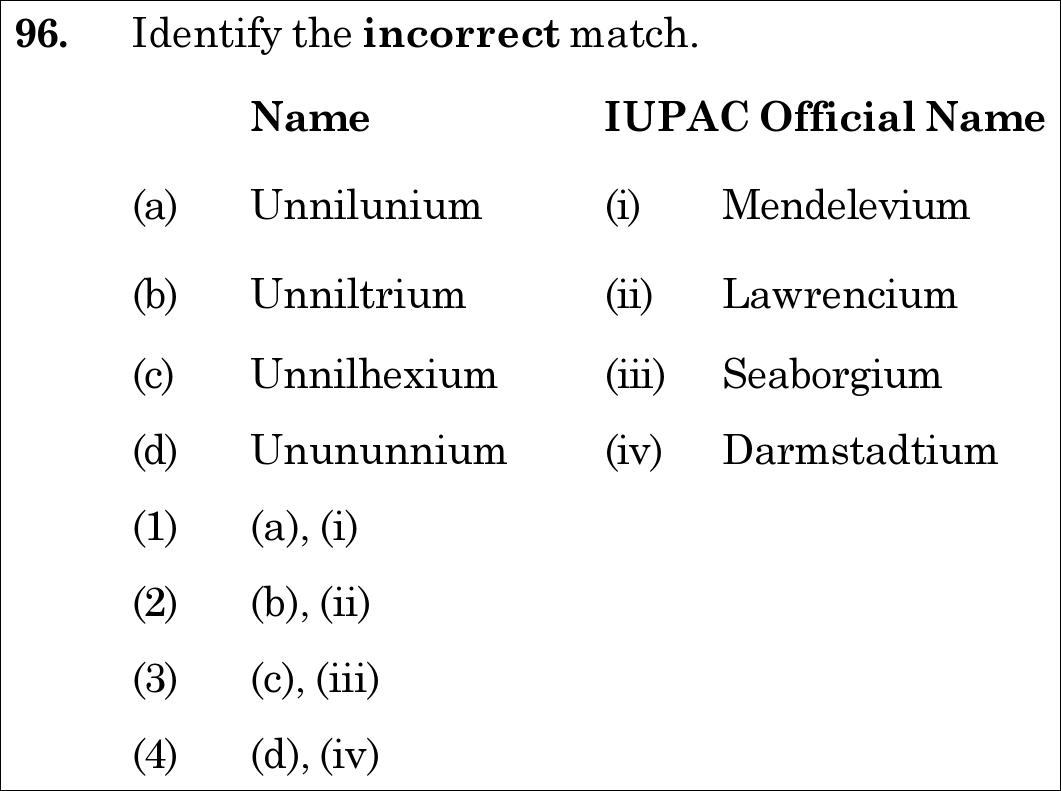
NEET 2020 · Q96 Easy
Official NEET 2020 Question 96 - Classification of Elements and Periodicity in Properties
1 (a), (i)
2 (b), (ii)
3 (c), (iii)
4 (d), (iv) ✓ Key
💡 Verified Solution & 30-Second Hack
✓
Verified Against NTA Final Answer Key
Option (4) : (d), (iv)
📚 Classification of Elements and Periodicity in Properties Easy
📋 Given Parameters & Problem Setup
(a) Unnilunium (Z = 101) (i) Mendelevium (Md)
(b) Unniltrium (Z = 103) (ii) Lawrencium (Lr)
(c) Unnilhexium (Z = 106) (iii) Seaborgium (Sg)
(d) Unununnium (Z = 111) (iv) Darmstadtium (Ds)
Question Objective Identify the INCORRECT match
⚡

The 30-Second Exam Hall Shortcut: ⚡ "Element 111 (Unununnium) is ROENTGENIUM (Rg), NOT Darmstadtium (Ds = 110)!"

⏱️ 20 seconds

Un-un-unnium has atomic number Z = 111. The official IUPAC name for element 111 is ROENTGENIUM (Rg). Darmstadtium (Ds) is element 110 (Ununnilium)! Therefore, pair (d), (iv) is the incorrect match. Mark Option (4) in 5 seconds!

1 Unnilunium = 101 -> Mendelevium (Md) (Correct match).
2 Unniltrium = 103 -> Lawrencium (Lr) (Correct match).
3 Unnilhexium = 106 -> Seaborgium (Sg) (Correct match).
4 Unununnium = 111 -> Roentgenium (Rg). Darmstadtium (Ds) is element 110.
5 Match (d), (iv) is INCORRECT. Select Option (4).
🛡️
Why You Can 100% Trust This Shortcut: NCERT Chemistry · Classification of Elements and Periodicity in Properties (Nomenclature of Elements with Atomic Numbers > 100)
📐

Step-by-Step Rigorous Workflow & Mathematical Proof

Step 1

IUPAC Systematic Naming Rules for Z > 100

Roots used: nil = 0, un = 1, bi = 2, tri = 3, quad = 4, pent = 5, hex = 6, sept = 7, oct = 8, enn = 9, ending with "-ium".

Step 2

Decode Element (a): Unnilunium

Un (1) + nil (0) + un (1) + ium = Atomic number 101 (Unu\text{Unu}). Official IUPAC name is Mendelevium (Md\text{Md}). Correct match.

Step 3

Decode Element (b): Unniltrium

Un (1) + nil (0) + tri (3) + um = Atomic number 103 (Unt\text{Unt}). Official IUPAC name is Lawrencium (Lr\text{Lr}). Correct match.

Step 4

Decode Element (c): Unnilhexium

Un (1) + nil (0) + hex (6) + ium = Atomic number 106 (Unh\text{Unh}). Official IUPAC name is Seaborgium (Sg\text{Sg}). Correct match.

Step 5

Decode Element (d): Unununnium

Un (1) + un (1) + un (1) + ium = Atomic number 111 (Uuu\text{Uuu}). Official IUPAC name is Roentgenium (Rg\text{Rg}). Darmstadtium (Ds\text{Ds}) is element 110 (Ununnilium, Z=110Z = 110). Thus, (d) matching with (iv) is incorrect.

⭐

360° Option Elimination Engine Key Feature

Diagnose every choice: Know exactly why the right option works and why distractors fail.

4-Option Deep Scan
1 A
✗ Incorrect
Verdict & Scientific Reason:

Correct match; element 101 is indeed Mendelevium.

⚠️
Student Fallacy (Why candidates pick this trap): Failing to notice the question asks for the INCORRECT match.
2 B
✗ Incorrect
Verdict & Scientific Reason:

Correct match; element 103 is indeed Lawrencium.

⚠️
Student Fallacy (Why candidates pick this trap): Assuming 103 is not Lawrencium.
3 C
✗ Incorrect
Verdict & Scientific Reason:

Correct match; element 106 is Seaborgium.

⚠️
Student Fallacy (Why candidates pick this trap): Unfamiliarity with trans-fermium element names.
4 D
✓ 100% Correct
Verdict & Scientific Reason:

Factually INCORRECT match (hence the correct answer); element 111 is Roentgenium (Rg), whereas Darmstadtium is element 110.

💡
Why this is airtight: None; precision check on elements 110 and 111.
⚠️

NTA Trap Alert: Element 110 vs Element 111

Z = 110 is Darmstadtium (Ds, Ununnilium). Z = 111 is Roentgenium (Rg, Unununnium). Z = 112 is Copernicium (Cn, Ununbium).

🛡️ How to avoid the -1 mark: Remember: 110 = Darmstadtium; 111 = Roentgenium!
📖

Core NEET Syllabus Standard

Chemistry · Classification of Elements and Periodicity in Properties Standard Benchmark
Core Scientific Principle Tested:

""

Syllabus Focus: IUPAC Nomenclature and Official Names of Superheavy Elements (Z > 100)
✓ Core NEET UG Syllabus Anchor Syllabus & Academic Standards ↗
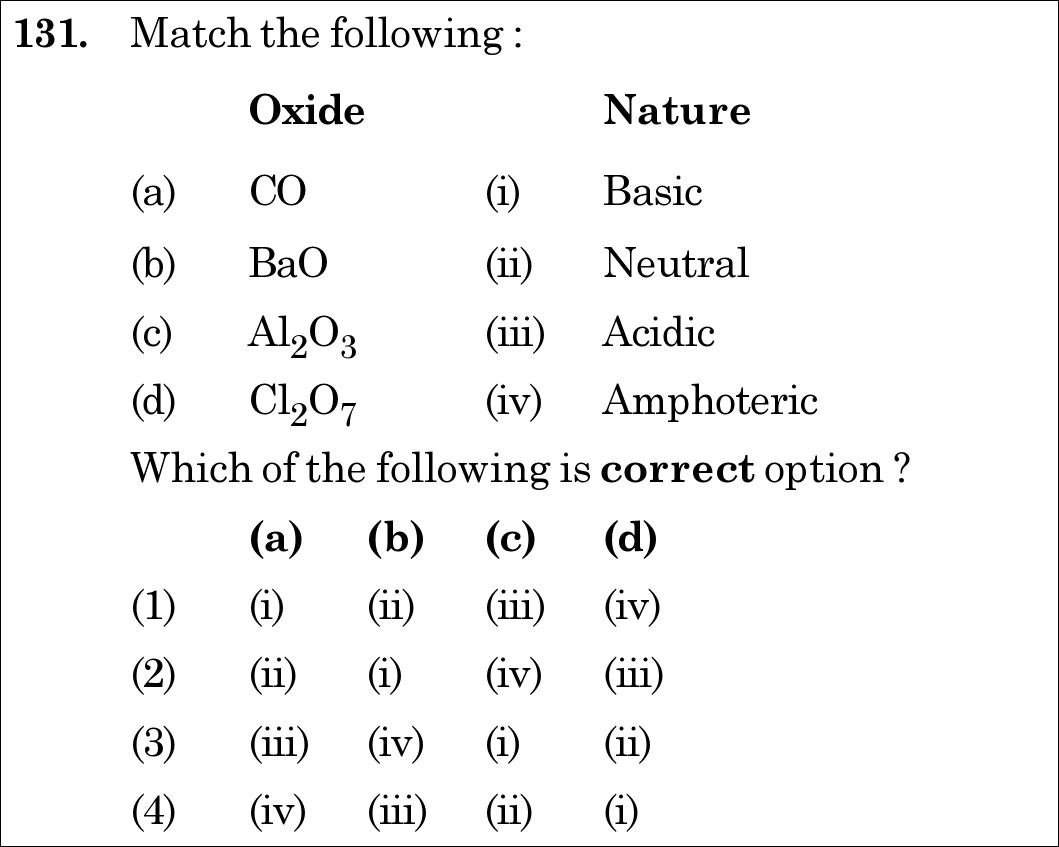
NEET 2020 · Q131 Easy
Official NEET 2020 Question 131 - Classification of Elements and Periodicity in Properties
1 (i) (ii) (iii) (iv)
2 (ii) (i) (iv) (iii) ✓ Key
3 (iii) (iv) (i) (ii)
4 (iv) (iii) (ii) (i)
💡 Verified Solution & 30-Second Hack
✓
Verified Against NTA Final Answer Key
Option (2) : (a)-(ii), (b)-(i), (c)-(iv), (d)-(iii)
📚 Classification of Elements and Periodicity in Properties Easy
📋 Given Parameters & Problem Setup
Column I (Oxides) (a) CO, (b) BaO, (c) Al2O3, (d) Cl2O7
Column II (Nature) (i) Basic, (ii) Neutral, (iii) Acidic, (iv) Amphoteric
⚡

The 30-Second Exam Hall Shortcut: ⚡ "CO = Neutral; BaO = Basic; Al2O3 = Amphoteric; Cl2O7 = Strongly Acidic!"

⏱️ 20 seconds

CO is a neutral oxide (along with NO and N2O; a->ii). BaO is an alkaline earth metal oxide, hence strongly basic (b->i). Al2O3 reacts with both acids and bases, hence amphoteric (c->iv). Cl2O7 is a non-metal oxide in maximum +7 oxidation state, hence strongly acidic (d->iii). Match gives (ii), (i), (iv), (iii) -> Option 2 in 5 seconds!

1 CO is neutral -> (a)-(ii).
2 BaO is an electropositive alkaline earth basic oxide -> (b)-(i).
3 Al2O3 is amphoteric (reacts with HCl and NaOH) -> (c)-(iv).
4 Cl2O7 is acidic (forms perchloric acid HClO4 with water) -> (d)-(iii).
5 Resulting combination: (a)-(ii), (b)-(i), (c)-(iv), (d)-(iii) -> Option 2.
🛡️
Why You Can 100% Trust This Shortcut: NCERT Chemistry · Classification of Elements and Periodicity in Properties (Periodic Trends: Chemical Reactivity of Oxides)
📐

Step-by-Step Rigorous Workflow & Mathematical Proof

Step 1

Match Carbon Monoxide (CO)

Carbon monoxide (CO\text{CO}) is neutral; it shows neither acidic nor basic properties and does not form salts with acids or bases (other neutral oxides are NO\text{NO} and N2O\text{N}_2\text{O}). Thus, (a) matches (ii).

Step 2

Match Barium Oxide (BaO)

Barium is a highly electropositive alkaline earth metal (Group 2). Its oxide, BaO\text{BaO}, dissolves in water to form the strong base barium hydroxide (Ba(OH)2\text{Ba(OH)}_2) and reacts vigorously with acids. Thus, (b) matches (i).

Step 3

Match Aluminium Oxide (Al2O3)

Al2O3\text{Al}_2\text{O}_3 exhibits both acidic and basic characteristics, dissolving in hydrochloric acid to form aluminium chloride and in sodium hydroxide to form sodium aluminate (Na[Al(OH)4]\text{Na[Al(OH)}_4]). Thus, (c) matches (iv) Amphoteric.

Step 4

Match Dichlorine Heptoxide (Cl2O7)

Chlorine is a strongly electronegative halogen in its highest oxidation state (+7). Cl2O7\text{Cl}_2\text{O}_7 dissolves in water to form perchloric acid (HClO4\text{HClO}_4), one of the strongest inorganic acids. Thus, (d) matches (iii) Acidic.

⭐

360° Option Elimination Engine Key Feature

Diagnose every choice: Know exactly why the right option works and why distractors fail.

4-Option Deep Scan
1 A
✗ Incorrect
Verdict & Scientific Reason:

Incorrect; claims CO is basic and BaO is neutral.

⚠️
Student Fallacy (Why candidates pick this trap): Swapping basic and neutral.
2 B
✓ 100% Correct
Verdict & Scientific Reason:

Accurate pairing across all four chemical oxide types.

💡
Why this is airtight: None; textbook acid-base oxide classification.
3 C
✗ Incorrect
Verdict & Scientific Reason:

Incorrect; misassigns CO to acidic and BaO to amphoteric.

⚠️
Student Fallacy (Why candidates pick this trap): Arbitrary matching.
4 D
✗ Incorrect
Verdict & Scientific Reason:

Incorrect; claims CO is amphoteric and Cl2O7 is basic.

⚠️
Student Fallacy (Why candidates pick this trap): Completely inverted assignments.
⚠️

NTA Trap Alert: Neutral Oxides in NCERT

Memorize the four common NEUTRAL oxides: CO, NO, N2O, and H2O! Non-metal oxides with low oxidation states are neutral, while high oxidation state oxides like Cl2O7 are strongly acidic.

🛡️ How to avoid the -1 mark: Remember: CO = Neutral; Al2O3 = Amphoteric!
📖

Core NEET Syllabus Standard

Chemistry · Classification of Elements and Periodicity in Properties Standard Benchmark
Core Scientific Principle Tested:

""

Syllabus Focus: Acid-Base Character of Oxides: Neutral, Basic, Amphoteric and Acidic Oxides
✓ Core NEET UG Syllabus Anchor Syllabus & Academic Standards ↗

Solve 4 NEET Questions a Day — One per Subject

Cover all 1,140 official NEET questions in 285 days at your own pace. Progress is saved on your device. No login needed.