MyCompetitiveExams Logo MyCompetitiveExams
Search 1,140+ Questions
Chapters, formulas, speed tricks
→
⚡ Brahmastra NEET 2027
720 MARKS

Dynamic 180-question full-length simulator mixed dynamically from all 6 years for 2027 & 2026 aspirants.

Launch Brahmastra 2027 Test →
Start Practice →
100% Free · No Login Required
Q.74 Chemistry ⭐ 360° Option Elimination Active
Vault ↗

NEET 2021 Chemistry Question 74 Solution

Topic: Surface Chemistry · Official NTA Booklet Code M1
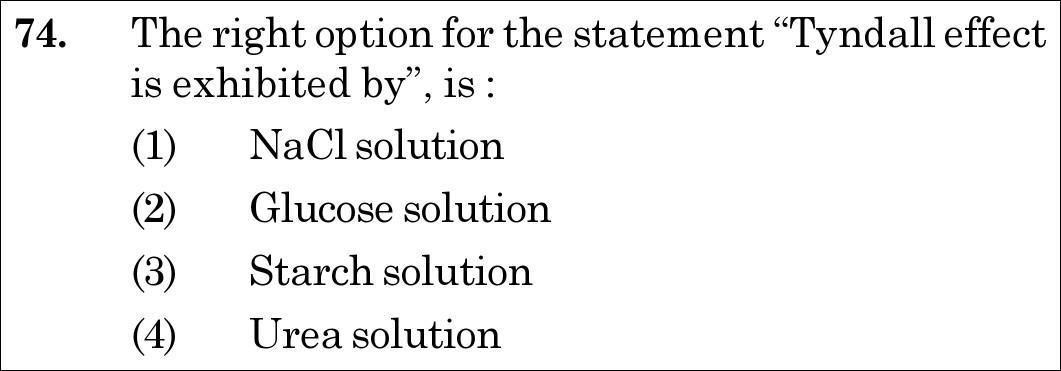
NEET 2021 Chemistry Question 74: Optical Properties of Colloids: Tyndall Effect

Question

The right option for the statement "Tyndall effect is exhibited by", is:

  1. (1)NaCl solution
  2. (2)Glucose solution
  3. (3)Starch solution
  4. (4)Urea solution
✓
Verified Against NTA Final Answer Key
Option (3) : Starch solution
📚 Surface Chemistry Easy
📋 Given Parameters & Problem Setup
Phenomenon Tyndall effect (scattering of light by dispersed particles)
⚡

The 30-Second Exam Hall Shortcut: ⚡ Tyndall Effect = Colloidal Solution Only!

⏱️ Save ~15 seconds

Tyndall effect is an optical property shown EXCLUSIVELY by colloidal dispersions (particle size 1 nm to 1000 nm). NaCl, glucose, and urea form true solutions where solute particles are < 1 nm and cannot scatter light. Starch forms a lyophilic colloidal sol; hence, ONLY starch solution exhibits the Tyndall effect! Match Option (3)!

1 Tyndall effect requires colloidal particle size (1−1000 nm1-1000\text{ nm}) comparable to light wavelength.
2 NaCl solution, Glucose solution, and Urea solution are TRUE solutions (particle size <1 nm< 1\text{ nm}).
3 Starch in water forms a macromolecular colloidal sol.
4 Therefore, Tyndall effect is exhibited by starch solution.
5 Match Option (3).
🛡️
Why You Can 100% Trust This Shortcut: Canonical NCERT Surface Chemistry criteria for Tyndall effect.
📐

Step-by-Step Rigorous Workflow & Mathematical Proof

Step 1

Definition of Tyndall Effect

When a converging beam of light is passed through a colloidal solution in a dark room, the path of the beam becomes illuminated by a blueish light when viewed at right angles. This phenomenon is known as the Tyndall effect, caused by the scattering of light by colloidal particles.

Step 2

Conditions Required for Tyndall Effect

According to NCERT Surface Chemistry, the Tyndall effect is observed only when two conditions are satisfied: 1. The diameter of the dispersed particles is not much smaller than the wavelength of the light used (1 nm−1000 nm1\text{ nm} - 1000\text{ nm}). 2. The refractive indices of the dispersed phase and the dispersion medium differ greatly.

Step 3

Classifying the Given Solutions

- NaCl, Glucose, and Urea solutions: Solute molecules/ions dissolve completely at the molecular level with particle diameters <1 nm< 1\text{ nm}, forming true homogeneous solutions. True solutions DO NOT scatter visible light. - Starch solution: Starch is a high-molecular-weight polysaccharide that forms a macromolecular colloidal sol in water. The large macromolecular aggregates (size 1−100 nm1-100\text{ nm}) scatter light effectively, producing a visible Tyndall cone.

⭐

360° Option Elimination Engine Key Feature

Diagnose every choice: Know exactly why the right option works and why distractors fail.

4-Option Deep Scan
1 1
✗ Incorrect
Verdict & Scientific Reason:

True ionic solution (Na+Na^+ and Cl−Cl^- ions <1 nm< 1\text{ nm}); does not scatter light.

⚠️
Student Fallacy (Why candidates pick this trap): Assuming ionic solutions exhibit Tyndall effect.
2 2
✗ Incorrect
Verdict & Scientific Reason:

True molecular solution; particle size is too small to scatter light.

⚠️
Student Fallacy (Why candidates pick this trap): Confusing sugar solution with a colloid.
3 3
✓ 100% Correct
Verdict & Scientific Reason:

Macromolecular colloidal sol that satisfies all conditions for the Tyndall effect.

💡
Why this is airtight: None; textbook colloid property recall.
4 4
✗ Incorrect
Verdict & Scientific Reason:

True solution; completely transparent to light beam.

⚠️
Student Fallacy (Why candidates pick this trap): Thinking urea forms a colloidal suspension.
⚠️

NTA Trap Alert: True Solution vs. Colloidal Sol Trap

Students frequently forget which common laboratory mixtures are colloids. Glucose, urea, and sodium chloride are small molecules that dissolve into true solutions. Starch, gelatin, gum, and egg albumin are macromolecular colloids that exhibit the Tyndall effect.

🛡️ How to avoid the -1 mark: Starch, protein, gum, and sol = Colloids   ⟹  \implies Show Tyndall effect. Sugars and salts = True solutions   ⟹  \implies No Tyndall effect.
📖

Core NEET Syllabus Standard

NCERT Chemistry · Surface Chemistry Standard Benchmark
Core Scientific Principle Tested:

"Tyndall effect is exhibited by colloidal solutions due to scattering of light by colloidal particles."

Syllabus Focus: Properties of Colloidal Solutions (Optical Properties - Tyndall Effect)
✓ Core NEET UG Syllabus Anchor Syllabus & Academic Standards ↗

Ready to attempt under real exam pressure?

Test your speed and accuracy in the authentic 200-minute timed NTA simulator.

Launch NEET 2021 CBT Test →

Spotted a mistake in this solution? Report an error ([email protected])

⚖️ Legal & Fair Dealing Notice: Sourced from publicly released NEET 2021 question papers and NEET answer keys for private study, research, and non-commercial educational practice under Fair Dealing (Section 52(1)(a) of the Indian Copyright Act, 1957). Not affiliated with or endorsed by NTA or NMC.

Solve 4 NEET Questions a Day — One per Subject

Cover all 1,140 official NEET questions in 285 days at your own pace. Progress is saved on your device. No login needed.