MyCompetitiveExams Logo MyCompetitiveExams
Search 1,140+ Questions
Chapters, formulas, speed tricks
→
⚡ Brahmastra NEET 2027
720 MARKS

Dynamic 180-question full-length simulator mixed dynamically from all 6 years for 2027 & 2026 aspirants.

Launch Brahmastra 2027 Test →
Start Practice →
100% Free · No Login Required
Q.75 Chemistry ⭐ 360° Option Elimination Active
Vault ↗

NEET 2021 Chemistry Question 75 Solution

Topic: Polymers · Official NTA Booklet Code M1
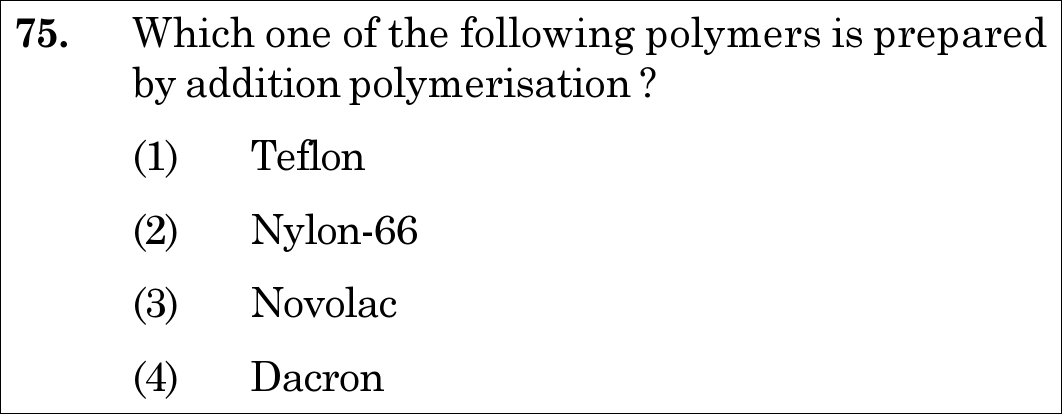
NEET 2021 Chemistry Question 75: Addition vs. Condensation Polymerisation: Preparation of Teflon

Question

Which one of the following polymers is prepared by addition polymerisation?

  1. (1)Teflon
  2. (2)Nylon-66
  3. (3)Novolac
  4. (4)Dacron
✓
Verified Against NTA Final Answer Key
Option (1) : Teflon
📚 Polymers Easy
📋 Given Parameters & Problem Setup
Polymerisation Mechanism Addition polymerisation (chain growth)
⚡

The 30-Second Exam Hall Shortcut: ⚡ Monomer with C=C Double Bond = Addition Polymer!

⏱️ Save ~20 seconds

Addition polymers form by repeated addition of unsaturated monomers containing double bonds without elimination of small molecules. Teflon (polytetrafluoroethene) is prepared from tetrafluoroethene (CF2=CF2CF_2=CF_2). Nylon-66, Novolac, and Dacron are all CONDENSATION polymers involving loss of H2OH_2O! Match Option (1)!

1 Addition polymer: Formed from monomers with double/triple bonds with no byproduct.
2 Check Teflon: nCF2=CF2→catalyst−[CF2−CF2]n−n CF_2=CF_2 \xrightarrow{\text{catalyst}} -[CF_2-CF_2]_n-   ⟹  \implies Pure addition polymer.
3 Check Nylon-66: Hexamethylenediamine + adipic acid →\to Condensation polymer (eliminates H2OH_2O).
4 Check Novolac: Phenol + formaldehyde →\to Condensation polymer (eliminates H2OH_2O).
5 Check Dacron (Terylene): Ethylene glycol + terephthalic acid →\to Condensation polymer (eliminates H2OH_2O).
6 Match Option (1) Teflon.
🛡️
Why You Can 100% Trust This Shortcut: Canonical NCERT Polymers classification based on mode of polymerisation.
📐

Step-by-Step Rigorous Workflow & Mathematical Proof

Step 1

Definition of Addition Polymerisation

Addition (chain-growth) polymerisation involves repeated addition of monomer molecules possessing double or triple bonds to a growing polymer chain, usually in the presence of free-radical initiators, without the elimination of any small molecular byproducts like water, alcohol, or ammonia.

Step 2

Preparation and Reaction of Teflon (Polytetrafluoroethene)

Teflon is manufactured by heating tetrafluoroethene with a free radical or persulphate catalyst at high pressures:

n CF2=CF2→High pressurePersulphate catalyst−[CF2−CF2]n−(Addition Polymer)n\,\text{CF}_2=\text{CF}_2 \xrightarrow[\text{High pressure}]{\text{Persulphate catalyst}} -[\text{CF}_2-\text{CF}_2]_n- \quad (\mathbf{\text{Addition Polymer}})
Step 3

Analysis of Condensation Polymers

- Nylon-66: Formed by condensation of hexamethylenediamine and adipic acid with elimination of H2OH_2O (polyamide condensation polymer). - Novolac: Linear condensation product of phenol and formaldehyde with loss of H2OH_2O. - Dacron (Terylene): Formed by condensation of ethylene glycol and terephthalic acid with elimination of H2OH_2O (polyester condensation polymer).

⭐

360° Option Elimination Engine Key Feature

Diagnose every choice: Know exactly why the right option works and why distractors fail.

4-Option Deep Scan
1 1
✓ 100% Correct
Verdict & Scientific Reason:

Formed strictly by addition polymerisation of tetrafluoroethene (CF2=CF2CF_2=CF_2).

💡
Why this is airtight: None; textbook polymer classification.
2 2
✗ Incorrect
Verdict & Scientific Reason:

Condensation polyamide polymer eliminating water molecules.

⚠️
Student Fallacy (Why candidates pick this trap): Confusing step-growth condensation with chain-growth addition.
3 3
✗ Incorrect
Verdict & Scientific Reason:

Condensation polymer formed from phenol and formaldehyde.

⚠️
Student Fallacy (Why candidates pick this trap): Misclassifying phenol-formaldehyde resins.
4 4
✗ Incorrect
Verdict & Scientific Reason:

Condensation polyester polymer eliminating water.

⚠️
Student Fallacy (Why candidates pick this trap): Confusing polyester condensation with addition.
⚠️

NTA Trap Alert: Polyamide/Polyester Condensation vs. Addition Trap

Students frequently mix up Nylon-66 and Dacron with addition polymers because they are common synthetic fibers. Nylon-66 and Dacron are both classic CONDENSATION polymers (step-growth). Teflon is an ADDITION polymer.

🛡️ How to avoid the -1 mark: Identify the monomer: CF2=CF2CF_2=CF_2 has a C=CC=C double bond   ⟹  \implies Addition polymer.
📖

Core NEET Syllabus Standard

NCERT Chemistry · Polymers Standard Benchmark
Core Scientific Principle Tested:

"Teflon is manufactured by addition polymerisation of tetrafluoroethene with a free radical catalyst under high pressure."

Syllabus Focus: Addition Polymers (Polytetrafluoroethene / Teflon)
✓ Core NEET UG Syllabus Anchor Syllabus & Academic Standards ↗

Ready to attempt under real exam pressure?

Test your speed and accuracy in the authentic 200-minute timed NTA simulator.

Launch NEET 2021 CBT Test →

Spotted a mistake in this solution? Report an error ([email protected])

⚖️ Legal & Fair Dealing Notice: Sourced from publicly released NEET 2021 question papers and NEET answer keys for private study, research, and non-commercial educational practice under Fair Dealing (Section 52(1)(a) of the Indian Copyright Act, 1957). Not affiliated with or endorsed by NTA or NMC.

Solve 4 NEET Questions a Day — One per Subject

Cover all 1,140 official NEET questions in 285 days at your own pace. Progress is saved on your device. No login needed.