MyCompetitiveExams Logo MyCompetitiveExams
Search 1,140+ Questions
Chapters, formulas, speed tricks
→
⚡ Brahmastra NEET 2027
720 MARKS

Dynamic 180-question full-length simulator mixed dynamically from all 6 years for 2027 & 2026 aspirants.

Launch Brahmastra 2027 Test →
Start Practice →
100% Free · No Login Required
Q.59 Chemistry ⭐ 360° Option Elimination Active
Vault ↗

NEET 2023 Chemistry Question 59 Solution

Topic: Polymers · Official NTA Booklet Code G5
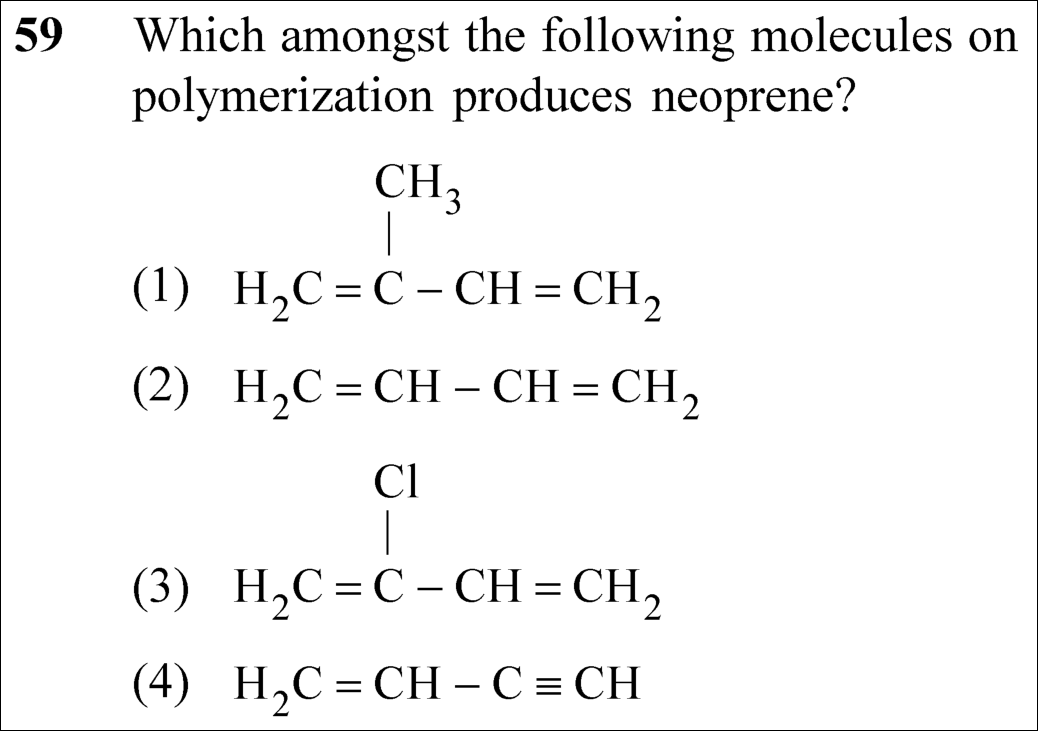
NEET 2023 Chemistry Question 59: Free Radical Polymerization of Chloroprene to Form Neoprene

Question

Which amongst the following molecules on polymerization produces neoprene?

✓
Verified Against NTA Final Answer Key
Option (3) : H₂C = C(Cl) – CH = CH₂ (Chloroprene)
📚 Polymers Easy
📋 Given Parameters & Problem Setup
Target polymer Neoprene (Polychloroprene)
Monomer class Conjugated diene derivative
⚡

The 30-Second Exam Hall Shortcut: ⚡ Rubber Monomer Match Hack: Neo = Chloro!

⏱️ Save ~25 seconds

Natural rubber is polyisoprene (methyl group at C-2). Synthetic Neoprene is polychloroprene (chlorine atom at C-2: H₂C = C(Cl)–CH = CH₂). Instant Option (3) in 5 seconds!

1 Recall common conjugated diene monomers:
2 - Isoprene: H₂C = C(CH₃)–CH = CH₂ ⟶ Natural rubber (cis-1,4-polyisoprene).
3 - 1,3-Butadiene: H₂C = CH–CH = CH₂ ⟶ Buna-S / Buna-N copolymer component.
4 - Chloroprene: H₂C = C(Cl)–CH = CH₂ ⟶ Neoprene (synthetic rubber).
5 Match the structure of chloroprene: 2-chlorobuta-1,3-diene, which is Option (3).
6 Select Option (3) directly!
🛡️
Why You Can 100% Trust This Shortcut: Polymer Chemistry · Monomers of Synthetic Rubbers (Neoprene is commercially prepared by the free radical polymerization of chloroprene, 2-chlorobuta-1,3-diene).
📐

Step-by-Step Rigorous Workflow & Mathematical Proof

Step 1

Identification of Neoprene

Neoprene (polychloroprene) is a synthetic elastomer with superior resistance to vegetable and mineral oils. It is synthesized by the addition polymerization of its monomer in the presence of oxygen or peroxide catalysts:

n H2C=CCl−CH=CH2→Polymerization[−CH2−CCl=CH−CH2−]nn\, \text{H}_2\text{C}=\overset{\text{Cl}}{\text{C}}-\text{CH}=\text{CH}_2 \xrightarrow{\text{Polymerization}} \left[ -\text{CH}_2-\overset{\text{Cl}}{\text{C}}=\text{CH}-\text{CH}_2- \right]_n
Step 2

IUPAC and Common Nomenclature of the Monomer

The monomer shown in Option (3) is 2-chlorobuta-1,3-diene, commonly known as chloroprene:

Chloroprene: H2C=C(Cl)−CH=CH2\text{Chloroprene: } \text{H}_2\text{C}=\text{C}(\text{Cl})-\text{CH}=\text{CH}_2
Step 3

Contrast with Other Diene Monomers

Differentiating the structures of the dienes provided in the options:

Option 1: H2C=C(CH3)−CH=CH2(Isoprene ⟶Natural Rubber)Option 2: H2C=CH−CH=CH2(Buta-1,3-diene ⟶Polybutadiene)Option 3: H2C=C(Cl)−CH=CH2(Chloroprene ⟶Neoprene)Option 4: H2C=CH−C≡CH(Vinylacetylene)\begin{aligned} \text{Option 1: } &\text{H}_2\text{C}=\text{C}(\text{CH}_3)-\text{CH}=\text{CH}_2 \quad (\text{Isoprene } \longrightarrow \text{Natural Rubber}) \\[4pt] \text{Option 2: } &\text{H}_2\text{C}=\text{CH}-\text{CH}=\text{CH}_2 \quad (\text{Buta-1,3-diene } \longrightarrow \text{Polybutadiene}) \\[4pt] \text{Option 3: } &\text{H}_2\text{C}=\text{C}(\text{Cl})-\text{CH}=\text{CH}_2 \quad (\text{Chloroprene } \longrightarrow \text{Neoprene}) \\[4pt] \text{Option 4: } &\text{H}_2\text{C}=\text{CH}-\text{C}\equiv\text{CH} \quad (\text{Vinylacetylene}) \end{aligned}
⭐

360° Option Elimination Engine Key Feature

Diagnose every choice: Know exactly why the right option works and why distractors fail.

4-Option Deep Scan
1 (1)
✗ Incorrect
Verdict & Scientific Reason:

Isoprene: monomer of natural rubber, not neoprene.

⚠️
Student Fallacy (Why candidates pick this trap): Candidate confused isoprene with chloroprene.
2 (2)
✗ Incorrect
Verdict & Scientific Reason:

1,3-Butadiene: monomer of polybutadiene and Buna rubbers.

⚠️
Student Fallacy (Why candidates pick this trap): Candidate selected unsubstituted butadiene.
3 (3)
✓ 100% Correct
Verdict & Scientific Reason:

Chloroprene (2-chlorobuta-1,3-diene): monomer of neoprene.

💡
Why this is airtight: None. Candidate knew the structure of chloroprene.
4 (4)
✗ Incorrect
Verdict & Scientific Reason:

Vinylacetylene: raw material used in synthesis of chloroprene, not the monomer itself.

⚠️
Student Fallacy (Why candidates pick this trap): Candidate confused the industrial precursor with the actual polymerization monomer.
⚠️

NTA Trap Alert: Confusing Isoprene (Natural Rubber) with Chloroprene (Neoprene)

Isoprene has a -CH₃ group at C-2, forming natural rubber. Chloroprene has a -Cl group at C-2, forming neoprene. Mixing up -CH₃ and -Cl leads directly to picking Option (1).

🛡️ How to avoid the -1 mark: Memory Hook: "Chloro-prene makes Neo-prene" (both end in -prene, and chloro matches neoprene).
📖

Core NEET Syllabus Standard

National Eligibility cum Entrance Test (NEET UG) · Polymers Standard Benchmark
Core Scientific Principle Tested:

"Neoprene is formed by the free radical polymerization of chloroprene (2-chlorobuta-1,3-diene)."

Syllabus Focus: Synthetic Rubbers – Neoprene
Preserved in Rationalized Curriculum Syllabus & Academic Standards ↗

Ready to attempt under real exam pressure?

Test your speed and accuracy in the authentic 200-minute timed NTA simulator.

Launch NEET 2023 CBT Test →

Spotted a mistake in this solution? Report an error ([email protected])

⚖️ Legal & Fair Dealing Notice: Sourced from publicly released NEET 2023 question papers and NEET answer keys for private study, research, and non-commercial educational practice under Fair Dealing (Section 52(1)(a) of the Indian Copyright Act, 1957). Not affiliated with or endorsed by NTA or NMC.

Solve 4 NEET Questions a Day — One per Subject

Cover all 1,140 official NEET questions in 285 days at your own pace. Progress is saved on your device. No login needed.