The 30-Second Exam Hall Shortcut: ⚡ Rubber Monomer Match Hack: Neo = Chloro!
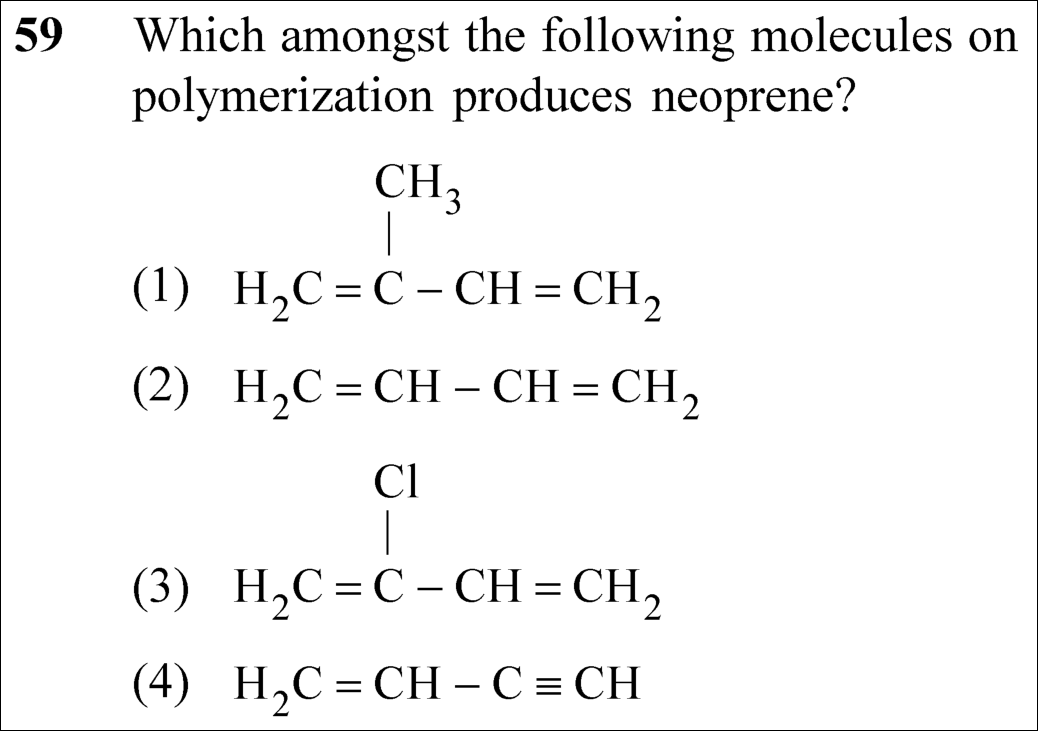
Natural rubber is polyisoprene (methyl group at C-2). Synthetic Neoprene is polychloroprene (chlorine atom at C-2: H₂C = C(Cl)–CH = CH₂). Instant Option (3) in 5 seconds!
Step-by-Step Rigorous Workflow & Mathematical Proof
Identification of Neoprene
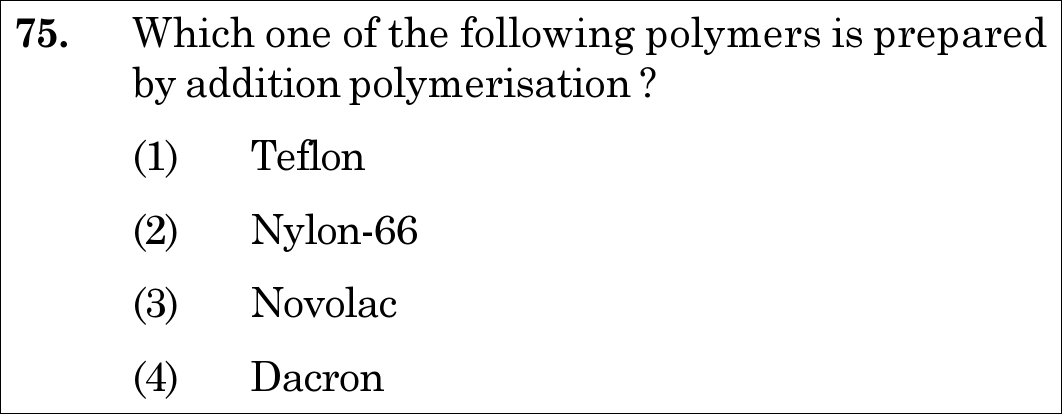
Neoprene (polychloroprene) is a synthetic elastomer with superior resistance to vegetable and mineral oils. It is synthesized by the addition polymerization of its monomer in the presence of oxygen or peroxide catalysts:
IUPAC and Common Nomenclature of the Monomer
The monomer shown in Option (3) is 2-chlorobuta-1,3-diene, commonly known as chloroprene:
Contrast with Other Diene Monomers
Differentiating the structures of the dienes provided in the options:
360° Option Elimination Engine Key Feature
Diagnose every choice: Know exactly why the right option works and why distractors fail.
Isoprene: monomer of natural rubber, not neoprene.
1,3-Butadiene: monomer of polybutadiene and Buna rubbers.
Chloroprene (2-chlorobuta-1,3-diene): monomer of neoprene.
Vinylacetylene: raw material used in synthesis of chloroprene, not the monomer itself.
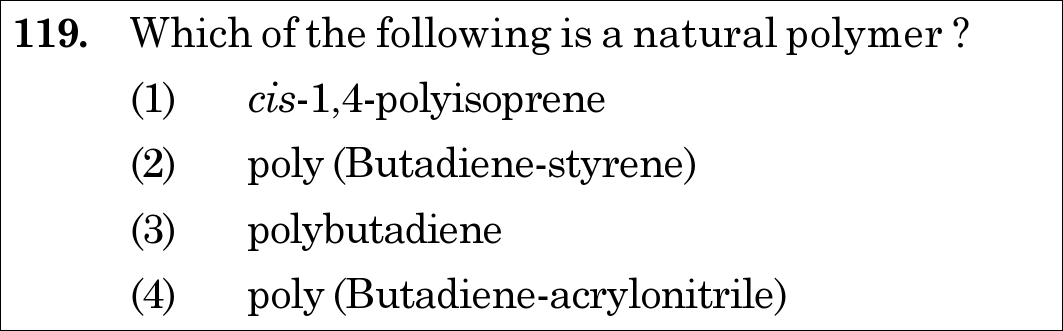
NTA Trap Alert: Confusing Isoprene (Natural Rubber) with Chloroprene (Neoprene)
Isoprene has a -CH₃ group at C-2, forming natural rubber. Chloroprene has a -Cl group at C-2, forming neoprene. Mixing up -CH₃ and -Cl leads directly to picking Option (1).
Core NEET Syllabus Standard
"Neoprene is formed by the free radical polymerization of chloroprene (2-chlorobuta-1,3-diene)."