NEET 2020 Chemistry Question 128 Solution
Question
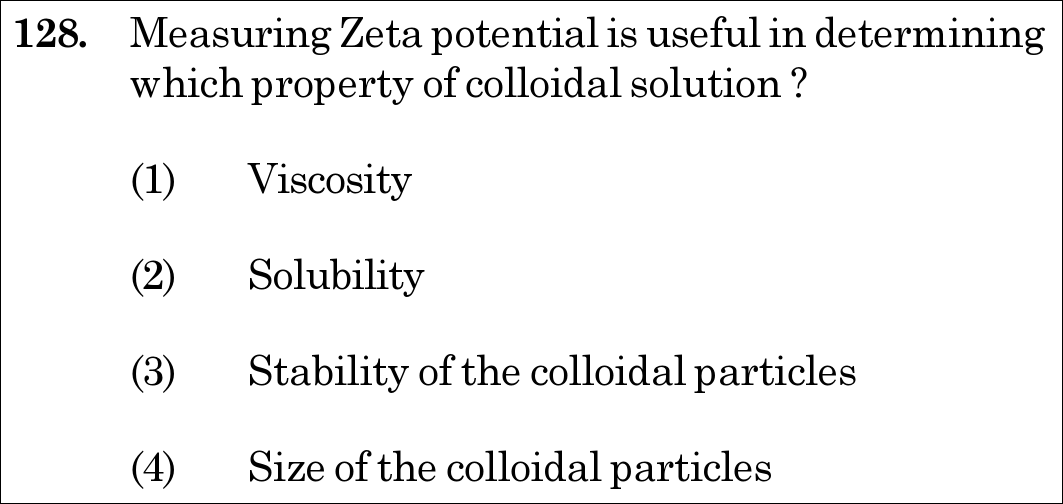
Measuring Zeta potential is useful in determining which property of colloidal solution?
- (1)Viscosity
- (2)Solubility
- (3)Stability of the colloidal particles
- (4)Size of the colloidal particles
Dynamic 180-question full-length simulator mixed dynamically from all 6 years for 2027 & 2026 aspirants.
Measuring Zeta potential is useful in determining which property of colloidal solution?
The potential difference between the fixed Helmholtz layer and the diffused layer of opposite charges is called the Electrokinetic Potential or ZETA POTENTIAL. If the zeta potential is high, electrostatic repulsion between colloidal particles prevents them from aggregating or coagulating, ensuring the STABILITY OF THE COLLOIDAL PARTICLES! Mark Option (3) in 5 seconds.
Colloidal particles acquire positive or negative charge by preferential adsorption of ions from solution, forming a firmly attached "fixed layer" on the particle surface.
The fixed layer attracts counter-ions from the dispersion medium, forming a second, mobile "diffused layer". The arrangement of double layers of opposite charges around the colloidal particle is called the Helmholtz electrical double layer.
The potential difference between the fixed layer and the diffused layer of opposite charges is termed the electrokinetic potential or zeta potential (denoted by ).
If the zeta potential is sufficiently large (typically exceeding ), the electrostatic repulsion between approaching colloidal particles is strong enough to overcome attractive van der Waals forces, preventing agglomeration/coagulation. Thus, measurement of zeta potential is universally employed to determine and predict the stability of colloidal dispersions.
Diagnose every choice: Know exactly why the right option works and why distractors fail.
Incorrect; viscosity is determined using an Ostwald viscometer, not from electrical zeta potential.
Incorrect; solubility is a thermodynamic phase property, not related to the surface charge double layer of lyophobic colloids.
Factually exact; zeta potential is the direct quantitative metric used to assess the electrostatic stability of colloidal particles against coagulation.
Incorrect; particle size is measured via dynamic light scattering (DLS), ultracentrifugation, or electron microscopy, not zeta potential.
Zeta potential measures the net charge repulsion between particles: High Zeta potential = High Repulsion = STABLE COLLOID. Low Zeta potential = Aggregation/Coagulation.
""
Test your speed and accuracy in the authentic 180-minute timed NTA simulator.
Spotted a mistake in this solution? Report an error ([email protected])
Cover all 1,140 official NEET questions in 285 days at your own pace. Progress is saved on your device. No login needed.