MyCompetitiveExams Logo MyCompetitiveExams
Search 1,140+ Questions
Chapters, formulas, speed tricks
→
⚡ Brahmastra NEET 2027
720 MARKS

Dynamic 180-question full-length simulator mixed dynamically from all 6 years for 2027 & 2026 aspirants.

Launch Brahmastra 2027 Test →
Start Practice →
100% Free · No Login Required
Q.127 Chemistry ⭐ 360° Option Elimination Active
Vault ↗

NEET 2020 Chemistry Question 127 Solution

Topic: Thermodynamics · Official NTA Booklet Code E1
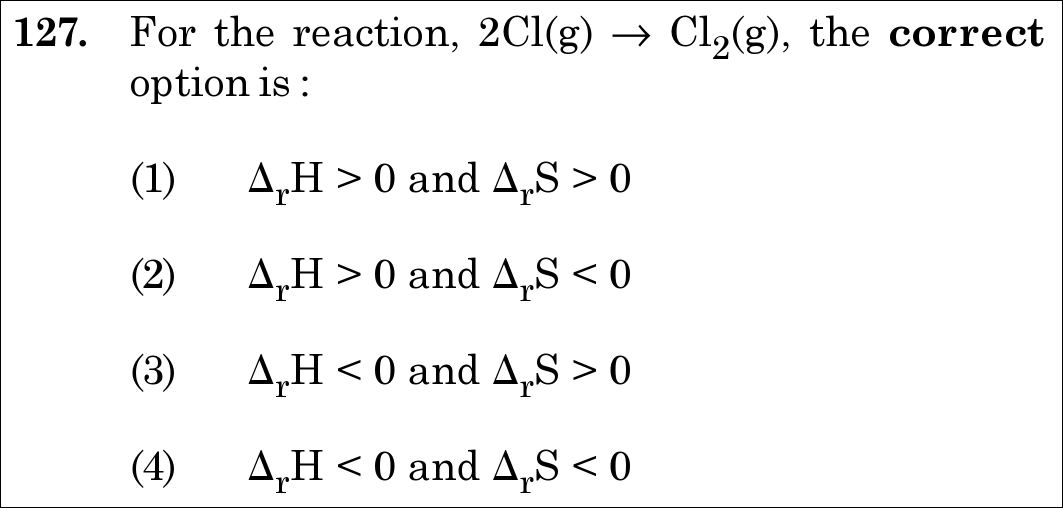
NEET 2020 Chemistry Question 127: Enthalpy and Entropy Changes in Bond Formation: 2Cl(g) -> Cl2(g)

Question

For the reaction, 2Cl(g) → Cl2(g), the correct option is:

  1. (1)∆rH > 0 and ∆rS > 0
  2. (2)∆rH > 0 and ∆rS < 0
  3. (3)∆rH < 0 and ∆rS > 0
  4. (4)∆rH < 0 and ∆rS < 0
✓
Verified Against NTA Final Answer Key
Option (4) : ∆rH < 0 and ∆rS < 0
📚 Thermodynamics Easy
📋 Given Parameters & Problem Setup
Chemical Reaction 2Cl(g) -> Cl2(g)
Process Formation of chlorine-chlorine single covalent bond from isolated chlorine atoms
Question Objective Determine the signs of ΔrH and ΔrS
⚡

The 30-Second Exam Hall Shortcut: ⚡ "Bond Formation is EXOTHERMIC (ΔH < 0); 2 Moles Gas -> 1 Mole Gas (ΔS < 0)!"

⏱️ 15 seconds

Bond formation releases energy, so enthalpy change is negative (ΔrH<0\Delta_r H < 0). Two isolated gaseous atoms combine into a single diatomic molecule (2 moles→1 mole2\text{ moles} \to 1\text{ mole}), decreasing translational degrees of freedom and disorder, so entropy change is negative (ΔrS<0\Delta_r S < 0). Both are negative: ΔrH<0\Delta_r H < 0 and ΔrS<0\Delta_r S < 0! Mark Option (4) in 5 seconds.

1 Bond formation releases energy: Cl + Cl -> Cl-Cl + Energy => ΔrH < 0 (negative).
2 Gaseous moles decrease from 2 mol to 1 mol: Δng = 1 - 2 = -1.
3 Decrease in number of particles reduces randomness: ΔrS < 0 (negative).
4 Thus, ΔrH < 0 and ΔrS < 0.
5 Select Option (4).
🛡️
Why You Can 100% Trust This Shortcut: NCERT Chemistry · Thermodynamics (Enthalpy of Bond Dissociation and Entropy)
📐

Step-by-Step Rigorous Workflow & Mathematical Proof

Step 1

Analyze Enthalpy of Reaction (ΔrH)

In the forward reaction 2Cl (g)→Cl2 (g)2\text{Cl (g)} \to \text{Cl}_2 \text{ (g)}, two isolated chlorine atoms form a stable covalent Cl−Cl\text{Cl}-\text{Cl} single bond. Because chemical bond formation stabilizes the system by lowering potential energy, heat is evolved into the surroundings (exothermic process): ΔrH<0 (negative)\Delta_r H < 0 \text{ (negative)}

Step 2

Analyze Entropy of Reaction (ΔrS)

Entropy (SS) is a measure of molecular randomness or disorder. On the reactant side, there are two independent moles of freely moving gaseous chlorine atoms. On the product side, they are constrained into a single mole of diatomic molecules: Δng=1−2=−1<0\Delta n_g = 1 - 2 = -1 < 0 Because the number of independent gaseous particles decreases from 2 to 1, the randomness of the system decreases: ΔrS<0 (negative)\Delta_r S < 0 \text{ (negative)}

Step 3

Examine Spontaneity Implications

According to Gibbs-Helmholtz equation: ΔrG=ΔrH−TΔrS\Delta_r G = \Delta_r H - T \Delta_r S Since both ΔH<0\Delta H < 0 and ΔS<0\Delta S < 0, the reaction is spontaneous (ΔG<0\Delta G < 0) only at low temperatures where the negative ΔH\Delta H term dominates over the positive −TΔS-T\Delta S term.

Step 4

Conclude Option 4

Both thermodynamic parameters are strictly less than zero: ΔrH<0\Delta_r H < 0 and ΔrS<0\Delta_r S < 0.

⭐

360° Option Elimination Engine Key Feature

Diagnose every choice: Know exactly why the right option works and why distractors fail.

4-Option Deep Scan
1 A
✗ Incorrect
Verdict & Scientific Reason:

Incorrect; this would describe the reverse reaction, the endothermic dissociation of Cl2(g)→2Cl(g)Cl_2(g) \to 2Cl(g).

⚠️
Student Fallacy (Why candidates pick this trap): Confusing bond formation with bond breaking.
2 B
✗ Incorrect
Verdict & Scientific Reason:

Incorrect; bond formation is never endothermic (ΔH\Delta H is not positive).

⚠️
Student Fallacy (Why candidates pick this trap): Assuming bond formation requires energy input.
3 C
✗ Incorrect
Verdict & Scientific Reason:

Incorrect; two moles of gas forming one mole of gas decreases entropy, so ΔS\Delta S cannot be positive.

⚠️
Student Fallacy (Why candidates pick this trap): Assuming exothermic reactions must always increase entropy of the system.
4 D
✓ 100% Correct
Verdict & Scientific Reason:

Factually and thermodynamically exact; bond formation releases energy (ΔH<0\Delta H < 0) and combines two particles into one (ΔS<0\Delta S < 0).

💡
Why this is airtight: None; fundamental chemical thermodynamic principle.
⚠️

NTA Trap Alert: Bond Breaking vs Bond Formation

- Bond BREAKING: Endothermic (ΔH>0\Delta H > 0) and Disorder increases (ΔS>0\Delta S > 0). - Bond FORMATION: Exothermic (ΔH<0\Delta H < 0) and Disorder decreases (ΔS<0\Delta S < 0).

🛡️ How to avoid the -1 mark: Remember: Forming bonds releases heat (ΔH<0\Delta H < 0) and ties up atoms (ΔS<0\Delta S < 0)!
📖

Core NEET Syllabus Standard

Chemistry · Thermodynamics Standard Benchmark
Core Scientific Principle Tested:

""

Syllabus Focus: Enthalpy and Entropy Changes in Bond Formation: 2Cl(g) -> Cl2(g)
✓ Core NEET UG Syllabus Anchor Syllabus & Academic Standards ↗

Ready to attempt under real exam pressure?

Test your speed and accuracy in the authentic 180-minute timed NTA simulator.

Launch NEET 2020 CBT Test →

Spotted a mistake in this solution? Report an error ([email protected])

⚖️ Legal & Fair Dealing Notice: Sourced from publicly released NEET 2020 question papers and NEET answer keys for private study, research, and non-commercial educational practice under Fair Dealing (Section 52(1)(a) of the Indian Copyright Act, 1957). Not affiliated with or endorsed by NTA or NMC.

Solve 4 NEET Questions a Day — One per Subject

Cover all 1,140 official NEET questions in 285 days at your own pace. Progress is saved on your device. No login needed.