The 30-Second Exam Hall Shortcut: ⚡ Phase Comparison Hack: Reactants (Gas) vs Catalyst (Solid)
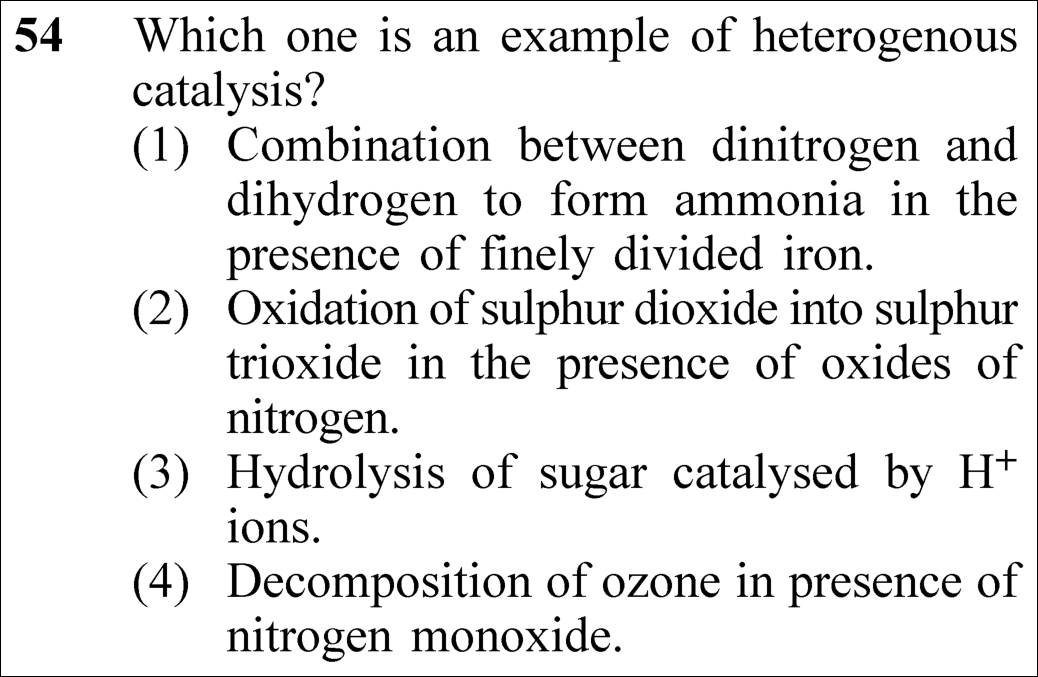
Haber process: N₂(g) + H₂(g) over solid Fe(s) ⟹ Gaseous reactants on a solid catalyst = Heterogeneous Catalysis in 5 seconds! (All other options have identical phases).
Step-by-Step Rigorous Workflow & Mathematical Proof
Definition of Heterogeneous Catalysis
When the catalyst and the reactants are in different phases, the catalytic process is termed heterogeneous catalysis. The reaction typically proceeds via the adsorption theory at the solid catalyst’s active surface sites:
Phase Analysis of Option 1 (Haber Process)
In the industrial synthesis of ammonia by Haber’s process, dinitrogen gas and dihydrogen gas react over solid finely divided iron containing molybdenum or potassium oxide promoter:
Confirmation of Phase Difference
The reactants (N₂ and H₂) are in the gaseous phase, whereas the catalyst (Fe) is in the solid phase. Because the phases are different, this is a classic canonical example of heterogeneous catalysis.
Phase Analysis of Distractors (Homogeneous Reactions)
In all other options, reactants and catalysts share the identical phase:
360° Option Elimination Engine Key Feature
Diagnose every choice: Know exactly why the right option works and why distractors fail.
Accurate: Reactants are gaseous (N₂, H₂) and catalyst is solid (Fe) — distinct physical phases.
Homogeneous catalysis: SO₂, O₂, and NO are all in the gaseous phase.
Homogeneous catalysis: Sugar, water, and acid catalyst H⁺ are all in the liquid/aqueous phase.
Homogeneous catalysis: Ozone and NO are both gases.
NTA Trap Alert: Confusing Sugar Hydrolysis with Heterogeneous Catalysis
Because sugar starts as solid crystalline table sugar, students often mistakenly classify sugar hydrolysis as heterogeneous. However, the reaction occurs in AQUEOUS SOLUTION, meaning reactants and H⁺ ions are in the same liquid phase (homogeneous).
Core NEET Syllabus Standard
"In heterogeneous catalysis, the catalytic process involves reactants and catalyst in different physical states, typically involving surface adsorption."