MyCompetitiveExams Logo MyCompetitiveExams
Search 1,140+ Questions
Chapters, formulas, speed tricks
→
⚡ Brahmastra NEET 2027
720 MARKS

Dynamic 180-question full-length simulator mixed dynamically from all 6 years for 2027 & 2026 aspirants.

Launch Brahmastra 2027 Test →
Start Practice →
100% Free · No Login Required
Q.168 Zoology ⭐ 360° Option Elimination Active
Vault ↗

NEET 2021 Zoology Question 168 Solution

Topic: Biotechnology: Principles and Processes · Official NTA Booklet Code M1
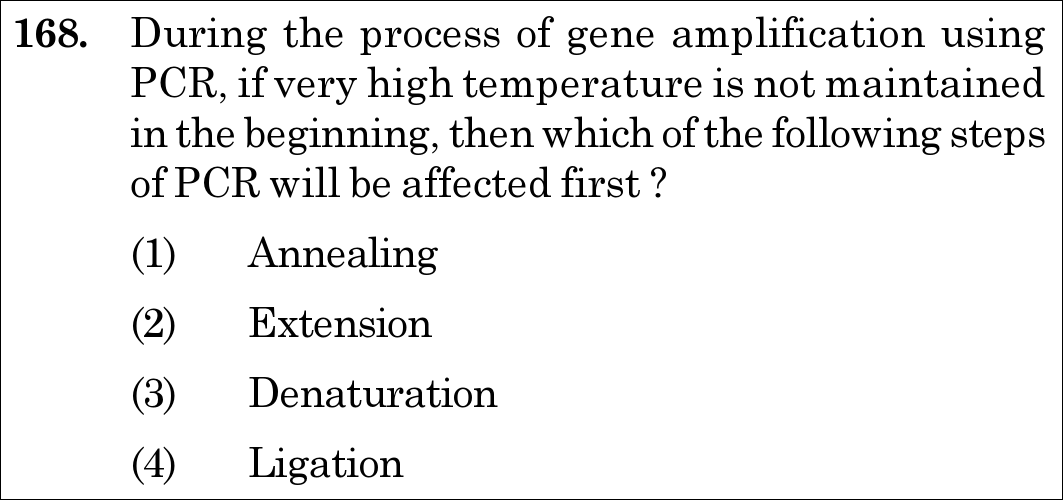
NEET 2021 Zoology Question 168: Thermocycling Steps of PCR: Denaturation Temperature Failure

Question

During the process of gene amplification using PCR, if very high temperature is not maintained in the beginning, then which of the following steps of PCR will be affected first?

  1. (1)Annealing
  2. (2)Extension
  3. (3)Denaturation
  4. (4)Ligation
✓
Verified Against NTA Final Answer Key
Option (3) : Denaturation
📚 Biotechnology: Principles and Processes Medium
📋 Given Parameters & Problem Setup
Technique Polymerase Chain Reaction (PCR)
Condition High temperature is not maintained at the very beginning of the cycle
Question Objective Identify which sequential step is affected first
⚡

The 30-Second Exam Hall Shortcut: ⚡ "PCR Cycle Sequence: Denaturation (94°C) → Annealing (54°C) → Extension (72°C)"

⏱️ Save ~20 seconds

Denaturation is the very first step of PCR requiring high thermal energy (~94–96 °C) to break inter-strand hydrogen bonds. Without initial high heat, dsDNA cannot melt into ssDNA, so Denaturation fails immediately!

1 Recall PCR thermocycling order: Step 1 = Denaturation (~94 °C), Step 2 = Annealing (~50–60 °C), Step 3 = Extension (~72 °C).
2 Analyze fault condition: "Very high temperature not maintained in the beginning".
3 Conclude: Step 1 (Denaturation) requires ~94 °C; without this, strands cannot separate.
4 Select Option (3).
🛡️
Why You Can 100% Trust This Shortcut: NCERT Biology · Biotechnology: Principles and Processes (Polymerase Chain Reaction: Denaturation is the initial step requiring high temperature (~94-96 °C) to separate DNA strands).
📐

Step-by-Step Rigorous Workflow & Mathematical Proof

Step 1

Thermal Architecture of Polymerase Chain Reaction (PCR)

In vitro enzymatic gene amplification relies on cyclic repetition of three sequential, temperature-dependent stages: 1. Denaturation (approx. 94–96 °C): High thermal energy disrupts the weak hydrogen bonds holding complementary purine-pyrimidine base pairs together, unzipping double-stranded DNA (dsDNA) into two single-stranded DNA (ssDNA) templates. 2. Annealing (approx. 50–60 °C): Temperature is lowered to enable synthetic oligonucleotide primers to hybridize specifically to complementary flanking sequences at the 3′3' ends of ssDNA. 3. Extension (approx. 72 °C): Thermostable *Taq* DNA polymerase (isolated from thermophilic bacterium *Thermus aquaticus*) adds deoxynucleotide triphosphates (dNTPs) onto the 3′-OH3'\text{-OH} primer ends in the 5′→3′5' \to 3' direction.

dsDNA→∼94∘CDenaturation (Step 1)2×ssDNA→∼54∘CAnnealing (Step 2)Primed ssDNA→∼72∘CExtension (Step 3)2×dsDNA\text{dsDNA} \xrightarrow[\sim 94^\circ\text{C}]{\textbf{Denaturation (Step 1)}} 2 \times \text{ssDNA} \xrightarrow[\sim 54^\circ\text{C}]{\textbf{Annealing (Step 2)}} \text{Primed ssDNA} \xrightarrow[\sim 72^\circ\text{C}]{\textbf{Extension (Step 3)}} 2 \times \text{dsDNA}
Step 2

Impact of Inadequate Temperature at the Beginning

Because denaturation is the initial gatekeeper step requiring maximum thermal energy (~94 °C), failure to reach or maintain high temperature prevents the separation of double-stranded DNA into single strands. Consequently, the primer target sites remain buried within duplex DNA. Hence, Denaturation is the very first step affected.

⭐

360° Option Elimination Engine Key Feature

Diagnose every choice: Know exactly why the right option works and why distractors fail.

4-Option Deep Scan
1 1
✗ Incorrect
Verdict & Scientific Reason:

Incorrect. Annealing is Step 2 and requires lower temperatures (~50–60 °C). It cannot proceed without preceding denaturation, but it is not the step requiring initial high heat.

⚠️
Student Fallacy (Why candidates pick this trap): Thinking annealing is affected first because primers fail to bind, missing that primer binding fails secondary to failure of strand denaturation.
2 2
✗ Incorrect
Verdict & Scientific Reason:

Incorrect. Extension is Step 3 operating at 72 °C by Taq polymerase.

⚠️
Student Fallacy (Why candidates pick this trap): Confusing the intermediate optimum temperature of Taq polymerase with initial boiling denaturation.
3 3
✓ 100% Correct
Verdict & Scientific Reason:

Correct. Denaturation is the initial step and specifically demands high heat (~94 °C) to break inter-strand hydrogen bonds.

💡
Why this is airtight: None. Candidate recognizes the sequential chronology and temperature demands of PCR.
4 4
✗ Incorrect
Verdict & Scientific Reason:

Incorrect. Ligation is catalyzed by DNA ligase during recombinant plasmid construction and is not a component step of PCR thermocycling.

⚠️
Student Fallacy (Why candidates pick this trap): Conflating recombinant cloning vectors with automated PCR amplification.
⚠️

NTA Trap Alert: Direct vs Downstream Effect Trap

While annealing and extension ultimately fail if denaturation fails, the question explicitly asks which step is affected *first* in the cycle. Denaturation is directly and immediately paralyzed by lack of initial high heat.

🛡️ How to avoid the -1 mark: Identify chronological sequence: Step 1 (Denaturation, 94°C) -> Step 2 (Annealing, 55°C) -> Step 3 (Extension, 72°C).
📖

Core NEET Syllabus Standard

NEET / NCERT Biology · Biotechnology: Principles and Processes Standard Benchmark
Core Scientific Principle Tested:

"Denaturation requires high temperature (~94-96 °C) to separate complementary DNA strands before primer annealing."

Syllabus Focus: Polymerase Chain Reaction (PCR)
✓ Core NEET UG Syllabus Anchor Syllabus & Academic Standards ↗

Ready to attempt under real exam pressure?

Test your speed and accuracy in the authentic 200-minute timed NTA simulator.

Launch NEET 2021 CBT Test →

Spotted a mistake in this solution? Report an error ([email protected])

⚖️ Legal & Fair Dealing Notice: Sourced from publicly released NEET 2021 question papers and NEET answer keys for private study, research, and non-commercial educational practice under Fair Dealing (Section 52(1)(a) of the Indian Copyright Act, 1957). Not affiliated with or endorsed by NTA or NMC.

Solve 4 NEET Questions a Day — One per Subject

Cover all 1,140 official NEET questions in 285 days at your own pace. Progress is saved on your device. No login needed.