MyCompetitiveExams Logo MyCompetitiveExams
Search 1,140+ Questions
Chapters, formulas, speed tricks
→
⚡ Brahmastra NEET 2027
720 MARKS

Dynamic 180-question full-length simulator mixed dynamically from all 6 years for 2027 & 2026 aspirants.

Launch Brahmastra 2027 Test →
Start Practice →
100% Free · No Login Required
Q.169 Zoology ⭐ 360° Option Elimination Active
Vault ↗

NEET 2021 Zoology Question 169 Solution

Topic: Structural Organisation in Animals · Official NTA Booklet Code M1
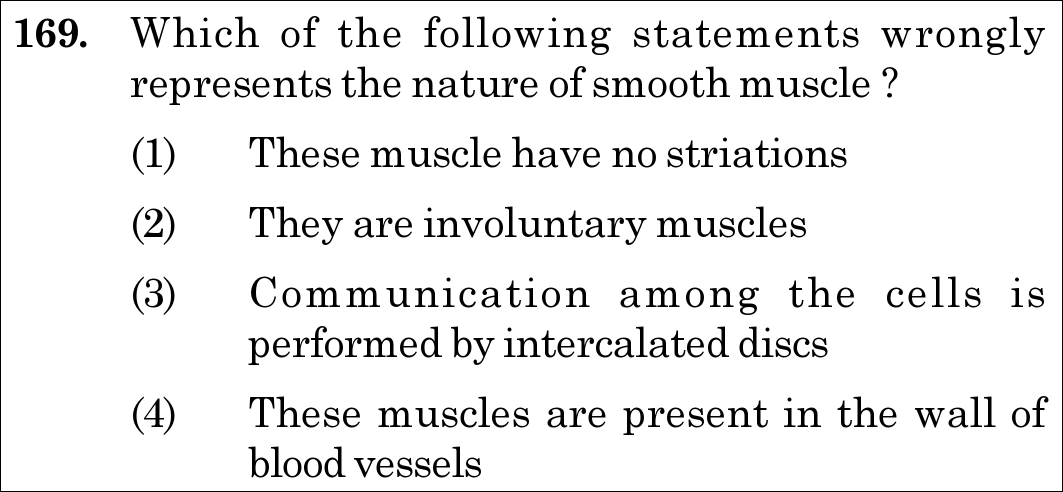
NEET 2021 Zoology Question 169: Smooth Muscle vs Cardiac Muscle Characteristics

Question

Which of the following statements wrongly represents the nature of smooth muscle?

  1. (1)These muscle have no striations
  2. (2)They are involuntary muscles
  3. (3)Communication among the cells is performed by intercalated discs
  4. (4)These muscles are present in the wall of blood vessels
✓
Verified Against NTA Final Answer Key
Option (3) : Communication among the cells is performed by intercalated discs
📚 Structural Organisation in Animals Easy
📋 Given Parameters & Problem Setup
Tissue Type Smooth Muscle (Non-striated, involuntary)
Question Objective Identify the statement that wrongly represents smooth muscle
⚡

The 30-Second Exam Hall Shortcut: ⚡ "Intercalated Discs are EXCLUSIVE to Cardiac Muscle!"

⏱️ Save ~20 seconds

Intercalated discs (containing gap junctions and desmosomes) are the diagnostic signature of cardiac muscle fibres. Smooth muscles possess simple gap junctions and fusiform cells, never intercalated discs. Option (3) is false for smooth muscle!

1 Check feature: Intercalated discs.
2 Diagnostic truth: Intercalated discs exist ONLY in heart muscle (cardiac muscle).
3 Cross-check other options: Smooth muscle is unstriated (1), involuntary (2), and lines blood vessel walls (4) — all true!
4 Option (3) is the false statement and therefore the correct answer.
🛡️
Why You Can 100% Trust This Shortcut: NCERT Biology · Structural Organisation in Animals (Muscular Tissue: Communication junctions (intercalated discs) at some fusion points allow cardiac cells to contract as a unit; smooth muscles do not have intercalated discs).
📐

Step-by-Step Rigorous Workflow & Mathematical Proof

Step 1

Microscopic and Physiological Profile of Smooth Muscle

Smooth muscle fibres are spindle-shaped (fusiform), unbranched, tapering at both ends, and strictly non-striated (unstriped) because their contractile myofilaments (actin and myosin) are not arranged in regular repeating sarcomeres. - They are involuntary and regulated by the autonomic nervous system. - They form the muscularis coat in the walls of internal visceral organs, including the stomach, intestine, urinary bladder, uterus, and blood vessels (tunica media).

Step 2

Cellular Junctions: Smooth Muscle vs Cardiac Muscle

- In smooth muscle, adjacent fusiform myocytes are bound together by loose connective tissue and communicate via simple gap junctions (nexus) across cell membranes. - In cardiac muscle, adjacent branched fibres are joined end-to-end by specialized zig-zag transverse thickenings called intercalated discs. These structures contain adherens junctions, desmosomes, and gap junctions that synchronize rapid electrical depolarization so the myocardium contracts as a functional syncytium. - Therefore, claiming that smooth muscle cells communicate via intercalated discs is factually wrong.

Intercalated Discs  ⟹  Unique Diagnostic Feature of Cardiac Muscle(NOT Smooth Muscle)\textbf{Intercalated Discs} \implies \text{Unique Diagnostic Feature of } \mathbf{Cardiac\,Muscle} \quad (\text{NOT Smooth Muscle})
⭐

360° Option Elimination Engine Key Feature

Diagnose every choice: Know exactly why the right option works and why distractors fail.

4-Option Deep Scan
1 1
✗ Incorrect
Verdict & Scientific Reason:

This is a true statement for smooth muscle (they lack dark A-bands and light I-bands), so it cannot be the answer to "wrongly represents".

⚠️
Student Fallacy (Why candidates pick this trap): Misreading the negative stem and seeking a true statement.
2 2
✗ Incorrect
Verdict & Scientific Reason:

This is a true statement. Smooth muscles operate automatically without voluntary conscious control.

⚠️
Student Fallacy (Why candidates pick this trap): Confusing voluntary somatic skeletal muscle with involuntary autonomic visceral muscle.
3 3
✓ 100% Correct
Verdict & Scientific Reason:

Correct as the false statement. Intercalated discs are strictly unique to cardiac muscle fibres, never smooth muscle.

💡
Why this is airtight: None. Candidate knows that intercalated discs define cardiac muscle.
4 4
✗ Incorrect
Verdict & Scientific Reason:

This is a true statement. The tunica media of blood vessels is composed of concentric layers of smooth muscle.

⚠️
Student Fallacy (Why candidates pick this trap): Thinking blood vessels contain elastic connective tissue only, unaware of vascular smooth muscle.
⚠️

NTA Trap Alert: Gap Junction vs Intercalated Disc Overlap Trap

Both smooth muscle and cardiac muscle utilize gap junctions for ion transfer. However, intercalated discs are complex mechanical and electrical junctional complexes found *only* at the junctions between cardiac myocytes.

🛡️ How to avoid the -1 mark: Remember: Intercalated disc = Heart / Cardiac muscle only.
📖

Core NEET Syllabus Standard

NEET / NCERT Biology · Structural Organisation in Animals Standard Benchmark
Core Scientific Principle Tested:

"Intercalated discs are specialized junctions found exclusively in cardiac muscle, not smooth muscle."

Syllabus Focus: Muscular Tissue
✓ Core NEET UG Syllabus Anchor Syllabus & Academic Standards ↗

Ready to attempt under real exam pressure?

Test your speed and accuracy in the authentic 200-minute timed NTA simulator.

Launch NEET 2021 CBT Test →

Spotted a mistake in this solution? Report an error ([email protected])

⚖️ Legal & Fair Dealing Notice: Sourced from publicly released NEET 2021 question papers and NEET answer keys for private study, research, and non-commercial educational practice under Fair Dealing (Section 52(1)(a) of the Indian Copyright Act, 1957). Not affiliated with or endorsed by NTA or NMC.

Solve 4 NEET Questions a Day — One per Subject

Cover all 1,140 official NEET questions in 285 days at your own pace. Progress is saved on your device. No login needed.